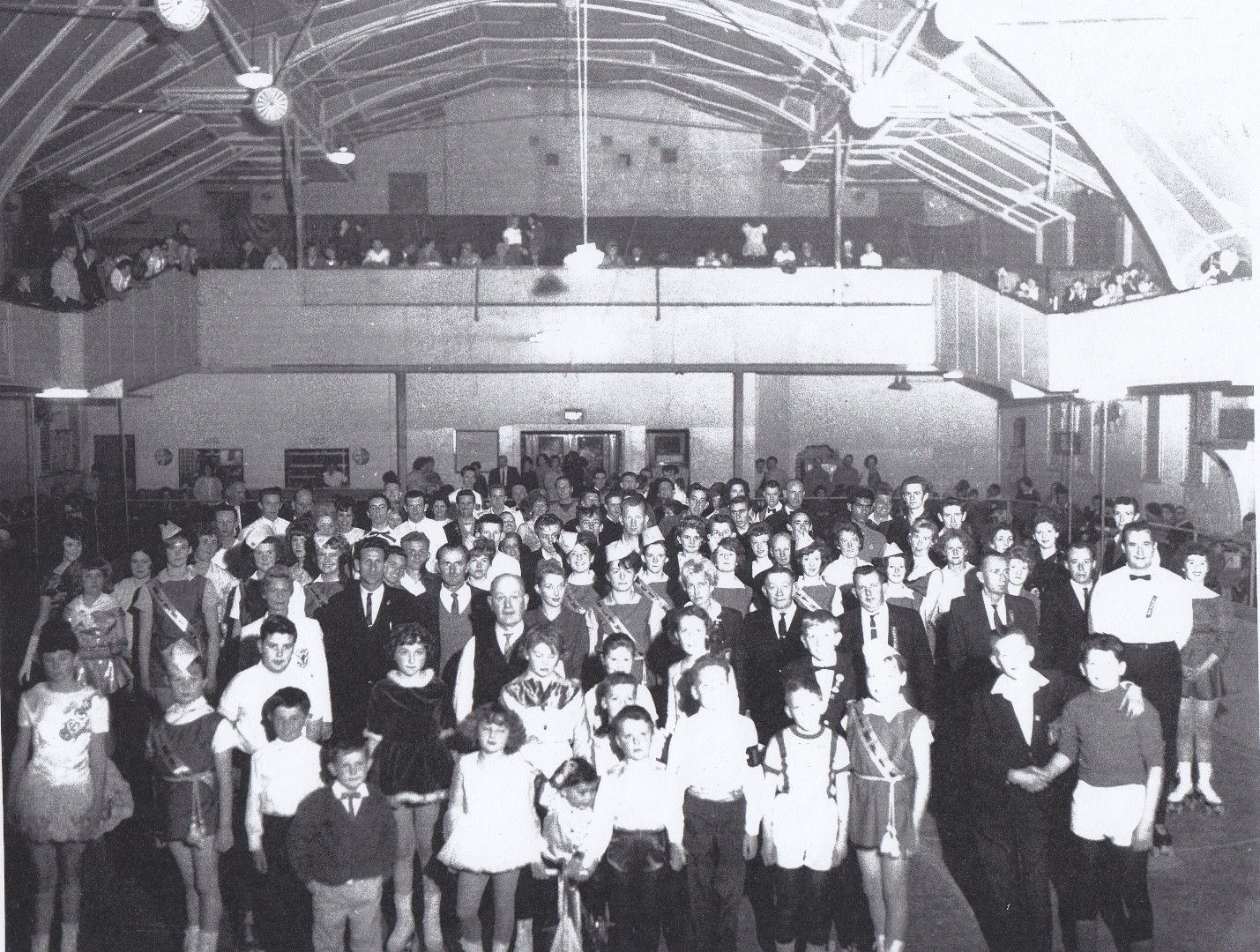
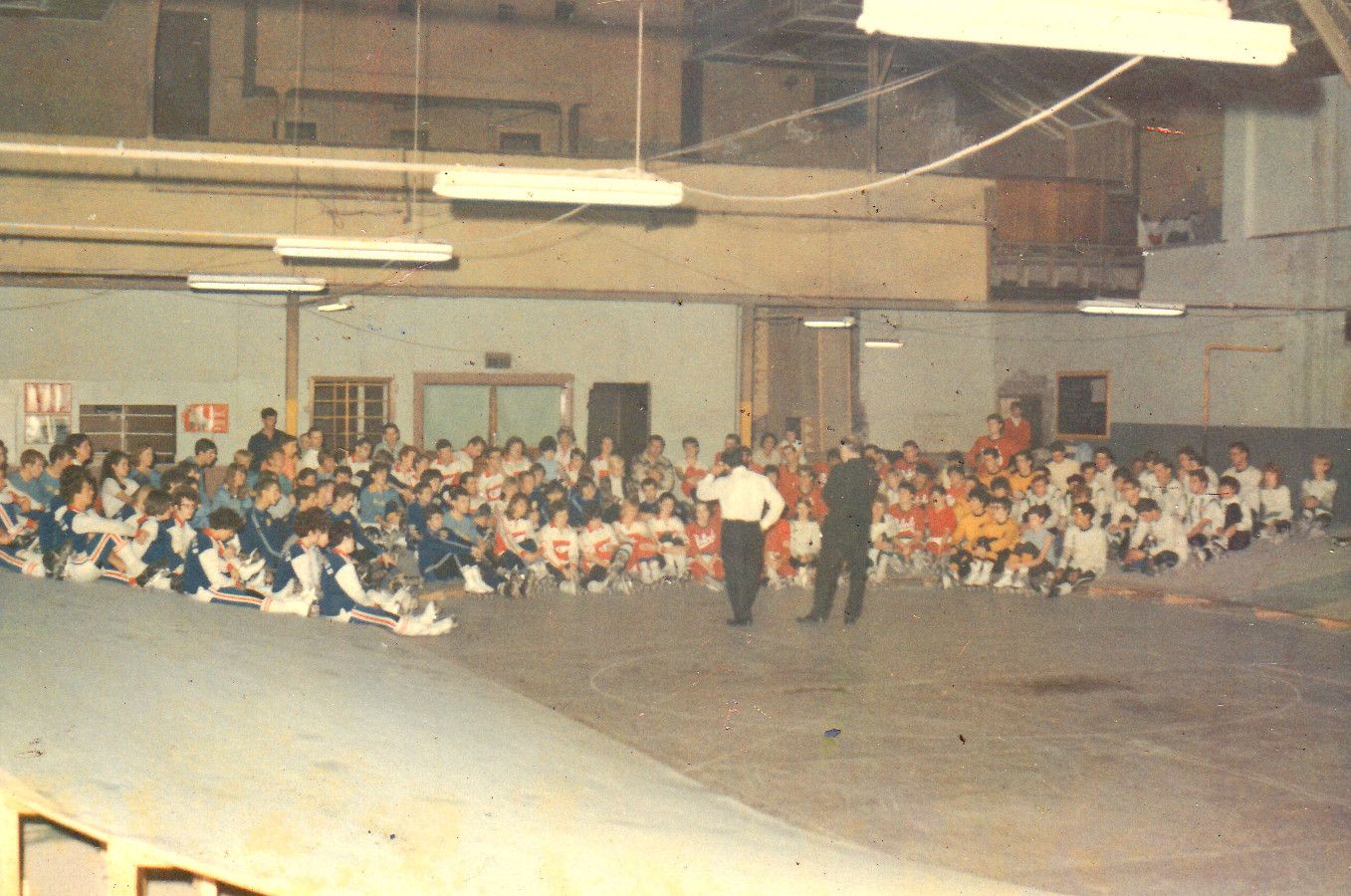
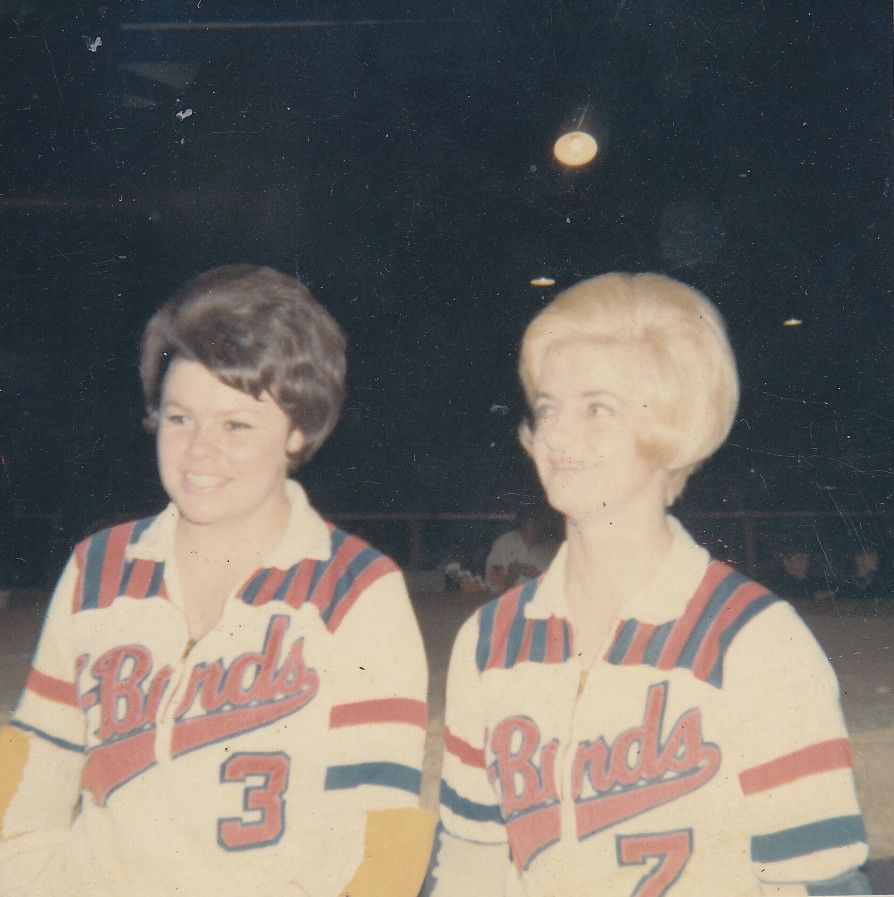
The Olympia Files

The Olympia Files, part one.

Before its sad but inevitable demise in 2017, the Olympia Milk Bar in the Sydney suburb of Stanmore was a place of powerful magic. The spell it cast varied depending on who was experiencing it. Most commonly it had the effect of opening a portal to the past.

The Olympia, circa 2014

When I first experienced this enchantment, I wasn't sure if it was a benign force or a dark and disturbing spell. It was 1993, and my partner and I were going to see a movie at the neighbouring Stanmore Twin cinema. We decided to buy our snacks from the charming, old fashioned milk bar next door, which was strangely deserted.

Even then the decor and the atmosphere of the place was antiquated. The glass concertina doors were folded back, giving way to an impeccable mosaic floor, boldly declaring the name of the establishment: Olympia. A long counter on the left and rear sides of the venue guarded old-fashioned equipment and shelves crowded with boxes of well-known snacks and treats. There were posters and advertisements on the wall, some of them for products which were no longer available, or had long since fallen out of favour.

The antiquity of the place revived childhood memories of the 1960s and 70s, when establishments like the Olympia Milk Bar could be found in towns and suburbs across Australia.

Even more striking was the man behind the counter. His eyes glowered at us from dark, sunken sockets, and he barely grunted when I greeted him and complimented him on his marvelous establishment, a far better choice than the soulless snack bar inside the cinema next door.

Buying a movie snack was next, and it was also an unorthodox process. Further grunts communicated to us that many of the usual products were not in stock. The boxes were empty and just for show. We had to run through a range of choices before hitting on something he actually had on the shelves.

It was reminiscent of the Monty Python cheese shop sketch, except the proprietor was like an imposing Christopher Lee character from a Hammer horror film... or so we imagined at the time.

Over the years many others had similarly striking experiences, and the Olympia became the centre of a minor maelstrom of popular culture discourse. There were songs, articles and artworks. There were urban myths and personal anecdotes.

Later, when the internet transformed, enhanced and poisoned human communication, the Olympia's fame exploded into the online world. Patrons would obsessively photograph the decaying gem, to the irritation of the always gruff owner of the establishment. He gave no sign whatsoever that he cared about the internet fame he and his milk bar were accruing. It was always 1965 in that world.

The pinnacle of the online culture surrounding the Olympia was the facebook group “Olympia Milk Bar Fan Club”. It became a source of information about this extraordinary venue. We learned that the owner was Nicholas Fotiou, but for a while there was confusion about his given name, so he was usually referred to as Mr Fotiou. He was nearly always taciturn, implacably reticent when people asked him about his background and the story of his milk bar.

The exceptions came from the Greek community, one of the bright jewels in the crown of Australia's diverse society. Through Greek contacts with Mr Fotiou, details filtered through to the “fans”, and we pieced together his story, which, while unconfirmed and based on anecdotes, seemed to make sense.

Nicholas Fotiou and his brother John had experienced the nightmare of the Second World War and the subsequent trauma of the Greek Civil War, which extended the disruption and chaos until 1949. John was reportedly injured in that later conflict, resulting in impaired mobility. Like so many Greek immigrants, when they arrived in Australia the Fotious found work and opportunities with the businesses established by Greeks who had arrived earlier. Greek-run Milk bars and small general stores were a mainstay of suburbs and towns.

In 1959, the Fotious bought the Olympia, complete with the shop fittings which had been installed 20 years earlier. One of the participants in the facebook group reminisced about being three years old and having his first taste of ice cream, bought from the Olympia in the 1950s. Like so many cultural phenomena from the epic decade of the 1960s, the Olympia Milk Bar had its genesis in the decade before.

I haven't researched the precise timeline of the Fotious' tenure at the Olympia. At some stage the spouse of one of the brothers established a hairdressing salon above the milk bar. And John Fotiou died many decades before his brother, who doggedly kept the family business going in a uniquely preserved state.

For the aficionados living in Sydney, the online experience wasn't enough. We had a strong sense that the time-warp Milk Bar and its ageing owner could fade away at any time. We arranged multiple meetups there for tea and a milkshake, to enjoy it while it lasted, and help promote its longevity with our patronage.

While the atmosphere and spirit of the milk bar were remarkably intact, by this time the ravages of time were starting to show in its physical traits. One of the windows had been broken, and rather than have it repaired, Mr Fotiou had patched it up with a piece of plywood. The interior was also decaying. While the tile floor was of high quality and might last for a thousand years, peeling paint and worn linoleum in other parts of the venue were starting to spread. The pressed metal ceiling was also in dire need of maintenance.

Had the Olympia been a museum, all these features would have been renovated, polished and maybe put under glass. But the Olympia was nothing like a museum, and for all the decay, the experience was superior to any museum display. The powerful feeling of nostalgia, the desire to bring back lost times, is accompanied with a bittersweet sense of loss. But visiting the Olympia was a tangible way of reviving those memories, and for half an hour or so, we could grasp a real, living fragment of our youths.

The viability of the business was also strained. There were so few customers, it was impossible for Mr Fotiou to stock any product with a short or even medium shelf life. He would only be able to sell a fraction of the chocolates or snacks before the rest expired. Instead, he maintained a stripped-down menu: tea, milkshakes, and cheese and tomato toasted sandwiches were always on offer, but not much else.

Soon we developed a respect for Mr Fotiou which grew into genuine affection. The seemingly stern and remote octogenarian returned the camaraderie in his own modest way. Usually it was with prompt and excellent service. Anything more personal than that was greatly appreciated by us milkshake sipping customers. The most colourful member of our group, Cassie, summed it up: “I love to see him smile”, she quipped. Mr Fotiou

Around this time another online fan recounted her experiences of the Olympia in the 1960s. The lovely Janice had moved to Queensland, and from there she gave glowing accounts of the roller skating rink which had existed next door to the milk bar. It had been a vital social hub for the kids of Sydney's inner west. In honour of this revelation, at our next meetup Cassie wore her skates into the milk bar. That definitely cracked a smile from Mr Fotiou, and it stayed on his face even as he reverted to type and ordered the skates be removed. Only then could the acceptable business of purchasing and consuming a milkshake proceed.

Janice mentioned that the manager of the roller skating rink was, like Mt Fotiou, a bit of a legend of the 1960s, who had plenty of stories of his own to tell.

Our thirst for more detailed knowledge about our beloved milk bar was never quenched. The urge to chronicle the history of the place was strong. Everyone wanted to post it to their social media feeds, often in defiance of Mr Fotiou's known dislike for photos to be taken in the milk bar. I wanted to make a video documentary, and wondered if there would ever be a way to win Mr Fotiou's confidence and convince him to tell his story on camera. Even with the charms of Cassie and our other group members, I feared it would never happen. But maybe the roller skating man from the 1960s would provide a different opportunity to inhale some more of that heady nostalgic air wafting through the portal of the Olympia.

Continues in part two

The Olympia files, by Jon Flynn: @AvonVilla@aus.social Please keep this post in the fediverse or similar free platforms. Don't allow it to be used for engagement algorithms, advertising, money-making, and surveillance capitalism.
The Olympia Files, part 2.

One of the things I like about roller skating is that it has never been elite in any way. It's been popular, it's been mainstream, it's been fringe. It's been black and it's been gay. If it becomes fashionable for a brief instant, it quickly reverts to being dated, retro, uncool, or camp. It's never made it into the Olympics; its much younger upstart cousin skateboarding overtook it to win that prized spot. But somehow, the core values of roller skating are only emphasised by these supposed failures... it's fun, it's pop, it's pep.

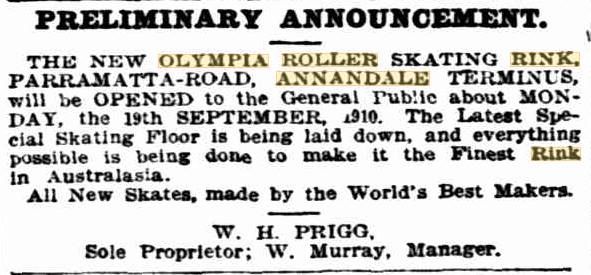
In the early 20th century, roller skating was undergoing one of its many periodic slumps. The pastime had exploded into the mainstream in the late 1800s and made its way to Australia; but by 1910 it was seemingly in decline. So that year may have been an inopportune time to launch a roller skating rink, but that was when the Olympia opened its doors.

Olympia opening - 1910 newspaper ad

Despite the best intentions of the esteemed Messrs Prigg and Murray (proprietor and manager respectively), the rink closed after a few years. The venue would eventually have a new life as a cinema, relaunching as the Olympia De-Luxe Theatre in 1931. Olympia DE-Luxe Theatre in the 1930s

The premises next to it had been a pool hall, before being fitted out as a cafe in 1939. In 1959, the Fotiou brothers took over the business. The Olympia Milk Bar which Sydneysiders came to know and love began its long and colourful tenancy, living rent-free in the collective imagination of a surprisingly large number of devotees.

The opening of the milk bar was an echo of history. Like roller skating 50 years earlier, the cinema business was in trouble. Growing numbers of patrons preferred to stay home and consume their entertainment via the new medium of television, depriving the new milk bar of its major source of business.

But a new lease on life was just around the corner, as roller skating prepared to get its revenge on cinema.

In 1960 the new owners of the theatre decided to reinstate its original function as a roller skating rink. That attracted the interest of roller skating guru Tony Stevens.

Tony was born in Lebanon in 1924, just two months before his family emigrated to Australia. His embrace of roller skating and its culture contrasts starkly with a series of hardships and tragedies which befell him and his family in the decades leading up to his involvement with the Olympia. Most significantly, he and his wife had a child with Down syndrome. Various circumstances, including the prevailing attitude to disability and a lack of support for parents, meant that from a young age little Larry would be raised in institutions. His parents' relationship fell apart during this fraught period.

Although he was an accomplished skater himself, it wasn't Tony's only interest. He had had a lifelong passion for gambling, and was one of the regulars at an illegal den called Thommo's Two-Up School. He was on his way to Thommo's when he noticed the sign outside the Olympia Theatre announcing the re-opening of a roller skating rink in the historic building.

This photo of Tony (in the dark shirt) is probably from the 1950s. Tony Stephens (dark shirt) in the 50s

After meeting the owners, Tony scored the job as manager of the revived Olympia roller skating rink. Barely a year had gone by when the owners got cold feet and decided to sell up. Tony approached the brothers in the Milk Bar next door and formed a joint venture to buy the theatre. The goal was to keep the wheels turning on the rink, and the milkshakes flowing in the bar.

Between the two parties, enough money was raised, but the Fotiou brothers were brewing their own plans. They had interest from the Greek community to revive the cinema and show foreign language films. Tony referred to the idea as a “Greek theatre”, although one imagines the vibrant Italian film scene would also have found a home there, especially with Sydney's “Little Italy” of Norton Street just a stone's throw away.

The showdown between milkshakes and roller skates ended up in court, and Tony won. Decades later his sense of satisfaction was still strong, when he recalled the day he returned triumphant to the rink. He says the Fotiou brothers had tried to have him arrested. Two police cars arrived at the premises on Parramatta Road, but the officers backed down when shown the court papers.

The golden era of the Olympia Roller Skating Rink was now dawning. Tony ripped up the timber floor to reveal the original concrete skating surface from 1910 was still in excellent condition. He demolished the mezzanine area to allow unimpeded skating without the structural pillars which held up the once premium theatre seats.
The Olympia reopens - 1960

Photos from the time show a vibrant scene of speed skating, dance and artistic competitions, and some eccentric skaters relishing fancy dress nights. The rink was also a music venue. Tony recalls the pre-superstar Bee Gees were one of the acts performing there. Col Joye was also a big drawcard for music fans. A skater in fancy dress

But culture in the 1960s was moving fast. By the mid 1960s, roller skating was having trouble keeping up... until it gained an injection of speed from a new sensation, Roller Derby.

Perhaps best described as a cross between pursuit cycling and American football (but played on roller skates of course) Roller Derby had existed in various forms since the 1920s. When its popularity waned several decades later, promoters turned it into a form of sports entertainment, akin to the professional wrestling circus which continues to thrive today.

Australia was a market for this garish spectacle. Promoters brought American teams to Australia (under the auspices of a rival American variant called Roller Game), and the bubblegum violence of sports entertainment was threatening to disrupt the orderly business of running a skating rink.

At the same time, the commercial appeal was hard to resist. If only it could find a foothold in Australia, rather than having American promoters vacuum up all the profits. As an old school skater, Tony Stevens swallowed his pride and embraced the opportunities presented by this television fueled novelty.

A banked track was constructed in the Olympia rink, and local skaters were auditioned and selected to join the American visitors. Roller derby stars and a big group of wannabes Members of the Sydney Thunderbirds roller derby team, 1967

Sydney Stadium was the venue for televised games, along with Melbourne and Brisbane Festival Halls. At its peak the game attracted 20,000 spectators a week, and half a million television viewers. Several Australian recruits left with their American team mates and continued to star in the game overseas. Many more joined a local amateur league, with banked tracks also popping up at other rinks around the country.

The female-dominated revival of Roller Derby in the 2000s is a very different prospect to the corporate circus of that took root in the sixties. Sport is not really my cup of poison, but I can't help feeling a kind of deep respect and approval of this eccentric expression of human culture, in both its historic and modern forms. But the 60s flare-up of the sport in Australia was brief. As far as I can determine, it died down after a few years. Once again, roller skating was surfing the same cultural waves as yo-yos, hula hoops and Bey Blades. A flyer for a roller derby game in Sydney

The Olympia's fortunes were also caught in a rip. Tony had ambitions to grow roller skating into a nationwide enterprise and funnel the profits to a scheme to house people with disabilities. With the Olympia in financial strife, he launched a campaign promoting the twin causes of roller skating and the disabled. It failed, and the Olympia closed in 1971.

A few years later, the building was demolished and replaced with a new twin cinema, which would itself be replaced by shops and apartments in the early two thousands.

But the milk bar prevailed.

Continues in part 3 Part 1 is here: https://write.underworld.fr/the-olympia-files/the-milk-bar-of-forgotten-dreams

The Olympia files, by Jon Flynn: @AvonVilla@aus.social Please keep this post in the fediverse or similar free platforms. Don't allow it to be used for engagement algorithms, advertising, money-making, and surveillance capitalism.

The Olympia Files, part 3

When I learned in 2013 that the mysterious Olympia Milk Bar had been associated with a neighbouring roller skating rink in the 1960s, it fired my imagination. This forgotten part of Sydney's cultural history should be commemorated, celebrated, documented.

The owner of the milk bar was implacably reticent. Perhaps the former manager of the roller skating rink would allow me to interview him and make my planned video documentary a viable proposition.

It wasn't hard to find Tony Stevens' phone number, and he invited me to his house at George's Hall, next to Bankstown airport.

Tony on Macquarie Street in 1975. Tony Stevens skating on Macquarie Street, Sydney

Tony, it turns out, was only too keen to re-enter the limelight. He served tea and iced vo-vo biscuits, and told me the story of his disabled son, who had since died. I told him that I, too, was raising a child with disabilities, who was then in high school. Tony was energised by this revelation. He said he wanted to revive his organisation to promote the combined causes of roller skating and disabled people, and appoint me to the post of “Public Officer”.

I told him I wasn't up for it, but he was still happy to do the documentary. He showed me photos of the period. Some of them were photocopies, others were proof sheets (like thumbnail images). He said he had the high-quality copies and many more photos in storage.

We went to the back of his property where two aluminium sheds stood. One of them was full to the rafters with piles of documents and folders. There was only a small space near the door where one could access the interior of the shed.

Tony suggested I come back in a fortnight, and he would have more for me.

When I returned, I wasn't surprised that the mammoth task of sorting his info-hoard had not commenced. But one photo he did unearth showed a theatrical performance in the Olympia, staged by the American Roller Derby skaters touring Australia. It looked like a drag show. It turned out that the sport had a high concentration of gay athletes.

Tony told me that the young performer in the photo was Gary Johnston, a talented skater who had gone on the become the very successful founder of the Jaycar chain of electronics stores. He was rich and famous! A theatrical show in wheels in the Olympia roller skating rink

Once again Tony suggested I come back in a fortnight and then he would be interviewed; a pattern was emerging. But Tony loved being on camera, and after several visits he eventually relented, and his memories were recounted on camera.

He also met me at State Parliament House on Macquarie Street, where he did a re-enactment of his publicity campaign, setting up banners, chatting to passers by, and roller skating like a demented pensioner amongst the traffic. Then in his 80s, he was getting around with the aid of a walking stick by that time, although he still skated expertly with cane in hand.

I did a rough cut of my mini-documentary and sent the link to Gary Johnston, along with a request for him to also be interviewed.

Gary phoned me back. He was very generous with his time and his advice. “I wish you well, but don't want to take part in your project,” he told me. “Also, I advise you to to tread carefully when you're dealing with Tony Stevens. He's a sociopath. When he was involved in local government he was a serial pest and he made a lot of enemies. A few years ago he approached me and asked for money. He was very belligerent, and I don't want to have anything more to do with him.”

Ouch.

Around the same time there was a reunion for roller skaters from the old days, to be held on the site of the former Sefton Skateland, the rink Tony had established after the demise of the Olympia. The lovely Janice Rowe, a skater from the Olympia's golden era, was coming down from Queensland to take part. Alas, I was working on that day and couldn't take up this opportunity to mine a rich seam of memory.

I had one last, and very long shot to achieve my goal. I took an ipad into the Olympia and showed my rough cut to Mr Fotiou. He chuckled when it got to the bit of Tony Stevens skating up and down Macquarie Street. It was, indeed, a pleasure to see him smile. Then he firmly but politely said he did not want to take part.

Dispirited, I decided to cut my losses. I finished the video with the material I had. It was a bit of a tribute to Tony in the end. I left out the criticisms of his public activities. The small satisfaction of shedding light on a largely forgotten bit of history was diminished somewhat, because I had been unable to tell the full story, including the darkest and brightest aspects of it.

Below: protests to keep the Olympia open, including a Harbour Bridge Skate, and a skateathon, featuring trade union leader Jack Mundey (not skating, turns out he was human after all!) 1971 Roller skating protest on the Sydney Harbour Bridge

Jack Mundey and skaters, 1971

Janice and other young skaters from the era had spoken glowingly of Tony. The Olympia and subsequent rinks Tony had set up had been a field of dreams for countless young Sydneysiders. On the other hand, there was Gary Johnston's blunt assessment of Tony's personality.

I had found Tony to be rather intense. He could be both demanding and generous. His self-published memoir was full of tales of conflict and accusations of corruption. Then there was his unapologetic celebration of gambling, both legal and illegal.

Recalling the Olympia in the 60s, Gary told me he had put that part of his life behind him. That might have been his biggest mistake. Roller skating makes everything all right.

In the end, I had no regrets about my brief association with Tony Stevens. It was about as wild a ride as you could expect to be taken on by an 83 year old man. I hope I've treated him fairly in this account. Like Nick Fotiou, he had endured some terrible traumas in his early life. Both men had found ways of coping with those traumas – one was gregarious and lived a life in public, the other was intensely private and shut himself into a world which he steadfastly refused to change.

Tony Stevens died in 2019. The Olympia Milk Bar shut its doors in 2017. Gary Johnston died unexpectedly in 2021. Nick Fotiou, the great survivor of this story, died in 2023.

Post script:

In a fit of righteous opposition to technocratic tyranny, I deleted my youtube account a few years ago. Then I had a hard drive crash, and all my Olympia video, including the documentary, was lost! There are plenty of other videos of Tony and the Olympia Milk Bar online. One of them shows Tony returning to Sefton in his 90s, and roller skating with the aid of a walking frame!

Last year the following was posted to social media by an anonymous contributor with connections to the new owners of the Olympia Milk Bar. If their plans bear fruit, it could end up being a sort of museum, but I hope it eventuates.


  1. Upon purchase the new owner carefully kept and put in storage all items that were still in working order. i.e.: The come in for tea sign The many intact posters The hand written reciept on back of cigarette packets The small personal belongings left The relic old stoves and shop items Old menus Old cutlery and milk shake cups Pieces of the original ceiling to match the pattern And anything else that could be salvaged
  2. After this. A rubbish removal team came through to make safe the area. The rubbish was just that. -8 cubic metre bins full of old wine bottles. There was a pile of drunk wine bottles nearly touching the ceiling. The pile was actually holding up part of the roof and upon removal the roof collapsed further. -6 mattresses -Furniture items with mushrooms growing out of them that fell apart when being lifted
  3. rubbish and cardboard which was a fire risk
  4. makeshift steel guttering that Mr Fotou must have fashioned himself as when it rains each wall forms a beautiful internal waterfall so he has redirected this with an intricate maze of old gutters to funnel outside. All mostly rusted out
  5. a rifle…. That the inner west police kindly came and collected
  6. Upstairs was thankfully mostly empty as the floor is so eaten by white ants that the upstairs walls are separated from the external walls and caving into floor. Any movement would result in the floor collapse.
  7. The new owner has temporarily supported the floor until council could see the extend of the damage.
  8. The council and heritage has visited site in its current condition and understands the requirements to get it back to its former glory. Happily the council and new owner have been working together to achieve the common goal.
  9. The goal for council AND the new owner. Restore Olympia back to its former glory! Have a time warp shop to honour not only Olympia and Mr fotou but an era that existed before internet trolls and tall poppy syndrome. A place you can go to get a coffee (no takeaway! If you can’t take the time to sit and have a coffee then there are many other takeaway places) Milkshakes Tea As it was. Maybe a little healthier with the confectioneries….

The Olympia files, by Jon Flynn: @AvonVilla@aus.social Please keep this post in the fediverse or similar free platforms. Don't allow it to be used for engagement algorithms, advertising, money-making, and surveillance capitalism.