The Baby of Mâcon (Peter Greenaway, 1993)
Dec
12
Dīpāvalī
.png)
The miraculous child (Nils Dorando) surrounded by candles. DP: Sacha Vierny.
Candles for Diwali*. Today's and tomorrow's theme are virtually interchangeable.
When an old crone gives birth to a beautiful baby, a young virgin claims the child as hers. With the Immaculately Conceived wonder put on display – to the child's contemporaries, the court of Cosimo de' Medici attending a reenactment of the events, and us film viewers – He protects the false Virgin from losing her chastity and blurs the walls between staging and gospel.
* “Diwali, one of the major religious festivals in Hinduism, Jainism, and Sikhism, lasting for five days from the 13th day of the dark half of the lunar month Ashvina to the second day of the light half of the lunar month Karttika. The corresponding dates in the Gregorian calendar usually fall in late October and November.” (source).
PeterGreenaway
“I have often thought it was very arrogant to suppose you could make a film for anybody but yourself… I like to think of The Falls as my own personal encyclopaedia Greenaway-ensis.” The Falls (Peter Greenaway, 1980)
Mar
1
US Constitution – 1781

A blonde wearing a floppy hat with peach-coloured ribbons and bird feathers attached to it, sits in front of three small whiteboards with study material such as pictures of waterfalls and pilots. Next to her a little fuse box, and on it a small, white fake bird and an orange-yellow egg. DPs: Mike Coles & John Rosenberg.
An important list in remembrance of the ratification of the Constitution of the United States on March 1, 1781.
– Peter Greenaway, via
Ninety-two people, all with a surname starting with f-a-l-l, survive unexpected catastrophes known as VUEs (Violent Unknown Events). These individuals experienced curious ailments, such as mutations of evolving into a bird-like form, speaking new languages, and becoming immortal.
This film, a list, describes them all.
“In the land of the legless, the one-legged woman is queen.”A Zed & Two Noughts [Z+00 / ZOO] (Peter Greenaway, 1985)
Dec
27
Visit The Zoo Day
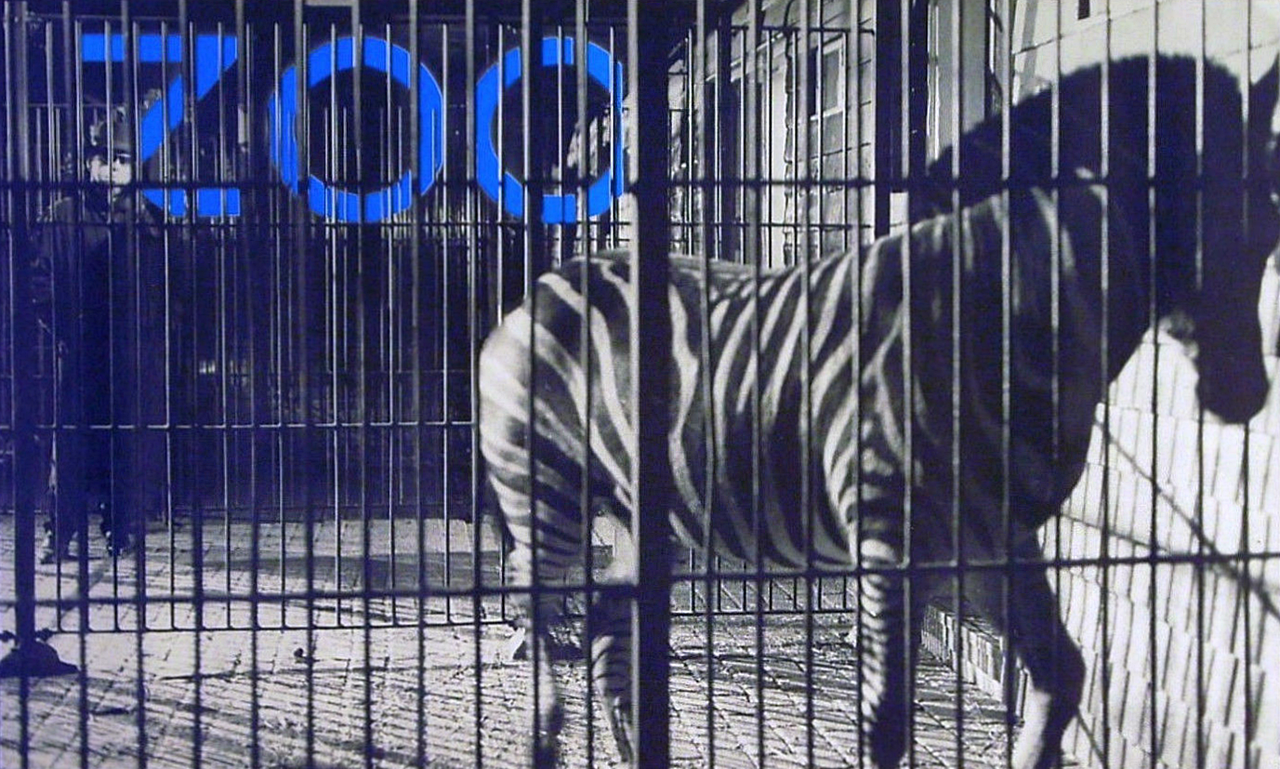
A zebra in a cage with the word ZOO in large blue lit capitals in the background. In the background a man. All but the lettering is black-and-white. DP: Sacha Vierny.
A zoo for National Visit The Zoo Day (USA)