“Dear child,
l received your letter and hope you will write often. l hope you won’t stay away too long and that you’ve found a job by now. If you’re doing well, we’re happy. Even though we do miss you. When will you be back? Everything is fine here, but Sylviane is home with the flu. My blood pressure is low. l’m on medication for it. Today is my birthday. l feel sad. lt’s quiet at the shop. Tonight we’re going out to dinner with friends. That’s all. Your birthday is coming up. l wish you all the best. Write to me soon about your work, about New York, about everything. Lots of love from the three of us.News from Home (Chantal Akerman, 1976)
Apr
3
Pony Express Day

New York, a street scene. Superimposed a quote from one Chantal Akerman's mother's letters. DPs: Jim Asbell & Babette Mangolte.
Mail or a mail carrier for Pony Express Day (USA).
Your loving mother” (quote via)
Chantal Akerman reads out letters that her mother wrote to the former's stay in New York City between 1971 and 1973. The words slowly blend with the city.
1970s
“Celui qui n’a jamais rien dit a cinquante ans d’âge et ne dira jamais rien s’est appris à lire dans les moindres gestes” Le moindre geste [The Slightest Gesture] (Jean-Pierre Daniel, Fernand Deligny + Josée Manenti, 1962–1964, 1971)
Apr
2
World Autism Awareness Day

Yves (Yves Guignard), resting. Deligny wrote a lot about the lack of words, and how it stays close to the heart of cinema. Still (and a wonderful essay) via. DP: Josée Manenti.
An autistic actor or character for World Autism Awareness Day
– Fernand Deligny, Essi & Copeaux. Derniers écrits et aphorismes, via
Fernand Deligny was an educator who promoted play and exploration, as opposed to drugs and force, to open up the lives of young nonverbal, autistic people. We follow Yves Guignard, one of Deligny's “patients”, who, in his own wordless rhythm shows us his world.
Over time, the film was forgotten and even lost, until it was found in a tree, then completed with a narrative and soundtrack in 1969, selected for the 1971 Cannes Film Festival and praised by Cahiers du Cinéma, lost once more, and eventually – with support of Chris Marker – restored and brought to a wider audience.
“This is the account
of when
all is still silent
and placid.
All is silent
and calm.
Hushed
and empty is the womb of the sky.”Chac: Dios de la lluvia [Chac: The Rain God] (Rolando Klein, 1975)
Mar
30
mythology

The villagers light torches in preparation of the ritual. Screenshot via. DP: William B. Kaplan + Álex Phillips Jr..
Mythology on the date Wrath of the Titans (2012) was released.
With their shaman lost to alcohol, villagers make their way to a diviner in the hope to appease Chac, the rain god.
– Popul Vuh, The Primordial World
Filmed in the forests of Tenejapa, Chiapas, Chac is probably the first film completely in Tzotzil, one of several Maya languages, and based on themes found in the Popol Vuh.
Die Patriotin [The Patriotic Woman] (Alexander Kluge, 1979)
Mar
29
秦始皇兵马俑

Teacher Gabi Teichert (Hannelore Hoger), knee-deep in a puddle with a shovel, inspecting a find. DPs: Guenter Hoermann, Werner Lüring, Thomas Mauch & Jörg Schmidt-Reitwein.
Something buried: discovery of the Terracotta Army on March 29, 1974
A German history teacher, unhappy with the standardised history textbooks she has to work with, literally digs up her nation's past and sees how it is reflected in modern society.
“I want to remain an enigma forever. To others, and also to myself.”Ludwig (Luchino Visconti, 1973)
Mar
25
Elton John – 1947

Elisabeth “Sissi” of Austria (Romy Schneider) and King Ludwig II of Bavaria (Helmut Berger) in his beloved Venus Grotto below Schloss Linderhoff. Ludwig wanted blue light in reference to the Grotta Azzurra in #Capri, and had electricity installed in the grotto, which was the first usage of electricity in Austria. DP: Armando Nannuzzi.
A flamboyant character for Elton John’s birthday (1947).
– Ludwig II
“In a short while you'll see that the moon won't be so bright as it is. Clouds will cover it… it'll get broken up there. I hope it won't break us.” The Moon Over the Alley (Joseph Despins, 1976)
Mar
21
End Racism Day

Ronnie Gusset (Patrick Murray), Sherry (Bill Williams), and Belinda (Sharon Forester) at a kitchen table, chatting and laughing. DP: Peter Hannan.
Diversity for the International Day for the Elimination of Racial Discrimination.
Today marks the anniversary of the Sharpeville massacre (1960), when police butchered dozens of people gathered to protest the pass law, one of Apartheid's many cruel segregation measurements.
– Sybil
The multicultural residents of a Notting Hill boarding house go about their day – listening to the radio, humming, singing – with the local council's imminent demolition of their home looming over them.
A kitchen sink drama, yes. But also a catchy musical, written by no other than Galt MacDermot, who brought the world the musical Hair (1967) and the blaxploitation neo-noir Cotton Comes to Harlem (1970).
“For me it’s important to note that the film’s information is also the only thing you know. That’s the idea of the tip of the iceberg, provided that only the portion above the water exists (in the film), because you know nothing of what’s under water and therefore it’s impossible for you to describe the entire iceberg.
For example, in De nieuwe ijstijd the characters are not described 'in their entirety'. What is shown is only what we’ve encountered when we were filming. It’s always a limited, fragmentary knowledge of everything that exists, and that’s how it’s shown.”De nieuwe ijstijd [The New Ice Age] (Johan van der Keuken, 1974)
Mar
16
Reykjavík Food & Fun Festival
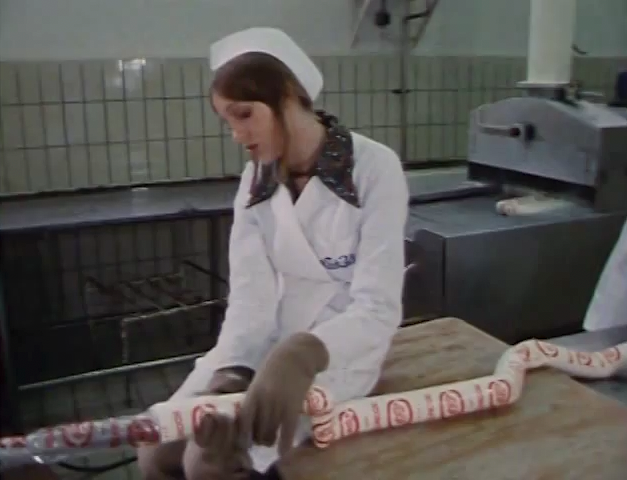
A young female factory worker listlessly fills a long plastic tube with pale ice-cream.. DP: Johan van der Keuken.
Ice or cold food to celebrate the final day of the Reykjavík Food & Fun Festival
– Johan van der Keuken, via
Part three of Van der Keuken's Noord-Zuid trilogy. Again we are confronted with the contrast between the First and Third world, here represented by a Dutch family of monotonous ice-cream factory hands, and impoverished Peruvian workers establishing self-governance, accompanied by Willem Breuker's punching free jazz cacophony.
– Dont raise your voice! I'll kill you if you make a sound. – Would you please? 聖母観音大菩薩 [Seibo Kannon daibosatsu / Eros Eterna] (Kōji Wakamatsu, 1977)
Mar
7
immortality

The yao bikuni (Eiko Matsuda) rises from the ocean. DP: Hideo Itō.
An immortal character on the date Highlander (1986) was released.
When a woman eats the flesh of a 人魚 (ningyo, litt. “human fish” but in Western context commenly translated as “mermaid”), she may become a 八百比丘尼 [yao bikuni], an 800 year* old Buddhist nun granted youth and longevity.
*The number 8 symbolises growth and prosperity. Larger numbers starting with 8 indicate that the amount is endless, comparable to saying “hundreds/thousands/millions of […]” in English. Therefore, 800 years can be understood as immortal.
“Just because people throw it out and don't have any use for it, doesn't mean it's garbage.”Trash (Paul Morrissey, 1970)
Feb
23
freebie: Paul Morrissey born

Jane Forth, Paul Morrissey, and Joe Dallesandro in a publicity photo for Trash. DP: Paul Morrissey.
Freebie: Paul Morrissey born (1938 – 2024)
– Holly
Laukaus tehtaalla [A Shot in the Factory] (Erkko Kivikoski, 1973)
Feb
21
Nixon goes to China

Workers and bosses negotiate the situation. DP: Esko Nevalainen.
Diplomacy on Nixon's visit to China (February 21 — 28, 1972)
The killing of the factory's boss by one of the workers leads to endless negotiations between the two parties.
Shot in cinéma vérité style, with a mostly amateur cast, Laukaus tehtaalla mirrors the working classes' insecurity caused by the 1973 energy crisis in more ways than one.