view
Vertigo (Alfred Hitchcock, 1958)
May
27
Golden Gate Bridge
A pensive Novak in black in front of a sunlit Golden Gate Bridge. DP: Robert Burks.
A bridge to celebrate the 1937 Golden Gate Bridge opening.
“Here I was born, and there I died. It was only a moment for you; you took no notice.”
view
Cuadecuc, vampir (Pere Portabella, 1971)
May
26
World Dracula Day
Lucy (Soledad Miranda) in bloody embrace with Dracula (Christopher Lee). DP: Manel Esteban.
A black forest. A man walks through, holding a smoke machine. Then a carriage with a familiar coachman. Dracula! Where are we? No, not 19th century #Transylvania. The film stock reveals bullet holes in ancient walls, and beyond these walls a ladder, maybe scaffolding. A pneumatic drill, more crew members, lights, a clapperboard. Are the characters aware of that? Them seem to interact with the disturbance yet oblige to the interruptions of the movie set. In a state of hypnopompia, guided by kuroko, maybe?
“cut”
Pere Portabella created a hyper-reality with his Cuadecuc, vampir. A director dismantles the man-behind-the-curtain, Franco, the other #Franco while setting up scaffolding for the next Spain. Everything's a reality, or an illusion, then nothing is.
view
薄面佬 [Mee Pok Man] (Eric Khoo, 1995)
May
24
National Caterers Appreciation Day
Bunny (Michelle Goh) leaning on a small table littered with empty beer bottles. Mee Pok (Joe Ng) is to her left, holding a stack of dirty dishes. In the background, a large pile of noodle boxes leans against the restaurant wall. DP: Yoke Weng Ho.
At night, a small group of prostitutes frequent a local 面薄 / mee pok #restaurant. One of them, Bunny (Michelle Goh), caught the hawker's eye, but she's not interested in the “mee pok” (the “fish ball”, as they call the vendor) (Joe Ng) and besides she has a boyfriend. Then, a car crash. Bunny is left for dead in front of the eatery. He takes her in, preparing endless meals
view
Culloden (Peter Watkins, 1964)
May
23
Wigged man at a table, drinking wine with three men lower in rank standing behind them with their arms crossed. DP: Dick Bush.
“Sir John MacDonald, Jacobite captain of cavalry. Aged, frequently intoxicated, described as 'a man of the most limited capacities'.”
– narrator
view
Padre padrone [My Father My Master / Father and Master] (Paolo + Vittorio Taviani, 1977)
May
23
freebie: National Sons Day
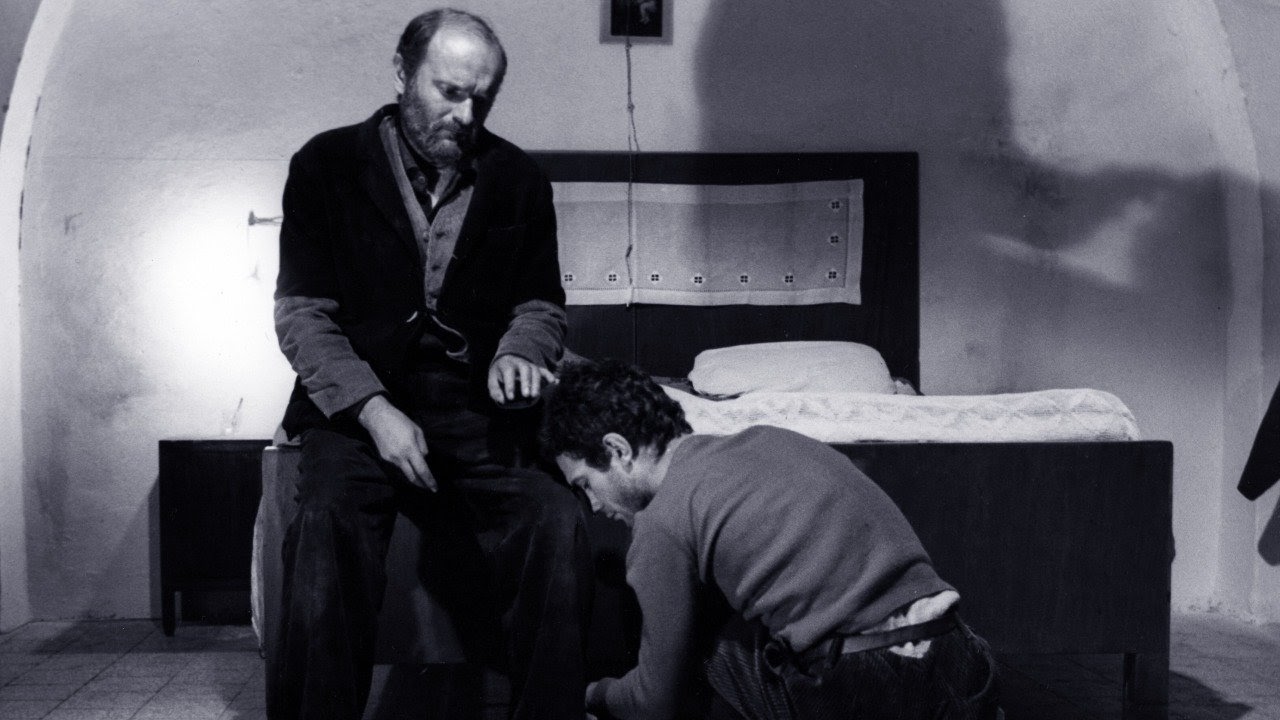
Father (Omero Antonutti) and son (Saverio Marconi). The son, an adult here, kneels and rests his head on his father's knee. The father, perched on the edge of a bed, looks down on the young man. DP: Mario Masini.
Not a film you can be prepared for, Padre padrone. The author, Gavino Ledda, hands a stick – that stick – to the actor who plays his part. There we are, in Sardinia, beautiful Sardinia. A boy in class, learning. His father barges in: the boy must attend the sheep, or else. From that moment on we become that boy Gavino. Life's cruel on the island, but his father, his master, is worse. But that's how it is, there's sheep to herd. When Gavino enlist in the army, he encounters a new world. The precise world of electronics, other people, other sounds, the Italian #language. When he returns home, he finds his father a small man.
“Don't laugh at Gavino. Hands on your desks! Today is Gavino's turn. Tomorrow will be yours.”
– father
In a 1977 New York Times article the Taviani's are cited as seeing Gavino in the same light as #Truffaut's L'Enfant sauvage (1970) and #Herzog's Kaspar Hauser (Jeder für sich und Gott gegen alle) (1974). However, the Sardinian boy's outsiderness is not caused by estrangement, but an immense loneliness that cannot be put into words. This is why Ledda's newfound language is such an important tool. It's not a stick, or a fist, or a dead snake. It's the foundation of his Home.
view
Ladybug Ladybug (Frank Perry, 1963)
May
21
the End Of The World
In a scene evoking Ingmar Bergman's Det sjunde inseglet [The Seventh Seal] (1957), one of the older girls leads the younger children in dance on top of a hill. Their teacher Mrs Andrews (Nancy Marchand) plus two of her students walk along. DP: Leonard Hirschfield.
It's another school day in rural America when the #NuclearAttack alarm starts ringing. A teacher, instructed to calmly walk the kids home, tries to keep the youngest ones oblivious of the impending doom.
“Ladybug, ladybug,
Fly away home”
children's song
While the children walk, talk and sing, this thing up there, in the sky and in the mind, grows bigger.
view
Οι Τεμπέληδες της Εύφορης Κοιλάδας [Oi tembelides tis eforis koiladas / The Idlers of the Fertile Valley] (Nikos Panayotopoulos, 1978)
May
15
The maid (Olga Karlatos) patiently feeding the father (Vasilis Diamantopoulos) in bed. DP: Andreas Bellis.
view
Malpertuis (Harry Kümel, 1971)
May
12
meat
view
Manden der tænkte ting [The Man Who Thought Life] (Jens Ravn, 1969)
May
12
National Hospital Day
A man in black (Preben Neergaard) seen from the back looks into an operating room. DP: Witold Leszczyński.
A strange man arrives at neurosurgeon Dr Max Holst's #hospital one day. So strange in fact that he's promptly send to the psychiatric ward. This man, a Mr Steinmetz, insists on the doctor's help. He can materialise things – look see here's a cigar – but living things is what he wants. This bird, it died. Can the doctor help? No no, not the bird, the brain! Steinmetz has set up a theatre in his home, it can be done there. While the doctor, however tempted, refuses, Steinmetz evolves.
“We are now entering the century of the soul!”
– Steinmetz
Manden der tænkte ting intrigues in its clinical monotonous settings, its pale late-60s stock, and precise composition. Early Cronenberg – Stereo (Tile 3B of a CAEE Educational Mosaic) (1969) and Crimes of the Future (1970) – comes to mind and, of course Lars von Trier's majestic Riget [The Kingdom] (1994 – 2022). But only Jens Ravn mastered this strangling lightness. Slowly, while you count backwards. Now you no longer feel the straps. 10… 9… …
view
The Swimmer (Frank Perry + Sydney Pollack, 1968)
May
6
Beverage Day
Swimmer Ned Merrill (Burt Lancaster) reaching for a drink handed to him by someone offscreen. DP: David L. Quaid.
At a poolside #CocktailParty, the swimmer appears. He notes that the houses in between his hosts' and his are connected by a “river” of #pools and decides to swim home, from one pool to the other, superficially meeting people, crashing suburban pool parties, in an increasingly irrational state.
“And the water up there. Remember? That transparent, light green water. It felt different. God, what a beautiful feeling. We could've swum around the world in those days.”
– Ned Merrill