“Anderntags hat man sofort getauft, weil jede Mutter lieber ein «Gotteskindli» auf die Arme nahm.” Wir Bergler in den Bergen sind eigentlich nicht schuld, daß wir da sind [We Who Dwell in the Mountains Cannot Be Blamed for Being There] (Fredi M. Murer, 1974)
Nov
17
.jpg)
A mountain man smokes his pipe, accompanied by a sow and a toddler in a wooden playpen. The Alps are all around them (via). DP: Iwan P. Schumacher.
A movie set in the woods or mountains*
– Gisler-Arnold Babette, midwife (via)
Murer describes the people from Switzerland's gorges in three movements, along the lines of a symphony
* the Bales 2025 Film Challenge for November is, again, not date-based, but follows a sloppy schmaltzy all-American Thanksgiving-y narrative. Trying to make it work my way.
mountains
Die Sage vom alten Hirten Xeudi und seinem Freund Reiman [The Legend of the Old Shepherd Xeudi and His Friend Reimann] (Hans-Jakob Siber, 1973)
Dec
11
International Mountain Day

The two friends setting off on their track of the Swiss mountains. Their chalet can be seen in the foreground. DP: Hans-Jakob Siber.
Mountain living on International Mountain Day. Available to watch via the Zürcher Hochschule der Künste's media archive.
“This winter… I'm going to the mountain. My mother went to the mountain, as did the mother-in-law of our home. So I have to go too.”楢山節考 [Narayama-bushi kō / The Ballad of Narayama] (Keisuke Kinoshita, 1958)
Dec
11
International Mountain Day
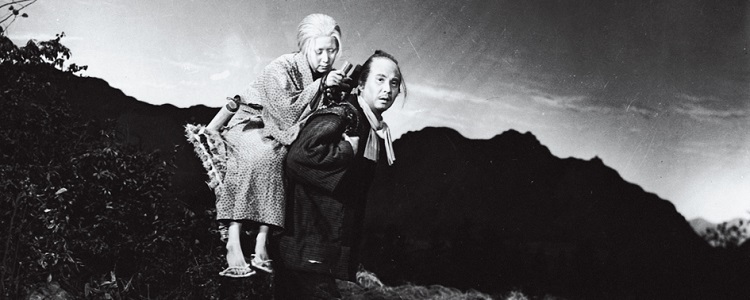
Tatsuhei (Teiji Takahashi) with his mother Orin (Kinuyo Tanaka) in a bamboo carrier on his back. She's combing his hair. Around them the mountain range. DP: Hiroshi Kusuda.
Travel mountains on International Mountain Day
A starving community has come to the agreement that the elders approaching the age of seventy are to be carried up Narayama mountain to die. The day prior to the mountain's festival, sixty-nine year old Orin prepares to leave, carried by her son Tatsuhei.
– Orin
In Keisuke Kinoshita's highly stylised 楢山節考, the arguably cruel (and most likely fictional) practice – of 姥捨て [ubasute, abandoning an old woman] – is superbly abstracted. Narration, dramatic lighting, colour filters and very obviously a soundstage underline that what we're watching is not a film, but a kabuki play.
Sie fallen unerwartet in einem traumlosen Schlaf.Grauzone [Zones] (Fredi M. Murer, 1979)
May
29
Mount Everest Day
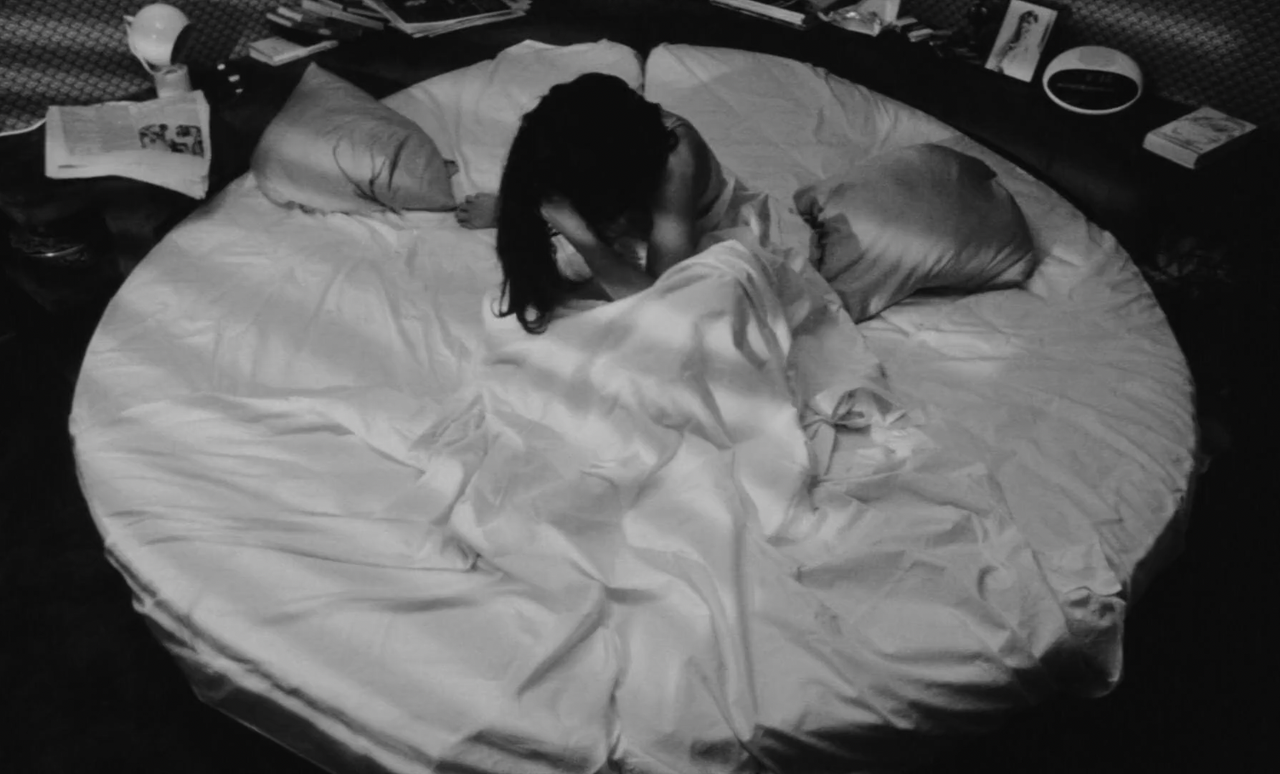
Julia (Olga Piazza) waking from a unusually deep sleep. DP: Hans Liechti.
Grauzone takes place in one of the three spaces documented in Murer's beautifully titled documentary Wir Bergler in den Bergen sind eigentlich nicht schuld, daß wir da sind [We, the mountain people, who live in the mountains are not really to blame for being there] (1974). One valley lives in tune with its natural rhythm, the second experiences a transition to modernity.
The third space, the “grey zone” – both this film's title and a descriptive term for an undefined neutral zone – is where the Bergler have become technology dwellers, where they live on summits made of concrete instead of rock. Where rumours about a #pandemic stir an ancient, unnamed fear. And symptoms: the sudden urge to wander out in nature, an acute melancholy, an overall hyper awareness. A young, prosperous couple become infected and pick up secret radio transmissions. What they believed was concrete, solid, immovable, suddenly shows signs of a shift.