“Mr. Hulot is off for a week by the sea. Take a seat behind his camera, and you can spend it with him. Don't look for a plot, for a holiday is meant purely for fun, and if you look for it, you will find more fun in ordinary life than in fiction.” Les vacances de Monsieur Hulot [Monsieur Hulot's Holiday] (Jacques Tati, 1953)
Jul
7
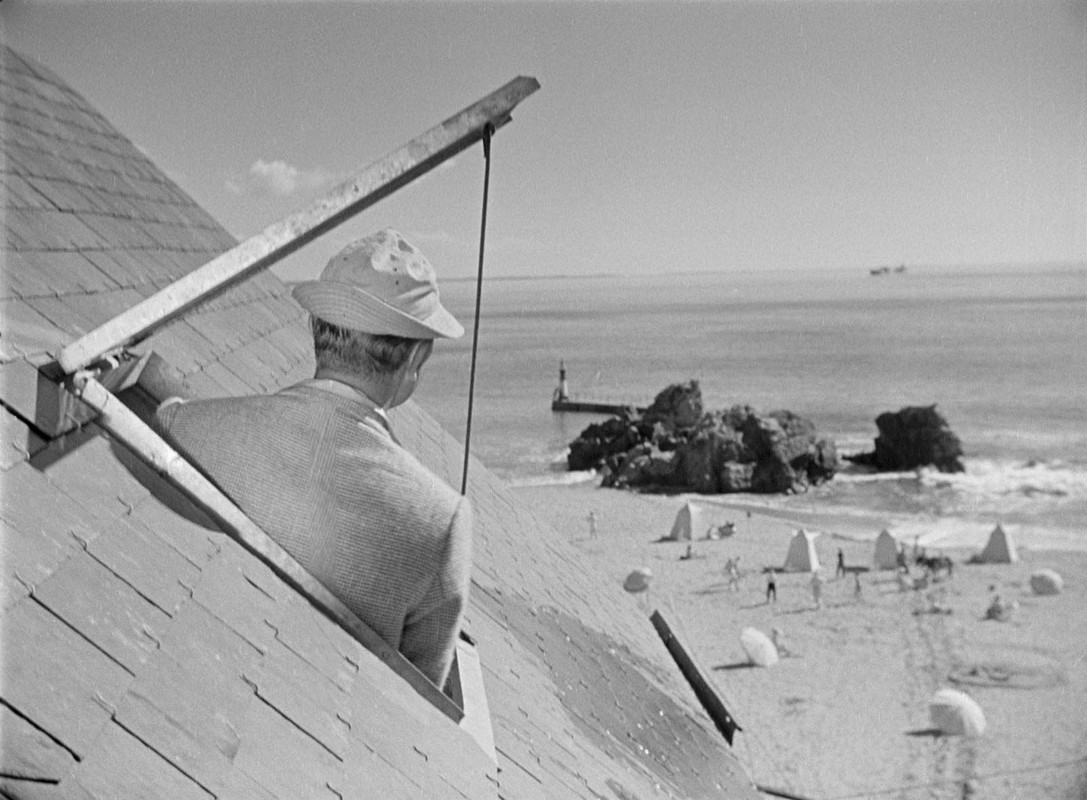
Mr Hulot's view from his hotel room. DPs: Jacques Mercanton & Jean Mousselle.
A film with people at, or taking place in, a hotel*
– opening lines
Located in the real-world Hôtel de la Plage in Saint-Marc-sur-Mer, Mr Hulot lovingly bumbles his way into your heart.
* the Bales 2025 Film Challenge for July is, for unknown reasons, mostly not date-related and follows some sort of vacation narrative.
vaudeville
“Bonsoir. Je m'appelle Rosalie!” Rosalie et son phonographe [Rosalie and Her Phonograph] (Romeo Bosetti, 1911)
Mar
28
Something-on-a-Stick Day

Rosalie (Sarah Duhamel) dances to her new phonograph. Duhamel makes eye contact with the viewer throughout the film, and even formally introduces herself during the intro.
A laugh out loud scene for Something on a Stick Day (USA)
Rosalie (the wonderful Sarah Duhamel) buys herself a phonograph and is delighted by the wonders it brings. Quick, the whole household should know!
Not only the obvious moments (no spoilers here), but the small, seemingly improvised bits is what makes Rosalie stand out above American productions of the time – with the exception of Roscoe Arbuckle's; his water bucket pun in His Wife's Mistakes (1916) still has me in stitches.
Duhamel makes great use of her physique, and doesn't shy away from looking inelegant, boorish even. Her hips are for pushing things and men out of her way, and her mighty paws easily toss any unwieldy piece of furniture out of the window.
Like Rosalie's irresistible gusto and her delightful ditties, the combination of Duhamel's physical comedy and (former #vaudeville-ian) Bosetti's Italian-flavoured slapstick, plus some of the best stop-motion trickery I've ever seen, is simply magical.
“Selling the Brooklyn Bridge again, huh?”Every Day's a Holiday (A. Edward Sutherland, 1937)
Nov
21
National Entrepreneurs Day

Lobbycard. Peaches O'Day (Mae West, dressed by Schiaparelli) hands her business card to yet another sucker. They're on the Brooklyn Bridge, which can be seen in the background. DP: Karl Struss.
The main character is an entrepreneur: National Entrepreneur's Day (USA)
In my book, entrepreneur is just a fancy talk for conman. A famous one, the one who may've tried to sell you the Brooklyn Bridge, was George C. Parker. He'd peddle the famous landmark to any hapless rube, immigrant, or sucker who then would promptly erect a little tollbooth to make a fast buck from any hapless rube, immigrant, or sucker.
– Police captain Jim McCarey
Like Parker, Mae West's Peaches O'Day bamboozles it her way. And boy, does she have a bridge to sell you!
Gertie the Dinosaur (1914)
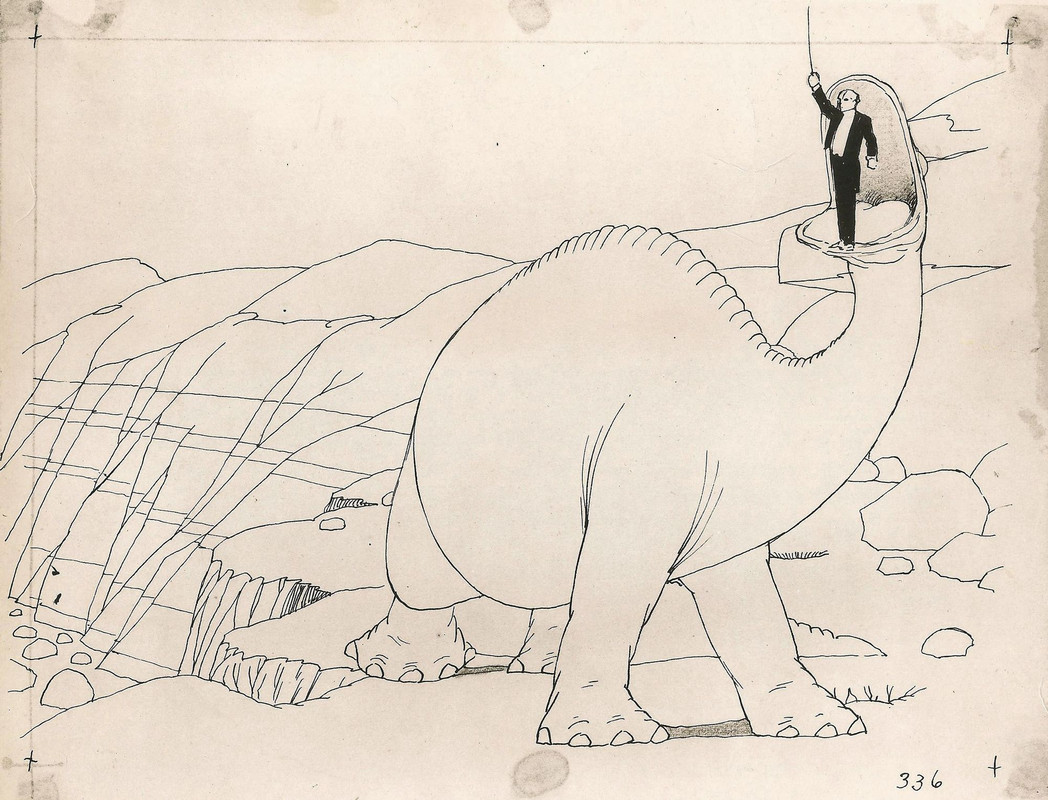
Gertie raises her creator Winsor McCay in her mouth. McCay holds a dressage whip but in his tuxedo resembles a musical conductor more than a lion tamer. DPs: John A. Fitzsimmons & Winsor McCay.
June 1: dinosaurs for #DinosaurDay
Gertie the Dinosaur (Winsor McCay, 1914)
I made ten thousand cartoons —each one a little bit different from the one preceding it.
Long before we all flocked to the movies, there was vaudeville. Vaudeville comes in many flavours, from raucous song and dance, acrobatics (see #BusterKeaton's start) to chalk talk: a live performance in which an artist would chat and draw on a blackboard in real time. The format is perfect to enlighten and entertain an audience, about the dangers of alcohol, the importance of religion, the demand for women's suffrage.
But where there's a scholar, there's a showman. As a chalk talk consists of a succession of quickly drawn illustrations, one flowing into the next while the performer raps over it, the leap to animation is a logical one. In 1914, a brontosaurus named Gertie and a comic strip creator called Winsor McCay travelled the land – both animated and real.
McCay, known for his fantastic comic strips Little Nemo in Slumberland and its predecessor Dream of the Rarebit Fiend, introduced the great animated animal to the audience with little tidbits of knowledge about the mighty brontosaurus, throw her an apple, demonstrate her gentleness by stepping into the screen (a parlour trick made the transition from real to animated look incredibly convincing) and let Gertie carry him around in her prehistoric world. In front of the delighted audience, the showman then would reappear into our realm.
The movies were young and promising, and Gertie's leap to celluloid was made the very same year. Gertie the Dinosaur (1914), an adaptation of the vaudeville act and the first animated dinosaur movie, moves the stage to a dinner party at the animator's studio, where McCay shows off his animation skills as part of a bet.
Gertie, with its combination of animated and real content, had a huge influence on film makers to come. You can see it in Max Fleischer's wonderful Out of the Inkwell cartoons (1918 – 1929) and Ubi Iwerk's Alice Comedies (1923 – 1927, the only original work that ever came out of the Disney studios). And Buster Keaton? In honour of Gertie he rode a claymation brontosaurus in his Three Ages (1923).
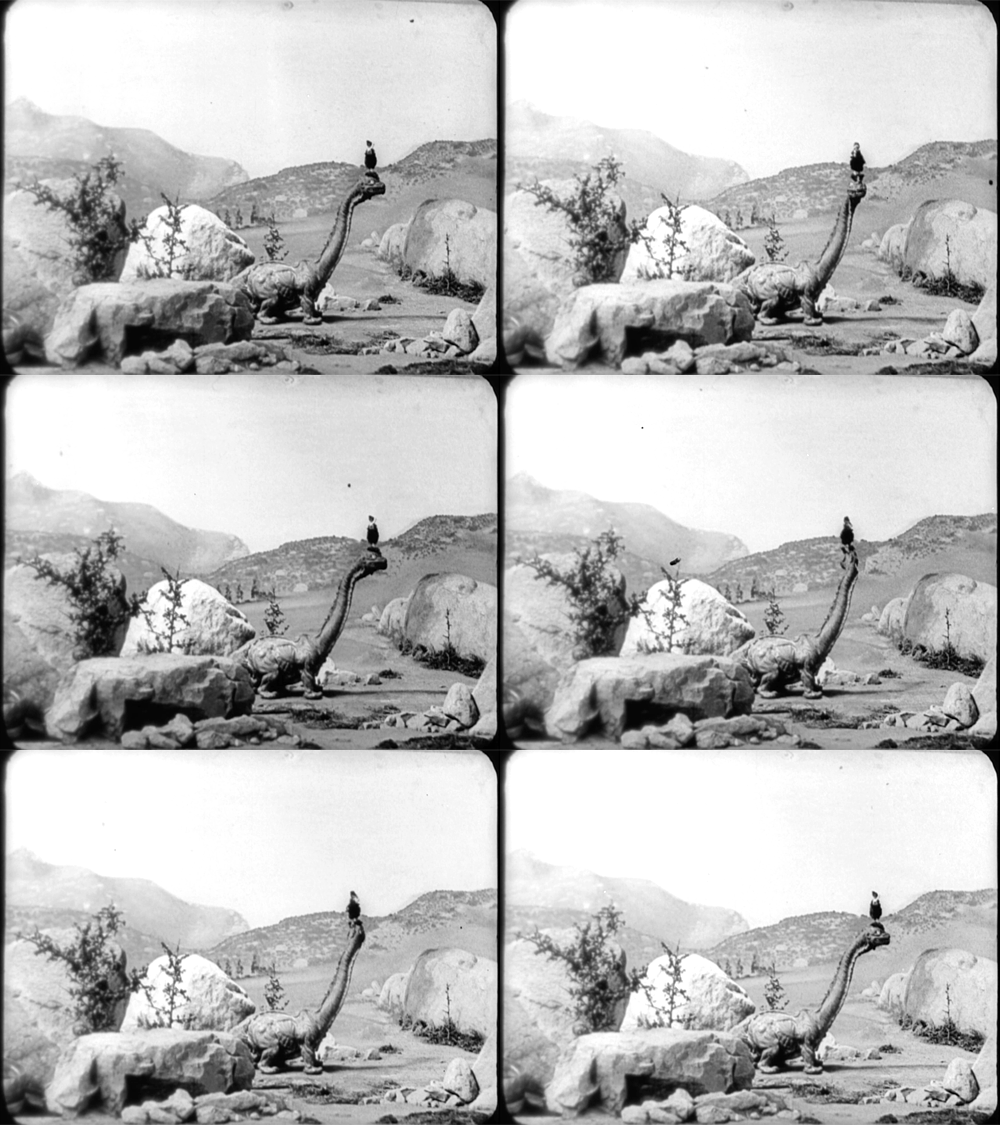
The Boy's (Buster Keaton) nifty use of a pre-Willis O’Brien stop-motion Brontosaurus' high vantage point. DPs: Elgin Lessley & William C. McGann.
#Bales2023FilmChallenge #WinsorMcCay #JohnAFitzsimmons #vaudeville #comedy #dinosaurs #animals #animation #ShortFilm #SilentFilm #USA #1910s
“In terms of sheer entertainment value, I think that it demonstrated that one eccentric genius alone in his garage can rival the best of the Hollywood studios”” Multiple SIDosis (Sid Laverents, 1970)
Mar
27
National Acoustic Soul Day

Clockwise: Sid playing a ukulele, Sid whistling, Sid playing improvised chimes (metal pipes and one cymbal hanging from an overhead microphone stand), Sid blowing a tune on champagne bottles, one metronome. DP: Sid Laverents.
There's a handful of notable amateur films in the National Film Registry. One of them is the Zapruder film, another Sid Laverents' Multiple SIDosis.
– Ross Lipman, UCLA Film & Television Archive restorationist
Sid Laverents was an airplane engineer and former one-man band vaudevillian who in his fifties joined the #SanDiego Amateur Moviemakers Club. One of his best-known outputs, Multiple SIDosis, took him and his 16 mm #Bolex four years and 1,900 feet of celluloid to make. In it, Sid – and a musical troupe made up of many overdubbed versions of himself – performs the popular and insanely catchy tune Nola.
Catch it here.
“I'm trying to teach you to run it – not wreck it!” Steamboat Bill, Jr. (Charles Reisner + Buster Keaton, 1928)
Mar
23
National Near Miss Day

A production photo showing the moment the façade crashing down towards Keaton. The photographer is standing to the right of Keaton at a very safe distance. The thickness of the wall is clearly, frightfully, visible. Even with the open window moving towards him, this blink-and-you-miss-it shot cannot guarantee a happy ending for Keaton or his movie persona William Canfield Jr. DPs: Bert Haines & Devereaux Jennings.
In Steamboat Bill, Jr., former vaudevillian Keaton narrowly escapes the façade of a house crashing down around him.
– William 'Steamboat Bill' Canfield
Both the man and the stunt lived on, probably most famously in Keaton aficionado #JackieChan's Project A Part II (HK, 1987).
Despite all the well-meant tributes, none of the later stunts are as nail biting as the pre-OSHA original.
“I have finally discovered my ancestors' traditional dance.”Sur un air de Charleston [Charleston Parade] (Jean Renoir, 1927)
Feb
14
Extraterrestrial Culture Day

Parisian savage Catherine Hessling and African explorer Johnny Hudgins exploring each other's alien ways. DP: Jean Bachelet.
Legendary African-American #vaudeville performer Johnny Hudgins – in historically correct Blackface – plays an African explorer who descends onto 2028 Paris to learn about the primitive ways of the white natives. Soon, he discovers the Charleston.
– Johnny Hudgins
A fantastic Afrofuturist short, made a decade before Sun Ra's trip to Saturn.
Le Pétomane du Moulin Rouge [The Fart Maniac] (1900)
Jan
7
National Pass Gas Day

Flatulist Joseph Pujol blowing out a candle with his derrière.
Witness the world famous pétomane shot on location at the Moulin Rouge (and amazingly not at Edison's Black Maria), as saved for prosperity by Edison Studios. The large trumpet-like contraption that can be seen on the left, the Edison Kinetophone, also present in The Dickson Experimental Sound Film (William Dickson, 1894/95), recorded the sound on a cylinder, that then could be played back in synch with the picture.
The original audio recording that accompanied this film is lost; do check your attic.