Sie fallen unerwartet in einem traumlosen Schlaf.Grauzone [Zones] (Fredi M. Murer, 1979)
May
29
Mount Everest Day
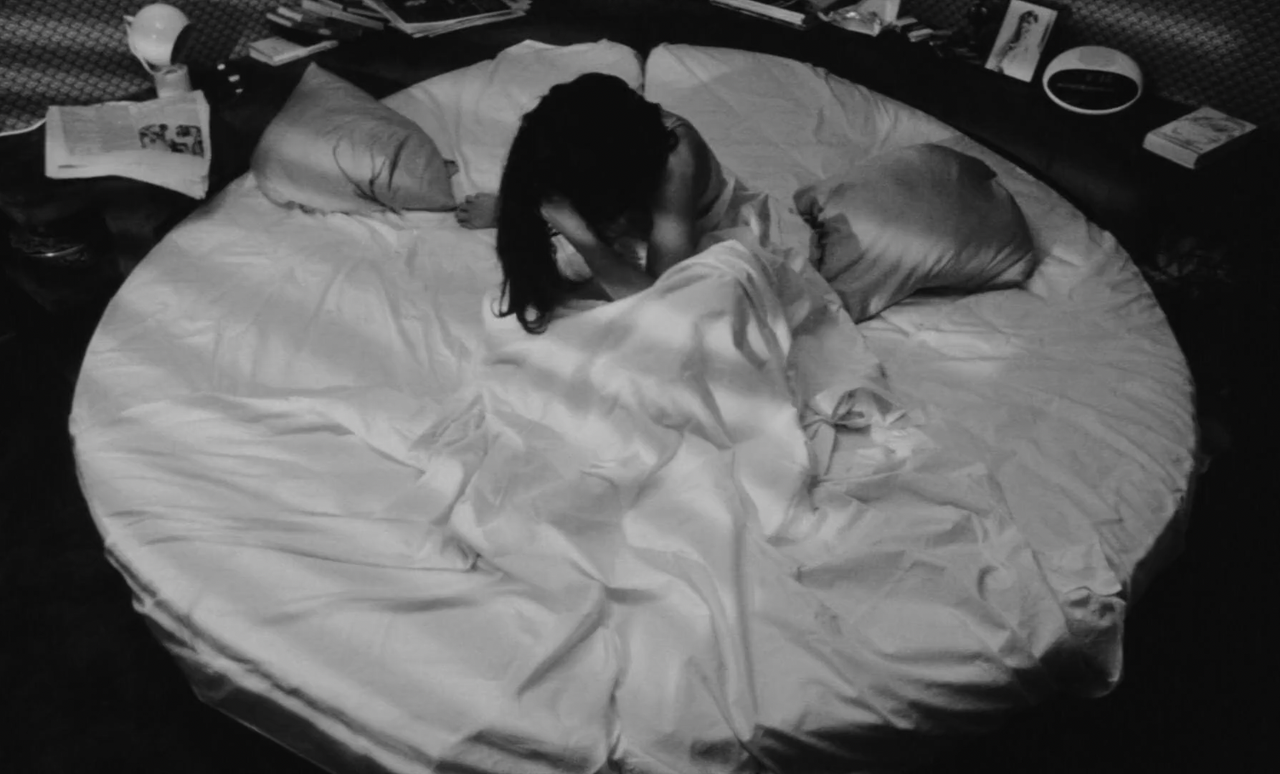
Julia (Olga Piazza) waking from a unusually deep sleep. DP: Hans Liechti.
Grauzone takes place in one of the three spaces documented in Murer's beautifully titled documentary Wir Bergler in den Bergen sind eigentlich nicht schuld, daß wir da sind [We, the mountain people, who live in the mountains are not really to blame for being there] (1974). One valley lives in tune with its natural rhythm, the second experiences a transition to modernity.
The third space, the “grey zone” – both this film's title and a descriptive term for an undefined neutral zone – is where the Bergler have become technology dwellers, where they live on summits made of concrete instead of rock. Where rumours about a #pandemic stir an ancient, unnamed fear. And symptoms: the sudden urge to wander out in nature, an acute melancholy, an overall hyper awareness. A young, prosperous couple become infected and pick up secret radio transmissions. What they believed was concrete, solid, immovable, suddenly shows signs of a shift.
আকালের সন্ধানে [Akaler Sandhane / In Search of Famine] (Mrinal Sen, 1982)
May
28
World Hunger Day

A woman in sari looks up to the sky, her left hand shielding her eyes. DP: K.K. Mahajan.
A film crew from Calcutta arrives in a small Bengal town to make a film about the 1943 Bengal Famine. Initially, their arrival sparks joy and wonder but while filming, the participants – travelling back and forth between 1943 and 1980, Calcutta and rural Bengal, and reality and re-enactment – come to realise that #famine has many faces.
“Here I was born, and there I died. It was only a moment for you; you took no notice.”Vertigo (Alfred Hitchcock, 1958)
May
27
Golden Gate Bridge

A pensive Novak in black in front of a sunlit Golden Gate Bridge. DP: Robert Burks.
A bridge to celebrate the 1937 Golden Gate Bridge opening.
“cut”Cuadecuc, vampir (Pere Portabella, 1971)
May
26
World Dracula Day

Lucy (Soledad Miranda) in bloody embrace with Dracula (Christopher Lee). DP: Manel Esteban.
A black forest. A man walks through, holding a smoke machine. Then a carriage with a familiar coachman. Dracula! Where are we? No, not 19th century #Transylvania. The film stock reveals bullet holes in ancient walls, and beyond these walls a ladder, maybe scaffolding. A pneumatic drill, more crew members, lights, a clapperboard. Are the characters aware of that? Them seem to interact with the disturbance yet oblige to the interruptions of the movie set. In a state of hypnopompia, guided by kuroko, maybe?
Pere Portabella created a hyper-reality with his Cuadecuc, vampir. A director dismantles the man-behind-the-curtain, Franco, the other #Franco while setting up scaffolding for the next Spain. Everything's a reality, or an illusion, then nothing is.
“Dragoljub
Son of our native land!
Teeth and muscles,
Tried and true
All our hearts go out to you!” “When they hammer your head,
The skull is hard,
And never cracks,
Mother's little babe of steel!
Dragoljub
Son of our native land!”Nevinost bez zaštite [Innocence Unprotected] (Dušan Makavejev, 1968)
May
25
Tap Dance Day

A woman tap dancing on top of the raised barrel of a very large cannon in a circus tent. This scene, lifted from Цирк [Tsirk / Circus] (DPs: Grigoriy Aleksandrov & Isidor Simkov; DPs Vladimir Nilsen & Boris Petrov, 1936) inspired Dragoljub Aleksić – a trained blacksmith – to build his own cannon to shoot people out off. DPs: Branko Perak & Stevan Mišković.
Nevinost bez zaštite is a treasure trove. Of fantastic people, feats, footage, and genres. We sit down to watch #Serbia's first feature talkie, also named Nevinost bez zaštite (1943), and are joined by the people who created it.
While they speak, and occasionally burst out into song, about living in Yugoslavia under Nazi, then communist control, we meet Dragoljub!, the movie's lead with the jaws of steel. A man of great works, humanitarian and other, demonstrates his iron will. And while so, we all, starstruck and in love, sing:
薄面佬 [Mee Pok Man] (Eric Khoo, 1995)
May
24
National Caterers Appreciation Day

Bunny (Michelle Goh) leaning on a small table littered with empty beer bottles. Mee Pok (Joe Ng) is to her left, holding a stack of dirty dishes. In the background, a large pile of noodle boxes leans against the restaurant wall. DP: Yoke Weng Ho.
At night, a small group of prostitutes frequent a local 面薄 / mee pok #restaurant. One of them, Bunny (Michelle Goh), caught the hawker's eye, but she's not interested in the “mee pok” (the “fish ball”, as they call the vendor) (Joe Ng) and besides she has a boyfriend. Then, a car crash. Bunny is left for dead in front of the eatery. He takes her in, preparing endless meals
“Sir John MacDonald, Jacobite captain of cavalry. Aged, frequently intoxicated, described as 'a man of the most limited capacities'.”Culloden (Peter Watkins, 1964)
May
23

Wigged man at a table, drinking wine with three men lower in rank standing behind them with their arms crossed. DP: Dick Bush.
– narrator
“Don't laugh at Gavino. Hands on your desks! Today is Gavino's turn. Tomorrow will be yours.”Padre padrone [My Father My Master / Father and Master] (Paolo + Vittorio Taviani, 1977)
May
23
freebie: National Sons Day
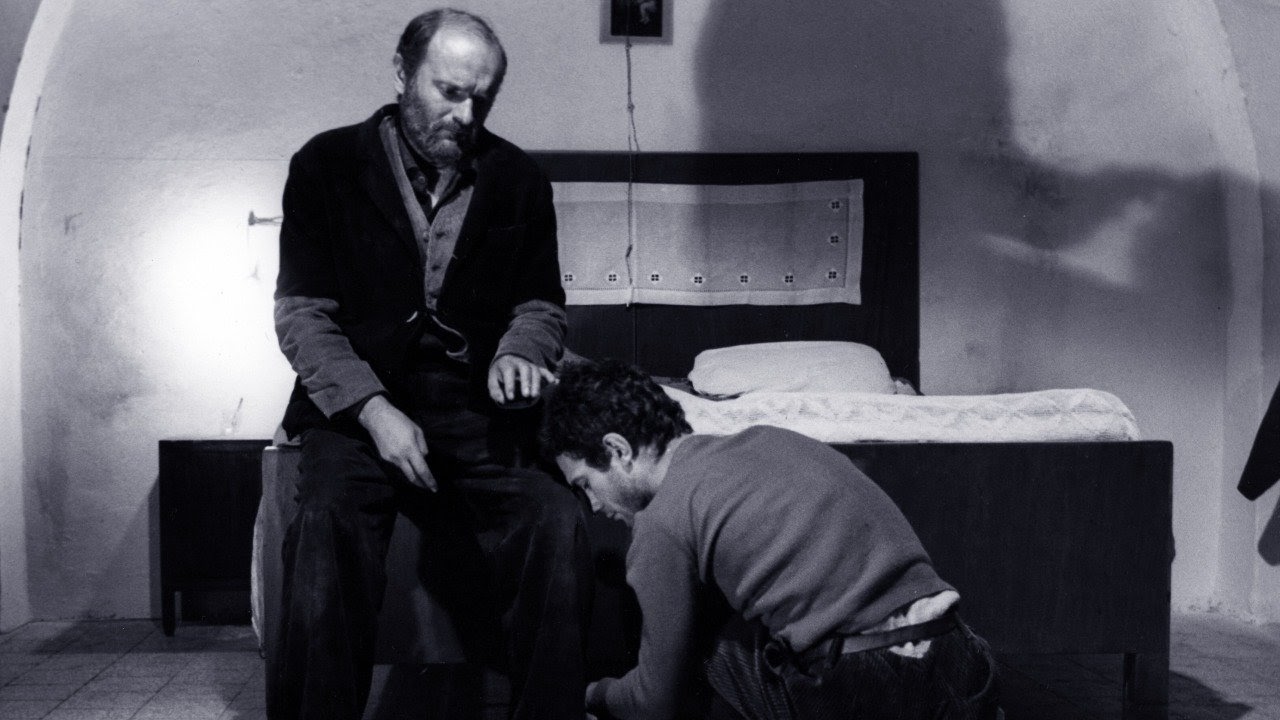
Father (Omero Antonutti) and son (Saverio Marconi). The son, an adult here, kneels and rests his head on his father's knee. The father, perched on the edge of a bed, looks down on the young man. DP: Mario Masini.
Not a film you can be prepared for, Padre padrone. The author, Gavino Ledda, hands a stick – that stick – to the actor who plays his part. There we are, in Sardinia, beautiful Sardinia. A boy in class, learning. His father barges in: the boy must attend the sheep, or else. From that moment on we become that boy Gavino. Life's cruel on the island, but his father, his master, is worse. But that's how it is, there's sheep to herd. When Gavino enlist in the army, he encounters a new world. The precise world of electronics, other people, other sounds, the Italian #language. When he returns home, he finds his father a small man.
– father
In a 1977 New York Times article the Taviani's are cited as seeing Gavino in the same light as #Truffaut's L'Enfant sauvage (1970) and #Herzog's Kaspar Hauser (Jeder für sich und Gott gegen alle) (1974). However, the Sardinian boy's outsiderness is not caused by estrangement, but an immense loneliness that cannot be put into words. This is why Ledda's newfound language is such an important tool. It's not a stick, or a fist, or a dead snake. It's the foundation of his Home.
– We're out of love potion. What now? – Take this one, for colic and bunions. What matters is how the bottle looks and how the potion tastes.Ansiktet [The Magician / The Face] (Ingmar Bergman, 1958)
May
22
love potion

Coach driver Simson (Lars Ekborg) serving maid Sara (Bibi Andersson) a potion from a flask. DP: Gunnar Fischer.
– Yes, I love the sea most of all. But I'm afraid of it, too. – I guess we're all a little afraid of what we love. Night Tide (Curtis Harrington, 1961)
May
22
National Maritime Day

Johnny Drake (Dennis Hopper) and Mora (Linda Lawson) in front of her joint that reads “MORA the MERMAID. ALIVE! LOVELY SIREN of the DEEP”. The sideshow's mural, and presumably the lettering too, were painted by Kenneth Anger associate Paul Mathison, both part of (Marjorie) Cameron's Magick Circle. DPs: Vilis Lapenieks & Floyd Crosby.
On the Santa Monica pier, sailor Johnny falls in love with one of the attractions of the local #sideshow, Mora the Mermaid. As people warn Johnny about the faith of Mora's previous suitors, captivated, he becomes convinced that she is a real siren, planning his downfall.
Night Tide is a vital key to understanding the odd connection between Hollywood and the workings of #Thelema. Several involved – Marjorie Cameron (as the “Water Witch”), #drag trapeze artist and once-Jean #Cocteau's lover Barbette – moved in Thelemic and related #occult, #esoteric circles. Painter Paul Mathison, Night Tide extra and crew member, created backdrops for the works of the great Lucifer himself, #KennethAnger.
This, lost dreamlike L.A. is gone; a treasure like Night Tide serves as a reminder of a more spellbinding Hollywood.