view
Ladybug Ladybug (Frank Perry, 1963)
May
21
the End Of The World
In a scene evoking Ingmar Bergman's Det sjunde inseglet [The Seventh Seal] (1957), one of the older girls leads the younger children in dance on top of a hill. Their teacher Mrs Andrews (Nancy Marchand) plus two of her students walk along. DP: Leonard Hirschfield.
It's another school day in rural America when the #NuclearAttack alarm starts ringing. A teacher, instructed to calmly walk the kids home, tries to keep the youngest ones oblivious of the impending doom.
“Ladybug, ladybug,
Fly away home”
children's song
While the children walk, talk and sing, this thing up there, in the sky and in the mind, grows bigger.
view
Valahol Európában / It Happened in Europe] (Géza von Radványi, 1947)
May
20
National Band Directors Day
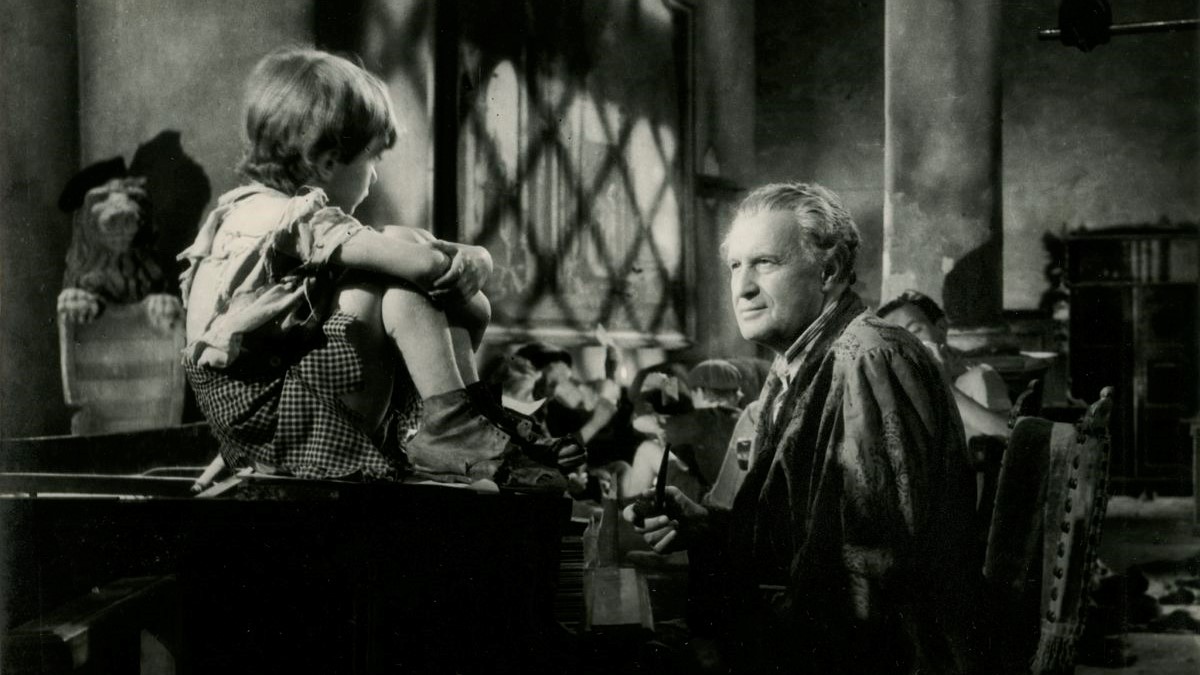
The old man (Artúr Somlay) at his grand piano. One of the children, in rags, sits on top of it. The children cast for the film were actual, aimless orphans, causing trouble on set. DP: Barnabás Hegyi.
In the children's film Valahol Európában, a gang of plundering feral orphans hiding out in a ruined castle find an old disillusioned pacifist conductor (Artúr Somlay) who's waiting out the war.
view
Dejlig er den himmel blå [Lovely Is the Blue Sky] (Jon Bang Carlsen, 1975)
May
19
Malcolm X Day
The Julemandshæren (“Santa Claus Army”) at Magasin, just after their arrest (image credit: Mother Jones, Dec. 1977). The performance was archived for prosperity in the documentary Dejlig er den himmel blå. DPs: Jimmy Andreasen, Morten Bruus, Dirk Brüel, Teit Jørgensen & Freddy Tornberg.
'Twas the week before Christmas. Not too far from Copenhagen a helicopter lands, carrying #SantaClaus and a Christmas angel. A small welcome orchestra plays carols, after which the party makes its way to the Danish capital. There, more Santas join the duo.
“Here Santa opens a factory with 1000 workers”
– banner next to a Julemandshæren-occupied factory
Over the course of several days they bring cheer, song and hot chocolate to delighted Copenhagen Christmas shoppers. Then they show up at a local bank, demanding low-interest loans. Then, in support of the laid-off workers, they unroll a large banner at the recently shutdown General Motors factory. On the final day, Santa Claus visits Magasin, the Danish version of Macy's. In the true spirit of Christmas the Julemandshæren hands out the store's books to thrilled customers. Magasin staff is not amused. Some of them start pummelling the Santas, ripping off beards to prove that these are crooks, not real #Santas. Small children are in tears, their dreams of a just world shattered.
view
Les statues meurent aussi [Statues also Die] (Ghislain Cloquet, Chris Marker + Alain Resnais, 1953)
May
18
International Museum Day
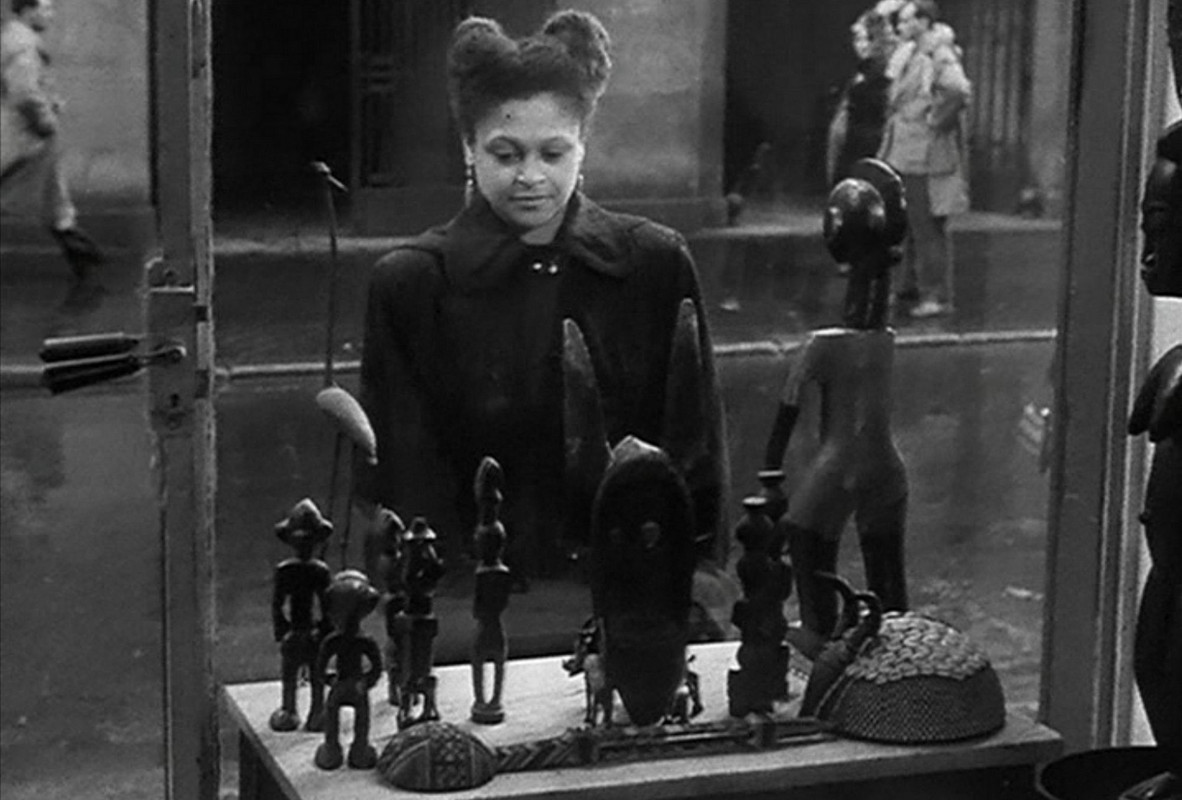
A Black African woman looks at objects of African origin – several statues, a mask, an object decorated with beadwork – in an antique store's window. Behind her white people pass by. It's raining. DP: Ghislain Cloquet.
Commissioned by the #PanAfrican literary magazine Présence Africaine to make a short film about African art, Chris Marker and his collaborator Alain Resnais – the latter still emboldened by his Van Gogh (1948) – were struck that unlike the Dutch painter's work, this #art was not on display in the Louvre or a similar cultural temple, but in the ethnological Musée de l'Homme.
“An object dies when the living glance trained upon it disappears. And when we disappear, our objects will be confined to the place where we send black things: to the museum.”
– narrator
These works of “Negro” art that embody such a deep cultural and artistic significance for the creators and the people they are part of, were, within the boundaries of Western civilisation, merely things. The editing (Alain Resnais), photography (Ghislain Cloquet) and dialogue (Chris Marker) bring life to these works. Through these voices they speak to the viewer, escaping the institutes' walls.
This voice was enough for the CNC to censor Les statues meurent aussi; only the first third of the film, the segment that's not blatantly #AntiColonial, was to be watched. And to this day, the documentary still has not seen a restored, digital release.
view
Idaho Transfer (Peter Fonda, 1973)
May
17
National Idaho Day
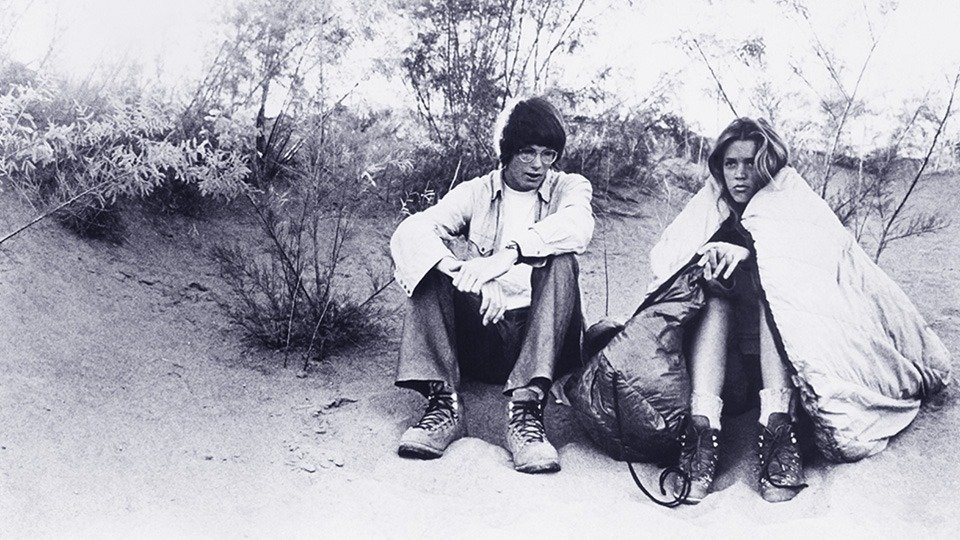
Teenagers Ronald (Kevin Hearst) and Karen (Kelly Bohanon) sitting next to each other in the desert. Karen, wearing untied shoes and a sleeping bag over her shoulders, looks distraught. DP: Bruce Logan.
A disaster has struck the future world. A private one, Karen's sister has had an accident. And a global one, one so severe that a Government project is put in place. The Project, located in the #Idaho desert and in different points in time, transfers teenagers 56 years forward so to repopulate the to-be-wiped-out land. Then, without warning or reason, The Project shuts down and the kids strand into a deserted future.
“Esto Perpetua”
– Idaho state motto
Idaho Transfer is, even for early 70s standards, an odd affair. It carries the weight of its time – hippie optimism had died thanks to #Manson, US meddling in Vietnam, the impending #EcoCrisis (we knew, we always did…) – but there too was this optimism for the upcoming millennium. Everything was going to be fine, in The Future. We'll be wiser, no more wars, no more famine, technology will save us. Released just 4 months before the first Oil Shock, Fonda somehow transferred a glimpse of our future.
view
Doc (Frank Perry, 1971)
May
16
A tense scene in a dark saloon, the table littered with empty bottles. DP: Gerald Hirschfeld.
“If it weren't for bad people, what would you do for a living, Marshal?”
– Doc Holliday
view
Trafic [Traffic] (Jacques Tati, 1971)
May
16
National Barbecue Day
A man prepares a steak on his nifty Renault 4 Altra grill (there's a pun), observed by M. Hulot and a perplexed Dutch customs officer. In the background a sign in Dutch that requests to refrain from smoking. DPs: Eduard van der Enden & Marcel Weiss.
Monsieur Hulot – who in his final appearance happens to be an automobile designer – travels to a car show in Amsterdam to demonstrate his latest creation, a camper van par excellence. The vehicle of course accommodates the latest gadgets, such as a collapsible grill.
“Where are you going, Mr. Hulot?”
However regarded as a lesser #Tati, Trafic, is another display of lovingly choreographed insanity, notably a #CarCrash that makes me wonder if this was Tati's attempt to transpose Godard's Week-end (1967) into a pleasant, pre-May 68 France.
view
May
15
National Nylon Stocking Day
Nan Prescott (Joan Blondell), semi-dressed, slipping on – then off – her suspender. DP: George Barnes.
Legs legs legs and then some! While Miss Bitc… err Rich (Claire Dodd) chats with Nan's boss Chester Kent (James Cagney), Nan (Joan #Blondell) absent-mindedly puts on two #stockings on one (lovely) leg, removes it, then slips it onto the other.
“Meow!”
view
Οι Τεμπέληδες της Εύφορης Κοιλάδας [Oi tembelides tis eforis koiladas / The Idlers of the Fertile Valley] (Nikos Panayotopoulos, 1978)
May
15
The maid (Olga Karlatos) patiently feeding the father (Vasilis Diamantopoulos) in bed. DP: Andreas Bellis.
view
West of Zanzibar (Tod Browning, 1928)
May
14
Spinalcord Injury Awareness Day
Lon Chaney as the tormented Phroso dragging himself along the ground. DP: Percy Hilburn.
A brawl over a woman. That's what breaks The Great Phroso. After recovery, a year later, he finds himself a #paraplegic and his stolen wife dead in a church with an infant next to her. To Africa he takes the child – it's the other man's, the ivory trader's – and carefully, vengefully raises her.
“How did God ever put a thing like you on this earth?”
– Maizie
Phroso, now known as Dead-Legs and White Voodoo to the tribe he resides over, uses his magician's skills to rule over his own little jungle empire. We see the gestation of Kurtz, oddly too an ivory trader in that other White Hell, Heart of Darkness (Joseph Conrad, 1899).
Despite attempts to tone it down on request of censors, West of Zanzibar is one of Tod Browning's meanest. Lon Chaney is fantastic, of course. His Phroso, torn by love and #revenge, one of the early and rare depictions of male frailty in western cinema.