view
Les trois couronnes du matelot [Three Crowns of the Sailor] (Raúl Ruiz, 1983)
Jun
5
view
Les trois couronnes du matelot [Three Crowns of the Sailor] (Raúl Ruiz, 1983)
Jun
4
National Week Of The Ocean
The sailor (Jean-Bernard Guillard) on his ship. DP: Sacha Vierny.
A man murders another and meets a drunk sailor. The drunk then tells the murderer about his life on the sea. Les trois couronnes du matelot is of course never a straightforward crime film. It's Raúl Ruiz, it never is.
“I got nothing out of this crime except the ring he offered me many times; several hundred marks; a collection of old coins, of no value; and a long letter where he advised me to leave the country.”
– the student
The sailor drinks, celebrates and mourns the women and men of his past, we all get drunk on life while the dark water closes itself again above our heads.
view
Lemora: A Child's Tale of the Supernatural (Richard Blackburn, 1973)
Jun
4
meat
A fancy looking silver plate with what appears to be raw meat. DP: Robert Caramico.
“Wouldn't you rather I did it out of love, than have one of those wood things do it out of their own animal hungers?”
– Lemora
view
Who Killed Teddy Bear (Joseph Cates, 1965)
Jun
3
A square 1960s man – Jan Murray as Lt. Dave Madden – smugly pouring himself a stiff drink. DP: Joseph C. Brun.
“I don't find you the least bit amusing, Lieutenant Whatever-your-problem- is!”
– Norah Dain
view
El ángel exterminador [The Exterminating Angel] (Luis Buñuel, 1962)
Jun
3
National Black Bear Day
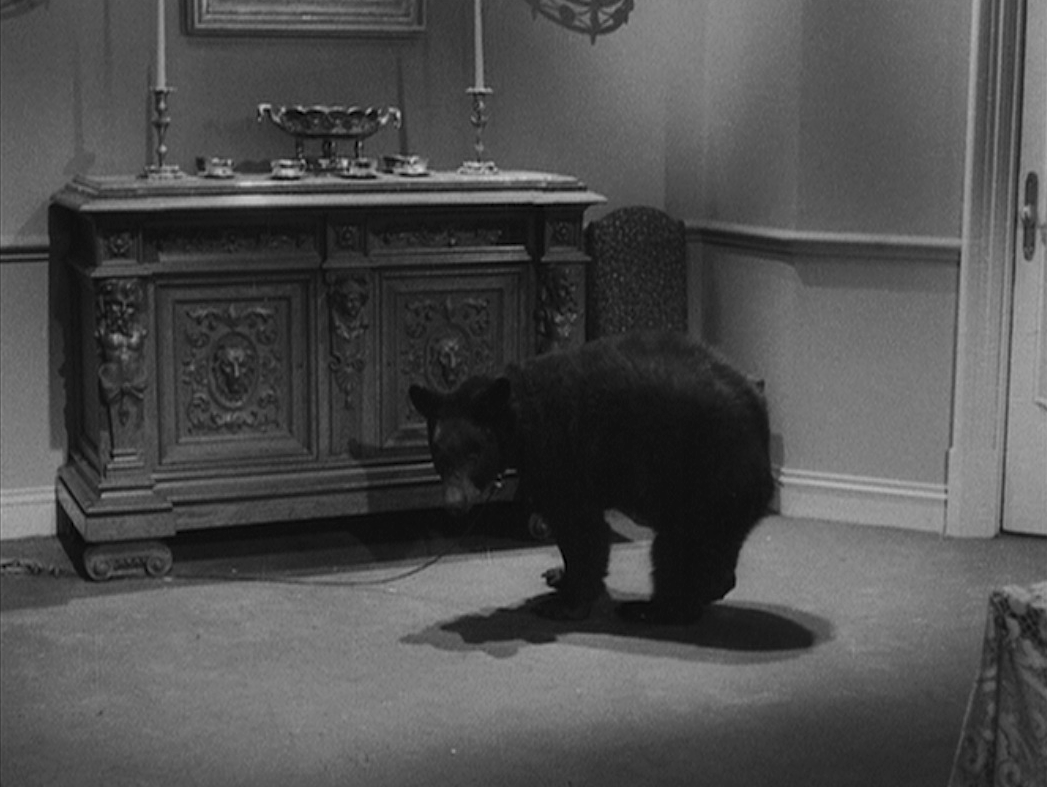
A young brown bear in a luxuriously furnished room. DP: Gabriel Figueroa.
As part of a witty surprise, Lucía Nóbile (Lucy Gallardo) arranged a #bear and three #sheep for the lavish dinner party she's thrown for her fellow #opera-loving guests. However, the joke is not appreciated and in the cause of the evening – and a ruined dinner when the staff decides to go even before serving any of the #food – the company find that they cannot leave the salon.
“I love the spontaneity of this situation. If you'd like to spend the night, we'll make up as many rooms as needed. I'm pleased to see the old spirit of improvisation is alive and well.”
– Edmundo Nobile
While the beasts roam the house, the elite are faced with hunger, primal urges, and no motivation to leave.
view
The Last Man on Earth (Ubaldo Ragona + Sidney Salkow, 1964)
Jun
2
Republic Day – Italy
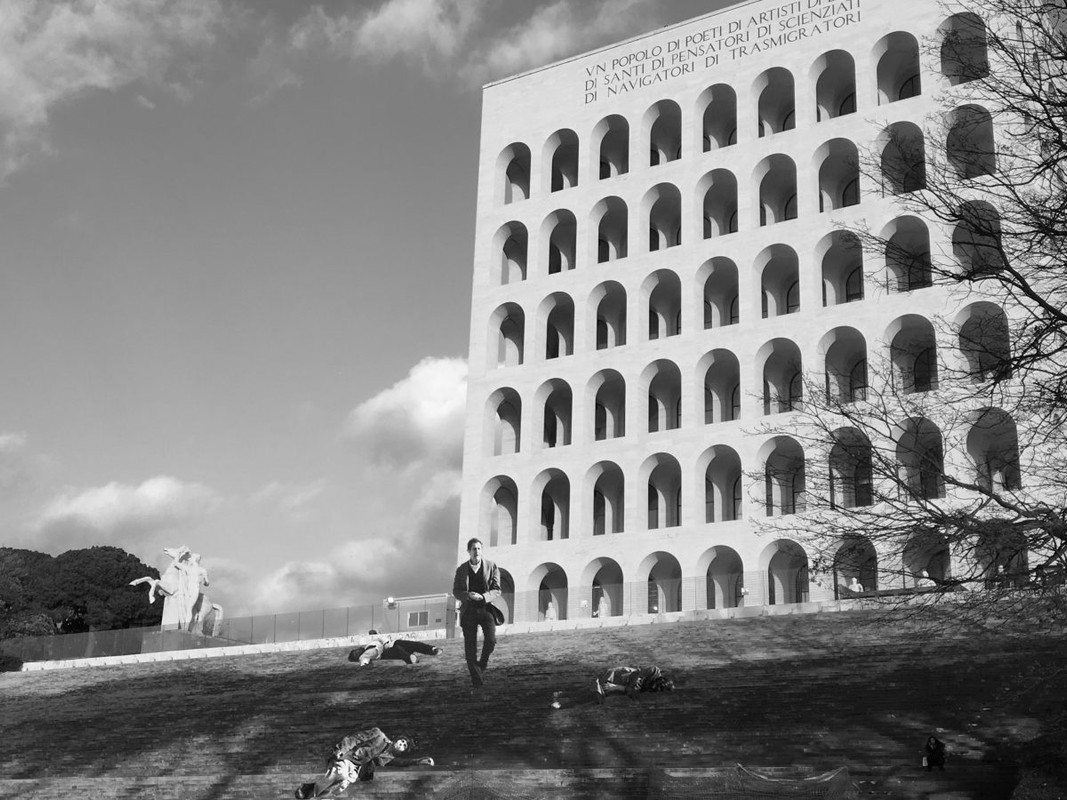
Dr. Robert Morgan (Vincent Price) walking down the stairs of the Palazzo della Civiltà Italiana (aka the Palazzo della Civiltà del Lavoro aka the Colosseo Quadrato), with bodies scattered around him. DP: Franco Delli Colli.
Rome's EUR was Italy's site for the 1942 World's Fair, and meant as a showcase for #Mussolini's then-20 year old fascist state. Due to the outbreak of World War 2, EUR was never used for the Fair. Instead, the Italian Republic restored the project after the war and – quite appropriately if I may say so – turned it into a business district.
“Your new society sounds charming.”
– Dr. Robert Morgan
An idealised, hypermodern interpretation of Classical Roman architecture, EUR feels alien and inhumane and serves as a perfect backdrop for the events a last man on earth may come up against.
viewGertie the Dinosaur (1914)
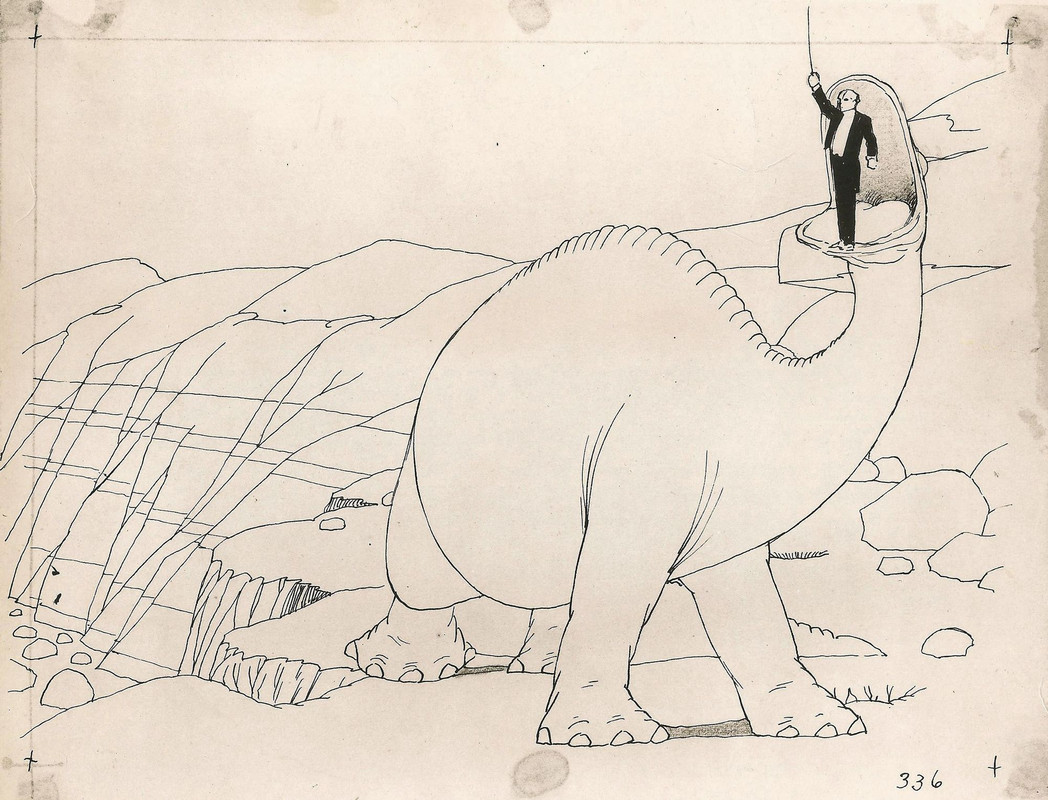
Gertie raises her creator Winsor McCay in her mouth. McCay holds a dressage whip but in his tuxedo resembles a musical conductor more than a lion tamer. DPs: John A. Fitzsimmons & Winsor McCay.
Gertie the Dinosaur (Winsor McCay, 1914)
I made ten thousand cartoons —each one a little bit different from the one preceding it.
Long before we all flocked to the movies, there was vaudeville. Vaudeville comes in many flavours, from raucous song and dance, acrobatics (see #BusterKeaton's start) to chalk talk: a live performance in which an artist would chat and draw on a blackboard in real time. The format is perfect to enlighten and entertain an audience, about the dangers of alcohol, the importance of religion, the demand for women's suffrage.
But where there's a scholar, there's a showman. As a chalk talk consists of a succession of quickly drawn illustrations, one flowing into the next while the performer raps over it, the leap to animation is a logical one. In 1914, a brontosaurus named Gertie and a comic strip creator called Winsor McCay travelled the land – both animated and real.
McCay, known for his fantastic comic strips Little Nemo in Slumberland and its predecessor Dream of the Rarebit Fiend, introduced the great animated animal to the audience with little tidbits of knowledge about the mighty brontosaurus, throw her an apple, demonstrate her gentleness by stepping into the screen (a parlour trick made the transition from real to animated look incredibly convincing) and let Gertie carry him around in her prehistoric world. In front of the delighted audience, the showman then would reappear into our realm.
The movies were young and promising, and Gertie's leap to celluloid was made the very same year. Gertie the Dinosaur (1914), an adaptation of the vaudeville act and the first animated dinosaur movie, moves the stage to a dinner party at the animator's studio, where McCay shows off his animation skills as part of a bet.
Gertie, with its combination of animated and real content, had a huge influence on film makers to come. You can see it in Max Fleischer's wonderful Out of the Inkwell cartoons (1918 – 1929) and Ubi Iwerk's Alice Comedies (1923 – 1927, the only original work that ever came out of the Disney studios). And Buster Keaton? In honour of Gertie he rode a claymation brontosaurus in his Three Ages (1923).
The Boy's (Buster Keaton) nifty use of a pre-Willis O’Brien stop-motion Brontosaurus' high vantage point. DPs: Elgin Lessley & William C. McGann.
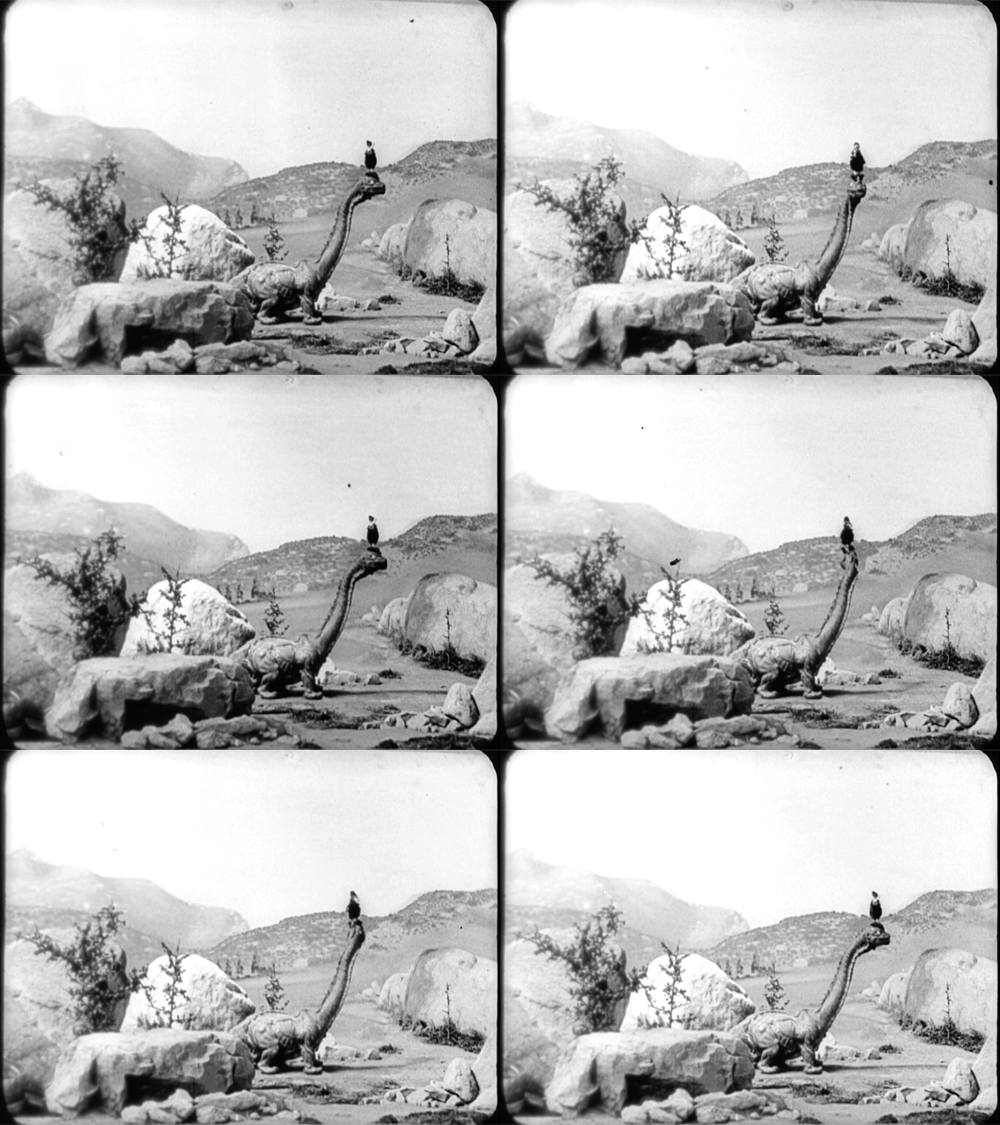
#Bales2023FilmChallenge #WinsorMcCay #JohnAFitzsimmons #vaudeville #comedy #dinosaurs #animals #animation #ShortFilm #SilentFilm #USA #1910s
#todo
view
Sure Fire (Jon Jost, 1990)
May
31
National Utah Day
Wes has it all laid out. His business partner just needs to see it. And his wife. And the people from the West Coast, California, where there's smog and people and no space. They surely want a home, or a second home, in Utah. It's close to Vegas, sure they'll love it. The people.
“One cannot even be sure, whether it is a sect, a mystery cult, a new religion, a church, a people, a nation, or an American subculture; indeed, at different times and places it is all of these.”
– Sydney E. Ahlstrom, historian (1982)
With Sure Fire, director Jon Jost accomplishes that what Lynch tries. A mundane gem with an ominous undertow, but all without the need for mystery or eccentric characters.
Just Utah, and its people.
view
Sinong lumikha ng yoyo? Sinong lumikha ng moon buggy? [Who Invented the Yoyo? Who Invented the Moon Buggy?] (Kidlat Tahimik, 1979)
May
30
National Creativity Day
Kidlat Tahimik test driving his moon buggy, closely followed by faithful crew member Gottlieb (Kidlat Gottlieb Kalayaan). DP: Kidlat Tahimik.
“If you don't eat too many Gummy Bears you could be my co-pilot.”
– Kidlat Tahimik, speaking to a budding crew member
Sinong lumikha ng yoyo? is a remarkable display of imaginative filmmaking. Together with Kidlat we ponder about practicalities, suddenly see connections that were obscured by too much thinking, and realise all the new possibilities we have in life. Part documentary, part animation, part fantasy, part sci-fi, Kidlat transports us to yet unexplored spaces!
view
আকালের সন্ধানে [Akaler Sandhane / In Search of Famine] (Mrinal Sen, 1981)
May
29
चाय
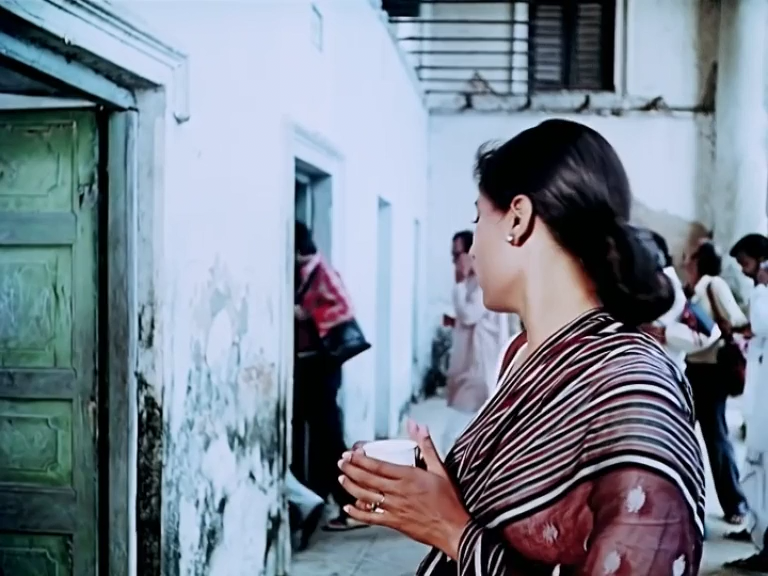
The Bollywood stars arrive at the temple. In the foreground one of the actresses, cupping a beaker with her hands. DP: K.K. Mahajan.