“Officer, come here. I wanna spit in your fucking eye!”Ghosts… of the Civil Dead (John Hillcoat, 1988)
Apr
26
Hug An Australian Day

One of the inmates near a small window. The light's cold. DPs: Paul Goldman & Graeme Wood.
John Hillcoat's deeply unpleasant debut is based on In the Belly of the Beast (1981), a collection of excerpts of letters between prisoner Jack Henry Abbott and author Norman Mailer. True to the book's format, Ghosts consists of disjointed vignettes of monologues, #CCTV footage, title cards, and prisoners' phone calls.
For the last 37 months, these filters inform the observer, the hypermodern #supermax Central Industrial Prison has been in permanent lockdown. The cast, a mix of professional actors and ex-cons, and the location, a clean factory-style hangar in the middle of the Australian desert, underscore the underlying raw brutality of the unfolding events.
– Maynard
The #industrial soundtrack is by Bad Seed Nick Cave (co-writer and starring as Maynard), Mick Harvey, and Blixa Bargeld from when they were still closer to being birthday boys than morose crooners.
SciFi
La folie du Docteur Tube [The Madness of Dr. Tube] (Abel Gance, 1915)
Apr
23
World Laboratory Day

The professor's assistant is a young Black kid, maybe 10 years old. He's wearing a white lab apron over his dark outfit and glances at something off camera (I assume he's waiting for his cue from the director; this is the scene where the hallucinogenic powder is about to reach him and he has to act the part). In the background is Dr. Tube, cracking up under the influence of his own invention. DP: Léonce-Henri Burel.
Dr. Tube (Séverin-Mars) invents a powder that distorts reality and promptly tests it out on some oblivious test subjects, who quickly can no longer recognise the world around them. The brilliance of La folie du Docteur Tube is its use of practical in-camera effects that makes us, the viewer, experience the hallucinogen.
This little folly by the great Abel Gance features Albert Dieudonné in a small part, who later would again work with Gance in his Napoleon (1927), as Napoléon Bonaparte.
This is one of the few (French) comedies from the time that I'm aware of with a Black character who is not a horrible racist stereotype or a white person in blackface. If you have any idea of who the professor's assistant is, please reach out on Mastodon.
Vynález zkázy (1958)

April 11: ride a #submarine on #NationalSubmarineDav
Vynález zkázy [A Deadly Invention] (Karel Zeman, 1958)
“Jules Verne was a dreamer. He was a dedicated follower of technology, but he saw it through his own eyes, and the eyes of his time. But with his vast imagination, he created a whole world of magical things imbued with a delightful naiveté, which charms us even today.” —Karel Zeman
Karel Zeman was a Czech film maker who seemingly magically combined live action with stop motion animation. In his Vynález zkázy, loosely based on Jules Verne's Face au Drapeau [Facing the Flag aka For the Flag] (1896), a fiendish count kidnaps a professor to get his hands on a terrible super-weapon. Underwater pursuits commence!
Based on the engravings that accompany the Verne story, Zeman came up with fantastic, highly stylised in-camera effects that make the sets, actors and props resemble cross-hatched etchings.
That's more than enough words for such a spectacle. Watch the trailer
#Bales2023FilmChallenge #KarelZeman #JulesVerne #LuborTokos #StopMotion #animation #fantasy #adventure #SciFi #BookAdaptation #trailer #Czechoslovakia #1950s ★★★½

Hu-Man [Pleurs] (Jérôme Laperrousaz, 1975)
Apr
7
Public Television Day
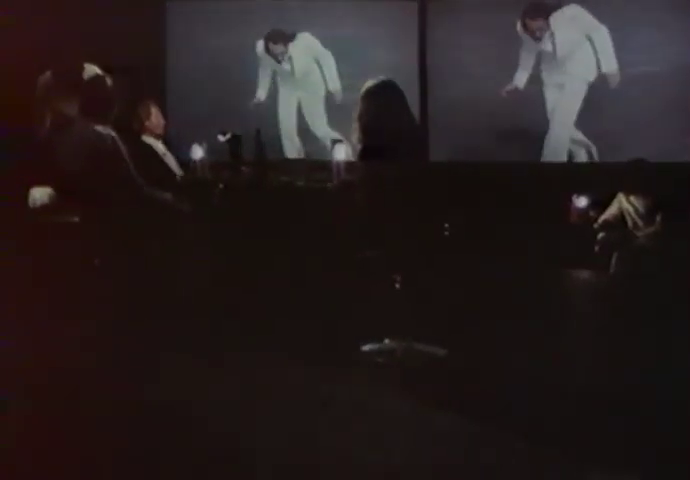
Terence (Terence Stamp) projected on multiple large screens with television executives watching. DP: Jimmy Glasberg.
The global audience of #Mondo-Vision, a live broadcast #TimeTravel experiment, determines through their emotional investment in the lead's screened experience what the man's destination will be. Even so, the spectators' collective energy should serve as a powerhouse, enabling a televised leap into the future. The man whose faith determines it all is Terence Stamp – played by the actor with the same name. He agrees to partake in the hope that enough emotional energy can be harvested for him to travel back in time so he can reunite with his lost love.
While definitely taking a cue or two from Alain Resnais' Je t'aime, je t'aime (1968), Hu-Man has a much grimmer feel to it. The seventies were not a time of or even for optimism, including Stamp's career and personal life. Noun Serra's dizzying editing and the real-world danger both the in-movie actor and real-world actor are exposed to makes Hu-Man a much more self-referential and personal experience for this future's reality-fatigued viewer.
Paris qui dort [Paris Asleep / The Invisible Ray / At 3:25] (René Clair, 1925)
Mar
30
freebie: Eiffel Tower Day

Two bright young things in their fashionable suits cease their scuffle mid fight, high up on the Eiffel Tower. DPs: Maurice Desfassiaux & Alfred Guichard.
Science fiction may be one of those genres that's forever linked to the future and, depending on which side of 2000 you are at, either in a dystopian of utopian fashion.
An #Eiffel Tower watchman wakes up to find the world around him asleep. The few ones still awake – the bright, pretty, carefree things – explore, live and loot.
“I'm strange, all right! I'll show you just how strange I am!” The Damned [These Are the Damned] (Joseph Losey, 1962)
Mar
19
National Automatic Door Day

An 11-year old boy, Henry (Kit Williams), opens a featureless door in a rock surface for a drenched King (Oliver Reed). DP: Arthur Grant.
An American tourist visiting Dorset is tricked by a prostitute, then falls victim to a youth gang controlled by volatile con King – a still very green Oliver Reed at his meanest. The trickster is King's sister, who confides in the American hoping to escape her brother's incestuous advances.
– King
The couple elopes to a nearby island, closely followed by King and his gang, where they find a group of #children, all contently living in an underground lab, with #AutomaticDoors only they can control.
They are the damned.
“A strange calm possessed me. I thought more clearly than I had ever thought before – as if my mind were bathed in a brilliant light.”The Incredible Shrinking Man (Jack Arnold, 1957)
Mar
5
National Scott Day

Scott Carey (Grant Williams) standing in a palm of someone's hand, his arms outstretched as if pleading. DP: Ellis W. Carter.
Despite its sensationalist pulpy title and #ColdWar premise, Jack Arnold's adaptation of the Richard Matheson's The Shrinking Man (1956) is an existentialist treatise.
– Scott Carey
The Incredible Shrinking Man plays with the understanding of what it means to be acknowledged as a human, and one's place in the world. The story is told through the eyes of the titular Shrinking Man – Scott Carey – who after being exposed to strange fog, finds himself increasingly lost in this world.
“I have finally discovered my ancestors' traditional dance.”Sur un air de Charleston [Charleston Parade] (Jean Renoir, 1927)
Feb
14
Extraterrestrial Culture Day

Parisian savage Catherine Hessling and African explorer Johnny Hudgins exploring each other's alien ways. DP: Jean Bachelet.
Legendary African-American #vaudeville performer Johnny Hudgins – in historically correct Blackface – plays an African explorer who descends onto 2028 Paris to learn about the primitive ways of the white natives. Soon, he discovers the Charleston.
– Johnny Hudgins
A fantastic Afrofuturist short, made a decade before Sun Ra's trip to Saturn.