𝛼-60: “Do you know what illuminates the night?” Lemmy Caution: “Poetry.”Alphaville: Une étrange aventure de Lemmy Caution (Jean-Luc Godard, 1965)
Jul
16
AI Appreciation Day

Natacha von Braun (Anna Karina) and Lemmy Caution (Eddie Constantine). Lights reflected in the windowpane that shields the two characters suggest “the existence of an obscure reality” (after Baudrillard). DP: Raoul Coutard..
Science fiction, of course, doesn't have to be driven by grandes effects, by superstar names and monumental backdrops. It can be cool, dry, colourless even. The hero, in trenchcoat and fedora, traverses a lightless city. There are few others at this time of night. The familiar landmarks of the City of Light become the voice of 𝛼-60, an artificial intelligence that presides over Alphaville.
– 𝛼-60 playing the imitation game with Lemmy Caution
Based on a poem by Paul Éluard, #Godard's Alphaville bears similarities with Jean #Cocteau's Orphée (1950), transported to a mirror world of sorts. It also foreshadows not only our time, but also M. Hulot's, whose #Tativille could be the simulacra of 𝛼-60's simulated, dehumanised world.
SciFi
Decoder (Muscha, 1984)
Jul
7
Milky Ways

Christiana (Christiane F) and F.M. (FM Einheit) at their Sperrmüll table in a neon green-lit kitchen with supermarket shelving. The former junkie prepares a Schrippe with fresh produce while the musician has a selection of wrapped chocolate bars in front of him. DP: Johanna Heer.
“Today over lunch I tried to improve morale and build a sense of camaraderie among the men by holding a humorous, round-robin discussion of the early days of the mission. My overtures were brutally rejected. These men do not want a happy ship. They are deeply sick and try to compensate by making me feel miserable.”Dark Star (John Carpenter, 1974)
Jun
23
space lunch

The men enjoying a joyless lunch, consisting of something semi-liquid in a squeeze packet. DP: Douglas Knapp.
– Sgt. Pinback's video diary
“You know, I wish I had my board with me… even if I could just wax it once in a while.” Dark Star (John Carpenter, 1974)
Jun
17
International Surfing Day
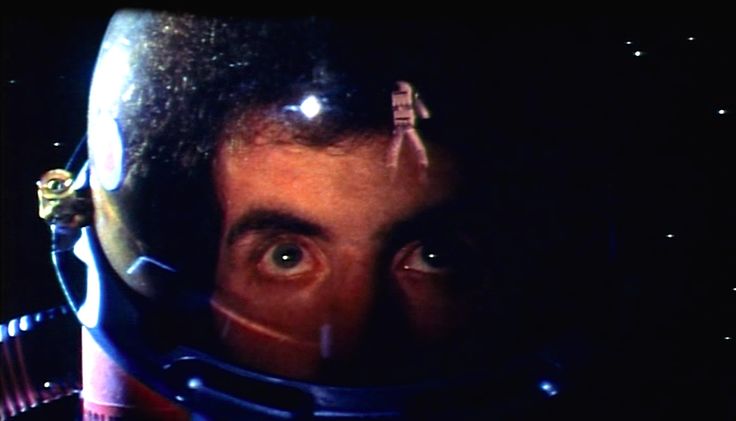
Lt. Doolittle (Brian Narelle) dreaming of catching that wave. DP: Douglas Knapp.
On the other end of outer space, far far away from existentialist odysseys and crypto-fascist space operas, there's a little stoner cosmos where a small, dilapidated starship manned by long-haired freaks drifts about.
– Lt. Doolittle
Dark Star started out as a highly ambitious, underfunded student film that, in a blessed pre-Lucas, pre-blockbuster universe, got recognised for its #counterculture glory. In the early 70s, when #surfing was not yet mainstream and a handful of restless pioneers continued west despite the lack of mainland, a cross-pollination between beach blond daredevils and stoner culture happened.
Carpenter's laidback space odyssey fully embraces the beach bum spirit; it's meandering, incoherent, and whatever the superlative of no-budget may be. With at its core: #boredom, the most honest form of cinema.
错位 [Cuo wei / Dislocation] (Huang Jianxin, 1986)
Jun
17
啤酒

The engineer (Zifeng Liu) drinking many many beers with his secretary (Hong Mu). DP: Xinsheng Wang.
“If you don't eat too many Gummy Bears you could be my co-pilot.”Sinong lumikha ng yoyo? Sinong lumikha ng moon buggy? [Who Invented the Yoyo? Who Invented the Moon Buggy?] (Kidlat Tahimik, 1979)
May
30
National Creativity Day

Kidlat Tahimik test driving his moon buggy, closely followed by faithful crew member Gottlieb (Kidlat Gottlieb Kalayaan). DP: Kidlat Tahimik.
Kidlat, while on Earth, wonders if on the Moon a yoyo behaves any differently. Thanks to his brilliant crew of Bavarian toddlers, his parents' collective aspirations, and generous donations from the First World in the form of assorted junk, he launches the first Filipino space program to find out.
– Kidlat Tahimik, speaking to a budding crew member
Sinong lumikha ng yoyo? is a remarkable display of imaginative filmmaking. Together with Kidlat we ponder about practicalities, suddenly see connections that were obscured by too much thinking, and realise all the new possibilities we have in life. Part documentary, part animation, part fantasy, part sci-fi, Kidlat transports us to yet unexplored spaces!
Sie fallen unerwartet in einem traumlosen Schlaf.Grauzone [Zones] (Fredi M. Murer, 1979)
May
29
Mount Everest Day

Julia (Olga Piazza) waking from a unusually deep sleep. DP: Hans Liechti.
Grauzone takes place in one of the three spaces documented in Murer's beautifully titled documentary Wir Bergler in den Bergen sind eigentlich nicht schuld, daß wir da sind [We, the mountain people, who live in the mountains are not really to blame for being there] (1974). One valley lives in tune with its natural rhythm, the second experiences a transition to modernity.
The third space, the “grey zone” – both this film's title and a descriptive term for an undefined neutral zone – is where the Bergler have become technology dwellers, where they live on summits made of concrete instead of rock. Where rumours about a #pandemic stir an ancient, unnamed fear. And symptoms: the sudden urge to wander out in nature, an acute melancholy, an overall hyper awareness. A young, prosperous couple become infected and pick up secret radio transmissions. What they believed was concrete, solid, immovable, suddenly shows signs of a shift.
“Esto Perpetua”Idaho Transfer (Peter Fonda, 1973)
May
17
National Idaho Day
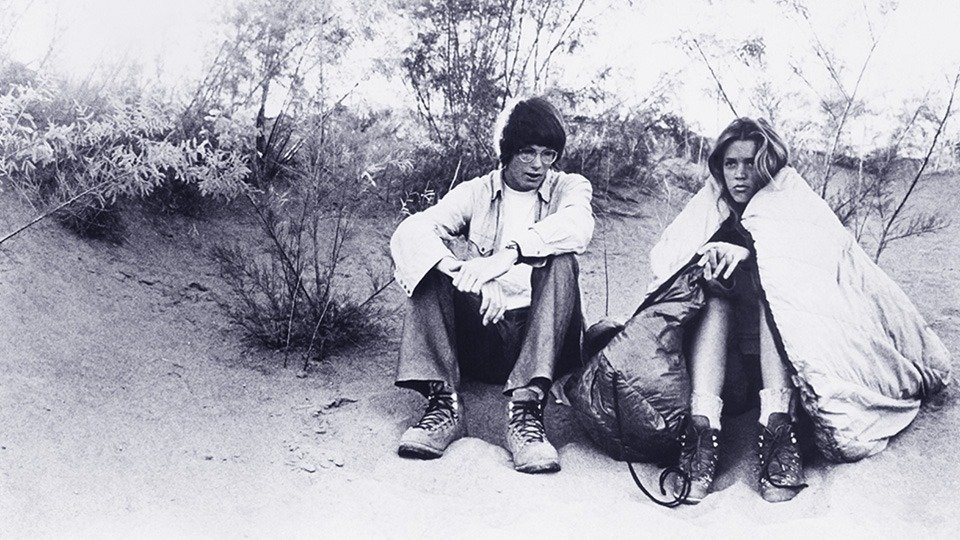
Teenagers Ronald (Kevin Hearst) and Karen (Kelly Bohanon) sitting next to each other in the desert. Karen, wearing untied shoes and a sleeping bag over her shoulders, looks distraught. DP: Bruce Logan.
Filmed in Idaho for National Idaho Day (USA)
A disaster has struck the future world. A private one, Karen's sister has had an accident. And a global one, one so severe that a Government project is put in place. The Project, located in the #Idaho desert and in different points in time, transfers teenagers 56 years forward so to repopulate the to-be-wiped-out land. Then, without warning or reason, The Project shuts down and the kids strand into a deserted future.
– Idaho state motto
Idaho Transfer is, even for early 70s standards, an odd affair. It carries the weight of its time – hippie optimism had died thanks to #Manson, US meddling in Vietnam, the impending #EcoCrisis (we knew, we always did…) – but there too was this optimism for the upcoming millennium. Everything was going to be fine, in The Future. We'll be wiser, no more wars, no more famine, technology will save us. Released just 4 months before the first Oil Shock, Fonda somehow transferred a glimpse of our future.
“We are now entering the century of the soul!”Manden der tænkte ting [The Man Who Thought Life] (Jens Ravn, 1969)
May
12
National Hospital Day

A man in black (Preben Neergaard) seen from the back looks into an operating room. DP: Witold Leszczyński.
A strange man arrives at neurosurgeon Dr Max Holst's #hospital one day. So strange in fact that he's promptly send to the psychiatric ward. This man, a Mr Steinmetz, insists on the doctor's help. He can materialise things – look see here's a cigar – but living things is what he wants. This bird, it died. Can the doctor help? No no, not the bird, the brain! Steinmetz has set up a theatre in his home, it can be done there. While the doctor, however tempted, refuses, Steinmetz evolves.
– Steinmetz
Manden der tænkte ting intrigues in its clinical monotonous settings, its pale late-60s stock, and precise composition. Early Cronenberg – Stereo (Tile 3B of a CAEE Educational Mosaic) (1969) and Crimes of the Future (1970) – comes to mind and, of course Lars von Trier's majestic Riget [The Kingdom] (1994 – 2022). But only Jens Ravn mastered this strangling lightness. Slowly, while you count backwards. Now you no longer feel the straps. 10… 9… …
Аэлита [Aelita / Aelita: Queen of Mars] (Yakov Protazanov, 1924)
Apr
29
International Astronomy Day

Queen Aelita (Yuliya Solntseva) peering through her telescope. DPs: Emil Schünemann & Yuri Zhelyabuzhsky.
Like in Enrico Novelli's Un matrimonio interplanetario [A Marriage in the Moon] (1910), interplanetary romance blooms in Аэлита.
Through her #telescope, Queen Aelita spots engineer Los, a handsome Earth man, and he promptly travels to #Mars to be with her. There, Los uncovers an uprising by the Elders against his beloved queen that he vows to – in good proletarian fashion – stomp down.
Aelita*'s constructivist stage and costume design had an enormous influence on science fiction, as far as the late 20th century.