view
Sinong lumikha ng yoyo? Sinong lumikha ng moon buggy? [Who Invented the Yoyo? Who Invented the Moon Buggy?] (Kidlat Tahimik, 1979)
Jul
20
1969
A Bavarian onion dome with the date July 20, 1969 superimposed over it. DP: Kidlat Tahimik.
“Fantastic! You are a first class dilettante!”
– Kidlat's proud parents
view
Mix-Up ou Meli-melo (Françoise Romand, 1986)
Nov
21
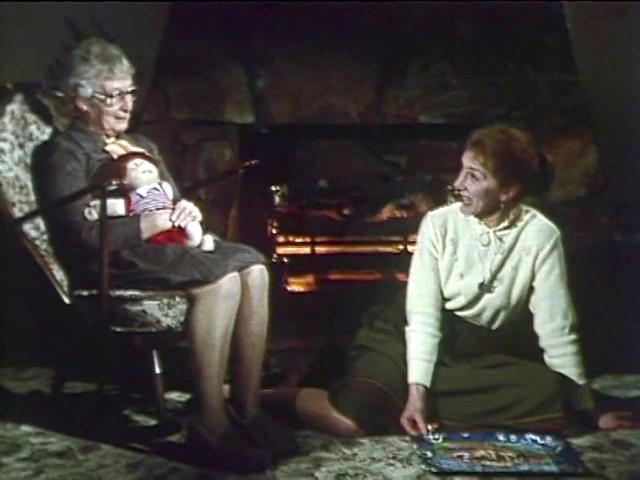
One of the daughters, here as a child, with one of their mothers. DP: Emile Navarro.
A heartfelt reunion scene*
“Oh, it's you.”
– Margaret Wheeler, welcoming the viewers to this curious retelling of her life's events
Through an unexplained muddle, the Wheeler and the Rylatt girls were mixed up at the maternity ward. One of the mothers, Mrs Wheeler, had a hunch something was off. Her girl was suspiciously long and skinny, unlike the one that was entrusted to her. Over the years and to Mrs Rylatt's increasing chagrin, Mrs Wheeler kept in touch with that woman from the maternity ward. And was proven to be correct. This film is one breezy yet tense reunion scene. Heartwarming, awkward, and – like all that's nostalgia – slightly surreal.
* the Bales 2025 Film Challenge for November is, again, not date-based, but follows a sloppy schmaltzy all-American Thanksgiving-y narrative. Trying to make it work my way.
view
Mix-Up ou Meli-melo (Françoise Romand, 1986)
Nov
18
1936
Mother and daughter in one of the surreal reenactment scenes. DP: Emile Navarro.
A bit – occasionally a lot – Greenaway without the room for interpretation. Lovely though and impossible to make in this overly self-aware selfie universe.
view
Ich bin meine eigene Frau [I Am My Own Woman] (Rosa von Praunheim, 1992)
May
16
Honor Our LGBT Elders Day
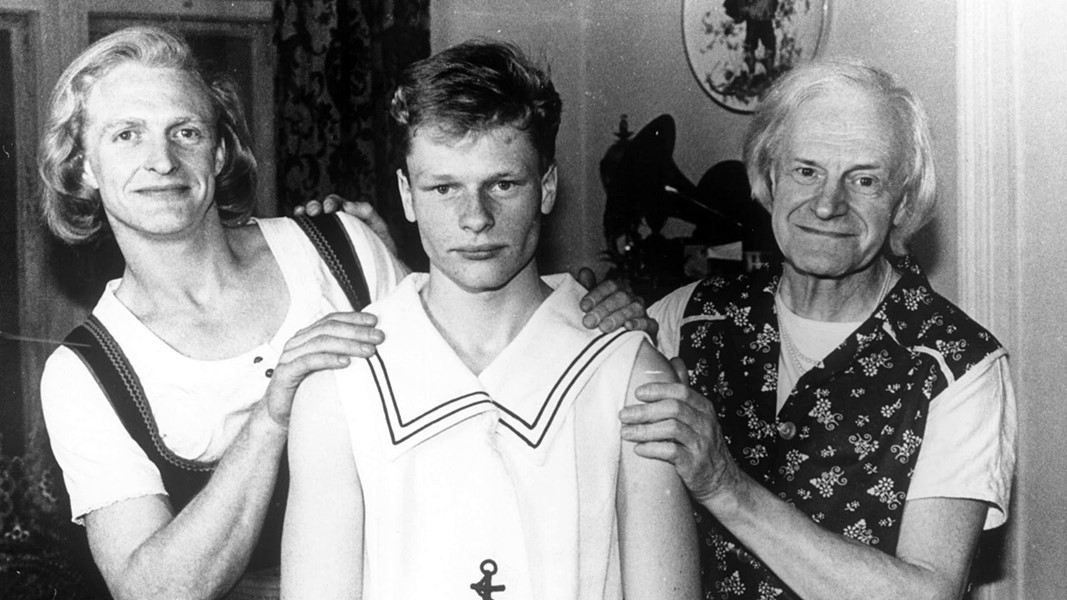
Ichgola Androgyn, Jens Taschner, and Charlotte von Mahlsdorf as Charlotte von Mahlsdorf. DP: Lorenz Haarmann.
“Ich bin meine eigene Frau” (“I am my own woman/wife”)
– Charlotte von Mahlsdorf, in response to her mother's request to settle and get married
view
Hotel of the Stars (Jon Bang Carlsen, 1981)
Apr
21
Heartbreak Hotel
The setting for a dramatic reenactment, watched over by the King. DP: Alexander Gruszynski.
A film set in a hotel, or involving Elvis Presley, on the date Heartbreak Hotel topped the charts in 1956.
“I love to see myself in Technicolor.”
view
Die Patriotin [The Patriotic Woman] (Alexander Kluge, 1979)
Mar
29
秦始皇兵马俑
Teacher Gabi Teichert (Hannelore Hoger), knee-deep in a puddle with a shovel, inspecting a find. DPs: Guenter Hoermann, Werner Lüring, Thomas Mauch & Jörg Schmidt-Reitwein.
A German history teacher, unhappy with the standardised history textbooks she has to work with, literally digs up her nation's past and sees how it is reflected in modern society.
view
La Chinoise, ou plutôt à la Chinoise: un film en train de se faire [La chinoise] (Jean-Luc Godard, 1967)
Mar
19
Howard University Protest
Yvonne (Juliet Berto) holed up behind piles of Mao's Little Red Book, wielding a machine gun. DP: Raoul Coutard.
“One must confront vague ideas with clear images”
– slogan on a wall
Five Maoist students theorise, then practice a radical overthrow via terrorism.
Loosely based on Dostoyevsky's Бѣсы [The Possessed] (1871–72).
view
Moi, un noir [I, a Negro] (Jean Rouch, 1958)
Oct
16
National Eddie Day
A young woman looks over her shoulder, smiling. DP: Jean Rouch.
Some of the leads play out their hopes and dreams and are named after famous actors from Western films. Petit Touré is #EddieConstantine.
view
R… ne répond plus [R… no longer responds] (Jean-Pierre Dardenne + Luc Dardenne, 1981)
Aug
28
Radio Commercials Day
In the nice room for special occasions a small boy is eating next to a large greying woman wearing an apron who in her turn eyes a younger woman who looks exactly like her tuning the radio. It's prominently placed next to an oversized, sensual cornucopian glass bowl, overflowing with oranges. DPs: Jean-Pierre Dardenne & Stéphane Gatti.
R… ne répond plus is Jean-Pierre and Luc Dardenne's exploring the airwaves. Some is clearly political. Radio Schwarzi Chatz (“Radio Black Cat”) and the feminist witches from Wellenhexe (”[radio] wave witch”) have important messages, unheard of in the mainstream media. Others broadcast in languages on the verge of extinction, so may that tongue survive in a world that – already forty years ago – was rapidly homogenising.
“This is called the comeback of reality.”
And then there are those, they're unnamed, who travel the land and across the borders with walkie-talkies – those too are radios, two-way – using their meandering frequencies to hold on to reality. It's all very elusive, but it's there. Maybe #radio is not dead. We just need to learn how to tune into that Enochian frequency again. It's real after all.
view
Sinong lumikha ng yoyo? Sinong lumikha ng moon buggy? [Who Invented the Yoyo? Who Invented the Moon Buggy?] (Kidlat Tahimik, 1979)
May
30
National Creativity Day
Kidlat Tahimik test driving his moon buggy, closely followed by faithful crew member Gottlieb (Kidlat Gottlieb Kalayaan). DP: Kidlat Tahimik.
“If you don't eat too many Gummy Bears you could be my co-pilot.”
– Kidlat Tahimik, speaking to a budding crew member
Sinong lumikha ng yoyo? is a remarkable display of imaginative filmmaking. Together with Kidlat we ponder about practicalities, suddenly see connections that were obscured by too much thinking, and realise all the new possibilities we have in life. Part documentary, part animation, part fantasy, part sci-fi, Kidlat transports us to yet unexplored spaces!

.png)