“Just close your eyes and call him… It's me, Ana… It's me Ana…” El espíritu de la colmena [The Spirit of the Beehive] (Víctor Erice, 1973)
Sep
3
National Cinema Day

Ana (Ana Torrent) watching James Whale's Frankenstein (1931). DP: Luis Cuadrado.
One day, in a quiet village, a traveling movie theatre appears. The proprietor has no words for the miracle he brings in on the reels. When it's finally time, and the whole town is crammed into the crumbling impromptu playhouse, and the lights are dimmed, a word of warning. This is the story of Dr. #Frankenstein, it starts.
– Teresa
The old folk in the audience remember their first brush with cinema, and life, and death. For sisters Ana (Ana Torrent) and Isabel (Isabel Tellería) it may be their first, and it may as well be real. The creature, Isabel assures her younger sister, is not dead. He's a spirit and you can call for him.
When you're little, everything is a miracle. Milagros is the name the maid answers too. And so does the landscape, the mushrooms, the heart, and the magic of cinema.
drama
Homicidal (William Castle, 1961)
Sep
2
Ice cream (melting)

Emily (Joan Marshall), a stately blonde, looking down on a sulky little kid holding his slowly melting ice cream. DP: Burnett Guffey.
“Tomorrow morning we'll get up early.”Le temps d'une chasse [The Time of a Hunt / Once Upon a Hunt] (Francis Mankiewicz, 1972)
Sep
1
National Hotel Employee Day

One of the men following Monique, one of the hotel employees (Luce Guilbeault, simply credited as “La Rousse”, “the redhead”) down the corridor. The young waitress (Frédérique Collin) can be seen in the door opening at the end of the hallway. DP: Michel Brault.
Le temps d'une chasse is the definition of unease. It starts at dawn, when two old friends pick up their buddy Richard (Marcel Sabourin) from the home he shares with his wife and son. The son, the wife insists, comes along. The men have planned a #hunting trip, in a cabin far away from #Montréal, far away from everything, with a beer-filled cooler at hand. The last they need is an underage kid towing along. But the boy comes along, she insists. With a trunk full of Dutch courage and a mouthful of boasting, the men find themselves at a hotel instead of the expected cabins.
Hotel days are short and its nights long and booze-filled, commanding their own temptation and regret.
“Speed is the ultimate, all-time high. That first rush. Wow! Just that burning, searing, soaring sense of perfection.” Ciao Manhattan (John Palmer + David Weisman, 1972)
Aug
31
International Overdose Awareness Day

A hollow-eyed Susan Superstar (or Edie Sedgwick, it doesn't matter) getting ready in the morning in one of the 1960s scenes. The cameraman is visible in the many bathroom mirrors. DPs: John Palmer & Kjell Rostad.
28 is no age to die, regardless if your name is Susan Superstar or Edie Sedgwick. But it happened, right during the wrap-up of Ciao Manhattan. Edie was gone, just like that, snuffed like so many of the other #Warhol Superstars. What did remain was footage, so much abandoned footage shot in the 60s when those stars were shining at their brightest. That footage, set in glitzy black-and-white Manhattan, is where Edie and Paul America race around town on amphetamine. Or see a doctor to get shots of some sorts.
– Susan
And there's colour footage too. Susan, topless, semi-(un)consciously dragged around the floor of her empty pool-turned-Superstar-temple. She babbles, drinks, dances around in her panties. And she ODs. Like Edie would even before this movie had seen the light of day.
They snuff so fast, these bright Superstars.
“If you're not sure a mushroom's good, don't pick it. Because if it's bad, and you eat it, it's your last mushroom and your last everything too.”El espíritu de la colmena [The Spirit of the Beehive] (Víctor Erice, 1973)
Aug
30
mushrooms
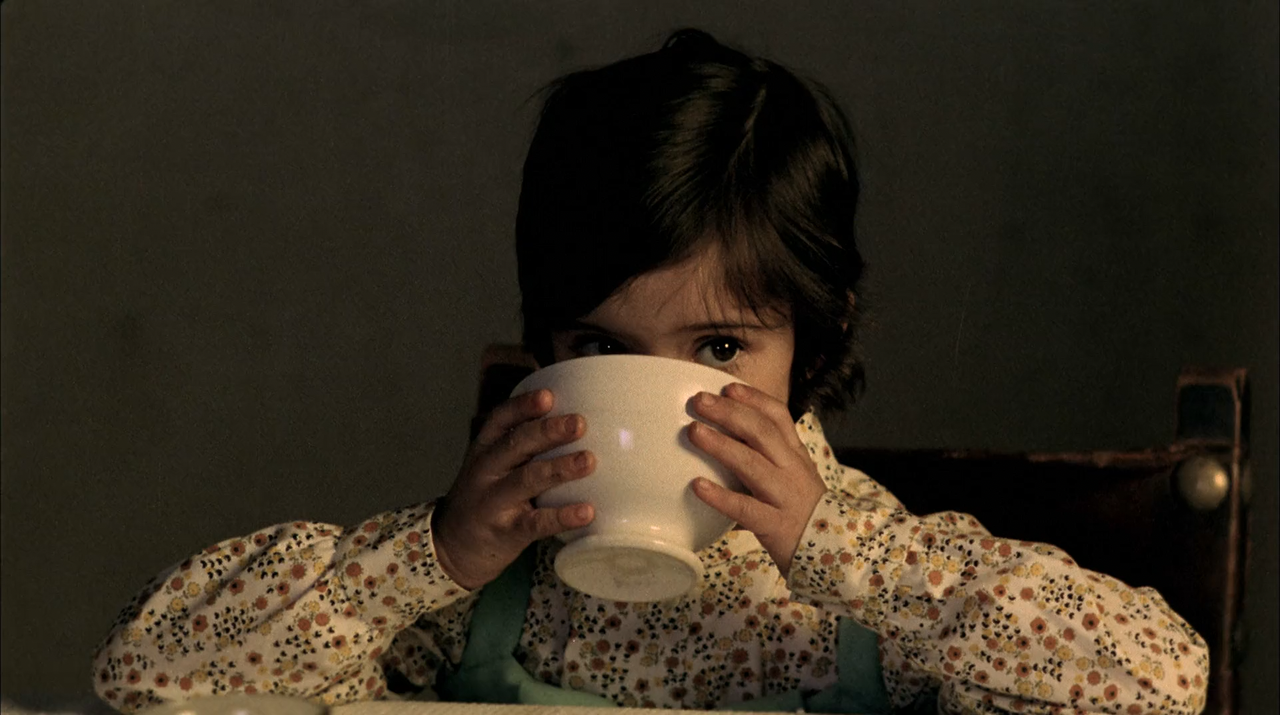
Little Ana (Ana Torrent) all but disappearing behind a for her almost too large ceramic bowl. DP: Luis Cuadrado.
It's August 30, #Frankensteinday.
ねこぢる草 [Nekojiru-sō / Cat Soup] (Tatsuo Satō, 2001)
Aug
30
National Grief Awareness Day
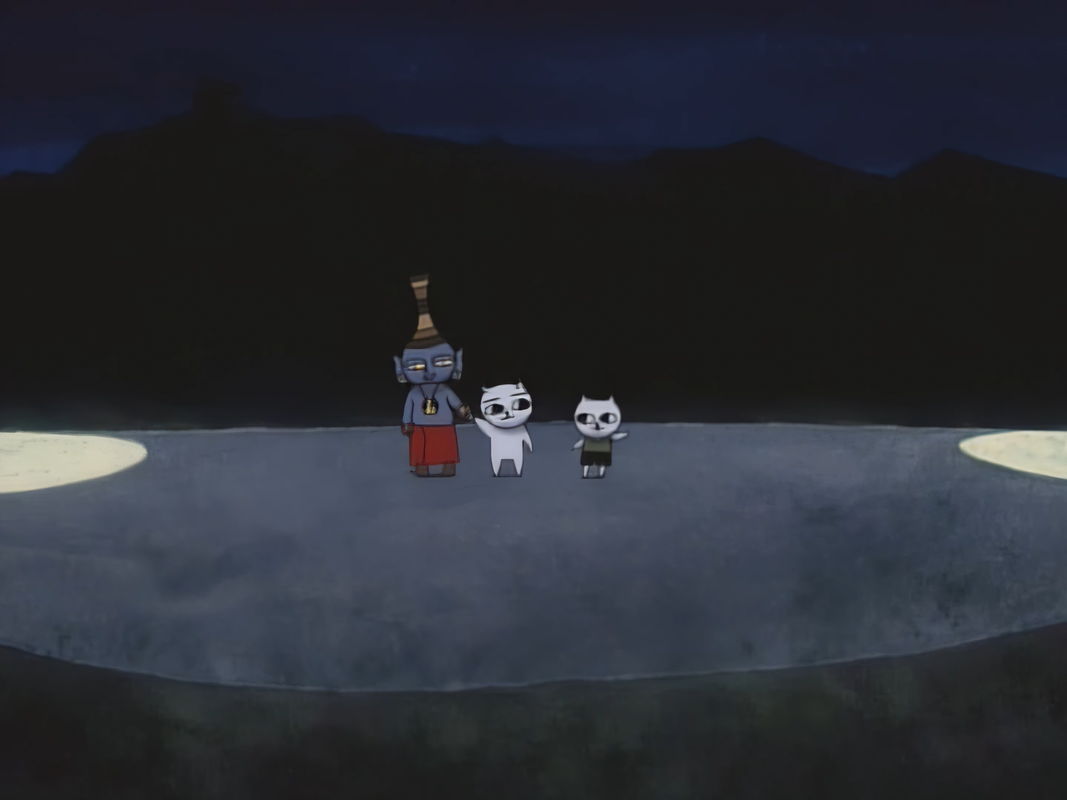
Nyāko taken away by Jizō with little brother Nyatta telling Nyāko to come back home. DP: Masaru Takase.
Nyatta is not ready to have Jizō take away his big sister Nyāko to Ne-no-kuni, the land of the dead. The kitten grabs his sister's paw, resulting in her soul being ripped in two and leaving Nyāko in a state of limbo. The cats' mother then sends the two off on a mission to buy fried #tofu. Maybe now Nyatta can find a way to put Nyāko's divided soul back together. But first, there's a circus to visit!
ねこぢる草 is based on works by mangaka Nekojiru / ねこぢる (1967—1998) whose trademark crudely drawn #cats caused a ripple in Japan's underground #manga circuit. Nyatta and Nyāko continued their surreal adventures by way of widower Yamano Hajime after Nekojiru's tragic suicide in 1998.
“And now for the benefit of the folks who tuned in late, I should like to say that this is the most traumatic spectacle I have ever had the GOOD fortune to witness.”Dial 1119 [The Violent Hour] (Gerald Mayer, 1950)
Aug
28
Sherry Flips

Dr. John Faron (Sam Levene) and barfly Freddy (Virginia Field) drinking at the counter. Freddy is enjoying her sherry flip with what appear to be olives instead of cherries. Two more glasses are waiting for her. DP: Paul Vogel.
– TV announcer
Zupa [Soup] (Zbigniew Rybczyński, 1975)
Aug
27
Crab Soup Day

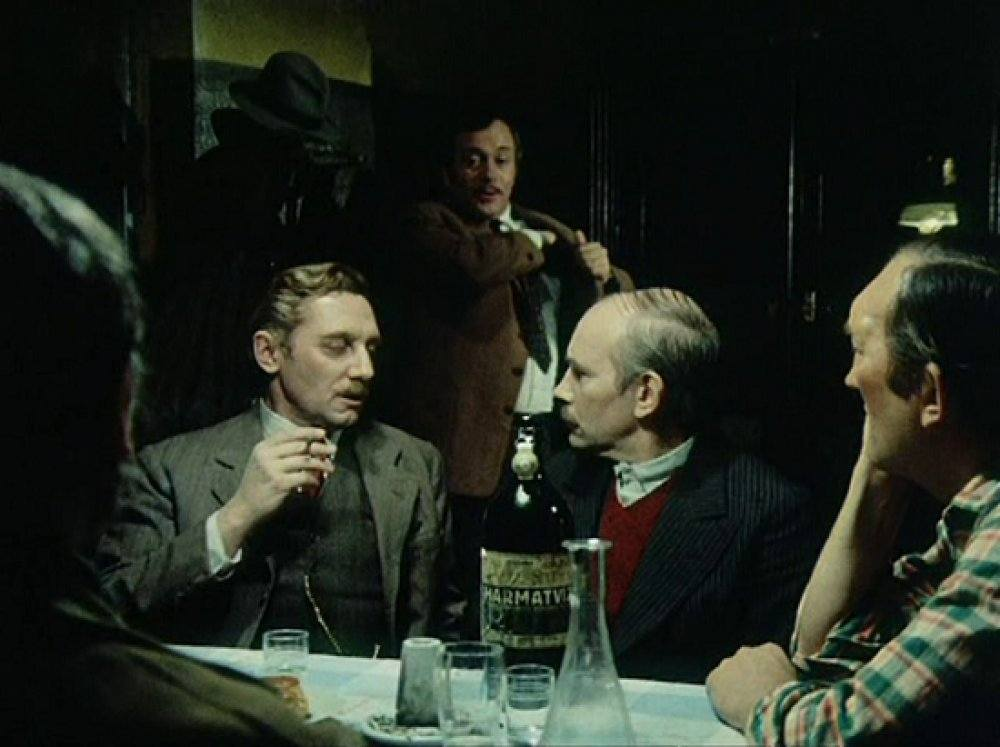
The husband eating soup. The colours are extremely bright and placed on top of animated black-and-white still photographs created with an optical printer. DP: Zbigniew Rybczyński..
Zbigniew Rybczyński's autobiographical Zupa follows an unnamed couple's faltering monotonous relationship.
Produced by the groundbreaking Se-ma-for Studios in Łódź – you may be familiar with their 1981 Oscar-winning Tango by, again, Rybczyński – the story is told through colourised analogue still #photography and electronic music and sound effects created by PRES's Eugeniusz Rudnik.
– What do you want? – We just want that horse of yours. – You want my horse, there's an awful lot of ya. What are you gonna do with just one horse, anyhow? – Eat it. We're gonna feed off that beast for at least a week.Il grande silenzio [The Great Silence] (Sergio Corbucci, 1968)
Aug
26
horse
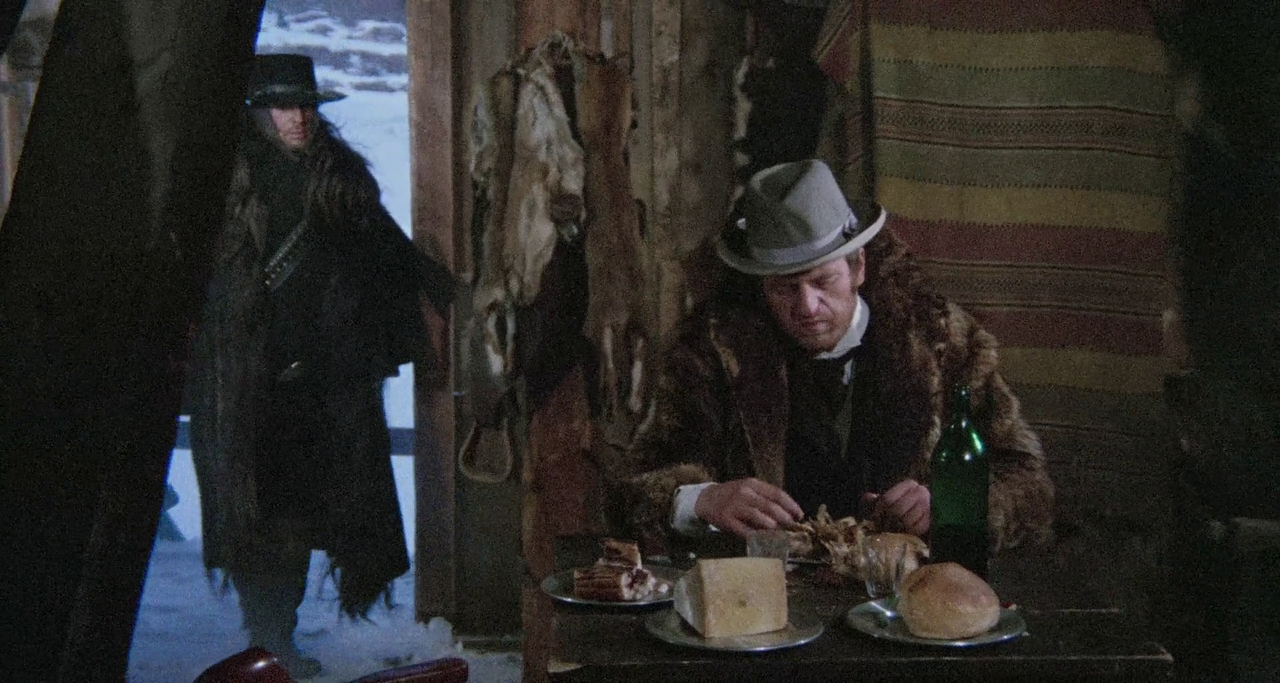
A man in a heavy fur coat (Bruno Corazzari) is eating at a small table when Silenzio (Jean-Louis Trintignant) enters the small establishment. Outside the landscape is covered in snow. DP: Silvano Ippoliti.