view
Kiss (Andy Warhol, 1963)
Feb
13
Kiss Day
An interracial couple kissing. © The Andy Warhol Museum, Pittsburgh.
“People should fall in love with their eyes closed.”
– Andy Warhol
view
Primate (Frederick Wiseman, 1974)
Feb
12
Georgia Day
Man and ape sharing a white concrete cell. The man playfully dangles from a chain attached to the wall while the ape looks on. DP: William Brayne.
“Now, we'll just let nature take its course.”
– researcher
view
Vivre sa vie: Film en douze tableaux (Jean-Luc Godard, 1962)
Feb
11
Global Movie Day
Nana (Anna Karina) crying in a dark movie theatre while watching Carl Theodor Dreyer's La passion de Jeanne d'Arc (1928). DP: Raoul Coutard.
A fascinating overlap with The Savage Eye (1959), a film #Godard must have been familiar with in 1962.
“Maybe I'll get into the movies.”
– Nana
view
The Naked City [Homicide (Jules Dassin, 1948)
Feb
10
All The News That's Fit To Print Day
On a crowded subway train, a distraught young woman looks at the back of a newspaper. She may just have read the front, held up by someone offscreen. Headlines read YOUNG MODEL FOUND SLAIN IN BATHTUB. The prop newspaper uses too many typefaces at once. DP: William H. Daniels; still photographers: Bert Anderson & Arthur “Weegee” Fellig.
Filmed on location in New York City, with still photography by Arthur “Weegee” Fellig and others. Weegee was a press photographer known for his stark black-and-white crime scene #photography in the city's seedy underbelly.
“There are eight million stories in the naked city. This has been one of them.”
– narrator
view
Françoise Durocher, Waitress (André Brassard, 1972)
Feb
9
freebie: Customer Service Day
23 actresses and one person in drag play the part of Québécois waitress Françoise Durocher in seven monologues.
“One grilled cheese, two slices of toast, two coffees. One pepper steak no chili and a plate of spaghetti and meatballs. Two glasses of milk. One plate of spare ribs. A chicken in a basket with three cups of honey. One lean smoked meat sandwich with pickles and mustard. One two-cream coffee and two club sandwiches. Two clubs.”
– Françoise Durocher
Watch the short on the NFB website.
view
Bröder Carl [Brother Carl] (Susan Sontag, 1971)
Feb
7
Ballet Day
view
Germania anno zero [Germany Year Zero] (Roberto Rossellini, 1948)
Feb
6
National Sickie Day
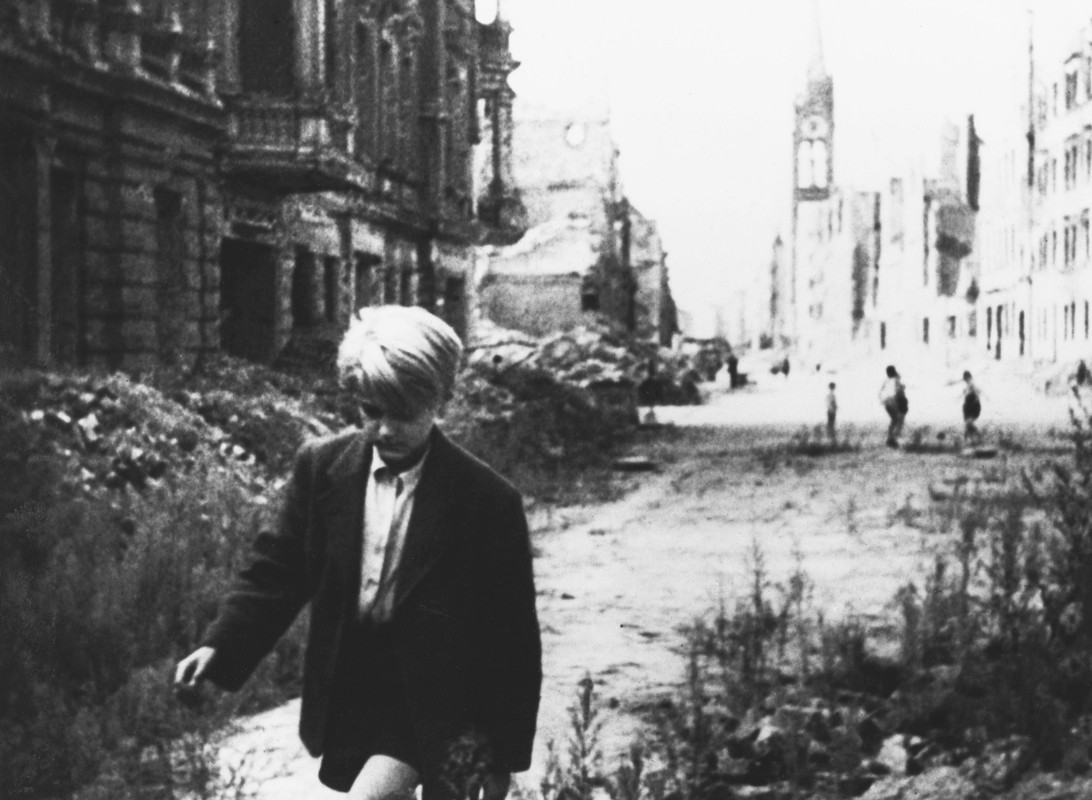
Edmund (Edmund Köhler) walking through rubble in a post-apocalyptic Berlin. DP: Robert Juillard.
Twelve-year-old Edmund – the oldest kid to survive – works to support his whole family including his sick bedridden father while the remains of what was a thousand-year empire lies in rubbles around them.
– I don't go to school anymore.
– Why not? You don't like the new teachers?
– I have to work now.
Following Roma città aperta (1945) and Paisà (1946) of #Rossellini's unofficial war trilogy.
view
H-8… (Nikola Tanhofer, 1958)
Feb
5
Disaster Day
The driver and a boy keep an eye on the road. The second driver is asleep. It's raining. DP: Slavko Zalar.
In mere hours, a disaster involving a bus and a truck is bound to happen. The story meanders from the bus passengers to the truck drivers, while the road stretches out before them.
view
Het kwade oog [Le mauvais oeil / The Evil Eye] (Charles Dekeukeleire, 1937)
Feb
4
Farmers Day
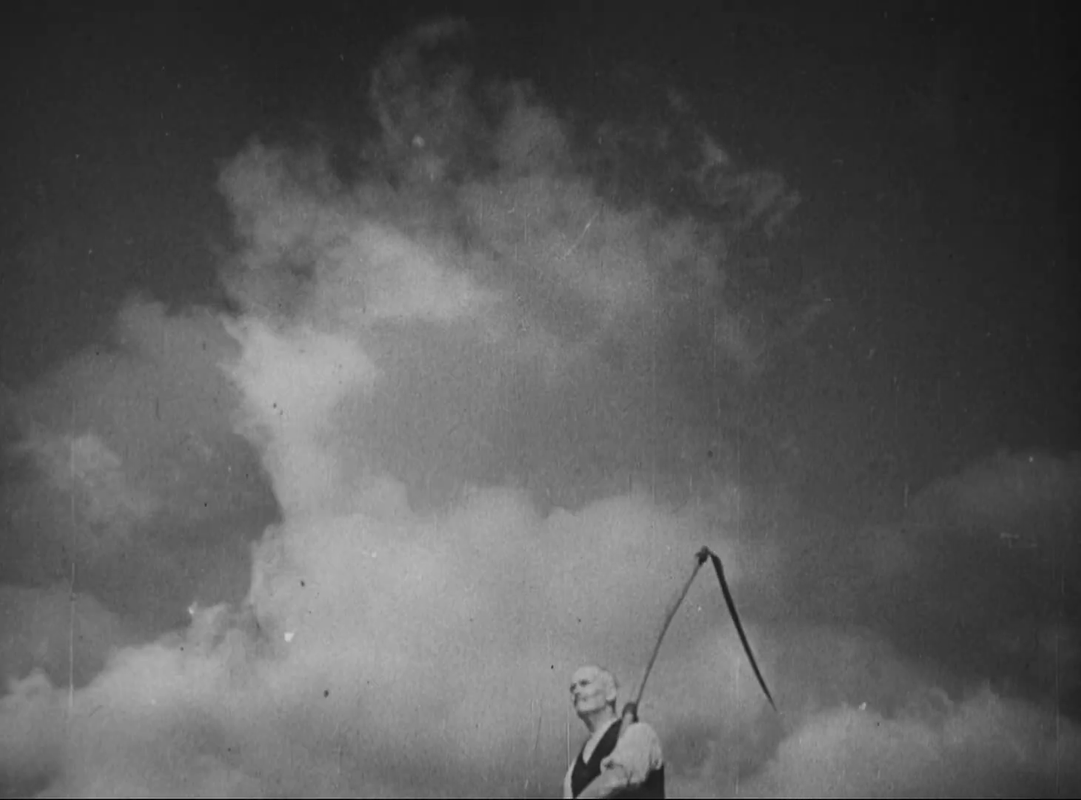
A farmer in the bottom of the screen holding a scythe against an imposing Flemish sky. DP: François Rents.
In the small East Flemish villages inhabited by non-actors, where the story takes place, one day, a vagrant shows up. The villagers say he has the evil eye. Mills burned and harvest cursed, they say. The man is cursed, by a deep sense of guilt, over something from the past that slowed down time.
De tweede politieagent: “Jean, hebt ge ze?” [het spel vertraagt]
– Herman Teirlinck, De vertraagde film (1922)
Het kwade oog occupies that small frozen moment between sound and silence. With an acute sense of what's possible in cinema, even more than in literature and theatre, Dekeukeleire applies what he had Eisenstein seen do to with his interpretation of Brecht's episches Theater (“epic theatre”).
view
De werkelijkheid van Karel Appel [The Reality of Karel Appel] (Jan Vrijman, 1962)
Feb
3
American Painters Day
Appel at work. He said about painting “Ik begin vanuit mijn materie, dat is verf.” (“I start from my matter, which is paint.”). DP: Eduard van der Enden.
CoBrA (1948—51) was a Copenhagen / Brussels / Amsterdam art collective whose manifest revolved around the liberation from the rigidity of art and life in drab, post-war Europe. Their spontaneous primal iconography and graffiti allowed them to not only regain the pleasure of painting, but also forge a new connection to colour and material. Especially the Dutch artists involved – Corneille, Appel, Lucebert, Constant – looked at the way children respond to the act of creation resulting in easy to comprehend semi-abstract paintings, sculptures and poems. The moronic “my child can paint that” that people still associate with modernist art can be traced back to (deliberately) misinterpreting these artists' objectives.
“Ik schilder als een barbaar van deze barbaarse tijd.”
– Karel Appel