view
Les trois couronnes du matelot [Three Crowns of the Sailor] (Raúl Ruiz, 1983)
Jun
5
view
Les trois couronnes du matelot [Three Crowns of the Sailor] (Raúl Ruiz, 1983)
Jun
4
National Week Of The Ocean
The sailor (Jean-Bernard Guillard) on his ship. DP: Sacha Vierny.
A man murders another and meets a drunk sailor. The drunk then tells the murderer about his life on the sea. Les trois couronnes du matelot is of course never a straightforward crime film. It's Raúl Ruiz, it never is.
“I got nothing out of this crime except the ring he offered me many times; several hundred marks; a collection of old coins, of no value; and a long letter where he advised me to leave the country.”
– the student
The sailor drinks, celebrates and mourns the women and men of his past, we all get drunk on life while the dark water closes itself again above our heads.
view
Who Killed Teddy Bear (Joseph Cates, 1965)
Jun
3
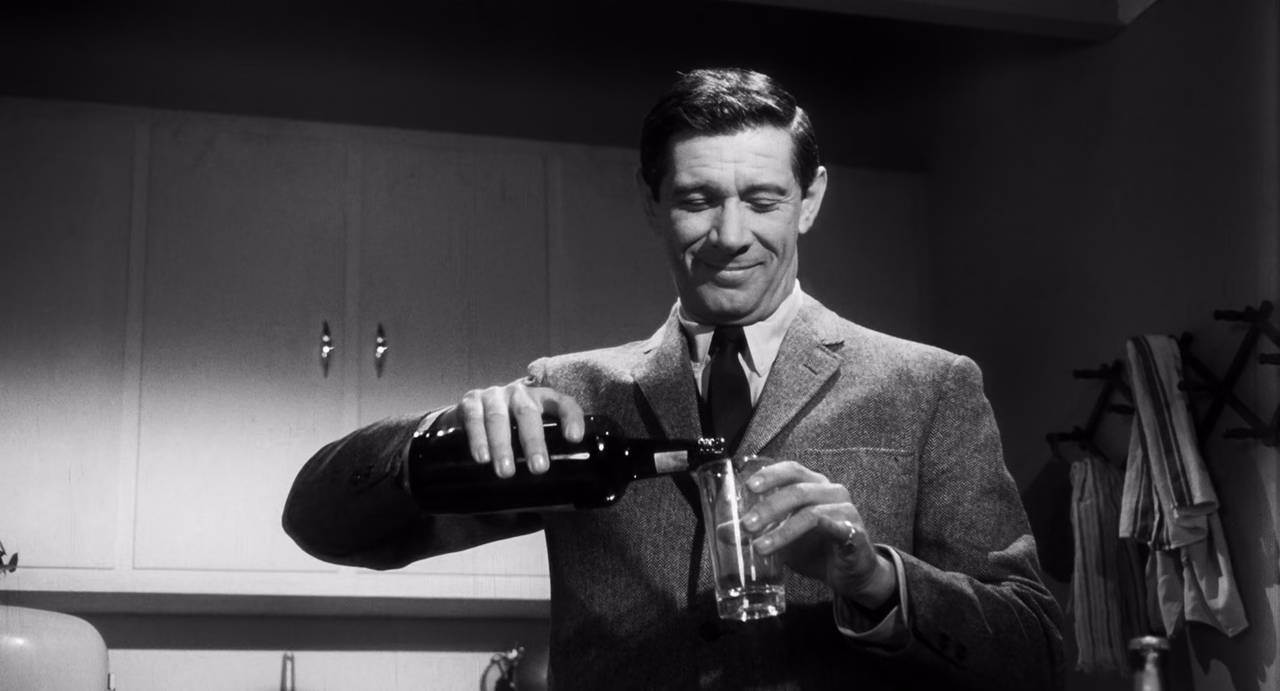
A square 1960s man – Jan Murray as Lt. Dave Madden – smugly pouring himself a stiff drink. DP: Joseph C. Brun.
“I don't find you the least bit amusing, Lieutenant Whatever-your-problem- is!”
– Norah Dain
view
Vertigo (Alfred Hitchcock, 1958)
May
27
Golden Gate Bridge
A pensive Novak in black in front of a sunlit Golden Gate Bridge. DP: Robert Burks.
A bridge to celebrate the 1937 Golden Gate Bridge opening.
“Here I was born, and there I died. It was only a moment for you; you took no notice.”
view
Rat Fink [My Soul Runs Naked / Wild and Willing] (James Landis, 1965)
May
11
World Ego Awareness Day
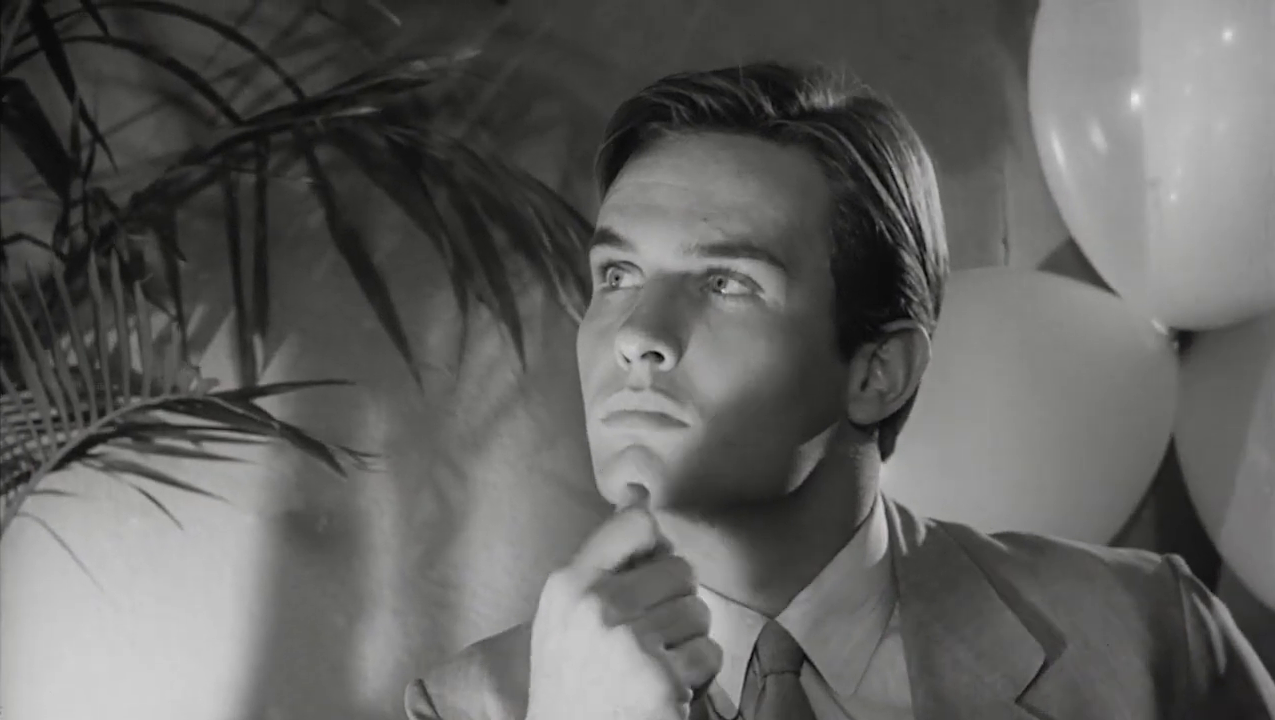
Real-world teen pop idol Schuyler Hayden as Lonnie. He's very pretty, and pensive, sitting in front of a potted palm and balloons, this thumb up to his chin. His face and eyes are lit in such a way that he looks strangely sinister. DP: Vilmos Zsigmond.
Pretty boy Lonnie gets what he wants. And he wants to be out of where he came from, and he wants to be wanted and rich. And he's got the looks and the voice and the ego. So he gets it, the getting out and the love and the money. And then some. And then some. And then.
“It's not my fault that opportunity came my way.”
– Lonnie
Rat Fink is not your pop-idol-turned-movie-star vehicle. Something's off, no good vibrations here. It's dark – not in the least thanks to cinematographer Vilmos “The Deer Hunter” Zsigmond's doings – and gritty – real-world pop singer Schuyler Hayden doesn't hold back in his portrayal of egomaniacal pretty boy Lonnie.
If it hadn't been lost for half a century you may be fooled to believe that it spawned a certain, fictional 80s investment banker.
view
點指兵兵 [Dian zhi bing bing / Cops and Robbers] (Kwok-Ming Cheung, 1979)
May
6
A table set with one small plate of meat, one small plate of vegetables, three empty bowls, and one pair of chopsticks.
view
Ghosts… of the Civil Dead (John Hillcoat, 1988)
Apr
26
Hug An Australian Day
One of the inmates near a small window. The light's cold. DPs: Paul Goldman & Graeme Wood.
“Officer, come here. I wanna spit in your fucking eye!”
– Maynard
The #industrial soundtrack is by Bad Seed Nick Cave (co-writer and starring as Maynard), Mick Harvey, and Blixa Bargeld from when they were still closer to being birthday boys than morose crooners.
view
Le Samouraï [The Samurai] (Jean-Pierre Melville, 1967)
Apr
25
License Plates Day
A pair of hands switching license plates on the front of a Citroën DS. The scene is almost black-and-white. DP: Henri Decaë.
Hitman Jef Costello (Alain Delon) coolly drives a #Citroën DS 21 to his garagiste (André Salgues), who routinely switches the license plates in a beautifully wordless, efficiently lit scene.
“I never lose. Never really.”
view
羅生門 [Rashōmon] (Akira Kurosawa, 1950)
Apr
22
April Showers Day
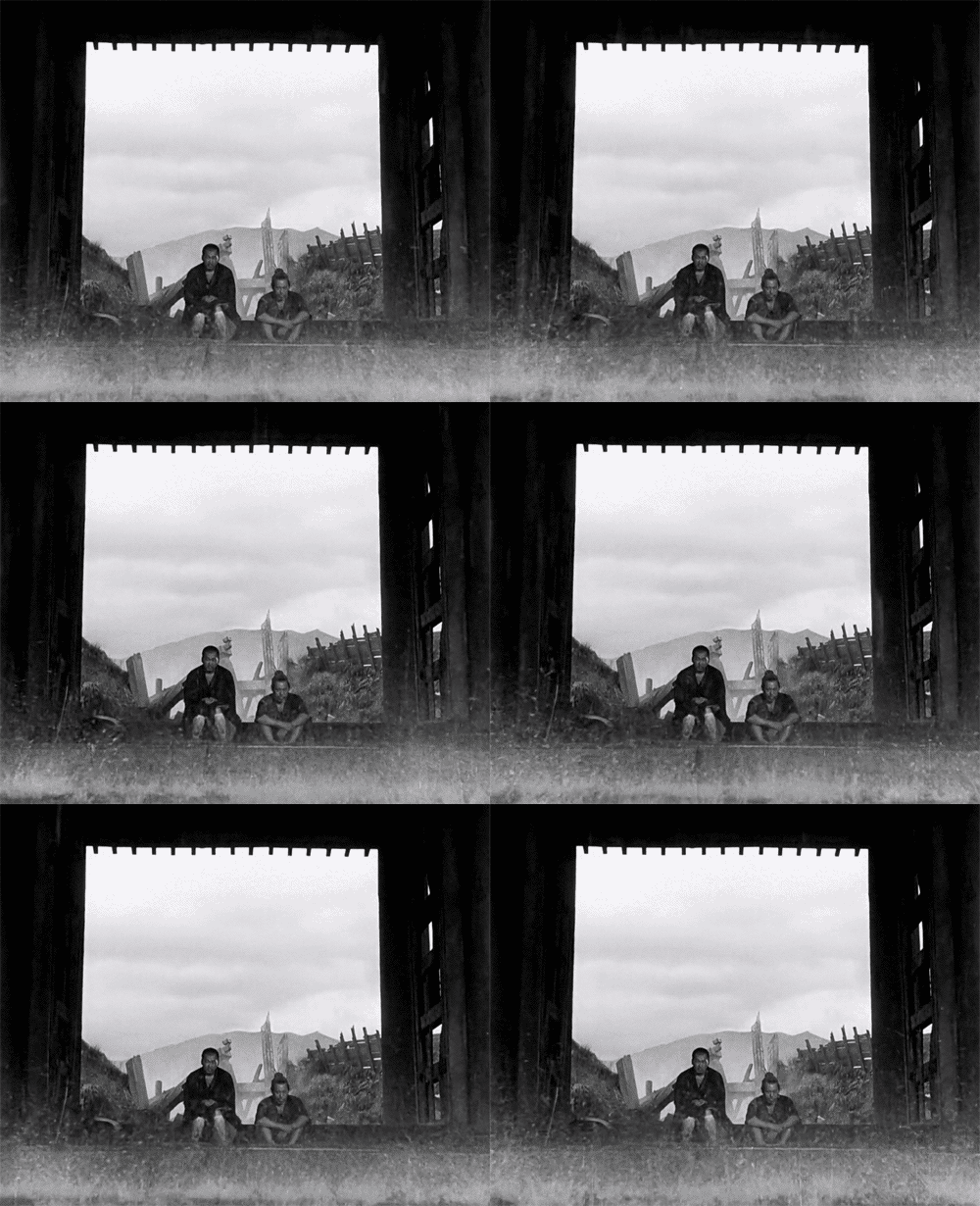
Two men sheltering from torrential rain in the gate of a wooden temple. DP: Kazuo Miyagawa.
“It sounded interesting, at least while I kept out of the rain. But if it's a sermon, I'd sooner listen to the rain.”
– commoner
view
Supermarkt [Die Stadt, Jane Love / Supermarket] (Roland Klick, 1974)
Apr
16
National Cash Day
A dirty, cut hand attempts to steal a few coins from a dish at a public toilet. DP: Jost Vacano.
Good-for-nothing Willi (Charly Wierzejewski) is in trouble. After yet another run-in with the law, and yet again meeting the wrong people at the wrong time, he falls in love with a destitute street worker (Eva Mattes). Now he really needs #money so he can support himself, her, and her kid. He tries his hand at renting himself out to a rich homosexual (homosexuality was illegal in 1970s W Germany), then moves forward to robbing the money transporter of a local supermarket with his pimp buddy. But as usual, Willi is in trouble.
Shot on location in #Hamburg's red-light district St. Pauli, Supermarkt is gritty, unpleasant and has an authenticity rarely seen in other films of this genre.