settima

usa

The Birds (Alfred Hitchcock, 1963)

Sep

10

chicken

The Birds (1963)

Alfred Hitchcock and Tippi Hedren in a promotional photo by Philippe Halsman. Hedren, as her character Melanie Daniels, is attacked by a large crow while Hitchcock calmly enjoys a fried chicken and a glass of wine. DP: Robert Burks.

Feeling rather peckish.

“Are the birds gonna eat us, Mommy?”

To Catch a Thief (Alfred Hitchcock, 1955)

Sep

8

leg or breast

To Catch a Thief (1955)

Francie (Grace Kelly) and John Robie (Cary Grant) taking a (lunch) break on the Grand Corniche coast road. DP: Robert Burks.

– You want a leg or a breast?

– You make the choice.

The Monster That Challenged the World (Arnold Laven, 1957)

Sep

7

National Salami Day

The Monster That Challenged the World (1957)

Coroner Nate Brown (Byron Kane) offering two cops a couple of nice cold sandwiches straight from one of the morgue coolers on his lunch break. DP: Lester White.

Arnold Laven's The Monster That Challenged the World is one of the earliest, if not thé earliest, example of this peculiar movie and television trope: the coroner's lunch break.

– You boys care for a sandwich? Got tuna fish and minced ham on rye.

– No, thanks.

– It's nice and cold.

Having some cold cuts over some cold cuts never gets old. Or appetising.

Red Roses of Passion (Joseph W. Sarno, 1966)

Sep

5

Red Roses of Passion (1966)

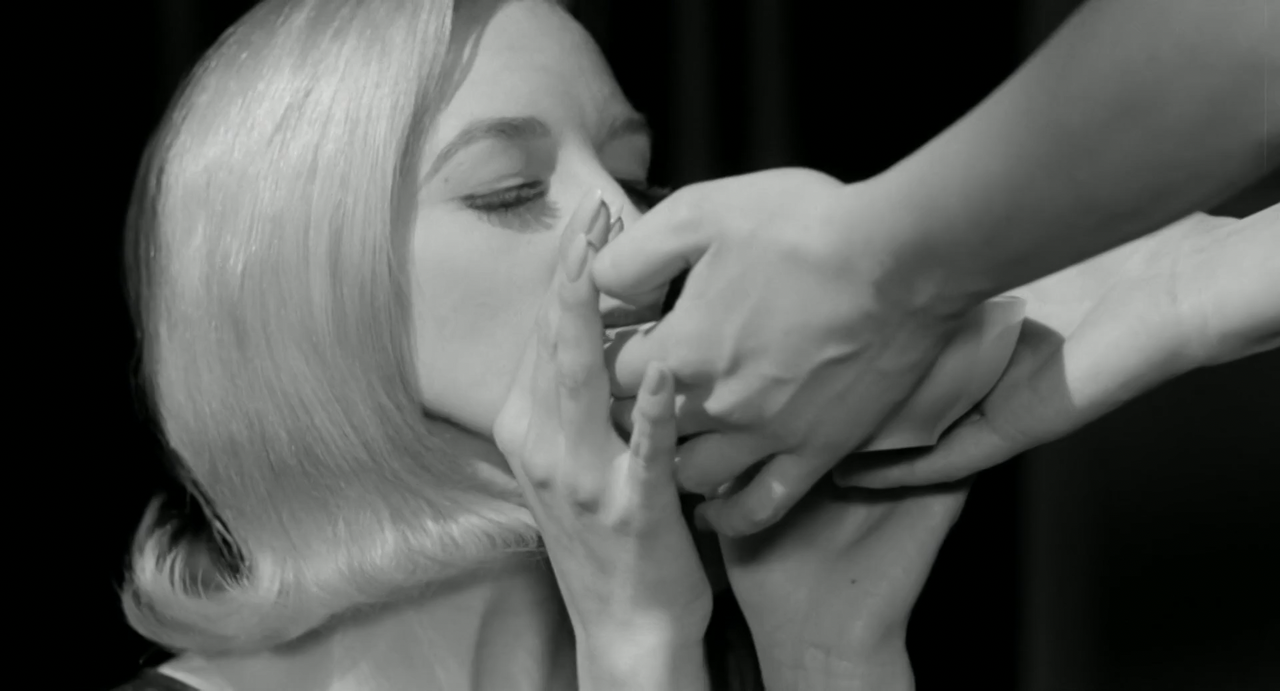
A blonde lustfully drinks from a cup held up for her by someone offscreen. DP: Anthony Lover.

Homicidal (William Castle, 1961)

Sep

2

Ice cream (melting)

Homicidal (1961)

Emily (Joan Marshall), a stately blonde, looking down on a sulky little kid holding his slowly melting ice cream. DP: Burnett Guffey.

Cremaster 1 (Matthew Barney, 1996)

Sep

2

National Tailgating Day

Cremaster 1 (1996)

Goodyear (Marti Domination) on the field, holding the two blimps from which she guides the chorus line. DP: Peter Strietmann.

American artist Matthew Barney dreamt of playing #AmericanFootball at Yale. His body, too short for the demanding game, became his personal battleground by way of torturous prosthetics and art performances testing its endurance. A fascination with biology – he considered medicine as his profession – is a recurring motif in his art. This will teach us that stage 1 of the cremaster cycle is the moment when the cremaster muscle – the muscle in the biological male responsible for the ascent and descent of the testes – is at its most ascended or undifferentiated state.


Cremaster 1, the second of the five part Cremaster cycle (1994—2002), is set at the Bronco Stadium in #Boise, #Idaho, Barney's hometown. Due of his personal connection with the place he was able to secure the stadium for a lush musical revue, complete with chorus girls and Goodyear #blimps. Instead of cheerleading yells and the crushing noise of chronic traumatic encephalopathy, we find ourselves quietly poised in an airship high above the field.


In each airship there is an ethereal woman (both played by gender-ambigious Marti Domination), arranging and rearranging grapes in intricate shapes, illustrating the development of the foetus from non-gendered to male. Below on luminous blue AstroTurf, the chorus line follows the same patterns.


Cremaster 1 is arguably the most accessible instalment of the cycle. Everyone, even if not familiar with the name Busby Berkeley, recognises the kaleidoscopic choreography. And those who have never watched a game of football in their lives, may pick up the subliminal patterns created by men dressed to overemphasise their already excessive masculinity.

Ciao Manhattan (John Palmer + David Weisman, 1972)

Aug

31

International Overdose Awareness Day

Ciao Manhattan (1972)

A hollow-eyed Susan Superstar (or Edie Sedgwick, it doesn't matter) getting ready in the morning in one of the 1960s scenes. The cameraman is visible in the many bathroom mirrors. DPs: John Palmer & Kjell Rostad.

28 is no age to die, regardless if your name is Susan Superstar or Edie Sedgwick. But it happened, right during the wrap-up of Ciao Manhattan. Edie was gone, just like that, snuffed like so many of the other #Warhol Superstars. What did remain was footage, so much abandoned footage shot in the 60s when those stars were shining at their brightest. That footage, set in glitzy black-and-white Manhattan, is where Edie and Paul America race around town on amphetamine. Or see a doctor to get shots of some sorts.

“Speed is the ultimate, all-time high. That first rush. Wow! Just that burning, searing, soaring sense of perfection.”

– Susan

And there's colour footage too. Susan, topless, semi-(un)consciously dragged around the floor of her empty pool-turned-Superstar-temple. She babbles, drinks, dances around in her panties. And she ODs. Like Edie would even before this movie had seen the light of day.


They snuff so fast, these bright Superstars.

The Hypnotic Eye (George Blair, 1960)

Aug

29

National Lemon Juice Day

The Hypnotic Eye (1960)

Suave hypnotist Desmond (Jacques Bergerac) and his lovely assistant Justine (Allison Hayes) using the magic of vitamin C to demonstrate to you, the viewer, how hypnotism works. DP: Archie R. Dalzell.

The Hypnotic Eye utilises what's called the movie gimmick. This one doesn't deploy anything hugely spectacular, no Percepto! seat vibrators (The Tingler (1959)) or Witchcraft (1964) witch deflectors or even a trained nurse on standby. There's a balloon. No spoilers here

“And now I am going to demonstrate to you the power of your own mind.”

– Desmond

There are also multiple moments where hypnotist Desmond (handsome future-Revlon-exec Jacques Bergerac) directly addresses you, the (wo)man in the audience. Because you too may laugh at that folly, that gimmick, that parlour trick. But who says it isn't real? Who says you really never went to see a hypnotism show…?

Dial 1119 [The Violent Hour] (Gerald Mayer, 1950)

Aug

28

Sherry Flips

Dial 1119 (1950)

Dr. John Faron (Sam Levene) and barfly Freddy (Virginia Field) drinking at the counter. Freddy is enjoying her sherry flip with what appear to be olives instead of cherries. Two more glasses are waiting for her. DP: Paul Vogel.

“And now for the benefit of the folks who tuned in late, I should like to say that this is the most traumatic spectacle I have ever had the GOOD fortune to witness.”

– TV announcer

Cleopatra (Joseph L. Mankiewicz + Rouben Mamoulian, 1963)

Aug

26

National Spark The World Day

Cleopatra (1963)

Cleopatra's – Elizabeth Taylor, anachronistically dressed as the goddess Nekhbet – grande entrée in Rome. She sits on top of a black, basalt-like sphinx, pulled by numerous slaves and greeted by a cast of thousands. There are 20 000 Italian extras; there's no CGI. DPs: Leon Shamroy & Jack Hildyard.

Like Rome, Cleopatra wasn't built in a day. Joseph L. Mankiewicz's epic studio breaker took six years to make and, despite it being the highest-grossing film of 1963, didn't break even until 1973. Was it a #flop? A classic flop but a flop nevertheless?

“There are never enough hours in the days of a queen, and her nights have too many.”

– Cleopatra


Is it all bad? Cleopatra is one of those movies that so many – and that includes obsessive cinephiles – will get around to watch. Eventually. All four hours of it. I'm still holding out, but ooh, the spectacle!