view
Ο Δράκος [O Drakos / The Ogre of Athens / The Ogre / The Vampire] (Nikos Koundouros, 1956)
Jan
2
Martini
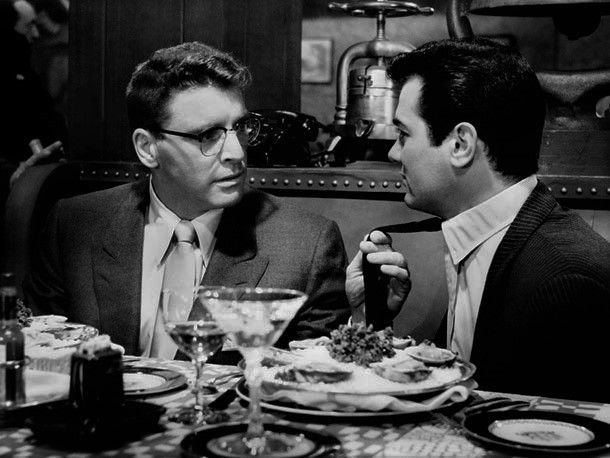
The boss, Hondros (Giannis Argyris), pours out a stiff drink on the floor of his cabaret with Mr Tomas (Dinos Iliopoulos) in the background. DP: Kostas Theodoridis.
The first film dinner of 2024.
view
Ο Δράκος [O Drakos / The Ogre of Athens / The Ogre / The Vampire] (Nikos Koundouros, 1956)
Dec
31
New Year's Eve
Men in identical white shirts and dark slacks dancing in the club during after hours. Their upper bodies seem top-heavy, tending to lunge towards the ground. DP: Kostas Theodoridis.
New Year's Eve celebrations.
A mousy bank clerk (Dinos Iliopoulos), who bears an uncanny resemblance to a criminal on the run, finds himself hiding in a shady cabaret on New Year's Eve instead of spending a quiet evening alone. During his forced stay at the nightclub, he comes to enjoy and identify more and more with his newfound persona and assumes the role of the notorious “Drago”.
An initial box office dud, it is now considered one of the top ten all-time best Greek films.
Happy new year, everyone! On to many more cinematic discoveries!
view
Umut [Hope] (Yılmaz Güney + Şerif Gören, 1970)
Dec
30
National Resolution Planning Day
Hasan (Tuncel Kurtiz) and Cabbar (Yılmaz Güney) planning their next step sitting atop of the pit. DP: Kaya Ererez.
Cabbar (Yılmaz Güney), an impoverished, illiterate phaeton driver, loses his already half-dead horse when a rich man crashes into the cart. Now destitute and burdened with feeding his six children, wife and grandmother, Cabbar is offered several ways out. While winning the lottery is not in his stars, his friend Hasan's (Tuncel Kurtiz) and imam Hodja's (Osman Alyanak) wondrous plan to go out into the Kurdish wastelands to dig up an illusive treasure may be his only escape.
“I left forty lira at home, the family is hungry now.”
– Cabbar
Umut is Turkey's early venture into Neorealismo. Banned by the national board of censorship – the display of abject poverty, characters not observing morning prayer etc etc – the film was smuggled out off the country and into Cannes, where its screening urged the Turkish government to reconsider its decision. It's now seen as one of Turkey's most important cinematic masterpieces.
view
Un condamné à mort s'est échappé ou Le vent souffle où il veut [A Man Escaped] (Robert Bresson, 1956)
Dec
29
slop
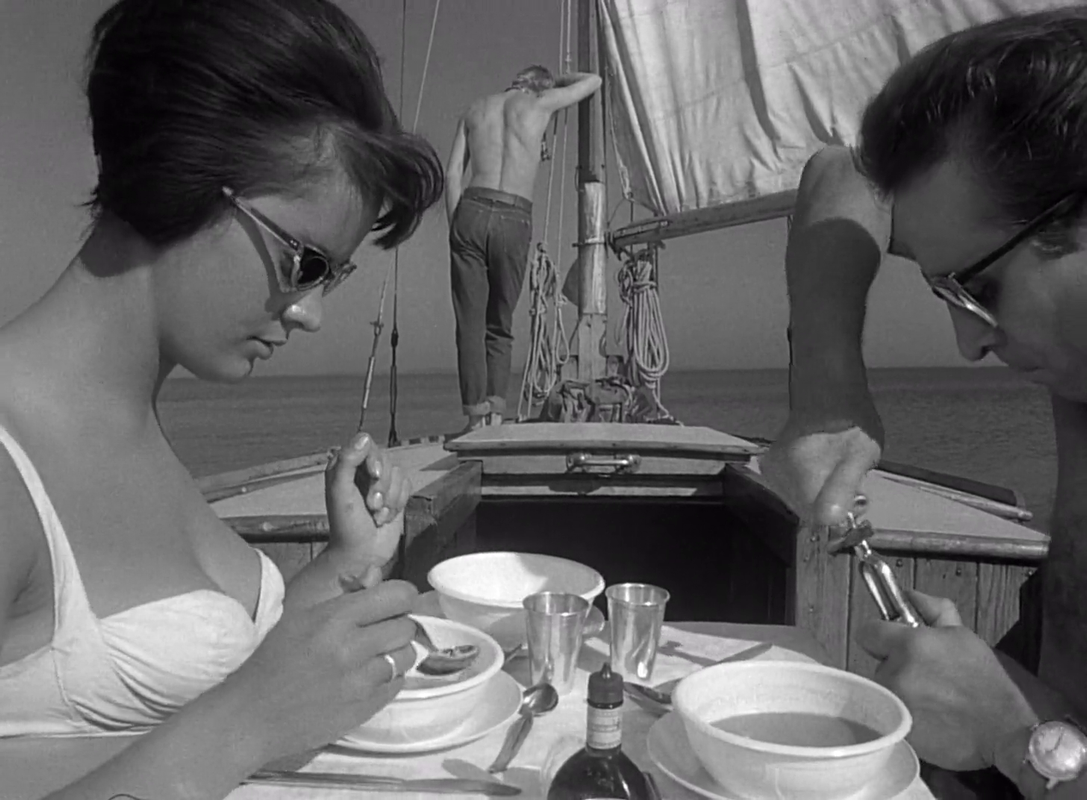
A man's hand holds a spoon at a perpendicular angle. DP: Léonce-Henri Burel.
“Time to empty our slop pails and run a little water over our faces, then back to our cells for the entire day.”
– Fontaine
view
剣 (小説) [Ken / The Sword] (Kenji Misumi, 1964)
Dec
29
Tick Tock Day
One of the kendōka kneeled on the floor in gruelling punishment faces a clock on the wall, while the other students continue their training. DP: Chikashi Makiura.
After World War II, the Japanese martial arts of #kendo was banished by the occupying forces in an attempt to “remove and exclude militaristic and ultra-nationalistic persons from life”. With that in mind, it makes complete sense that nationalist author and former kendo practitioner Yukio Mishima wrote a short story – Sword, originally published in literary magazine Shincho in 1963 – about the art.
– So what is your goal in life then?
– Satisfaction of the present. The sword, and nothing else.
Both the story and Kenji Misumi's 1964 film adaptation follow arrogant kendo student Jiro, played by sublime kabuki actor Raizō Ichikawa who also appears in an earlier Mishima adaptation, 炎上 [Enjō / The Temple of the Golden Pavilion / Conflagration] (1958).
view
Invasión [Invasion] (Hugo Santiago, 1969)
Dec
27
maté
Don Porfirio (Juan Carlos Paz) pours water from a small kettle into a maté. DP: Ricardo Aronovich.
view
A Zed & Two Noughts [Z+00 / ZOO] (Peter Greenaway, 1985)
Dec
27
Visit The Zoo Day
A zebra in a cage with the word ZOO in large blue lit capitals in the background. In the background a man. All but the lettering is black-and-white. DP: Sacha Vierny.
“In the land of the legless, the one-legged woman is queen.”
view
飼育 [Shiiku / The Catch] (Nagisa Ōshima, 1961)
Dec
26
offerings
An altar with two rotund, smiling stone statues – possibly Jizō, a bowl of rice with chopsticks stuck into it, and a Japanese soldier's photograph. The position of the chopsticks tells us that the soldier has died. DP: Yoshitsugu Tonegawa.
viewРождество обитателей леса (ca 1912)
Various beetles and a grasshopper rejoice around the Christmas tree materialised by Old Man Frost.

December 25: a Santa for #Christmas
Pождество обитателей леса [Rozhdestvo obitateley lesa / The Insects' Christmas] (Wladyslaw Starewicz, ca 1912)
Father Christmas makes a Christmas tree for the people of the forest.
Дед Мороз (Ded Moroz, or Old Man Frost) is the Slavic version of Saint Nicholas or Santa Claus. An ornament depicting the old grey climbs down a child's (or doll's) Christmas tree and sets off to the forest where he plants his magic staff to create a Christmas feast for the woodland animals.
The word “animation” means “a bestowing of life“. Like his ancestor in the arts Bernard Palissy and the ancient winter solstice celebration of the return of light that long ago spawned Christmas, Wladyslaw Starewicz's Insects' Christmas breathes life into real but inanimate beetles, dragonflies, and frogs. The illusion is complete as you effortlessly forget they are painstakingly animated.
From me to you, a little Christmas treat
Director Wladyslaw Starewicz and his daughter Irina (Irene), surrounded by several of his tiny actors. Irina, writer and director in her own right, starred in her father's WW1 short “Liliya Belgii” [“The Lily of Belgium”] (1915).

#Bales2023FilmChallenge #WladyslawStarewicz #Russia #fantasy #animation #ShortFilm #Christmas #holidays #StopMotion #insects #animals #1910s ★★★★☆
#todo
view
Празник [Praznik / The Feast] (Đorđe Kadijević, 1967)
Dec
25
Christmas dinner
Soldiers eating bread at a set table. DP: Aleksandar Petković.