settima

@settima@zirk.us

La Belle et la Bête [Beauty and the Beast] (Jean Cocteau + René Clément, 1946)

Aug

15

a cornucopia of wonder

La Belle et la Bête (1946)

La Belle (Josette Day) at a fancy table stacked with good foods and nice wines. She's cleaning her fingernails with the silverware while a chagrined Bête (Jean Marais) looks on. As magical as the story are the production and set design by Christian Bérard, Lucien Carré, and René Moulaert. They breathed a soul into almost everything, including the candelabras. DP: Henri Alekan.

– Does he crawl on four legs? What does he eat and drink?

– I've given him water to drink on occasion. He would never eat me.

Les créatures [The Creatures] (Agnès Varda, 1966)

Aug

14

Les créatures (1966)

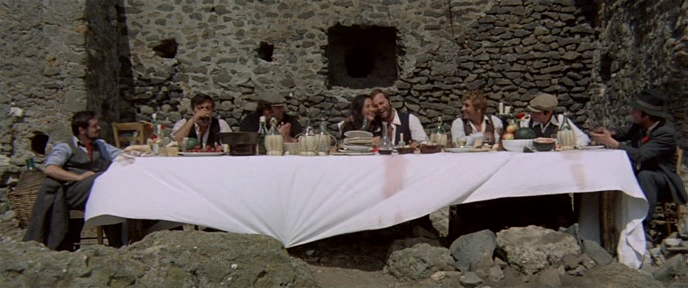
Edgar (Michel Piccoli) and Mylène (Catherine Deneuve) all dressed up for a home-cooked meal. On the wall behind them a huge framed mounted crab. DPs: Willy Kurant, William Lubtchansky & Jean Orjollet.

新宿泥棒日記 [Shinjuku Dorobō Nikki / Diary of a Shinjuku Thief] (Nagisa Ōshima, 1969)

Aug

14

Love Your Bookshop Day

新宿泥棒日記 (1969)

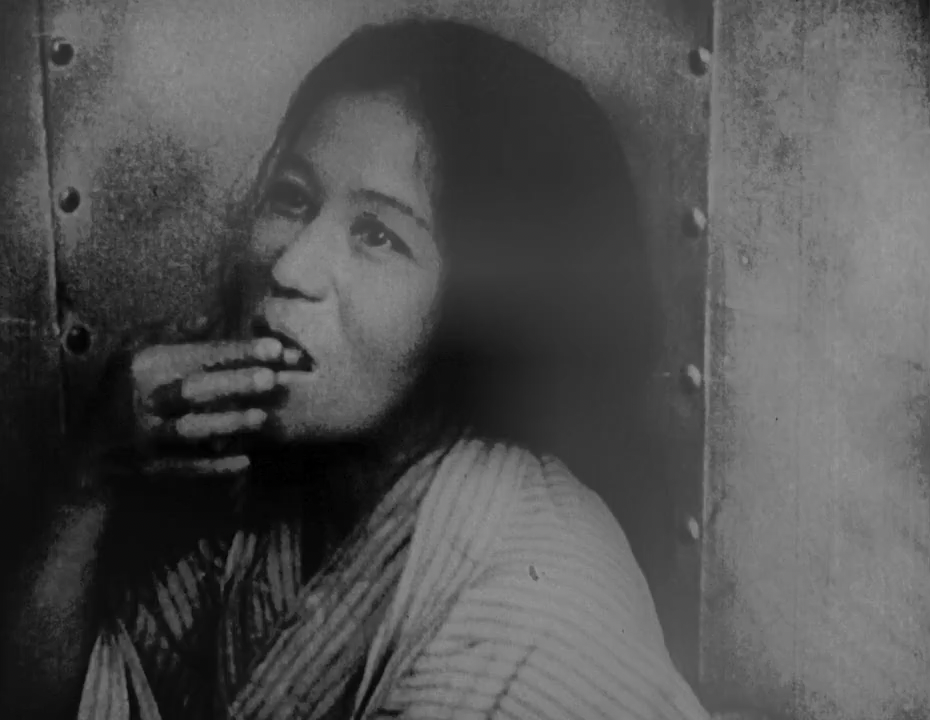
Umeko (Rie Yokoyama) in a bookstore. In the foreground a large messy pile of books. DPs: Seizō Sengen & Yasuhiro Yoshioka.

Umeko (Rie Yokoyama) believes to have caught Torio redhanded (Tadanori Yokoo, whose character has been renamed “Birdey” in the English translation), shoplifting from her bookstore. Torio however is a performance actor – and real-world Art Theatre Guild performer – and the act of stealing is part of his research. The young people's encounter sets something in motion. Together them embark on committing crimes in #Tokyo's labyrinthine #Shinjuku neighbourhood and find their mirror images in a #kabuki play.


新宿泥棒日記 is a playful, dangerous exploration of youth and rebellion in a rapidly shifting Japan.

Salón México (Emilio Fernández, 1949)

Aug

13

$120 cerveza

Salón México (1949)

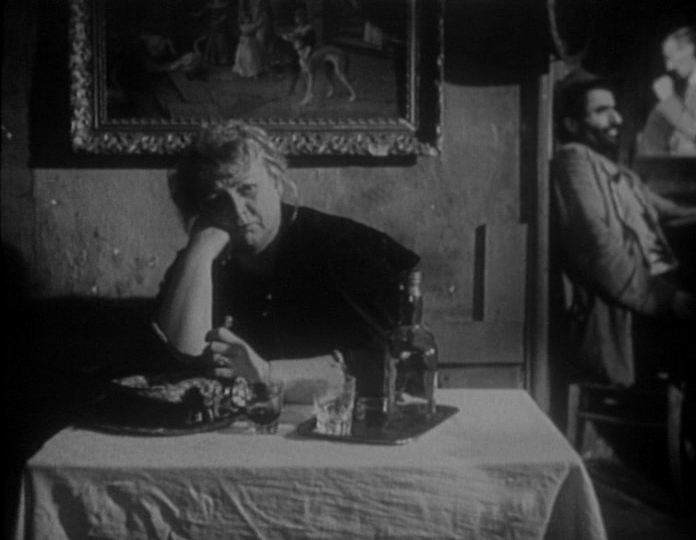
Mercedes (Marga López) sitting at a small round table at the salón. A waiter just came over to take her order. In the other room, meticulously dressed couples dance to live music. DP: Gabriel Figueroa.

El lugar sin límites [The Place Without Limits] (Arturo Ripstein, 1978)

Aug

13

Gay Uncles Day

El lugar sin límites (1978)

Pancho (Gonzalo Vega) watches La Manuela (Roberto Cobo) dance flamenco for him. DP: Miguel Garzón.

Cabaretera, a sub-genre from the Epoca de Oro (the golden epoch of Mexican filmmaking, 1930s—1950s), combines film noir with melodrama and musical numbers. Often set in cabarets (brothels), these films talk about the plight of the prostitute who – not without their pride and dignity – are forced to being the breadwinner in a poverty-stricken community.


El lugar sin límites harks back to those days. We follow the plight of La Manuela, a transvestite* who together with daughter La Japonesita works as a fichera (a dancehall performer) in the brothel run by Madame La Japonesa, La Japonesita's mother.


The return of Pancho, a hyper-macho trucker, disrupts the family regime. The trucker's attraction to the #flamenco dancing fichera is at odds with his machismo. Him being outed as a maricón (a Mexican slur for homosexual) would be the end of his world.


El lugar remains a groundbreaking film, not only in how it handles taboos like #gender roles and trans- and homosexuality, but also because it highlights how (self) destructive #machismo is in Mexican society.


Sergio de la Mora's excellently researched EL LUGAR SIN LÍMITES: Ripstein in Review delves much deeper than this little writeup here. Do read it (spoilers ahead).


*Roberto Cobo's La Manuela is transsexual. The term “transvestite” is what's used in the film and typical for its time.

Sedmi kontinent [Sedmý kontinent / The Seventh Continent] (Dušan Vukotić, 1966)

Aug

12

teevee dinner

Sedmi kontinent (1966)

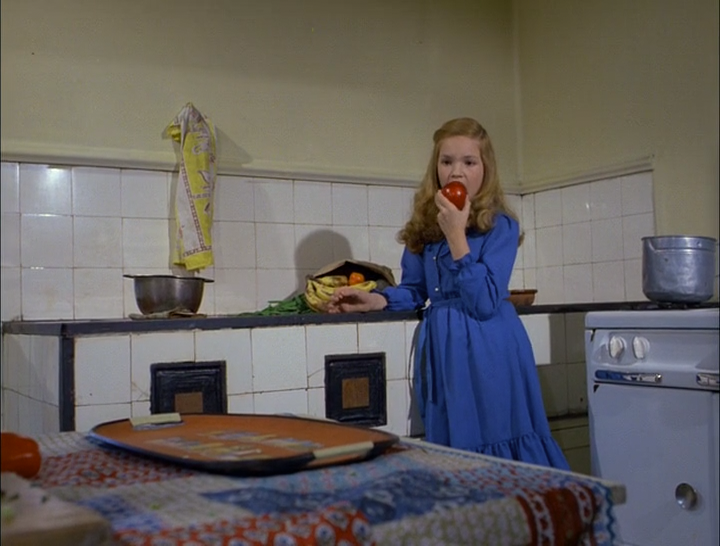
A little blond boy on a red tricycle driving past his TV-ish dinner in an empty house. DP: Karol Krška.

Alice Doesn't Live Here Anymore (Martin Scorsese, 1974)

Aug

12

National Garage Sale Day

Alice Doesn't Live Here Anymore (1974)

Tommy (Alfred Lutter III), Harold (Jefferson Burstyn), Alice (Ellen Burstyn) and Bea (Lelia Goldoni) counting out Alice's yard sale earnings. DP: Kent L. Wakeford.

After her husband is gone, Alice (Ellen Burstyn) sells her stuff and the house, picks up her son Tommy (Alfred Lutter III) and embarks on fulfilling her childhood dream of becoming a singer just like Alice Faye.

Tommy: Life is short.

Alice: Yeah, well, so are you.

Big Fun in the Big Town (Bram van Splunteren, 1986)

Aug

11

Hip Hop Day

Big Fun in the Big Town (1986)

Run-DMC sitting on a limo with a NYC license plate. We only see their Adidas (and Nikes). Under the car a half-eaten apple.

There's something really peculiarly narrow-minded about the Dutch called “verzuiling”, “pillarisation”; society is split into vertical columns and depending on your background you join certain circles. You play soccer, join a trade union, or listen to the radio in a Catholic, Protestant, or social-democratic context. Deeply socialist, (for you American-styled liberals rather extremely) leftist, and seasoned with a generous dash of subversive underground ánd highbrow culture, Dutch radio and TV broadcaster VPRO belongs to the latter.


When VPRO radiomaker Bram van Splunteren came across Beastie Boys' rock/rap crossover 12” She's On It (from the 1985 #HipHop movie Krush Groove), he knew he was onto something and he would play the Beasties and other rappers on his De Wilde Wereld alongside Oingo Boingo and The Fall.

“Some people don't know rock 'n' roll came out the same way rap came out. People would say: No, it will never last.”

– Schoolly D

Despite the VPRO boasting about their leftie open-mindedness, Van Splunteren's embrace of such lowbrow, poor people culture (not the right kind of frugal-by-choice types but the low-cultured tracksuit wearing ones) didn't sit well with the broadcaster. Minorities boasting about their accomplishments, their cars, girls, gold? That's got no place in this social-democratic-Lutheran column!


Yet time moved on and Van Splunteren was given a budget to make a TV program about that weird talking-over-drum-machines music. With a small crew that included Belgian comedian/musician Marcel Vanthilt – who would sporadicly rap with his oddball New Beat group Arbeid Adelt! – Van Splunteren explored the music from the then-still predominantly Black neighbourhoods in the Big Town: the Bronx, Harlem, Queens, while Vanthilt interviews everyone available; from a boasting LL Cool J and his grannie to a very green Biz Markie and old old old skoolers The Last Poets.


Over time, this obscure 1986 Dutch TV documentary Big Fun in the Big Town has become an essential snapshot of hip hop culture. It captures an optimism and fire elemental to survive Reagan's America and highlights the urge to continue the Black struggle that the Panthers and others set in motion.


Happy birthday, hip hop. To many more powerful years to come.

Le lit de la vierge (1969)

Marie/M. Magdalène (Zouzou) embracing a lost Jesus (Pierre Clémenti). She's wears a black tunic with a black headscarf, he a white outfit (long johns?) and a crown of thorns. She appears to speak to him. DP: Michel Fournier.

Le lit de la vierge (1969)

August 10: a Mary for #NationalMaryDay

Le lit de la vierge [The Virgin's Bed] (Philippe Garrel, 1969)

After the dust of May 68 had settled and it became clear that the promised revolution would never be, the young were lost. Filmed in an unscripted haze of drugs and dimmed hope, Le lit de la vierge brings back Jesus [Pierre Clémenti] – now mocked as an astray, confused man and representing the many once-hopeful of '68 – to the desert where he meets Marie, his mother the virgin and the prostitute Marie Magdalène, 60s scene girl Zouzou la twisteuse in a double role.

The mother/whore and hippie aspire a new revolution of sorts, exposing the beach under the pavement as a desert of contemplation.

A gif of Tina Aumont during the filming of “Le lit de la vierge”. From Frédéric Pardo's short psychedelic documentary “Home Movie, autour du 'Lit de la vierge” (1968). DP: Frédéric Pardo.

Home Movie, autour du 'Lit de la vierge' (1968)

#Bales2023FilmChallenge #PhilippeGarrel #Zouzou #PierreClémenti #TinaAumont #GroupeZanzibar #JohnCale #Nico #MichelFournier #France #Mai68 #drugs #religion #hippies #Morocco #1960s

#todo

Drak sa vracia [Dragon's Return / The Return of Dragon] (Eduard Grečner, 1968)

Aug

9

Smokey Bear Day

Drak sa vracia (1968)

Drak (Radovan Lukavský), a Caucasian man with a rough looking face and an eyepatch over his left eye. The landscape behind him is mere blurs. DP: Vincent Rosinec.

Drak [“dragon” or “devil”] returns to his village. No one understands why he came back, or where he has been. The villagers postulate smugglers and there's other drunk nefarious thoughts, but for sure they know that with the potter, the draught returned. In an unspoken ritual sung in old tongues, the grey women summon the rain. The forest, dry as tinder, has taken the cattle, all there is. Drak knows where the animals went and a deal is struck.

“Don't you recognise me?”

– Drak

Drak sa vracia speaks in mere whispers and smoky greys. The main characters – the #fire, smoke, pottery, and composer Ilja Zeljenka's often silent motif – weave their wordless presence throughout the ancient landscape; that same landscape that carved itself into the locals' being.