“No, no, geh' nicht vorbei, als wär' nichts gescheh'n,
Es ist zu spät, um zu lügen,
Komm und verzeih, ich werd' mit dir geh'n,
Wohin dein Weg auch führt,
Und die Welt, sie wird schön.”Warum läuft Herr R. Amok [Why Does Herr R. Run Amok] (Michael Fengler, 1970)
Sep
11
National Boss Employee Exchange Day
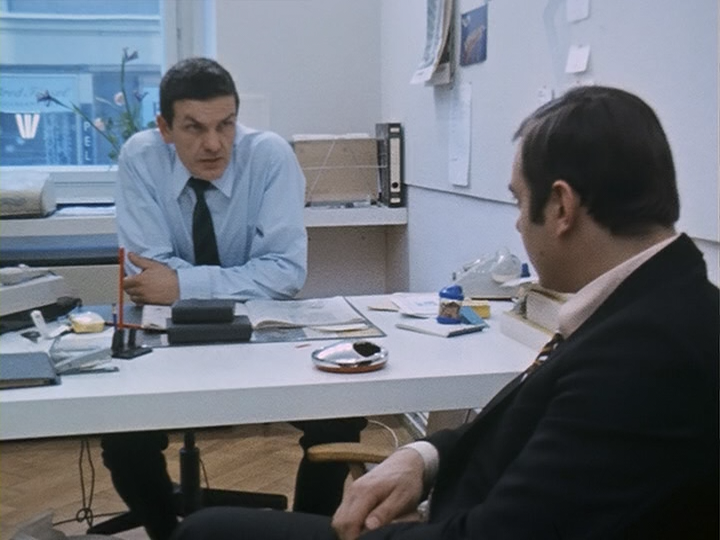
Der Chef (Franz Maron) berates Herr R. (Kurt Raab). DP: Dietrich Lohmann.
Mr R. (Kurt Raab), his full name is irrelevant, is a hardworking, almost invisible man. He laughs along when his coworkers make stale jokes to shorten the long days. He neatly completes his draftman's assignments and politely nods when the boss berates him. He smokes too much, 80 a day, and at the yearly checkup is told to cut the habit down. His son fails at school and Mrs R. wishes for nicer furniture and a skiing holiday, when Mr R. is promoted.
– Christian Anders, Geh nicht vorbei (1969)
So why does Herr R run amok?
“Are the birds gonna eat us, Mommy?”The Birds (Alfred Hitchcock, 1963)
Sep
10
chicken

Alfred Hitchcock and Tippi Hedren in a promotional photo by Philippe Halsman. Hedren, as her character Melanie Daniels, is attacked by a large crow while Hitchcock calmly enjoys a fried chicken and a glass of wine. DP: Robert Burks.
Feeling rather peckish.
Ostia [A Violent Life] (Sergio Citti, 1970)
Sep
10
National Pet Memorial Day
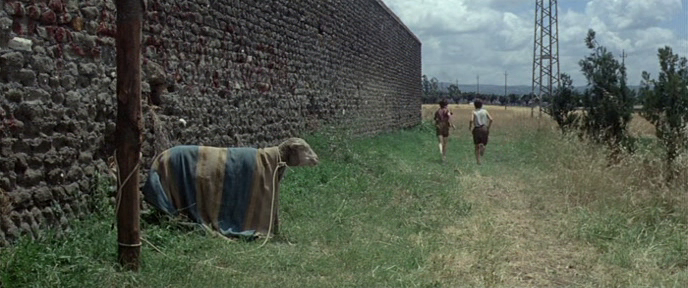
Bandiera and Rabbino and their beloved Rosina, thoughtfully covered with a woollen blanket. DP: Mario Mancini.
Bandiera and Rabbino, two young bumpkins, find that Rosina, their beloved ewe, has been butchered by their father. Years later, the two share their lives with a beautiful blonde who they found believing to be dead.
“Was ist loos? Der Hund is loose.” Stroszek (Werner Herzog, 1977)
Sep
9
German Language Day

A warm Railroad Flats, Wis. “Willcomen” [sic] for (LtR) Scheitz, Eva, and Bruno, with Mr Scheitz's nephew (Clayton Szalpinski) squeezed between his “Onkellein” and Eva. DP: Thomas Mauch.
Bruno Stroszek (Bruno S.), his friends Eva (Eva Mattes) and Scheitz (Clemens Scheitz, responsible for the fairy-tale music you hear in this film) decide to leave dreary #Berlin behind and move to #Wisconsin where the latter's nephew lives. A new life, with dreams of music and animal magnetism, awaits them there.
– Clayton
As so oft with #Herzog, the story behind Stroszek is as engrossing as the resulting film. Documentary maker Errol Morris and Herzog were fascinated by Wisconsin's own Ed Gein and wondered if Gein had dug up his own mother, as was rumoured at the time. As they would, they decided to open the poor woman's grave. Morris never showed up, and neither did Herzog but only because his car broke down en route to Plainfield, Wisconsin. Trying to get the vehicle fixed, Herzog entered the workshop of a Clayton Szalpinski.
A character in his own right, and a non-actor to boot, Clayton ended up in Stroszek as Scheitz's nephew; a MacGuffin odder than a dancing chicken.
“We're in America now.”Stroszek (Werner Herzog, 1977)
Sep
9
turkey
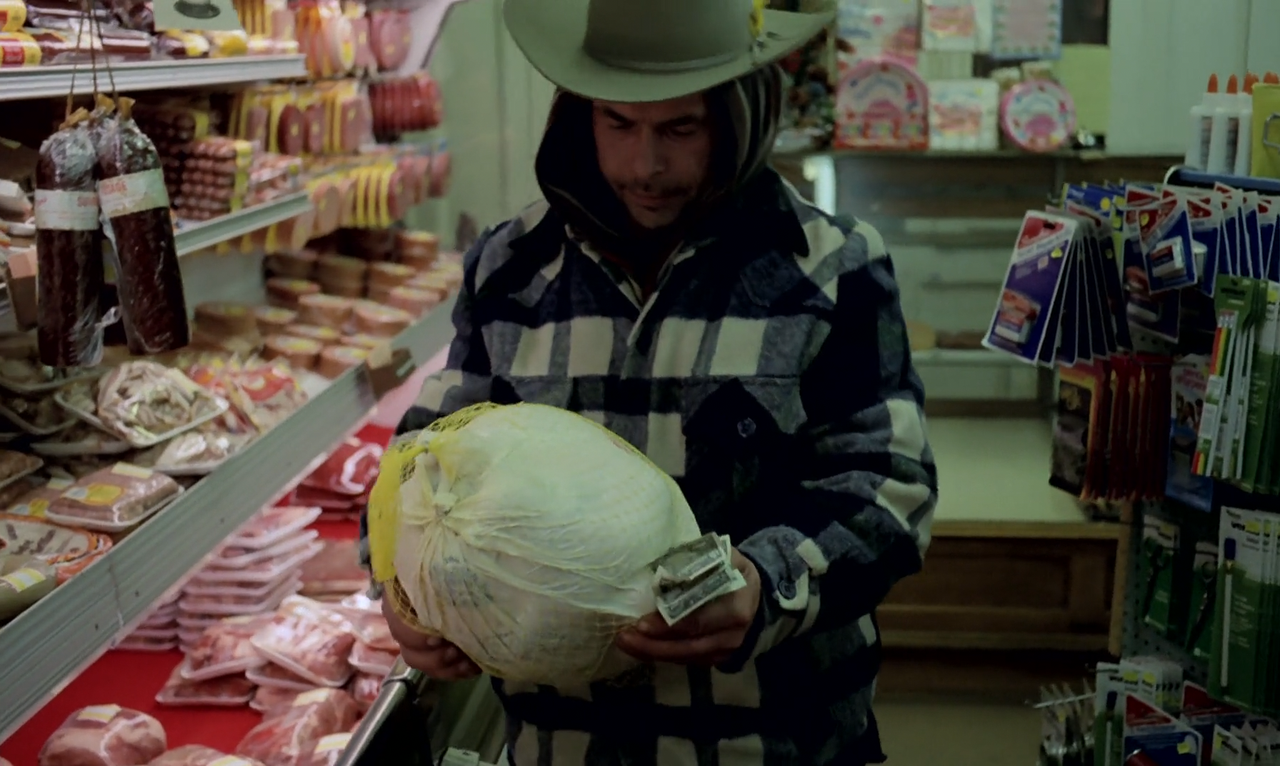
Bruno (Bruno S.) shopping in a small American convenience store. He's holding a wad of dollar bills and a huge bird that he just took out of a very opulently stocked cooler. DP: Thomas Mauch.
– Bruno S.
“Prison is good for the good and bad for the wicked. It teaches the good a lesson but only makes the wicked worse.”کلوزآپ ، نمای نزدیک [Klūzāp, nemā-ye nazdīk / Close-Up] (Abbas Kiarostami, 1990)
Sep
8
Pardon Day

Hossain Sabzian riding passenger on a motorcycle holding a large potted rose-red dahlia. DP: Ali Reza Zarrindast.
کلوزآپ ، نمای نزدیک is visual narrative illustrating a crime. A cinephile, Hossain Sabzian, pretends to be filmmaker Mohsen Makhmalbaf and slowly extorts a family into believing to star in the director's next film.
– Hossain Sabzian
An article about the case intrigued director #Kiarostami so much that he decided to film the court case against Sabzian, and ask the accused, Makhmalbaf, and the Ahankhah family to reenact some of the events.
– You want a leg or a breast? – You make the choice.To Catch a Thief (Alfred Hitchcock, 1955)
Sep
8
leg or breast

Francie (Grace Kelly) and John Robie (Cary Grant) taking a (lunch) break on the Grand Corniche coast road. DP: Robert Burks.
– You boys care for a sandwich? Got tuna fish and minced ham on rye. – No, thanks. – It's nice and cold.The Monster That Challenged the World (Arnold Laven, 1957)
Sep
7
National Salami Day

Coroner Nate Brown (Byron Kane) offering two cops a couple of nice cold sandwiches straight from one of the morgue coolers on his lunch break. DP: Lester White.
Arnold Laven's The Monster That Challenged the World is one of the earliest, if not thé earliest, example of this peculiar movie and television trope: the coroner's lunch break.
Having some cold cuts over some cold cuts never gets old. Or appetising.
“I've got it. Film star! You'd be perfect. Dark glasses, lots of red lipstick, and 100,000 rupees per picture. And if it's a Hindi film, we'll all fly to Bombay.”মহানগর [Mahanagar / The Big City] (Satyajit Ray, 1963)
Sep
6
freebie: National Lipstick Day

Edith (Vicky Redwood) applying colour to Arati's (Madhavi Mukherjee) lips. DP: Subrata Mitra.
Set in 1950s Calcutta, মহানগর is a story of emancipation in a changing society. Arati (Madhavi Mukherjee) is a housewife from a traditionalist family, who – in order to support her relatives' lavish demands – goes out to work as a door-to-door saleswoman. Slowly, she discovers her independence.
– Bani
“Just you wait, it won't be long,
The man in black will soon be here,
With his cleaver's blade so true,
He'll make mincemeat out of you!”M [M – Eine Stadt sucht einen Mörder] (Fritz Lang, 1931)
Sep
5
Jury Rights Day
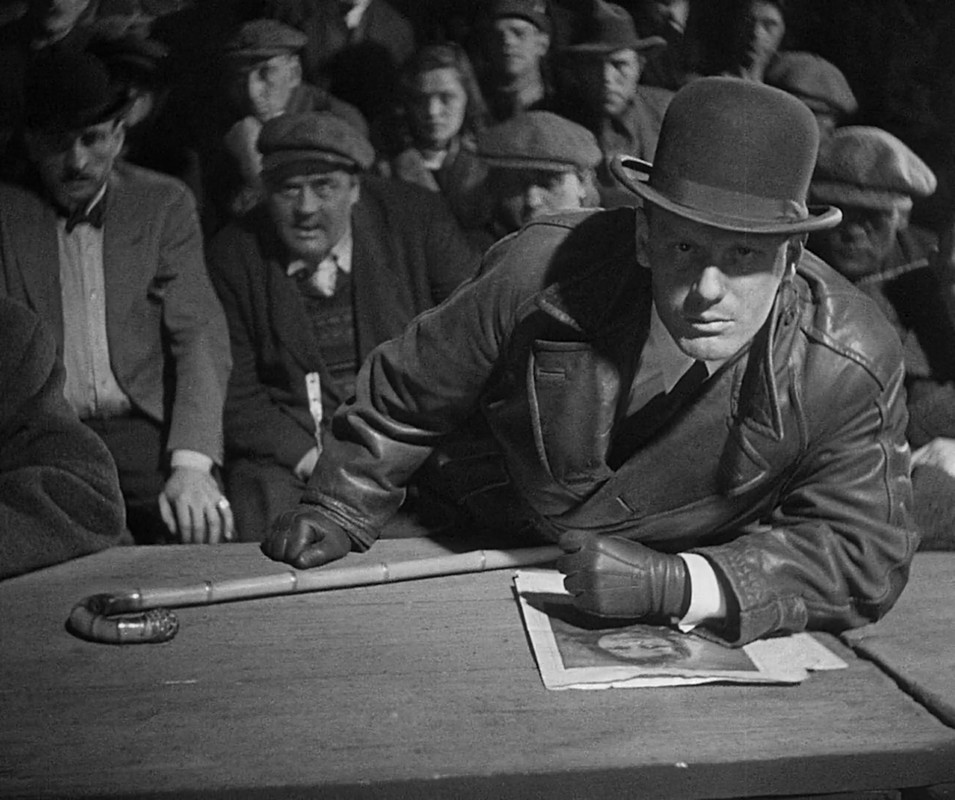
Schränker (Gustaf Gründgens) and his kangaroo court. Under his clenched fist a photograph of one of the murdered girls. DP: Fritz Arno Wagner.
– children singing