view
A Face in the Crowd (Elia Kazan, 1957)
Nov
21
1956
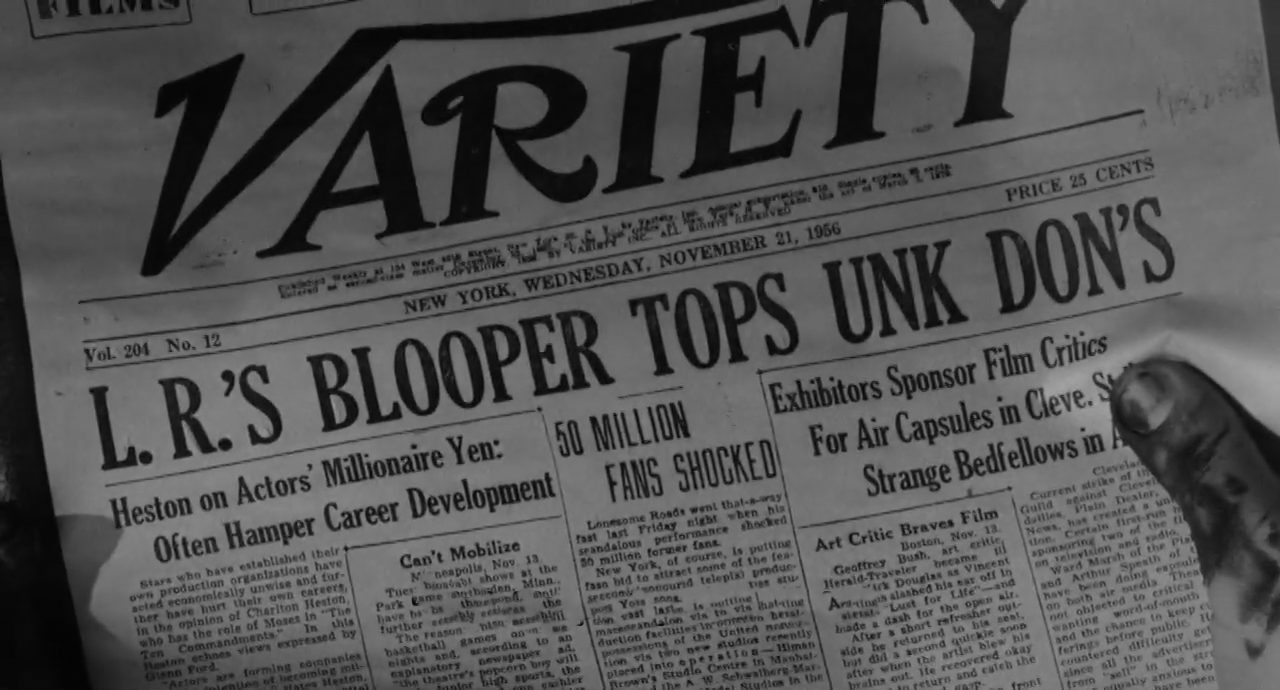
Variety blares L. R.'S BLOOPER TOPS UNK DON'S. It's Wednesday, November 21, 1956. DPs: Gayne Rescher & Harry Stradling Sr..
“I'm not just an entertainer. I'm an influence, a wielder of opinion, a force… a force!”
– Lonesome Rhodes
view
The Big Combo (Joseph H. Lewis, 1955)
Nov
15
1946
A man's hand holds up a photo negative of a black-and-white picture, showing two men and a woman, and the date 11-15-46 underneath. DP: John Alton.
“I'm trying to run an impersonal business. Killing is very personal. Once it gets started, it's hard to stop.”
– Mr. Brown
view
The Thing from Another World (Christian Nyby + Howard Hawks, 1951)
Nov
1
Scientists and crew armed to the teeth. DP: Russell Harlan.
Until November 3.
“No pleasure, no pain… no emotion, no heart. Our superior in every way.”
– Dr. Arthur Carrington
view
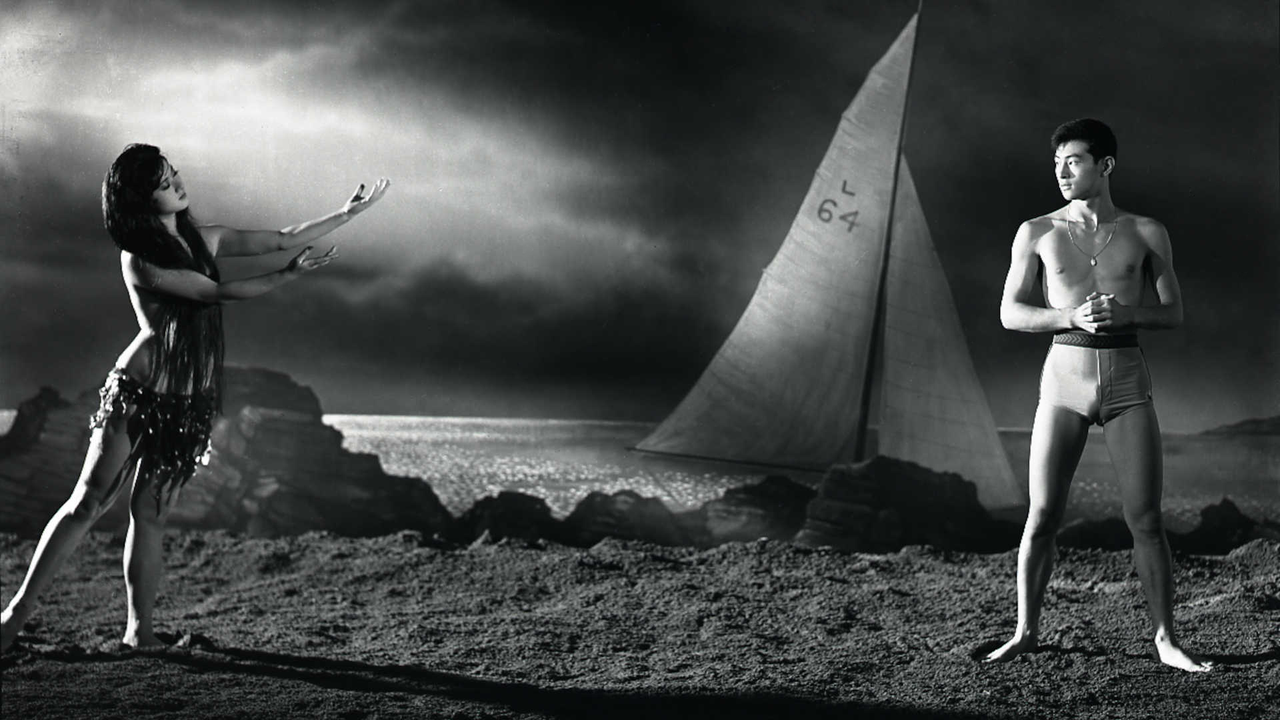
海底から来た女 [Kaitei kara kita onna / Woman from the Sea] (Koreyoshi Kurahara, 1959)
Sep
4
The mysterious sea woman (Hisako Tsukuba, who under the name Chako van Leeuwen went on to produce the Jawsploitation franchise Piranha) and a bewitched Toshio (Tamio Kawachi). Note how the boat's sail resembles a shark's dorsal fin. DP: Yoshihiro Yamazaki.
A strange woman appears in the life of a young man. He falls in love with her, but the fishermen know. She's the wife of a shark killed years ago. And she's out for revenge.
Doing Hooptober parallel to Bales. Expect some contamination of the September/October posts.
view
Mon oncle (Jacques Tati, 1958)
Aug
29
Mr Hulot and three women enjoy an outdoor lunch in Villa Arpel's concrete backyard. A woman in furs laughs heartily, head thrown back, with Hulot looking into her open mouth, halting a woman reaching for a carafe mid-movement. The third woman, in an avant-garde Eastmancolor-red poncho, calmly smokes through her cigarette holder. DP: Jean Bourgoin.
view
Mon oncle (Jacques Tati, 1958) / Koolhaas Houselife (Ila Bêka + Louise Lemoine, 2008)
Aug
29
grey
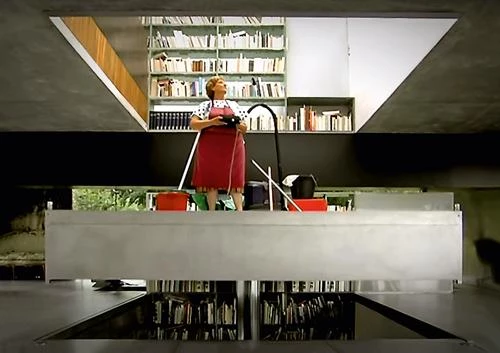
A delivery man in front of the gates of Villa Arpel (via), and custodian Guadalupe Acedo working the lift in Maison à Bordeaux. DP of Mon Oncle: Jean Bourgoin.
[A favourite] colour: grey*
Approaching the 60s, Mr Hulot finally switches from black-and-white to colour. Suddenly, we see that his suit is a beigeish grey and so is the Arpels' house, that modernist masterpiece designed by Tati. The beloved luddite struggles with hypermodern people and their hypermodern constructs, much alike the future Hulot from Playtime (1967).
– A house like yours must be such a job!
– Oh, a leaf! Ah, yes it's a chore.
– Admit it, you love it.
In similar absurd fashion, Guadalupe Acedo, cleaning lady, works her way through Rem Koolhaas' Maison à Bordeaux (1998) in Bêka and Lemoine's Koolhaas Houselife (2008). Too steep are the stairs, too leaky everything else. Levelheaded, she does her thing; a small beacon of romantic practicality in a world of absurd efficiency.
view
A Face in the Crowd (Elia Kazan, 1957)
Aug
22
milkshake
A young woman with an impressive coif, a fur stole and a large milkshake peeks from around a corner with a surprised look on her face. DPs: Gayne Rescher & Harry Stradling Sr..
“Shucks, I could take chicken fertilizer and sell it to them as caviar. I could make them eat dog food and think it was steak. Sure, I got 'em like this…”
– Lonesome Rhodes
view
Nineteen Eighty-Four (Rudolph Cartier, 1954)
Aug
18
indigo
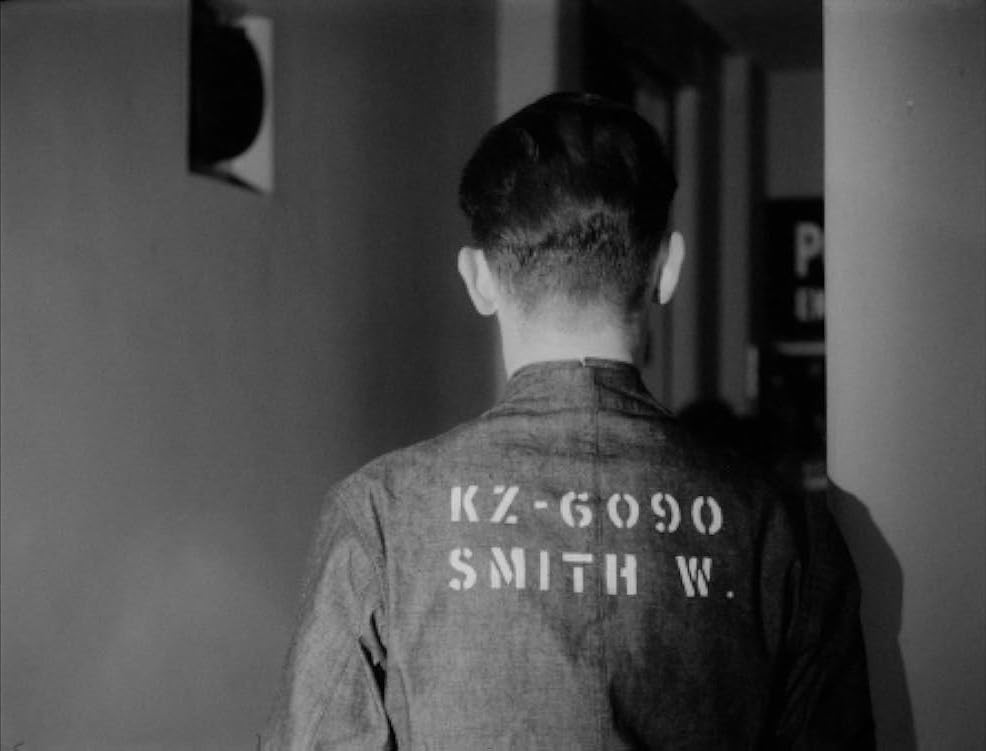
Winston Smith (Peter Cushing). We only see his frail looking back with the identifier KZ-6090, and his name SMITH W.
Indigo, in food or fashion*
“He moved over to the window: a smallish, frail figure, the meagreness of his body merely emphasized by the blue overalls which were the uniform of the party. His hair was very fair, his face naturally sanguine, his skin roughened by coarse soap and blunt razor blades and the cold of the winter that had just ended. “
– George Orwell, Nineteen Eighty-Four (1949) (via)
view
Lola Montès (Max Ophüls, 1955)
Aug
14
Bavaria
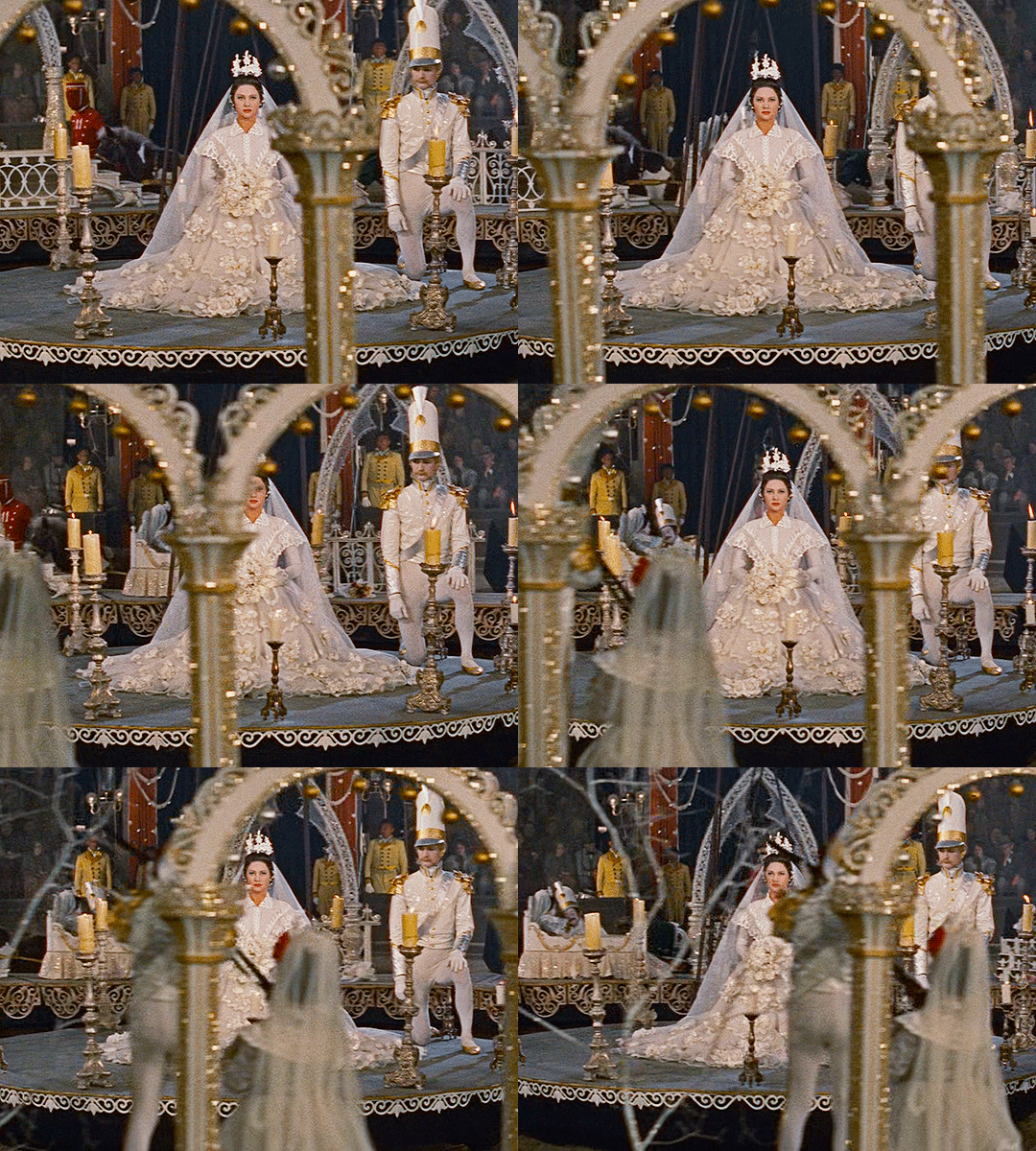
Celebrating Oktoberfest [in September/October] and the Bavarian royals [rip]: a royal character or family*
“The painter takes his time. He doesn't like her dress. He doesn't like her gloves. One day he asks her if she dares pose for him – all in pink. She dares! And the king, enraptured by her pose, offers her a palace!”
– circus master
Maria Dolores Porriz y Montez, Countess von Landsfeld, Lola Montès for short, now a circus attraction, once the mistress to Ludwig I, King of Bavaria. While her fellow circus performers play Lola's former lovers, the ringmaster tells her story.
view
Du côté de la côte [Along the Coast] (Agnès Varda, 1958)
Aug
9
yellow
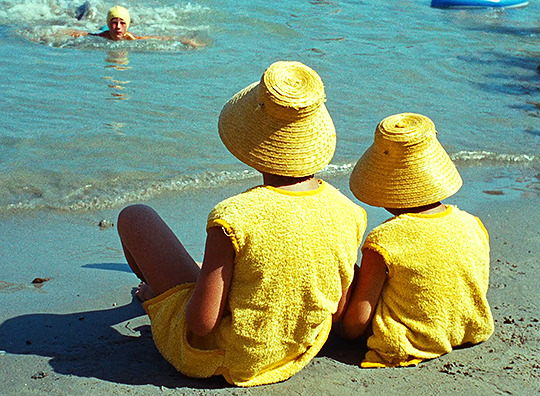
Yellow, in food or fashion*
“Tourists prefer the trendy colors, yellow and blue. Pacing fancies, hotels are painted yellow and blue. Blue wins. All women want to be fashionable. All women wear blue, except the English, those learning to swim, and the Germans, who are dedicated to green.”
– narrator


.png)

.png)