“The reality is that we do not wash our own laundry; it just gets dirtier.”Serpico (Sidney Lumet, 1973)
Jul
30
National Whistleblower Day

The cover of the Austrian film magazine “Neues Filmprogramm”. A red-filtered lobby card of Frank Serpico (Al Pacino) and his partner (F. Murray Abraham, uncredited) during police proceedings. DP: Arthur J. Ornitz.
In the late 1960s, Frank Serpico worked as a plainclothes cop for the #NYPD. He spoke out when he uncovered systematic, widespread #corruption within the force, but his findings were ignored. In 1970, Serpico cowrote a page 1 article for the New York Times about the problem, which led to the instalment of the Commission to Investigate Alleged Police Corruption aka the Knapp Commission.
– Frank Serpico
The following year during a drug-related arrest attempt, he was shot in the face under shady circumstances. This is where Sidney Lumet's Serpico, based on Peter Maas and Frank Serpico's book of the same name, starts.
1970s
“Ich werde mich entschlossen verirren.” Die Angst des Tormanns beim Elfmeter [The Goalie's Anxiety at the Penalty Kick] (Wim Wenders, 1972)
Jul
28
National Soccer Day

Trainer, reserve players and goalkeeper Bloch on the bench after the latter has been removed from the match. Bloch (Arthur Brauss) has his upper body turned away from the others' and sits with only half of his backside on the bench. DP: Robby Müller.
A lot of #soccer there's not, in Wim Wenders' Die Angst des Tormanns beim Elfmeter. What we do have happens almost right at the start. After a foul, the titular goalkeeper Bloch (Arthur Brauss) is removed from the match. Frustrated he leaves and finds himself roaming the streets of #Vienna where he picks up boxoffice girl Gloria (Erika Pluhar). In the morning he kills her and travels to the countryside, waiting for the police to arrest him.
– Peter Handke
Die Angst is an early, perfect example of Junger Deutscher Film (”New German Cinema”). Its cinematic thanks to Robby Müller's observant eye and Peter Handke's precise language, both describing scenes and performers as if observed through a fourth wall.
A very slow burning road movie, a Taxi Driver in reverse if you will, that does without the neurotic showmanship of its Hollywood counterpart.
Moć [Power] (Vlatko Gilić, 1973)
Jul
25
Threading The Needle Day

One of the men, threading the needle. He's young, bearded, and shirtless and in what appears to be a cave or cellar. DP: Ljubomir Ivković.
Slobodan Ćirković aka Roko was (or is? I cannot find a lot of information online) a Serbian hypnotist capable of making people painlessly self-inflict torment. In Vlatko Gilić's short and rather disturbing Moć, Roko initiates a large group of men to thread a needle and slowly, going from him to the next to the other, connect the one thread through their bodies until all of them are stitched into one.
Strangely homoerotic and determinately violent, Moć feels deeply rooted in the #Serbian psyche. There's beauty and an unflinching élan-vital under the skin, a tenderness that comes with great, unmentionable #pain, love and death.
“It's you.”Flammes [Flames] (Adolfo Arrieta, 1978)
Jul
19
National Barbara Day

Barbara (Caroline Loeb) waking up to her fireman. DP: Thierry Arbogast.
Barbara wakes up believing a fireman entered her bedroom through the window. Her father reassures her there's nothing, just a children's story. Years later, the adult Barbara (Caroline Loeb), grown up, withdrawn, living with her father (Dionys Mascolo), tutor, half brother (Pascal Greggory), and a persistent longing for her fireman, sparks a scheme that forces the fire brigade to come to their house and climb through her window once again.
Flammes has a strange, stilted quality to it which reminds me, not in the least because of the presence of Geoffrey Carey as the restless American who travels with his own firefighter suit, of Raúl Ruiz's staged cinematic language. As in Ruiz's The Territory (1981), the characters drift in and out of space, and as in its half brother Der Stand der Dinge (Wim Wenders, 1982) we're left with wonderfully lingering performers who seem detached from, yet devoted to, their raison d'être.
Le temps d'une chasse [Once Upon a Hunt / The Time of a Hunt] (Francis Mankiewicz, 1972)
Jul
17
after hours coffee

A Hopperesque glimpse through a corridor reveals a young woman (Frédérique Collin) sitting at a mostly empty dinner table. There are two coffee cups and a fruit bowl, and a bare bulb hanging from the ceiling. DP: Michel Brault.
Flammes [Flames] (Adolfo Arrieta, 1978)
Jul
15

Barbara (Caroline Loeb) – in a patterned firetruck-red dress – descends a grande staircase. At the bottom of the stairs a long, beautifully set table with well-dressed guests. The seat at the head of the table is empty. DP: Thierry Arbogast.
“The five flavors dull all the tastes.”少林三十六房 [Shao Lin san shi liu fang / The 36th Chamber of Shaolin] (Chia-Liang Liu, 1978)
Jul
8
rice
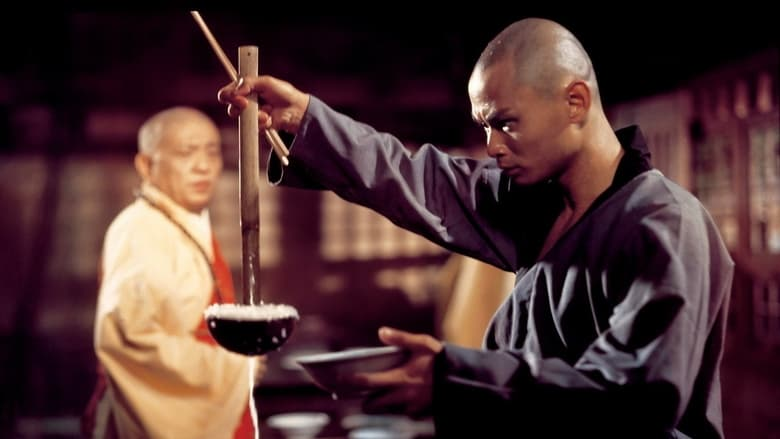
With the utmost focus, Monk San Te (Chia-Hui Liu aka Gordon Liu) carefully handles a large ladle with watery rice. His sceptical sifu (Hung Wei) looks on. DPs: Yueh-Tai Huang & Arthur Wong.
“Werdet stolz auf eure Homosexualität! Raus aus den Toiletten, rein in die Strassen! Freiheit für die Schwulen!”Nicht der Homosexuelle ist pervers, sondern die Situation, in der er lebt [It Is Not the Homosexual Who Is Perverse, But the Society in Which He Lives] (Rosa von Praunheim, 1971)
Jul
6
National Daniel Day
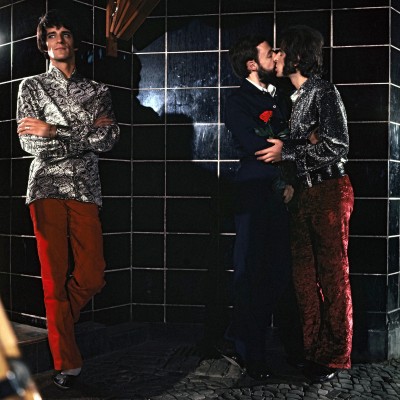
A gay couple kissing on the street in front of a black-tiled Berlin bar. A third gay man nearby looks away. DP: Robert van Ackeren.
Daniel (Bernd Feuerhelm) is a young man in #WestBerlin exploring his homosexuality. Initially he opts for a spießbürgerlich, petit-bourgeois, almost heterosexual affair. He then probes further, swings by Berlin's public toilets and pools. Only when he encounters a leftwing gay commune he finds that pride, not conformity, is his way of living his life.
Von Praunheim's Nicht der Homosexuelle ist pervers is a plea for rebellion and visibility. For revolt and love. A wakeup call for gays and straights alike. Such a stir this film pamphlet made it became the blueprint for West-Germany's gay liberation movement.
“An diesem Tag war das Bild, drei Monate nach Beginn und 67 Arbeitstagen fertig.”Ein Bild von Sarah Schumann [A Picture of Sarah Schumann] (Harun Farocki, 1978)
Jun
26
National Sarah Day
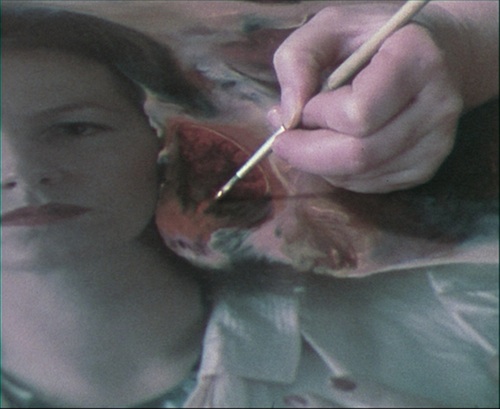
A close-up of the artist's hand at work. More stills and details about this film on Frieze. DP: Ingo Kratisch.
Commissioned for a West-German TV series called Kunstgeschichten (litt. both “art stories” and “#art histories”), filmmaker Harun Farocki visits artist Sarah Schumann in her #Berlin studio.
– narrator
The resulting documentary shows the process of creating one art piece over the course of nine weeks. Schumann's work in that period consists of collage portraits of women important in her life.
“I paint what I like when I like, and where I like.” A Bigger Splash (Jack Hazan, 1973/74)
Jun
24
Swim A Lap Day
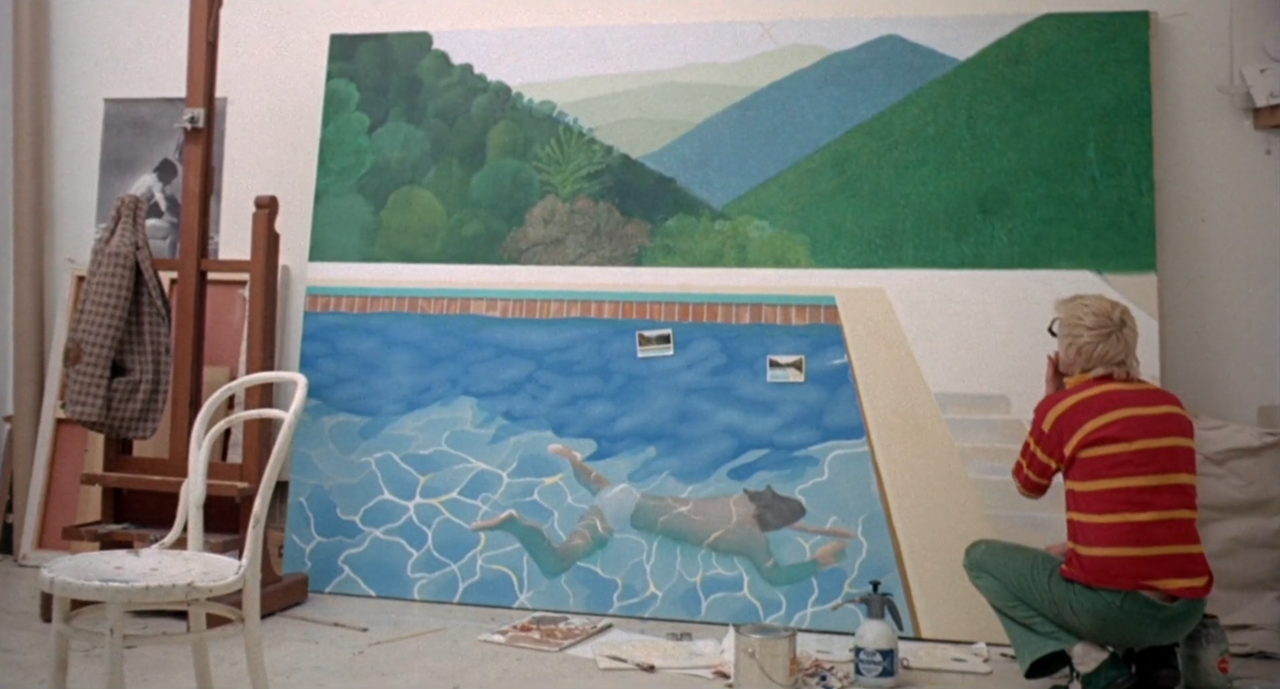
David Hockney as himself working on his painting Portrait of an Artist (Pool with Two Figures) (1971—1972). Two photos are pinned directly to the canvas. Yet unpainted is a figure on the poolside wearing a pink jacket, artist and Hockney's former lover and muse Peter Schlesinger. Hockney almost occupies the space of the missing figure. DP: Jack Hazan.
A Bigger Splash is the name of one of painter David Hockney's best known works and part of a series of pool portraits of the artist's close friends, one of them his lover Peter Schlesinger, an artist in his own right. When in the early 1970s the relationship between the two men started to unravel it affected #Hockney so much it almost rendered him incapable of working.
– David Hockney
While going through Polaroids he found that two of the shots, one of a man #swimming underwater, the other of a man standing on a poolside, fell into the composition he was looking for. The resulting Portrait of an Artist (Pool with Two Figures) – where an unknown man can be seen swimming towards Hockney's fully-dressed former lover – bears similarities to Renaissance paintings where the composition of human figures, landscape, and perspective culminate in proto-cinematic storytelling.
Cinematographer and filmmaker Jack Hazan juxtaposes David Hockney working on Portrait of an Artist (Pool with Two Figures) with speculative scenes about the creation of the work and the disintegration of Hockney's and Schlesinger's relationship. It did create a splash, in particular in its ordinary depiction of a homosexual relationship.
A Bigger Splash is of course not the only (pseudo) documentary about an artist and his or her life, but one of the very few honest ones. The struggle to create is not romanticised, nor is the intimate relationship between artist and muse a playground of lazy, perverse speculation. As Hockney creates, destroys, and recreates his Pool, so we all destroy our lovers to bloom again.