view
Dark Star (John Carpenter, 1974)
Jun
23
space lunch
The men enjoying a joyless lunch, consisting of something semi-liquid in a squeeze packet. DP: Douglas Knapp.
“Today over lunch I tried to improve morale and build a sense of camaraderie among the men by holding a humorous, round-robin discussion of the early days of the mission. My overtures were brutally rejected. These men do not want a happy ship. They are deeply sick and try to compensate by making me feel miserable.”
– Sgt. Pinback's video diary
view
Umut [Hope] (Yilmaz Güney + Şerif Gören, 1970)
Jun
18
Cabbar (Yilmaz Güney, center), his travel companions, and their hosts share an opulent meal. DP: Kaya Ererez.
“I left forty lira at home, the family is hungry now.”
– Cabbar
view
Dark Star (John Carpenter, 1974)
Jun
17
International Surfing Day
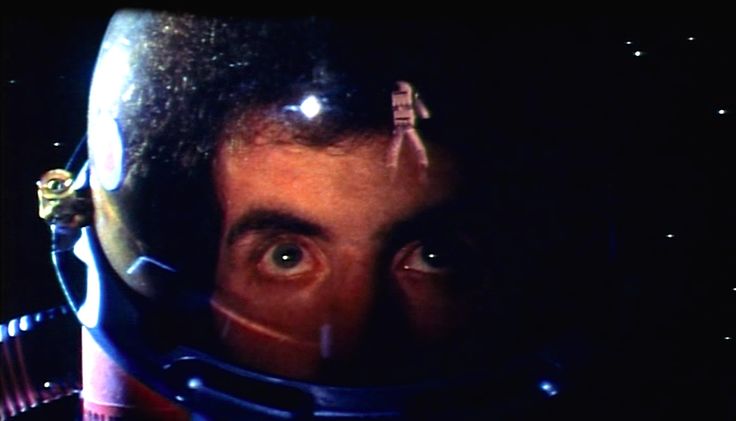
Lt. Doolittle (Brian Narelle) dreaming of catching that wave. DP: Douglas Knapp.
On the other end of outer space, far far away from existentialist odysseys and crypto-fascist space operas, there's a little stoner cosmos where a small, dilapidated starship manned by long-haired freaks drifts about.
“You know, I wish I had my board with me… even if I could just wax it once in a while.”
– Lt. Doolittle
Dark Star started out as a highly ambitious, underfunded student film that, in a blessed pre-Lucas, pre-blockbuster universe, got recognised for its #counterculture glory. In the early 70s, when #surfing was not yet mainstream and a handful of restless pioneers continued west despite the lack of mainland, a cross-pollination between beach blond daredevils and stoner culture happened.
view
Lisztomania (Ken Russell, 1975)
Jun
16
National Richard Day
“No, Wagner! Stay in Hell where you belong!”
– Franz Liszt
view
Général Idi Amin Dada: Autoportrait [General Idi Amin Dada: A Self Portrait / No One Can Run Faster Than a Rifle Bullet] (Barbet Schroeder, 1974)
Jun
9
National Heroes Day Of Uganda
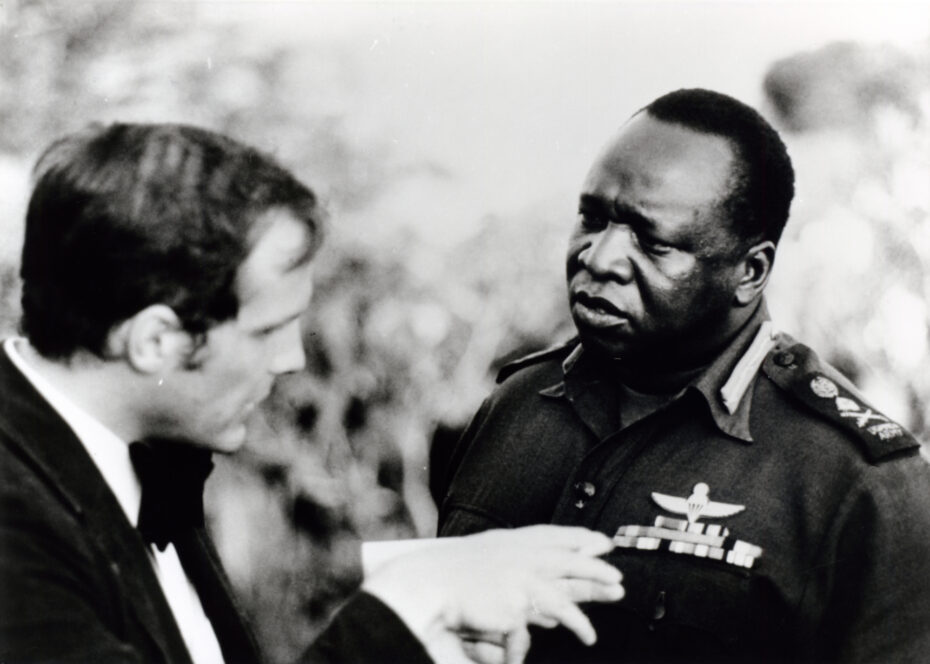
Schroeder in tuxedo interviewing General Idi Amin Dada Oumee. Even in the context of the scene, Schroeder just came from a gala event, the tuxedo is a statement of assumed superiority. DP: Néstor Almendros.
It's easy… no lazy to put this documentary away as a failed Idi Amin propaganda project. In 1974, German-Swiss Barbet Schroeder, privileged son of a diplomat, already knew more than enough about how to select framing and manipulate timing. The result, Général Idi Amin Dada: Autoportrait, is a prime example of the neo-colonialist gaze.
“You film. Film helicopter.”
– The General explaining a director's one and only task
Amin, clearly not speaking his native language, tries to explain his plans for #Uganda. The camera (Spanish cinematographer) moves in on his gesturing hands, then a jump cut (French editor) to soldiers who – instructed in English – seem unsure of what is asked of them. When (in the copy I watched) people speak in Swahili, no translation is provided and the portrayed are little more than undeveloped, exotic backdrop. Everything seems to be a joke to Schroeder: the air force's MiGs, Amin and his higher-ups joining tribesmen in dance, even the President's children are used to exemplify the stereotype of the overly virile, primitive African male.
Amin was, as Schroeder is, a product of Europe's Scramble. With the difference that, although bloody and despicable, Amin's strategy was not to embolden the West's moribund empire.
view
Grands soirs & petits matins [May Days] (William Klein, 1978)
Jun
6
National Higher Education Day
Students discussing at the Sorbonne. DPs: William Klein & Bernard Lutic.
A ripple went through France in the early months of 1968. It started when the Communist and socialist party joined forces in an attempt to remove President De Gaulle from office. A month later, students at Nanterre (a Parisian university) teamed up with poets, musicians and small leftist groups to discuss class discrimination and political bureaucracy on campus. The meeting was peacefully disassembled but tensions remained. In May, Sorbonne students stood up for Nanterre, by then shut down. Then, police invaded the university and 20 000 stood up against the police.
“Convert all Parisian universities into reception centres for the revolutionary youth of the whole world.”
– student proposal
Somewhere in that crowd were those whose interest went beyond the main spectacle: the toppling of the new ancien regime. A #JeanRouchian anthropologist of sorts, artist, photographer and filmmaker William Klein pushes the eye through the masses. But it's also his eye; each frame is a Klein. However, we see not a documentary. Sound is asynchronous. Suddenly, it's night and flames lick the black sky. When bricks fly, frames follow. And then… the end.
view
Lemora: A Child's Tale of the Supernatural (Richard Blackburn, 1973)
Jun
4
meat
A fancy looking silver plate with what appears to be raw meat. DP: Robert Caramico.
“Wouldn't you rather I did it out of love, than have one of those wood things do it out of their own animal hungers?”
– Lemora
view
Sinong lumikha ng yoyo? Sinong lumikha ng moon buggy? [Who Invented the Yoyo? Who Invented the Moon Buggy?] (Kidlat Tahimik, 1979)
May
30
National Creativity Day
Kidlat Tahimik test driving his moon buggy, closely followed by faithful crew member Gottlieb (Kidlat Gottlieb Kalayaan). DP: Kidlat Tahimik.
“If you don't eat too many Gummy Bears you could be my co-pilot.”
– Kidlat Tahimik, speaking to a budding crew member
Sinong lumikha ng yoyo? is a remarkable display of imaginative filmmaking. Together with Kidlat we ponder about practicalities, suddenly see connections that were obscured by too much thinking, and realise all the new possibilities we have in life. Part documentary, part animation, part fantasy, part sci-fi, Kidlat transports us to yet unexplored spaces!
view
Grauzone [Zones] (Fredi M. Murer, 1979)
May
29
Mount Everest Day
Julia (Olga Piazza) waking from a unusually deep sleep. DP: Hans Liechti.
Sie fallen unerwartet in einem traumlosen Schlaf.
The third space, the “grey zone” – both this film's title and a descriptive term for an undefined neutral zone – is where the Bergler have become technology dwellers, where they live on summits made of concrete instead of rock. Where rumours about a #pandemic stir an ancient, unnamed fear. And symptoms: the sudden urge to wander out in nature, an acute melancholy, an overall hyper awareness. A young, prosperous couple become infected and pick up secret radio transmissions. What they believed was concrete, solid, immovable, suddenly shows signs of a shift.
view
Cuadecuc, vampir (Pere Portabella, 1971)
May
26
World Dracula Day
Lucy (Soledad Miranda) in bloody embrace with Dracula (Christopher Lee). DP: Manel Esteban.
A black forest. A man walks through, holding a smoke machine. Then a carriage with a familiar coachman. Dracula! Where are we? No, not 19th century #Transylvania. The film stock reveals bullet holes in ancient walls, and beyond these walls a ladder, maybe scaffolding. A pneumatic drill, more crew members, lights, a clapperboard. Are the characters aware of that? Them seem to interact with the disturbance yet oblige to the interruptions of the movie set. In a state of hypnopompia, guided by kuroko, maybe?
“cut”
Pere Portabella created a hyper-reality with his Cuadecuc, vampir. A director dismantles the man-behind-the-curtain, Franco, the other #Franco while setting up scaffolding for the next Spain. Everything's a reality, or an illusion, then nothing is.