“Don't laugh at Gavino. Hands on your desks! Today is Gavino's turn. Tomorrow will be yours.”Padre padrone [My Father My Master / Father and Master] (Paolo + Vittorio Taviani, 1977)
May
23
freebie: National Sons Day
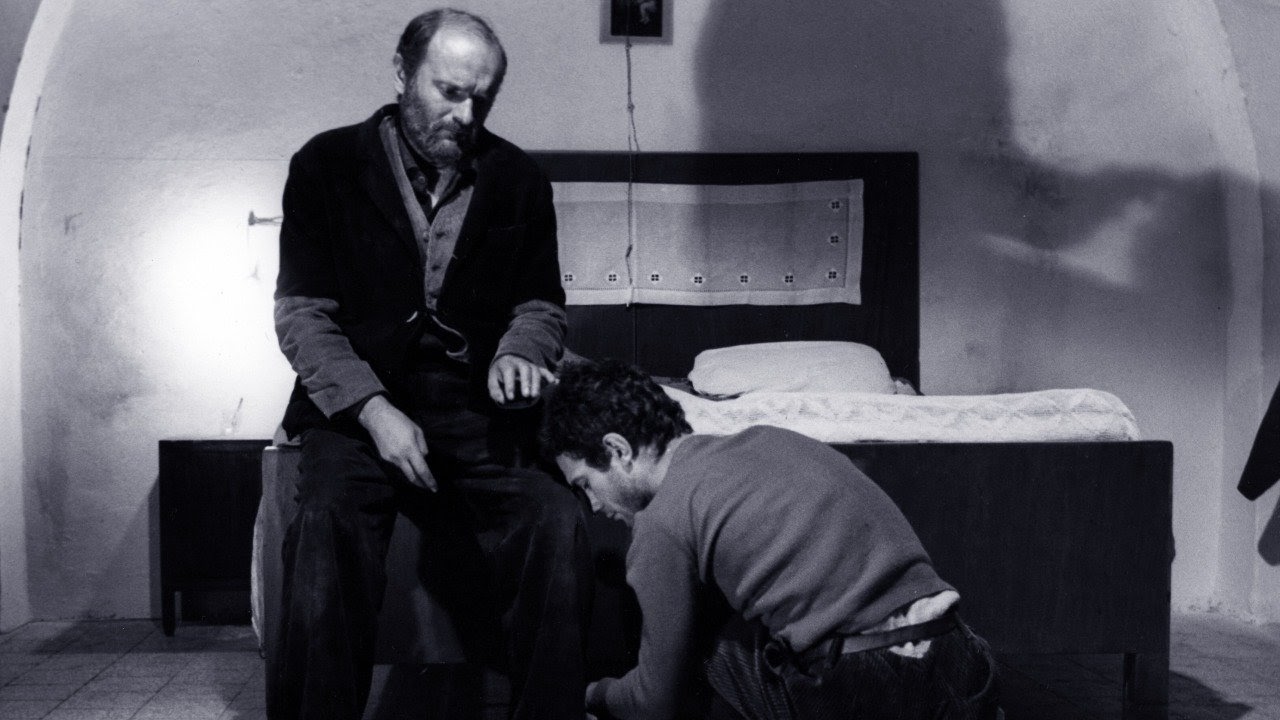
Father (Omero Antonutti) and son (Saverio Marconi). The son, an adult here, kneels and rests his head on his father's knee. The father, perched on the edge of a bed, looks down on the young man. DP: Mario Masini.
Not a film you can be prepared for, Padre padrone. The author, Gavino Ledda, hands a stick – that stick – to the actor who plays his part. There we are, in Sardinia, beautiful Sardinia. A boy in class, learning. His father barges in: the boy must attend the sheep, or else. From that moment on we become that boy Gavino. Life's cruel on the island, but his father, his master, is worse. But that's how it is, there's sheep to herd. When Gavino enlist in the army, he encounters a new world. The precise world of electronics, other people, other sounds, the Italian #language. When he returns home, he finds his father a small man.
– father
In a 1977 New York Times article the Taviani's are cited as seeing Gavino in the same light as #Truffaut's L'Enfant sauvage (1970) and #Herzog's Kaspar Hauser (Jeder für sich und Gott gegen alle) (1974). However, the Sardinian boy's outsiderness is not caused by estrangement, but an immense loneliness that cannot be put into words. This is why Ledda's newfound language is such an important tool. It's not a stick, or a fist, or a dead snake. It's the foundation of his Home.
1970s
“Here Santa opens a factory with 1000 workers” Dejlig er den himmel blå [Lovely Is the Blue Sky] (Jon Bang Carlsen, 1975)
May
19
Malcolm X Day

The Julemandshæren (“Santa Claus Army”) at Magasin, just after their arrest (image credit: Mother Jones, Dec. 1977). The performance was archived for prosperity in the documentary Dejlig er den himmel blå. DPs: Jimmy Andreasen, Morten Bruus, Dirk Brüel, Teit Jørgensen & Freddy Tornberg.
'Twas the week before Christmas. Not too far from Copenhagen a helicopter lands, carrying #SantaClaus and a Christmas angel. A small welcome orchestra plays carols, after which the party makes its way to the Danish capital. There, more Santas join the duo.
– banner next to a Julemandshæren-occupied factory
Over the course of several days they bring cheer, song and hot chocolate to delighted Copenhagen Christmas shoppers. Then they show up at a local bank, demanding low-interest loans. Then, in support of the laid-off workers, they unroll a large banner at the recently shutdown General Motors factory. On the final day, Santa Claus visits Magasin, the Danish version of Macy's. In the true spirit of Christmas the Julemandshæren hands out the store's books to thrilled customers. Magasin staff is not amused. Some of them start pummelling the Santas, ripping off beards to prove that these are crooks, not real #Santas. Small children are in tears, their dreams of a just world shattered.
The Santas were a gift to the workers from Solvognen, Fristaden Christiania's anarchist theatre troupe. With disruptive, meticulously planned performances they sought to bring attention to social issues such as worker's rights, the massacre of Wounded Knee and – as late as 2006 – Guantanamo Bay.
“Esto Perpetua”Idaho Transfer (Peter Fonda, 1973)
May
17
National Idaho Day
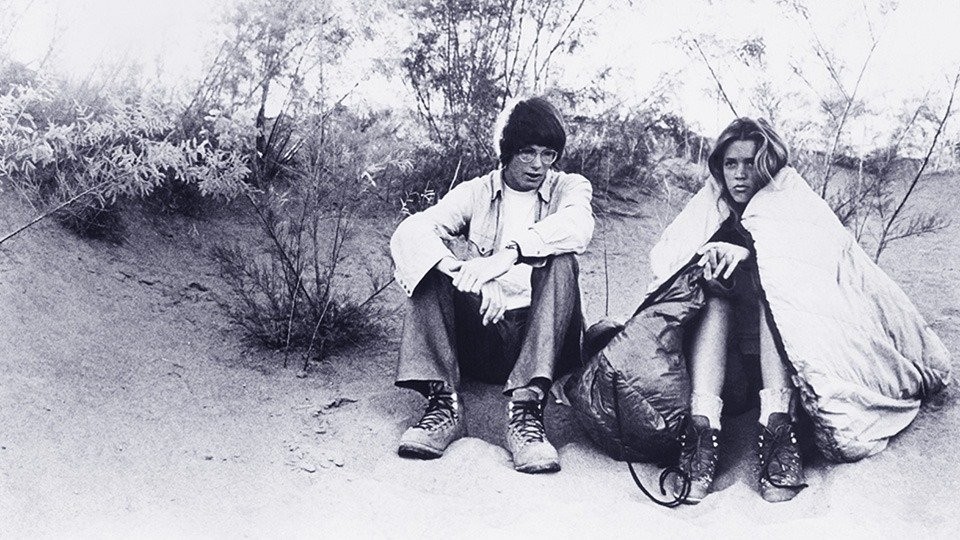
Teenagers Ronald (Kevin Hearst) and Karen (Kelly Bohanon) sitting next to each other in the desert. Karen, wearing untied shoes and a sleeping bag over her shoulders, looks distraught. DP: Bruce Logan.
Filmed in Idaho for National Idaho Day (USA)
A disaster has struck the future world. A private one, Karen's sister has had an accident. And a global one, one so severe that a Government project is put in place. The Project, located in the #Idaho desert and in different points in time, transfers teenagers 56 years forward so to repopulate the to-be-wiped-out land. Then, without warning or reason, The Project shuts down and the kids strand into a deserted future.
– Idaho state motto
Idaho Transfer is, even for early 70s standards, an odd affair. It carries the weight of its time – hippie optimism had died thanks to #Manson, US meddling in Vietnam, the impending #EcoCrisis (we knew, we always did…) – but there too was this optimism for the upcoming millennium. Everything was going to be fine, in The Future. We'll be wiser, no more wars, no more famine, technology will save us. Released just 4 months before the first Oil Shock, Fonda somehow transferred a glimpse of our future.
“If it weren't for bad people, what would you do for a living, Marshal?”Doc (Frank Perry, 1971)
May
16

A tense scene in a dark saloon, the table littered with empty bottles. DP: Gerald Hirschfeld.
– Doc Holliday
“Where are you going, Mr. Hulot?”Trafic [Traffic] (Jacques Tati, 1971)
May
16
National Barbecue Day

A man prepares a steak on his nifty Renault 4 Altra grill (there's a pun), observed by M. Hulot and a perplexed Dutch customs officer. In the background a sign in Dutch that requests to refrain from smoking. DPs: Eduard van der Enden & Marcel Weiss.
Monsieur Hulot – who in his final appearance happens to be an automobile designer – travels to a car show in Amsterdam to demonstrate his latest creation, a camper van par excellence. The vehicle of course accommodates the latest gadgets, such as a collapsible grill.
However regarded as a lesser #Tati, Trafic, is another display of lovingly choreographed insanity, notably a #CarCrash that makes me wonder if this was Tati's attempt to transpose Godard's Week-end (1967) into a pleasant, pre-May 68 France.
Οι Τεμπέληδες της Εύφορης Κοιλάδας [Oi tembelides tis eforis koiladas / The Idlers of the Fertile Valley] (Nikos Panayotopoulos, 1978)
May
15

The maid (Olga Karlatos) patiently feeding the father (Vasilis Diamantopoulos) in bed. DP: Andreas Bellis.
Malpertuis (Harry Kümel, 1971)
May
12
meat

Cassavius (Orson Welles), looking monstrous on his sickbed, surrounded by peopel who appear to be in mourning. On his bed's foot-end a large silver platter with cooked meat, and a rat on its hind legs. DP: Gerry Fisher.
點指兵兵 [Dian zhi bing bing / Cops and Robbers] (Kwok-Ming Cheung, 1979)
May
6

A table set with one small plate of meat, one small plate of vegetables, three empty bowls, and one pair of chopsticks.
Last Chants for a Slow Dance (Jon Jost, 1977)
May
3
National Montana Day

Tom Blair as Tom Bates. We see him through a rest stop's window with the reflection of the word ƎᖷAƆ in red neon over his face. Tom's reading a newspaper. DP: Jon Jost.
Last Chants for a Slow Dance is shocking in its simplicity. Tom (Tom Blair) is out there looking for work. Out of the way of his wife and into the heart of Montana. On a slow moving road trip, as scorching and dragging like hot tar, we accompany him and some of the vapid interactions with others out there. The heat, pursuit of sex, and inter-human exchanges are endless.
Things do break.
How much Wood would a Woodchuck chuck… – Beobachtungen zu einer neuen Sprache (Werner Herzog, 1976)
Apr
20
National Auctioneers Day

One of the younger auctioneers during his attempt. DP: Thomas Mauch.
#Herzog travels to New Holland, Pennsylvania to witness the 1976 World Livestock Auctioneer Championship. Cattle is weighed and paraded in front of the buyers, and the 53 contestants have a few minutes to auction the animals off to the highest bidder.
We see glimpses of the audience. New Holland is the land of the money-eschewing #Amish, descendants of German-speaking Swiss, whose dress, ways and speech found an ideal state in an increasingly convoluted world. While money rolls, the Amish hand out their home-baked pies free of charge to the Championship onlookers.
To German-as-Apfeltorte Herzog, the auction is bewildering, the “last #poetry possible, the poetry of #capitalism”. In keeping with Herzog's poetic, ecstatic truth, Bruno S. too travels to America and encounters the auctioneers in Stroszek (1977).