“In the evenings, the little Hedgehog went to the Bear Cub to count stars. They would sit on the log and sip tea, gazing at the starry sky. It hung on the roof, just behind the chimney. To the right of the chimney were the Bear Cub's stars and the stars to the left were the Hedgehog's”Ёжик в тумане [Yózhik v tumáne / Hedgehog in the Fog] (Yuri Norstein, 1975)
Jun
9
Donald Duck – 1934
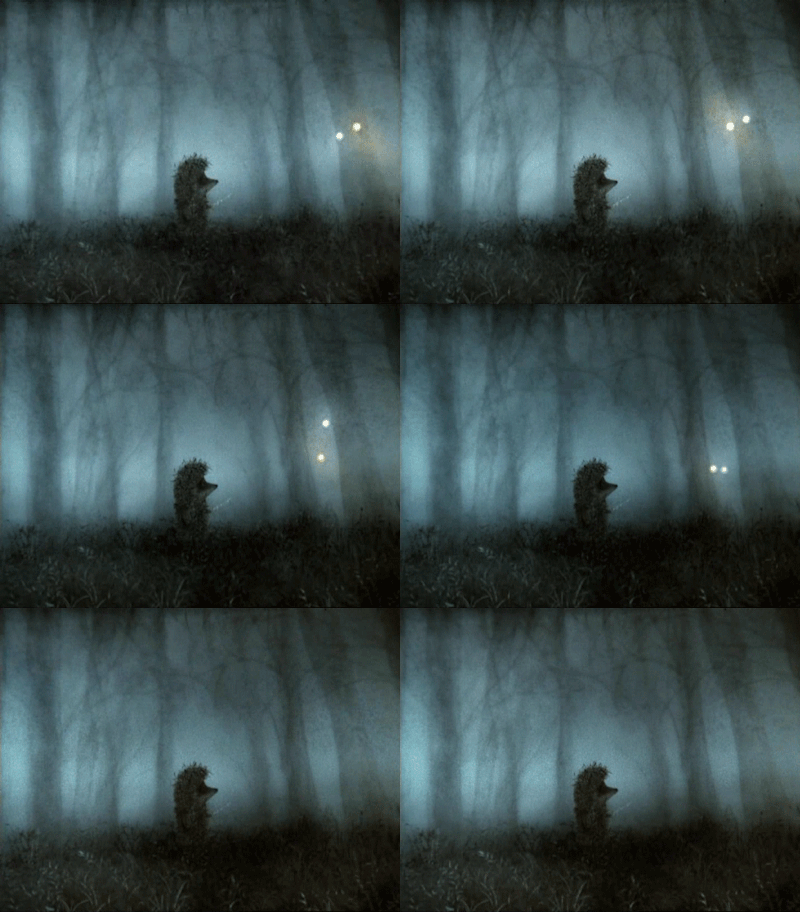
Fireflies in the fog. DP: Aleksandr Zhukovskiy.
A [favourite] animated character for Donald Duck Day (USA)
– opening lines
On his way to visit his friend Bear Cub, Hedgehog finds himself in a dense mistbank. Strange sounds, and even stranger creatures, omit from it. And all he wanted was have strawberry jam and tea with his friend.
animals
“Had I the time to keep a diary, I’d use that time to better effect; sleeping on the veranda” 吾輩は猫である [Wagahai wa neko de aru / I Am a Cat] (Kon Ichikawa, 1975)
May
30
Hug Your Cat Day

The cat and his master, teacher Sneaze. DP: Kōzō Okazaki.
A pet for National Hug Your Cat Day (USA) *
– The cat
A school teacher's house cat observes and comments his household's going-ons as a microcosm of Japan's paradoxical Meiji period. The second adaptation of Sōseki Natsume's 1900s satirical novel.
* The event falls on June 4
Le Songe Des Chevaux Sauvages [Dream of the Wild Horses] (Denys Colomb de Daunant, 1960)
Mar
10
ithrah69's birthday

Camargue horses galloping through a haze of water and dreams. DPs: Denys Colomb de Daunant & André Costey.
A film ithrah69 may like for their birthday.
Filmmaker and photographer Colomb de Daunant's spiritual sequel to Crin blanc : le cheval sauvage [White Mane] (1953) and Glamador (1958) follows the same wild Camargue horses in their dreams.
The accompanying music is performed on a Cristal Baschet, a glass instrument key to several avant-garde films. I refer to John Coulthart's writeup about Le Songe, which links through to an article about the Cristal Baschet.
“I like the settings where the lights and desire cross path. The desire to communicate with the invisibles in the darkness, or in memory, or in the future. It's always related to cinema and we as insects that are drawn to lights.”สัตว์วิกาล [Sud Vikal / Vampire] (Apichatpong Weerasethakul, 2008)
Mar
2
Dr. Seuss' birthday

Applying blood to attract the Nok Phii. It's cold. DP: Chaisiri Jiwarangsan.
Imaginary animals or food for Theodor “Dr.” Seuss Geisel's birthday (1904).
– Apichatpong Weerasethakul, via
Villagers in the north of Thailand reported a rare sighting of a male and female Nok Phii, an elusive species of bird that feeds on animals' blood. It is unknown if the sighting was reliable, and if this vampire does, or ever did, exist.
“For me, Afrikareise is, in its own genre, the most intense sound film that exists. Sound and images are in synch like in nature (even if it isn’t about the natural sound of something). The sound becomes the acoustic portrait of the visual action.”Unsere Afrikareise [Our Trip to Africa] (Peter Kubelka, 1966)
Feb
22
National Wildlife Day

A frame (source) shows a freshly killed zebra on its side. The film stock's perforations and sound track are visible. DP: Peter Kubelka.
Wild animals for this year's first National Wildlife Day (USA). A second one is on September 4.
– Peter Kubelka, via
Commissioned to film a rich Austrian couple's hunting trip, Kubelka sat on the material for several years before editing it in something more than the sum of its parts.
“I'm sharing my husband with a cat. This is humiliating!”猫と庄造と二人のをんな [Neko to Shōzō to futari no onna / A Cat, Shozo, and Two Women] (Shirō Toyoda, 1956)
Feb
20
Love Your Pet Day
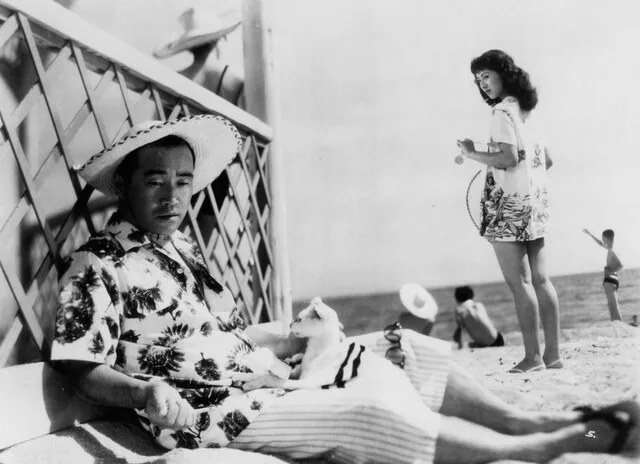
Shōzō (Hisaya Morishige) on the beach with his beloved cat Lily. DP: Mitsuo Miura.
Someone owns a pet on Love Your Pet Day (UK)
– Nakajima
Shōzō is torn between his ex-wife and his current spouse, but really just wants to spend time with Lily, his cat.
Ormen: Berättelsen om Iréne [Ormen / The Serpent] (Hans Abramson, 1966)
Jan
29
Lunar New Year – 巳

The German poster. An illustration of a nude woman with a serpent's head. DP: Mac Ahlberg.
Snakes (巳) in celebration of Lunar New Year.
Ormen is an adaptation of the first two chapters of the novel Berättelsen om Iréne (Stig Dagerman, 1945).
In an army barrack, a sergeant is bitten by a snake. A soldier hides the animal in his bag in order to blackmail his superior. Iréne – who works in the same barrack's mess and is the soldier's lover – pushes her mother off a train during a quarrel about the daughter's lack of morals.
Dagerman's novel is a metaphor of Sweden's uncomfortable position in a post-WW2 world (it had declared itself neutral, which by default made it complicit in helping the Nazis). Due to its violence and nudity, outside its homecountry the film adaptation mostly played porn theatres.
– Now, see! You kill-a de monk!
– Pay him for that baboon… or I'll run you in!The Cameraman (Edward Sedgwick + Buster Keaton, 1928)
Jan
14
National Dress Up Your Pet Day
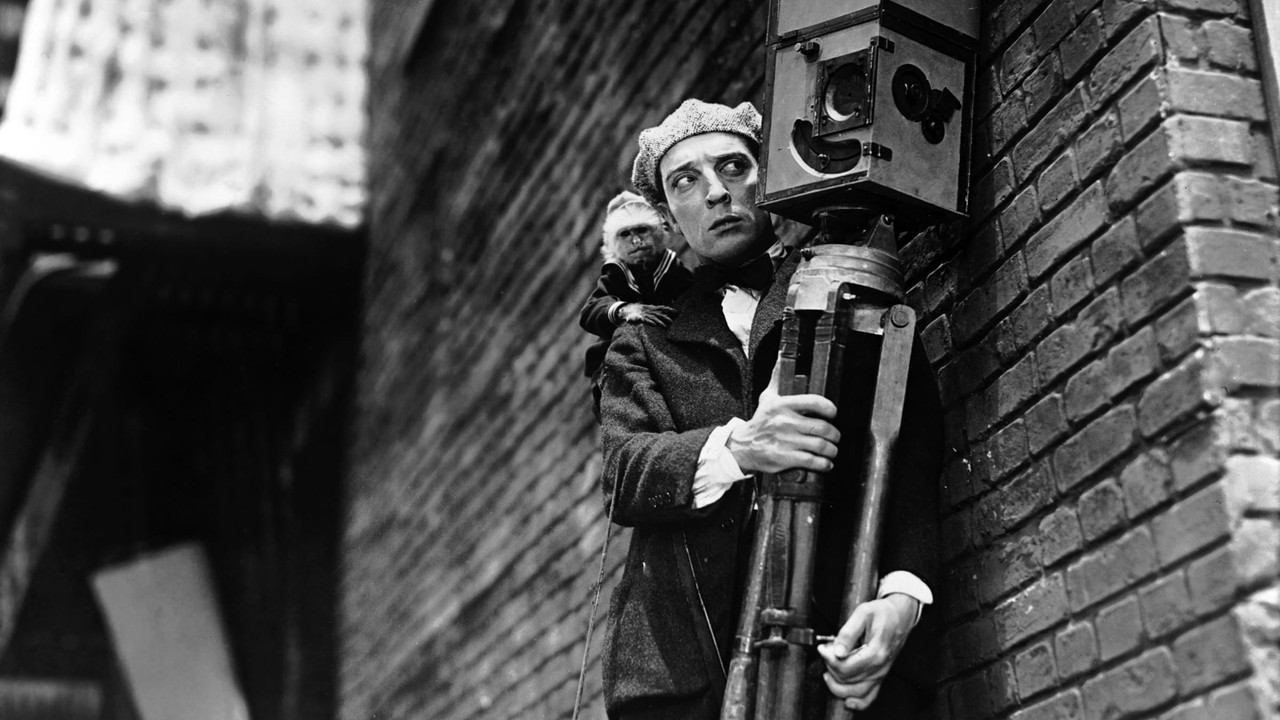
Buster (Buster Keaton) with Josephine the monkey on his shoulder. DPs: Reggie Lanning & Elgin Lessley.
A funnily dressed pet for National Dress Up Your Pet Day (USA) (please don't!).
After cameraman Buster accidentally knocks over a monkey, he has no choice but to take the sailor-suited simian along on his movie shoots.

