view
Hotel of the Stars (Jon Bang Carlsen, 1981)
Apr
21
Heartbreak Hotel
The setting for a dramatic reenactment, watched over by the King. DP: Alexander Gruszynski.
A film set in a hotel, or involving Elvis Presley, on the date Heartbreak Hotel topped the charts in 1956.
“I love to see myself in Technicolor.”
view
Vagabunden Karawane [Vagabond’s Band] (Werner Penzel, 1980)
Apr
16
હડતાળ
“I had appealed to the people to fast on April 6, and the whole nation followed my call. Who was I? But it was the voice of God… India was awakened that day.”
view
Το άλλο γράμμα [To allo gramma / The Other Letter] (Lambros Liaropoulos, 1976)
Apr
6
Greece
Something something Greece (or the Olympics) on the date of the 1896 Summer Olympics
Athens seen through words put down in letters, forming a narrative of the city, Greece, its history, and its people.
view
The Patriot Game (Arthur MacCaig, 1979)
Apr
4
MLK Jr. – 1968
“All the ideas I'd previously had were shown to be completely false. This was the first time I had really seen the strength and the power of a mass struggle; ordinary people directly participating in organizing their communities, and the defense of their communities.”
– Arthur MacCaig, title card
view
News from Home (Chantal Akerman, 1976)
Apr
3
Pony Express Day
New York, a street scene. Superimposed a quote from one Chantal Akerman's mother's letters. DPs: Jim Asbell & Babette Mangolte.
“Dear child,
l received your letter and hope you will write often. l hope you won’t stay away too long and that you’ve found a job by now. If you’re doing well, we’re happy. Even though we do miss you. When will you be back? Everything is fine here, but Sylviane is home with the flu. My blood pressure is low. l’m on medication for it. Today is my birthday. l feel sad. lt’s quiet at the shop. Tonight we’re going out to dinner with friends. That’s all. Your birthday is coming up. l wish you all the best. Write to me soon about your work, about New York, about everything. Lots of love from the three of us.
Your loving mother” (quote via)
view
ドキュメント 路上 [Document Rojo / On the Road: The Document] (Noriaki Tsuchimoto, 1964)
Mar
26
Road Traffic Act 1934
A look from a Tokyo cab driver's perspective. We see the dashboard, heavy trucks ahead, and behind, and the reflection of the driver in his rearview mirror. DP: Tatsuo Suzuki.
Bad drivers: the start of compulsory driving tests in the UK was established on March 26, 1934* with the Road Traffic Act.
“This film portrays the traffic war that goes on every day. — Tokyo, 1964”
– opening title
view
De nieuwe ijstijd [The New Ice Age] (Johan van der Keuken, 1974)
Mar
16
Reykjavík Food & Fun Festival
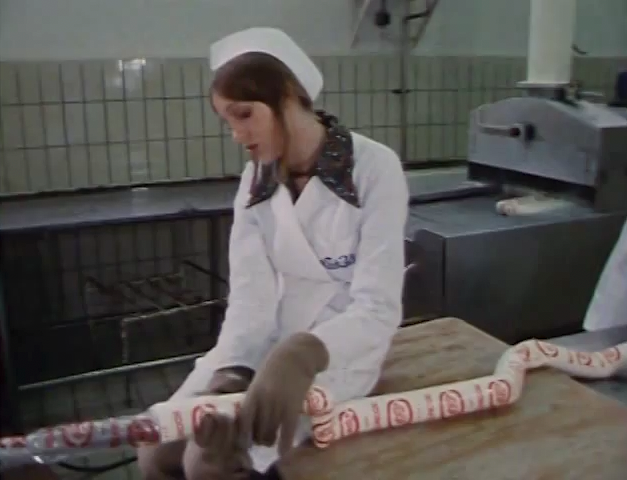
A young female factory worker listlessly fills a long plastic tube with pale ice-cream.. DP: Johan van der Keuken.
“For me it’s important to note that the film’s information is also the only thing you know. That’s the idea of the tip of the iceberg, provided that only the portion above the water exists (in the film), because you know nothing of what’s under water and therefore it’s impossible for you to describe the entire iceberg.
For example, in De nieuwe ijstijd the characters are not described 'in their entirety'. What is shown is only what we’ve encountered when we were filming. It’s always a limited, fragmentary knowledge of everything that exists, and that’s how it’s shown.”
– Johan van der Keuken, via
view
絵を描く子どもたち [E o kaku kodomotachi: jidōga o rikai suru tame ni / Children Who Draw] (Susumu Hani, 1956)
Mar
13
Youth Art Month
A little girl painting. DP: Shizuo Komura.
Small children work with clay, paint, and other materials. Under the camera's watchful eye, we see their work come to life.
view
Le tombeau d'Alexandre [The Last Bolshevik] (Chris Marker, 1993)
Feb
25
Warsaw Pact
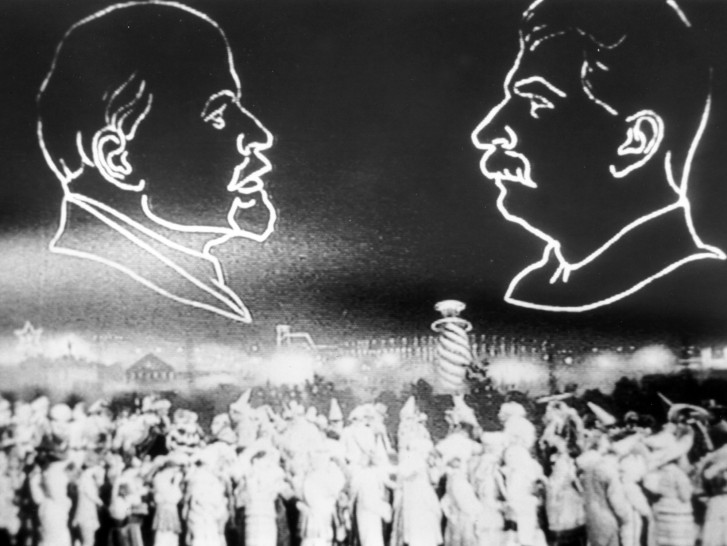
Still from a Medvedkin film. Silhouettes in light of Lenin and Stalin facing each other are projected above a crowd of people. DP of Le tombeau d'Alexandre: Chris Marker.
“Alexandre Ivanovitch Medvedkine est le seul cinéaste russe né en 1900. (…) Son énergie, son courage, ses illusions, ses désillusions, ses compromissions, ses bagarres avec les bureaucrates, ses illuminations prophétiques, ses aveuglements, volontaires ou non, son humour indestructible et la lumière déchirante que l’effondrement de l’URSS jette rétrospectivement sur toute sa vie, ce sont ceux de toute une génération, et c’est le portrait de cette génération que j’entends tracer à travers le portrait d’un ami.”
– press kit (via)
A film essay using the life and work of filmmaker Aleksandr Medvedkin to tell the story of communism. Medvedkin traveled the Soviet Union with his Kinopoezd or Cinetrain (also Agit-train), a moving film production train with the sole purpose to create Agitprop while documenting the Five Year Plan.
view
Unsere Afrikareise [Our Trip to Africa] (Peter Kubelka, 1966)
Feb
22
National Wildlife Day
Wild animals for this year's first National Wildlife Day (USA). A second one is on September 4.
“For me, Afrikareise is, in its own genre, the most intense sound film that exists. Sound and images are in synch like in nature (even if it isn’t about the natural sound of something). The sound becomes the acoustic portrait of the visual action.”
– Peter Kubelka, via
Commissioned to film a rich Austrian couple's hunting trip, Kubelka sat on the material for several years before editing it in something more than the sum of its parts.