view
Alphaville: Une étrange aventure de Lemmy Caution (Jean-Luc Godard, 1965)
Jul
16
petit déjeuner
In one of the very few daytime scenes, Natacha (Anna Karina) and Lemmy Caution (Eddie Constantine) share breakfast at a small table while awkwardly sitting on the armrests of two upholstered chairs. A large television is set up directly behind the table. DP: Raoul Coutard.
“Yes, I'm afraid of death… but for a humble secret agent that's a fact of life, like whisky. And I've drunk that all my life.”
– Lemmy Caution
view
Alphaville: Une étrange aventure de Lemmy Caution (Jean-Luc Godard, 1965)
Jul
16
AI Appreciation Day
Natacha von Braun (Anna Karina) and Lemmy Caution (Eddie Constantine). Lights reflected in the windowpane that shields the two characters suggest “the existence of an obscure reality” (after Baudrillard). DP: Raoul Coutard..
Science fiction, of course, doesn't have to be driven by grandes effects, by superstar names and monumental backdrops. It can be cool, dry, colourless even. The hero, in trenchcoat and fedora, traverses a lightless city. There are few others at this time of night. The familiar landmarks of the City of Light become the voice of 𝛼-60, an artificial intelligence that presides over Alphaville.
𝛼-60: “Do you know what illuminates the night?”
Lemmy Caution: “Poetry.”
Based on a poem by Paul Éluard, #Godard's Alphaville bears similarities with Jean #Cocteau's Orphée (1950), transported to a mirror world of sorts. It also foreshadows not only our time, but also M. Hulot's, whose #Tativille could be the simulacra of 𝛼-60's simulated, dehumanised world.
view
Flammes [Flames] (Adolfo Arrieta, 1978)
Jul
15
Barbara (Caroline Loeb) – in a patterned firetruck-red dress – descends a grande staircase. At the bottom of the stairs a long, beautifully set table with well-dressed guests. The seat at the head of the table is empty. DP: Thierry Arbogast.
view
La piscine [The Swimming Pool] (Jacques Deray, 1969)
Jul
13
“Chinese food”
The two couples (Delon and Schneider, and Ronet and Birkin) awkwardly share dinner. There's wine in red glasses and the food, plated on rustic French dinnerware, is handled with chopsticks. DP: Jean-Jacques Tarbès.
view
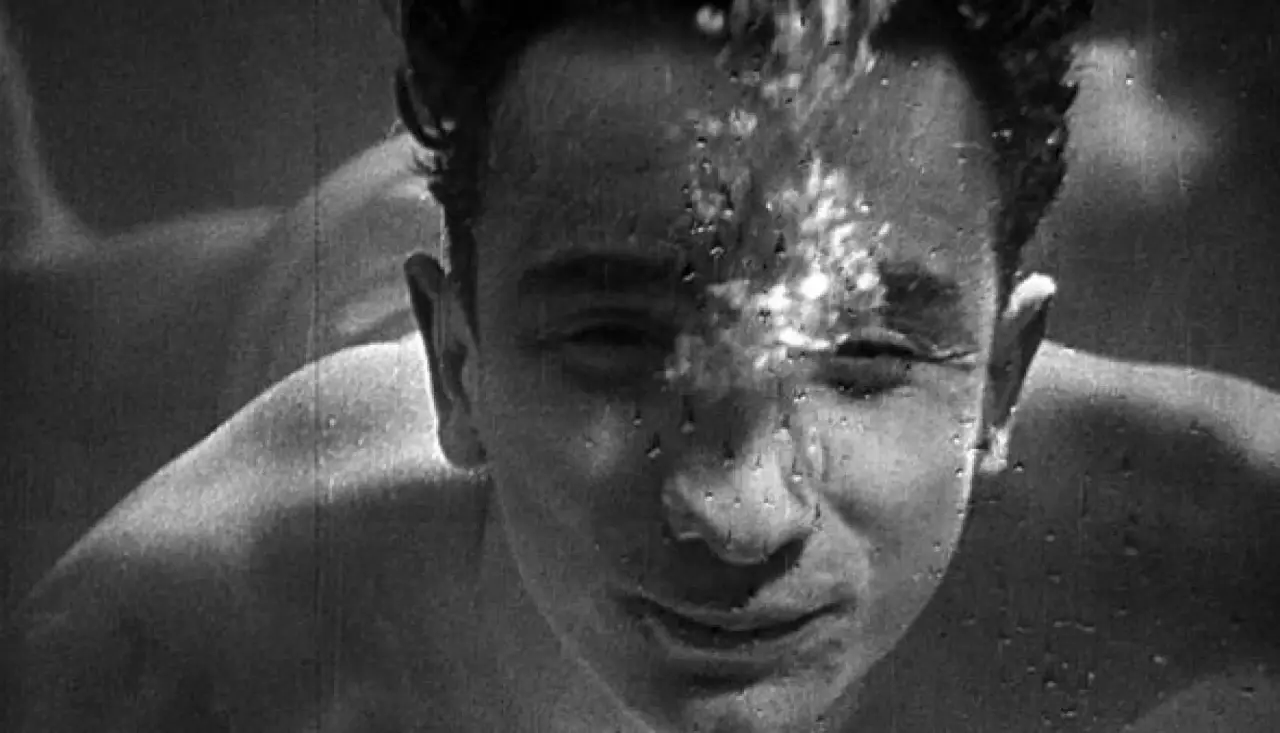
Taris, roi de l'eau [Taris, King of the Water] (Jean Vigo, 1931)
Jul
12
freebie: Swim A Lap Day
Jean Taris in his element. DP: Boris Kaufman.
A proto-Jean Painlevé exercise avant la lettre.
view
Araya [Araya l'enfer du sel] (Margot Benacerraf, 1959)
Jul
5
Venezuela Independence Day
Workers in front of pyramid-shaped piles of salt. DP: Giuseppe Nisoli.
“Above all… don’t cut a single image.”
– Jean Renoir in a letter to Margot Benacerraf
view
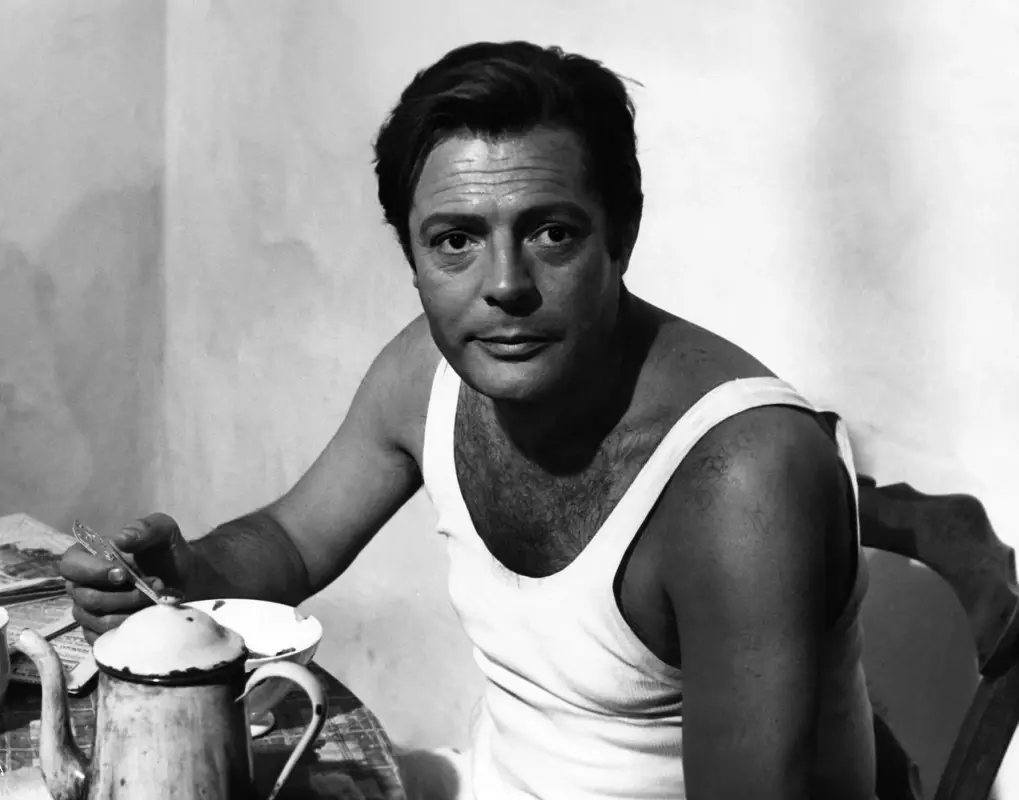
Lo straniero [The Stranger] (Luchino Visconti, 1967)
Jul
3
soup
Arthur Meursault (Mastroianni) eating from a cracked bowl. DP: Giuseppe Rotunno.
view
La main du diable [The Devil's Hand / Carnival of Sinners] (Maurice Tourneur, 1943)
Jun
27
dinner (late)
A disgruntled man in a hotel restaurant. DP: Armand Thirard.
– Why so grumpy?
– I'm starved! Dinner is always late!
view
Le trou [The Hole / The Night Watch] (Jacques Becker, 1960)
Jun
25
care package
Butchering a care package – butter, sausage and other joys of life – for contraband. DP: Ghislain Cloquet.
view
Le procès [The Trial] (Orson Welles, 1962)
Jun
23
National Typewriter Day
Josef K. (Anthony Perkins) crossing an enormous open office space. The endless room is filled with clerks, identical desks, telephones, and typewriters. DP: Edmond Richard.
Office worker Josef K. is brought to trial and at no point told what he is accused of, if anything. Orson Welles' Le procès is an adaptation of Franz Kafka's unfinished 1914/15 novel Der Prozess. The manuscript, guarded from Kafka by his friend #MaxBrod in an attempt to keep the self-doubting author from destroying his work, was against K's wishes posthumously (re)assembled by Brod without the latter knowing the intended sequence of the loose pages nor what chapters were finished.
“All these fancy electronics, they're all right in their place, but not for anything practical.”
– Uncle Max
The story holds up in its vagueness thanks to the quirks of #Kafka's Brotberuf; Franz K. was a trained lawyer, working as an insurance agent in an impossible artifice world of reports and precise wording. Within its extended logic, a man can get perplexedly lost, either within the walls of his #office or one's bed.