view
Maléfices [Where the Truth Lies] (Henri Decoin, 1962)
Aug
16
milk
Ronga (Maîthé Mansoura accompanied by cheetah Nyète), sits on a straw-covered floor while holding a bowl with milk. There are potted plants and gardening equipment is placed against the wall. DP: Marcel Grignon.
view
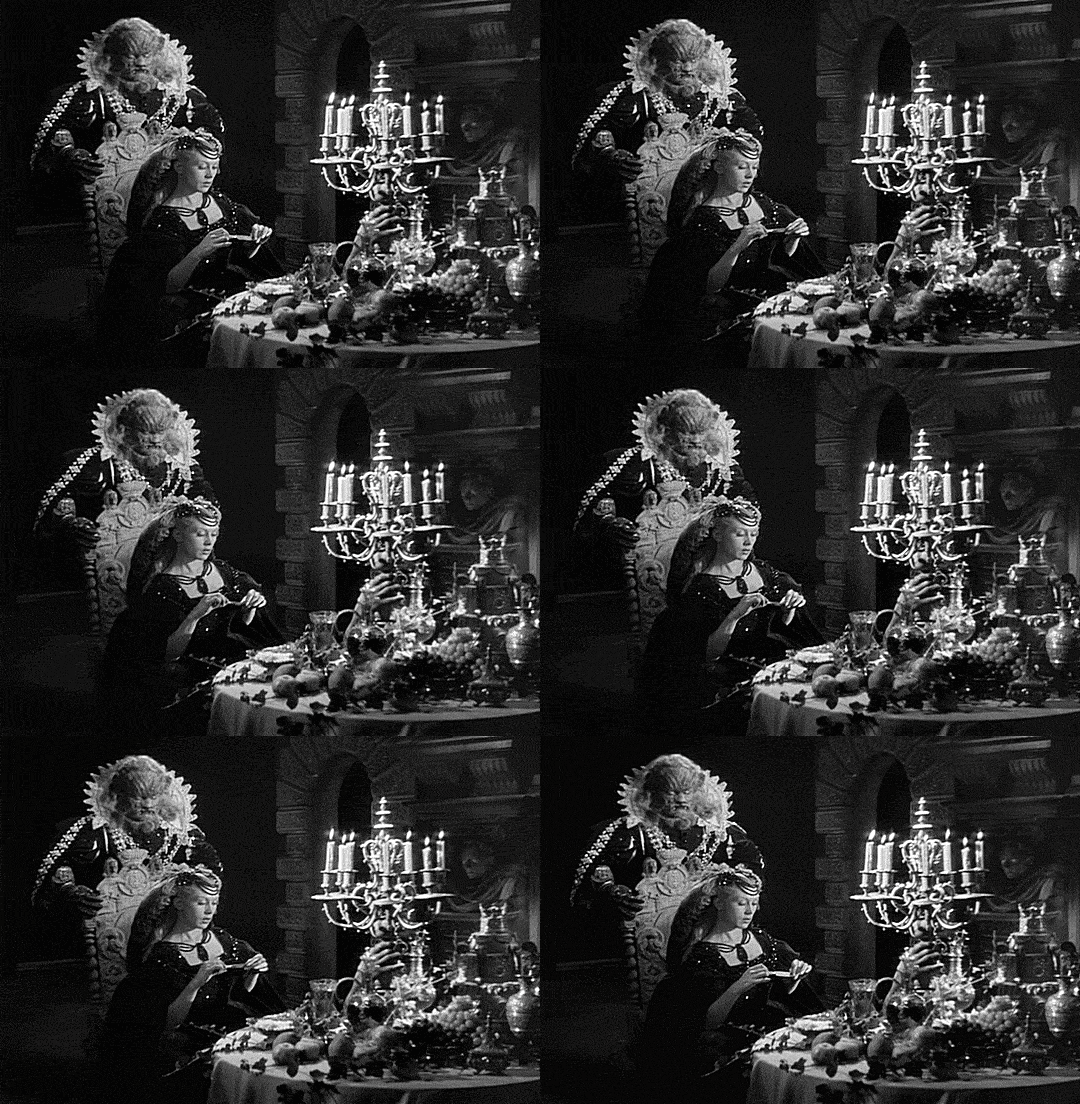
La Belle et la Bête [Beauty and the Beast] (Jean Cocteau + René Clément, 1946)
Aug
15
a cornucopia of wonder
La Belle (Josette Day) at a fancy table stacked with good foods and nice wines. She's cleaning her fingernails with the silverware while a chagrined Bête (Jean Marais) looks on. As magical as the story are the production and set design by Christian Bérard, Lucien Carré, and René Moulaert. They breathed a soul into almost everything, including the candelabras. DP: Henri Alekan.
– Does he crawl on four legs? What does he eat and drink?
– I've given him water to drink on occasion. He would never eat me.
view
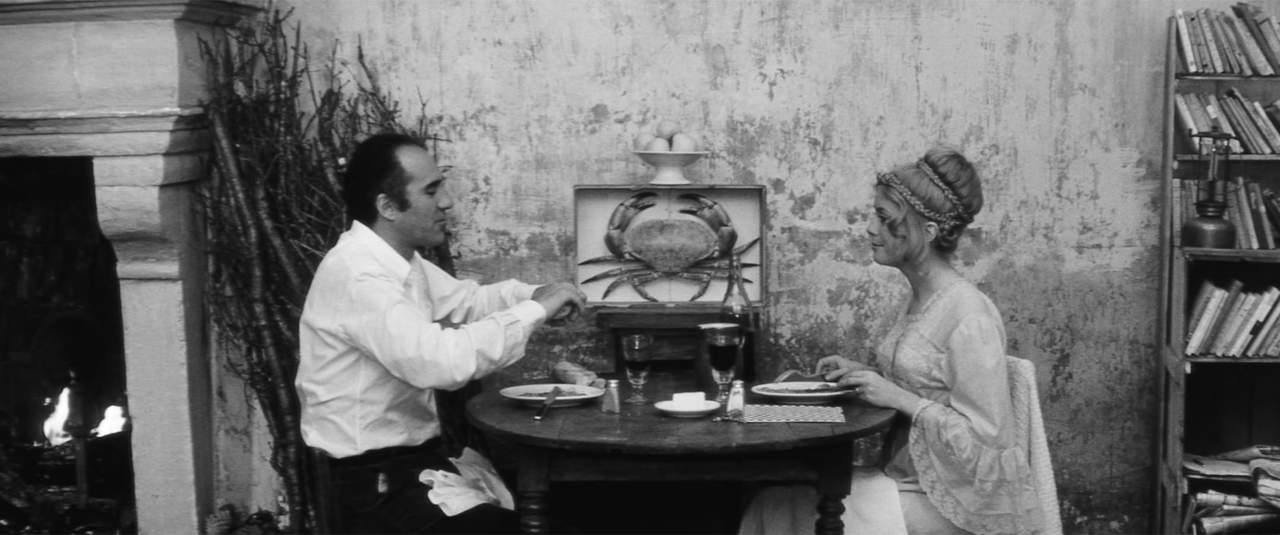
Les créatures [The Creatures] (Agnès Varda, 1966)
Aug
14
Edgar (Michel Piccoli) and Mylène (Catherine Deneuve) all dressed up for a home-cooked meal. On the wall behind them a huge framed mounted crab. DPs: Willy Kurant, William Lubtchansky & Jean Orjollet.
view
L'œil du malin [The Eye of Evil / The Third Lover] (Claude Chabrol, 1962)
Aug
8
A table covered with a neatly ironed table cloth and on it, several stacks of flat and soup plates, plus silverware and nesting aluminium pans. DP: Jean Rabier.
view
Festival panafricain d'Alger [The Panafrican Festival in Algiers] (William Klein, 1969)
Jul
26
One Voice Day
Black hands holding each other. In translation the caption reads “Down with colonialism! Down with imperialism!”. DP: William Klein et al.
In typical Western fashion the credits for William Klein's Festival panafricain d'Alger focusses on the French and American participants. After Algeria regained its independence in 1962, it became Africa's – and the #AfricanDiaspora's – centre for postcolonial and liberation moments.
“À bas le colonialisme ! À bas l'imperialisme !”
The 12-day Festival panafricain attracted 5000 people from all over the African continent, as well as liberation fighters from the United States.
view
L'homme qui ment [The Man Who Lies] (Alain Robbe-Grillet, 1968)
Jul
25
soup
The titular man (Jean-Louis Trintignant) at a dinner table, observed by Sylvia (Sylvia Turbová) and Maria (Sylvie Bréal). The room is white and sparsely furnished. DP: Igor Luther.
view
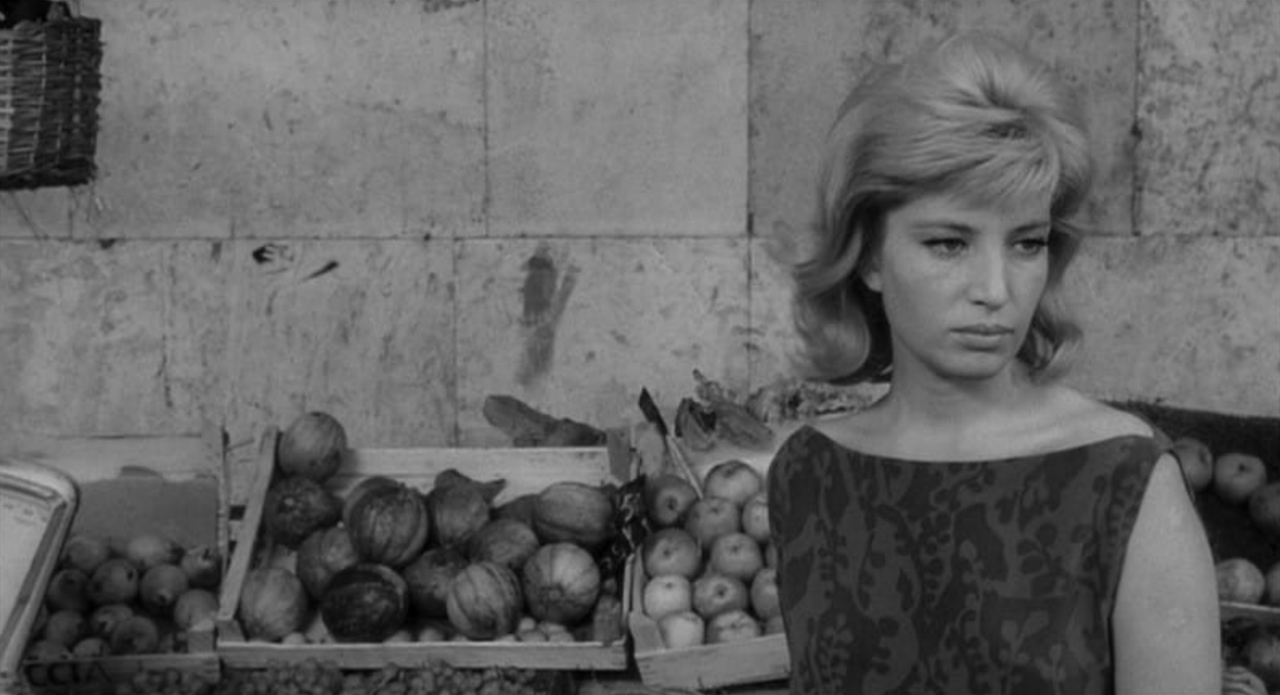
L'eclisse [The Eclipse] (Michelangelo Antonioni, 1962)
Jul
19
fruit
“I still can't figure out if it's an office, a market place, or a boxing ring. And maybe I don't even need to.”
– Vittoria
view
Flammes [Flames] (Adolfo Arrieta, 1978)
Jul
19
National Barbara Day
Barbara (Caroline Loeb) waking up to her fireman. DP: Thierry Arbogast.
Barbara wakes up believing a fireman entered her bedroom through the window. Her father reassures her there's nothing, just a children's story. Years later, the adult Barbara (Caroline Loeb), grown up, withdrawn, living with her father (Dionys Mascolo), tutor, half brother (Pascal Greggory), and a persistent longing for her fireman, sparks a scheme that forces the fire brigade to come to their house and climb through her window once again.
“It's you.”
view
Le notti di Cabiria [Nights of Cabiria] (Federico Fellini, 1957)
Jul
18
National Caviar Day
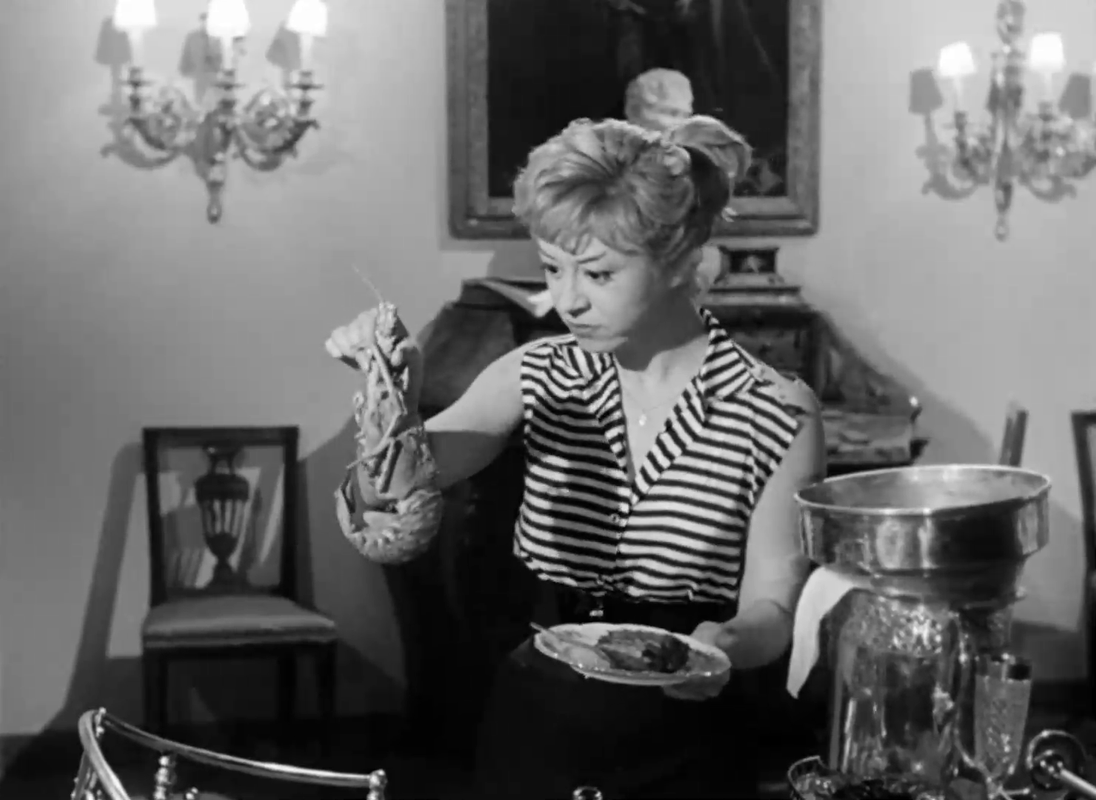
Cabiria (Giulietta Masina) about to experience an unforgettable meal of lobster and caviar. She's holding the lobster up by its antennae with a mix of bewilderment and amusement on her face. Her frumpy outfit looks completely out of place in Lazzari's (Amedeo Nazzari) fancy apartment. DP: Aldo Tonti.
Maria “Cabiria“ Ceccarelli (Giulietta Masina), a prostitute looking for happiness, meets famous movie star Alberto Lazzari (handsomely moustachioed Amedeo Nazzari). In his plush mansion, he treats her to an opulent – if not bewildering to Cabiria – meal of lobster and caviar.
“And what's this? I saw it in a movie once.”
– Cabiria
Co-written by #Pasolini, #Fellini's Le notti di Cabiria is a love letter to hope, life, #Rome, and of course his Giulietta.