view
Lemora: A Child's Tale of the Supernatural (Richard Blackburn, 1973)
Jun
4
meat
A fancy looking silver plate with what appears to be raw meat. DP: Robert Caramico.
“Wouldn't you rather I did it out of love, than have one of those wood things do it out of their own animal hungers?”
– Lemora
view
Who Killed Teddy Bear (Joseph Cates, 1965)
Jun
3
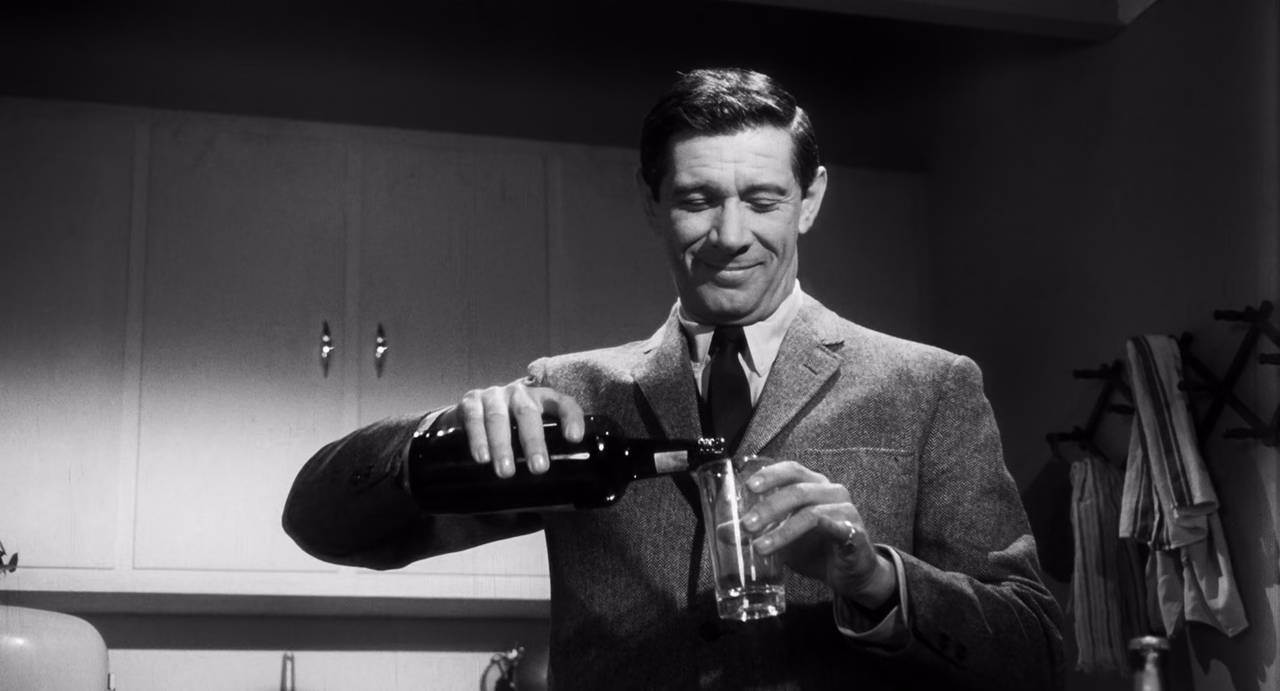
A square 1960s man – Jan Murray as Lt. Dave Madden – smugly pouring himself a stiff drink. DP: Joseph C. Brun.
“I don't find you the least bit amusing, Lieutenant Whatever-your-problem- is!”
– Norah Dain
view
The Last Man on Earth (Ubaldo Ragona + Sidney Salkow, 1964)
Jun
2
Republic Day – Italy
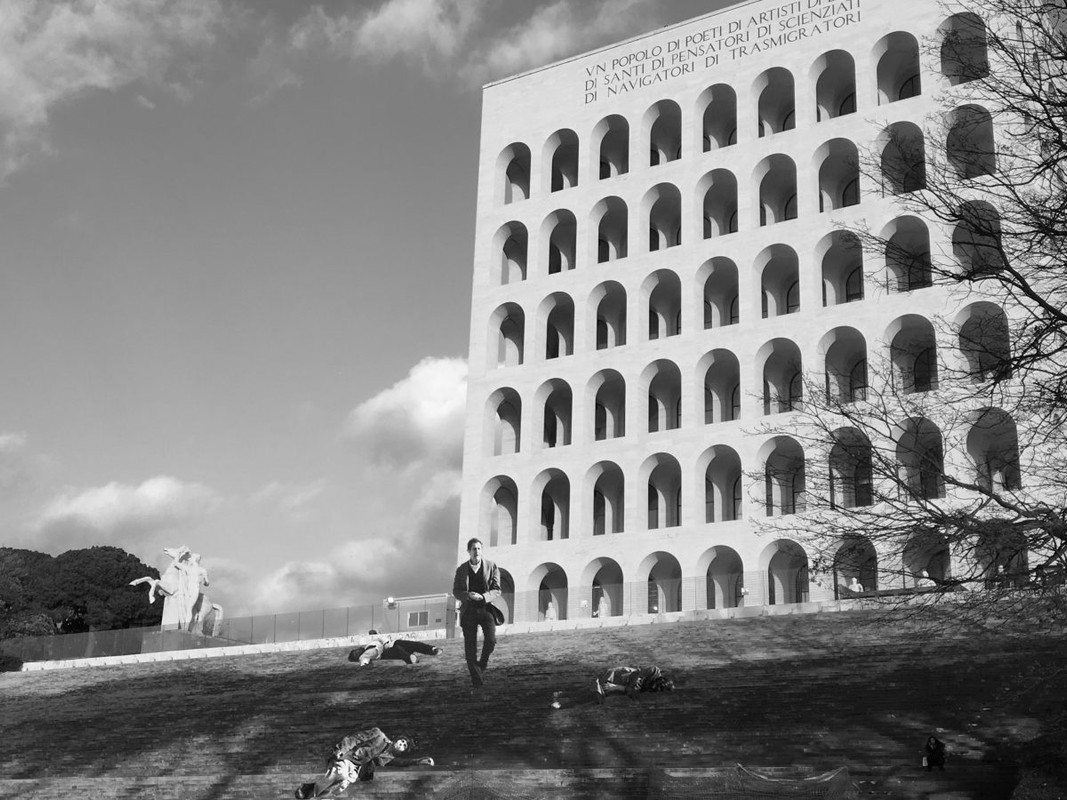
Dr. Robert Morgan (Vincent Price) walking down the stairs of the Palazzo della Civiltà Italiana (aka the Palazzo della Civiltà del Lavoro aka the Colosseo Quadrato), with bodies scattered around him. DP: Franco Delli Colli.
Rome's EUR was Italy's site for the 1942 World's Fair, and meant as a showcase for #Mussolini's then-20 year old fascist state. Due to the outbreak of World War 2, EUR was never used for the Fair. Instead, the Italian Republic restored the project after the war and – quite appropriately if I may say so – turned it into a business district.
“Your new society sounds charming.”
– Dr. Robert Morgan
An idealised, hypermodern interpretation of Classical Roman architecture, EUR feels alien and inhumane and serves as a perfect backdrop for the events a last man on earth may come up against.
viewGertie the Dinosaur (1914)
Gertie raises her creator Winsor McCay in her mouth. McCay holds a dressage whip but in his tuxedo resembles a musical conductor more than a lion tamer. DPs: John A. Fitzsimmons & Winsor McCay.
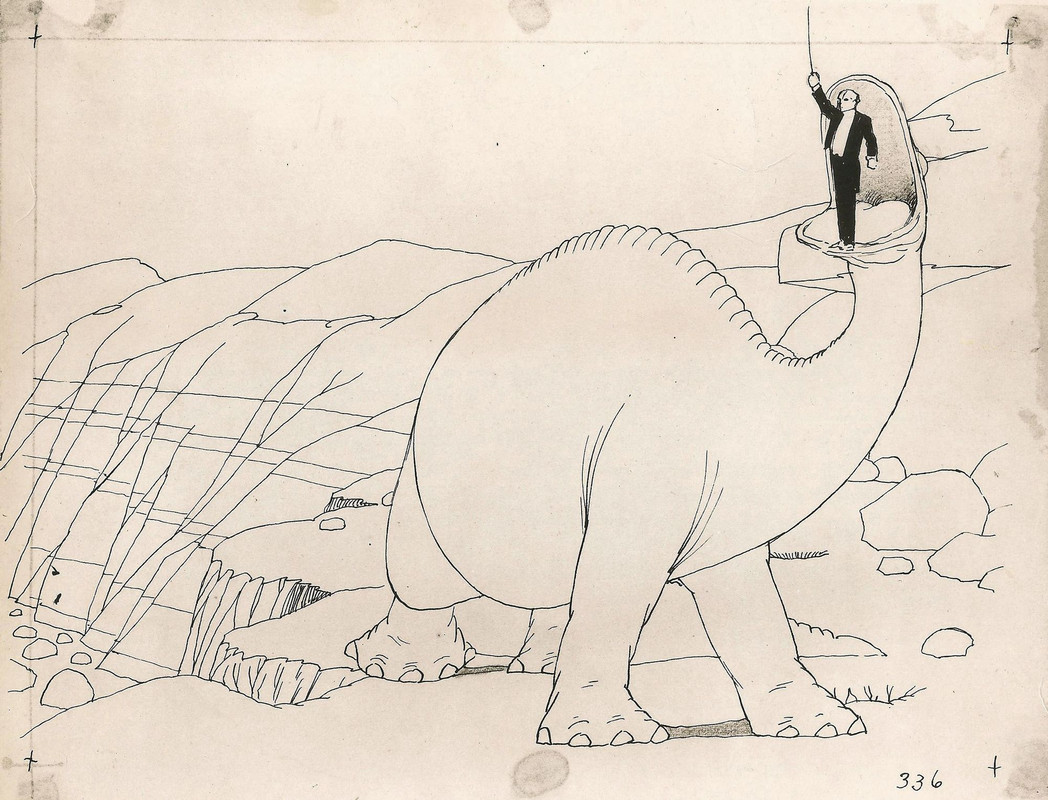
Gertie the Dinosaur (Winsor McCay, 1914)
I made ten thousand cartoons —each one a little bit different from the one preceding it.
Long before we all flocked to the movies, there was vaudeville. Vaudeville comes in many flavours, from raucous song and dance, acrobatics (see #BusterKeaton's start) to chalk talk: a live performance in which an artist would chat and draw on a blackboard in real time. The format is perfect to enlighten and entertain an audience, about the dangers of alcohol, the importance of religion, the demand for women's suffrage.
But where there's a scholar, there's a showman. As a chalk talk consists of a succession of quickly drawn illustrations, one flowing into the next while the performer raps over it, the leap to animation is a logical one. In 1914, a brontosaurus named Gertie and a comic strip creator called Winsor McCay travelled the land – both animated and real.
McCay, known for his fantastic comic strips Little Nemo in Slumberland and its predecessor Dream of the Rarebit Fiend, introduced the great animated animal to the audience with little tidbits of knowledge about the mighty brontosaurus, throw her an apple, demonstrate her gentleness by stepping into the screen (a parlour trick made the transition from real to animated look incredibly convincing) and let Gertie carry him around in her prehistoric world. In front of the delighted audience, the showman then would reappear into our realm.
The movies were young and promising, and Gertie's leap to celluloid was made the very same year. Gertie the Dinosaur (1914), an adaptation of the vaudeville act and the first animated dinosaur movie, moves the stage to a dinner party at the animator's studio, where McCay shows off his animation skills as part of a bet.
Gertie, with its combination of animated and real content, had a huge influence on film makers to come. You can see it in Max Fleischer's wonderful Out of the Inkwell cartoons (1918 – 1929) and Ubi Iwerk's Alice Comedies (1923 – 1927, the only original work that ever came out of the Disney studios). And Buster Keaton? In honour of Gertie he rode a claymation brontosaurus in his Three Ages (1923).
The Boy's (Buster Keaton) nifty use of a pre-Willis O’Brien stop-motion Brontosaurus' high vantage point. DPs: Elgin Lessley & William C. McGann.
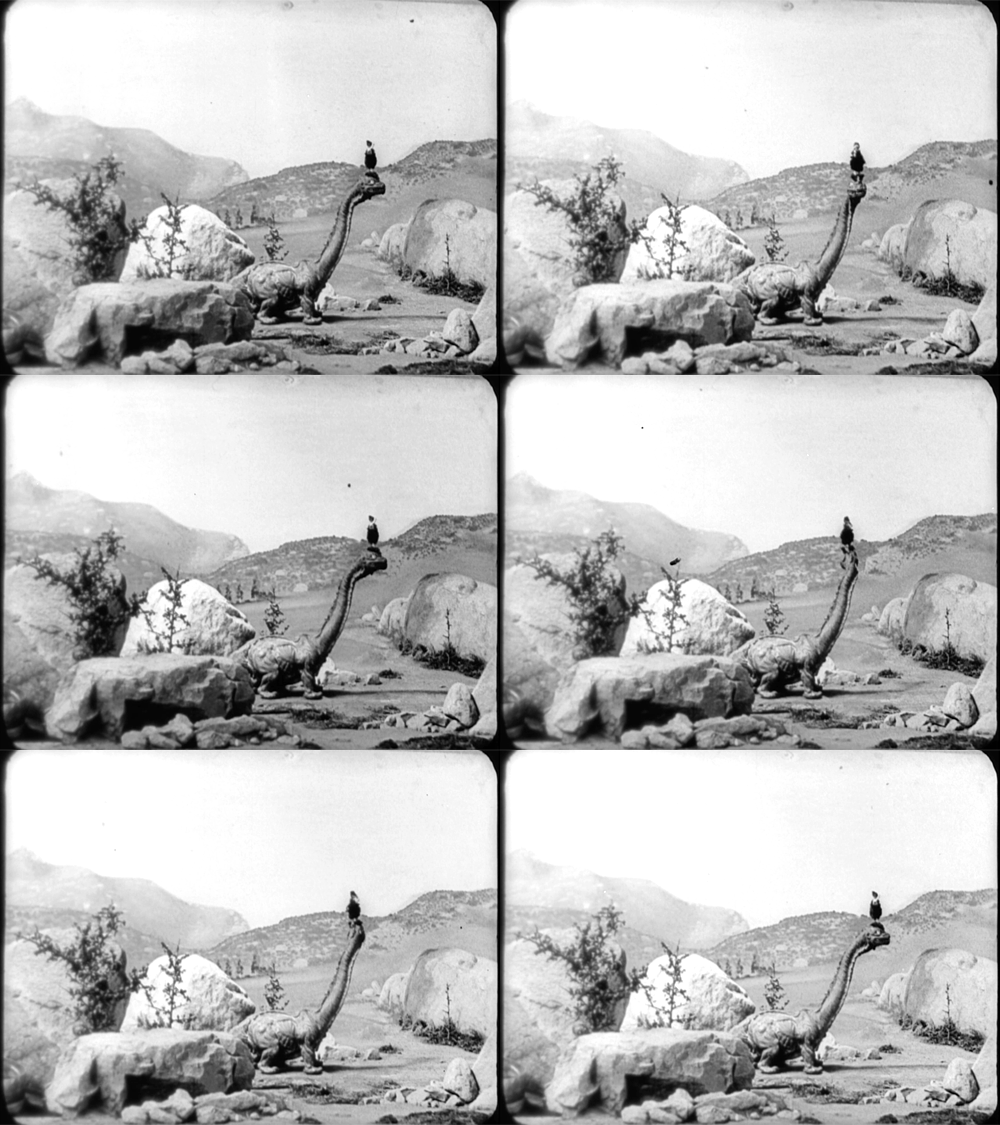
#Bales2023FilmChallenge #WinsorMcCay #JohnAFitzsimmons #vaudeville #comedy #dinosaurs #animals #animation #ShortFilm #SilentFilm #USA #1910s
#todo
view
Sure Fire (Jon Jost, 1990)
May
31
National Utah Day
Wes has it all laid out. His business partner just needs to see it. And his wife. And the people from the West Coast, California, where there's smog and people and no space. They surely want a home, or a second home, in Utah. It's close to Vegas, sure they'll love it. The people.
“One cannot even be sure, whether it is a sect, a mystery cult, a new religion, a church, a people, a nation, or an American subculture; indeed, at different times and places it is all of these.”
– Sydney E. Ahlstrom, historian (1982)
With Sure Fire, director Jon Jost accomplishes that what Lynch tries. A mundane gem with an ominous undertow, but all without the need for mystery or eccentric characters.
Just Utah, and its people.
view
Vertigo (Alfred Hitchcock, 1958)
May
27
Golden Gate Bridge
A pensive Novak in black in front of a sunlit Golden Gate Bridge. DP: Robert Burks.
A bridge to celebrate the 1937 Golden Gate Bridge opening.
“Here I was born, and there I died. It was only a moment for you; you took no notice.”
view
Night Tide (Curtis Harrington, 1961)
May
22
National Maritime Day
Johnny Drake (Dennis Hopper) and Mora (Linda Lawson) in front of her joint that reads “MORA the MERMAID. ALIVE! LOVELY SIREN of the DEEP”. The sideshow's mural, and presumably the lettering too, were painted by Kenneth Anger associate Paul Mathison, both part of (Marjorie) Cameron's Magick Circle. DPs: Vilis Lapenieks & Floyd Crosby.
On the Santa Monica pier, sailor Johnny falls in love with one of the attractions of the local #sideshow, Mora the Mermaid. As people warn Johnny about the faith of Mora's previous suitors, captivated, he becomes convinced that she is a real siren, planning his downfall.
– Yes, I love the sea most of all. But I'm afraid of it, too.
– I guess we're all a little afraid of what we love.
view
Ladybug Ladybug (Frank Perry, 1963)
May
21
the End Of The World
In a scene evoking Ingmar Bergman's Det sjunde inseglet [The Seventh Seal] (1957), one of the older girls leads the younger children in dance on top of a hill. Their teacher Mrs Andrews (Nancy Marchand) plus two of her students walk along. DP: Leonard Hirschfield.
It's another school day in rural America when the #NuclearAttack alarm starts ringing. A teacher, instructed to calmly walk the kids home, tries to keep the youngest ones oblivious of the impending doom.
“Ladybug, ladybug,
Fly away home”
children's song
While the children walk, talk and sing, this thing up there, in the sky and in the mind, grows bigger.
view
Idaho Transfer (Peter Fonda, 1973)
May
17
National Idaho Day
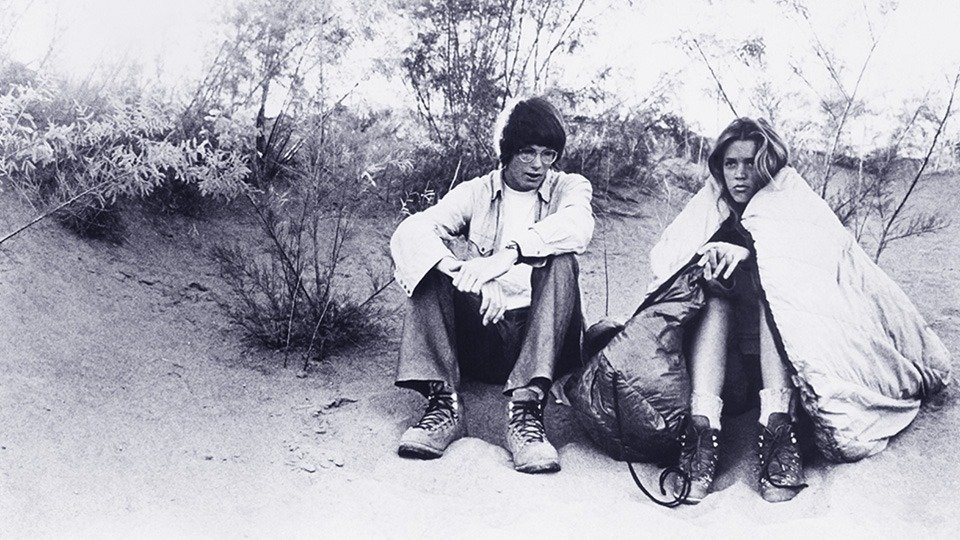
Teenagers Ronald (Kevin Hearst) and Karen (Kelly Bohanon) sitting next to each other in the desert. Karen, wearing untied shoes and a sleeping bag over her shoulders, looks distraught. DP: Bruce Logan.
A disaster has struck the future world. A private one, Karen's sister has had an accident. And a global one, one so severe that a Government project is put in place. The Project, located in the #Idaho desert and in different points in time, transfers teenagers 56 years forward so to repopulate the to-be-wiped-out land. Then, without warning or reason, The Project shuts down and the kids strand into a deserted future.
“Esto Perpetua”
– Idaho state motto
Idaho Transfer is, even for early 70s standards, an odd affair. It carries the weight of its time – hippie optimism had died thanks to #Manson, US meddling in Vietnam, the impending #EcoCrisis (we knew, we always did…) – but there too was this optimism for the upcoming millennium. Everything was going to be fine, in The Future. We'll be wiser, no more wars, no more famine, technology will save us. Released just 4 months before the first Oil Shock, Fonda somehow transferred a glimpse of our future.
view
Doc (Frank Perry, 1971)
May
16
A tense scene in a dark saloon, the table littered with empty bottles. DP: Gerald Hirschfeld.
“If it weren't for bad people, what would you do for a living, Marshal?”
– Doc Holliday