view
火まつり [Himatsuri / Fire Festival] (Mitsuo Yanagimachi, 1985)
Feb
16
water
A man drinks from a small stream like an animal. DP: Masaki Tamura.
view
剣 (小説) [Ken / The Sword] (Kenji Misumi, 1964)
Dec
29
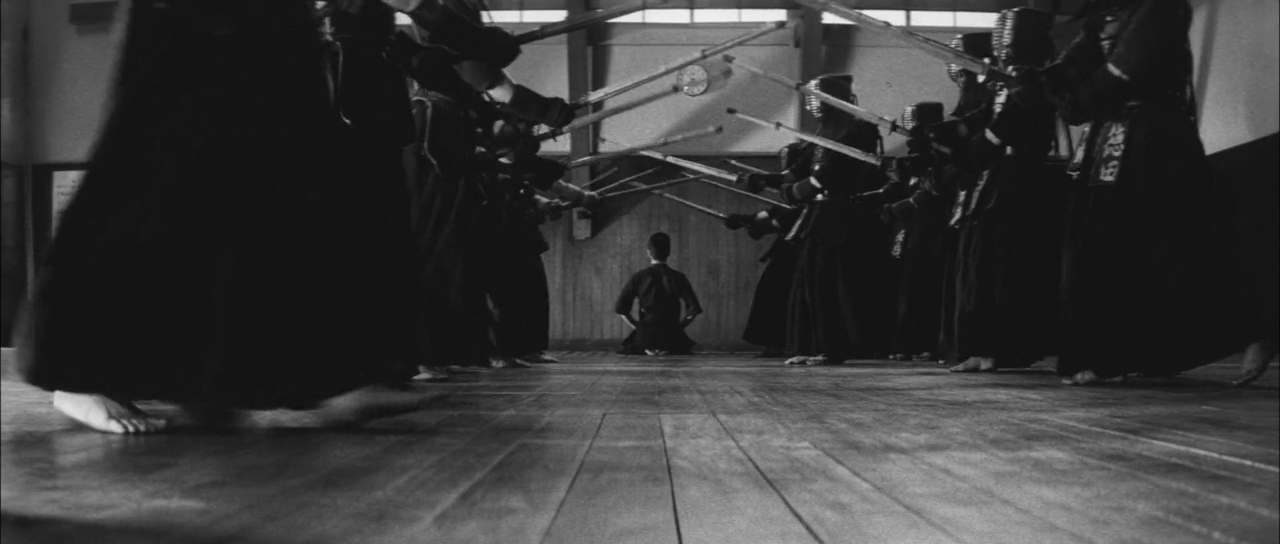
Tick Tock Day
One of the kendōka kneeled on the floor in gruelling punishment faces a clock on the wall, while the other students continue their training. DP: Chikashi Makiura.
After World War II, the Japanese martial arts of #kendo was banished by the occupying forces in an attempt to “remove and exclude militaristic and ultra-nationalistic persons from life”. With that in mind, it makes complete sense that nationalist author and former kendo practitioner Yukio Mishima wrote a short story – Sword, originally published in literary magazine Shincho in 1963 – about the art.
– So what is your goal in life then?
– Satisfaction of the present. The sword, and nothing else.
Both the story and Kenji Misumi's 1964 film adaptation follow arrogant kendo student Jiro, played by sublime kabuki actor Raizō Ichikawa who also appears in an earlier Mishima adaptation, 炎上 [Enjō / The Temple of the Golden Pavilion / Conflagration] (1958).
view
飼育 [Shiiku / The Catch] (Nagisa Ōshima, 1961)
Dec
26
offerings
An altar with two rotund, smiling stone statues – possibly Jizō, a bowl of rice with chopsticks stuck into it, and a Japanese soldier's photograph. The position of the chopsticks tells us that the soldier has died. DP: Yoshitsugu Tonegawa.
view
少年 [Shōnen / Boy] (Nagisa Ōshima, 1969)
Dec
17
Freebie: National Insurance Awareness Day
The boy waiting next to a buzy road. DPs: Seizō Sengen & Yasuhiro Yoshioka.
Freebie: National Insurance Awareness Day (USA) redux.
A boy (Bin Amatsu), helps out his father and stepmother's insurance money scam by pretending to be injured in traffic.
view
楢山節考 [Narayama-bushi kō / The Ballad of Narayama] (Keisuke Kinoshita, 1958)
Dec
11
International Mountain Day
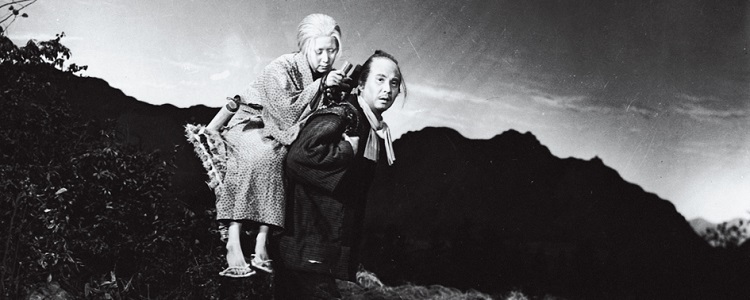
Tatsuhei (Teiji Takahashi) with his mother Orin (Kinuyo Tanaka) in a bamboo carrier on his back. She's combing his hair. Around them the mountain range. DP: Hiroshi Kusuda.
“This winter… I'm going to the mountain. My mother went to the mountain, as did the mother-in-law of our home. So I have to go too.”
– Orin
In Keisuke Kinoshita's highly stylised 楢山節考, the arguably cruel (and most likely fictional) practice – of 姥捨て [ubasute, abandoning an old woman] – is superbly abstracted. Narration, dramatic lighting, colour filters and very obviously a soundstage underline that what we're watching is not a film, but a kabuki play.
view
剣 (小説) [Ken / The Sword] (Kenji Misumi, 1964)
Dec
6
rice
Young people eating. An older woman in kimono scoops rice from an electric rice cooker. When read from right to left, this scene – as are numerous others in Chikashi Makiura's photographed 剣 (小説) – are split into tradition and modernity. DP: Chikashi Makiura.
“We come to life, we die… It's a perpetual renewal. How boring.”
– Mibu
view
隠し砦の三悪人 [Kakushi-toride no san-akunin / The Hidden Fortress] (Akira Kurosawa, 1958)
Nov
25
White Ribbon Day
General Makabe (Toshirō Mifune) facing us with Princess Yuki (Misa Uehara) seemingly standing high above him on the fortress' wall, facing away. DP: Kazuo Yamazaki.
“I don't know what to do with her Highness. Say right and she'll go left, say left and she'll go right. And though she is a girl, she has never shown me a tear.”
– old lady-in-waiting
In Kurosawa's 隠し砦の三悪人, a couple of greedy peasants escort a man and woman across enemy lines after the man has promised them a share of the gold they're carrying. Unknowingly, the fools not only protect their bounty, but a general and princess trying to escape an enemy clan so they can rebuild their kingdom. And also unbeknownst to the tricksters, Makabe and Yuki are not as helpless as they may seem.
view
儀式 [Gishiki / The Ceremony] (Nagisa Ōshima, 1971)
Nov
11
World Origami Day
A man kneeled in front of a Shintō altar. Ceremonial origami, known as origata or girei origami can be seen hanging from the altar. This is 幣帛 [heihaku], an offering made of cloth or paper. DP: Tōichirō Narushima.
view
Goshogaoka [御所ケ丘] (Sharon Lockhart, 1998)
Nov
6
Play Basketball Day
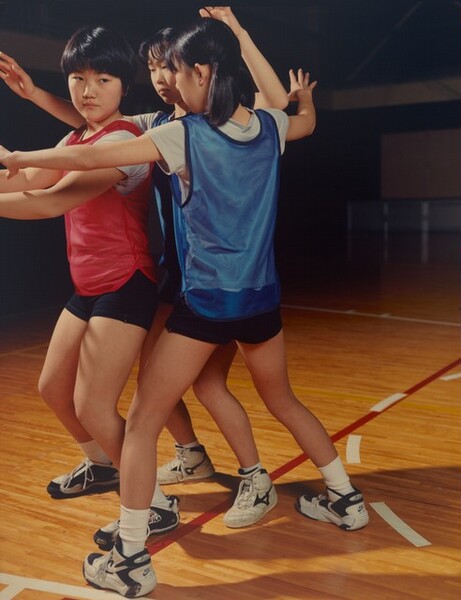
Within the boundaries of Sharon Lockhart's static camera, girls from Goshogaoka junior high school practice basketball. In six uninterrupted 10 minute scenes, we see them warm up and train several typical moves, shots, and blocks. With the camera set in one position, some of the action happens off-screen, resulting in unrehearsed synchronised choreography.
view
瘋癲老人日記 [Fūten rōjin nikki / Diary of a Mad Old Man] (Keigo Kimura, 1962)
Oct
29
World Stroke Day
Utsugi (Sō Yamamura) lusting after his daughter-in-law Sachiko's (Ayako Wakao) feet while she takes a shower. DP: Nobuo Munekawa.