view
Hullumeelsus [Безумие / Madness] (Kaljo Kiisk, 1968)
Sep
15
International Day of Democracy
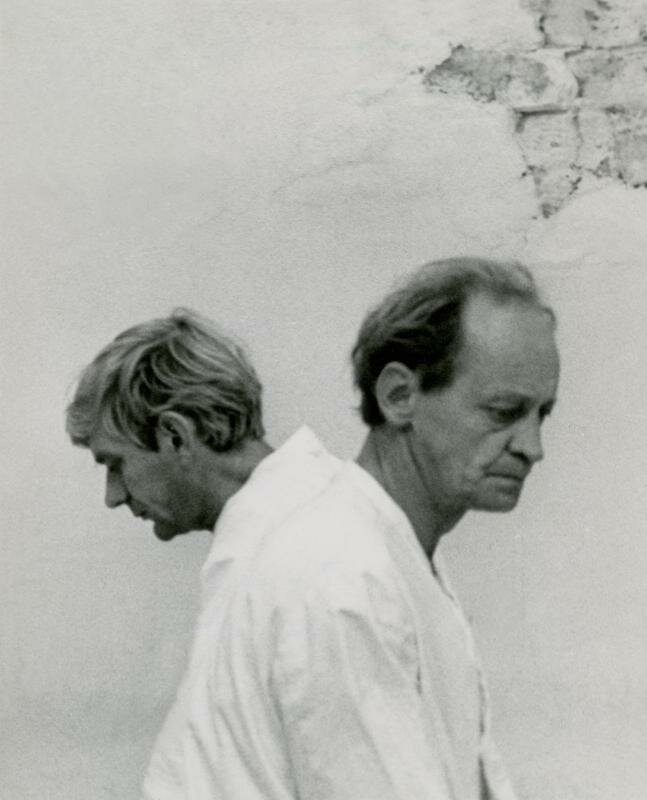
Windisch (Jüri Järvet) pacing, blending in with a white-clad inmate. DP: Anatoliy Zabolotskiy.
“Stop shooting! Stop democracy!”
– Person Nr. 1
The Gestapo arrives to liquidate the inmates of a mental hospital. Then Windisch, plainclothes Nazi, brings them a letter: there's a special commando hiding amidst the 583 patients. Interrogating them slowly pushes Windisch among them.
view
Estate violenta [Violent Summer] (Valerio Zurlini, 1959)
Jul
19
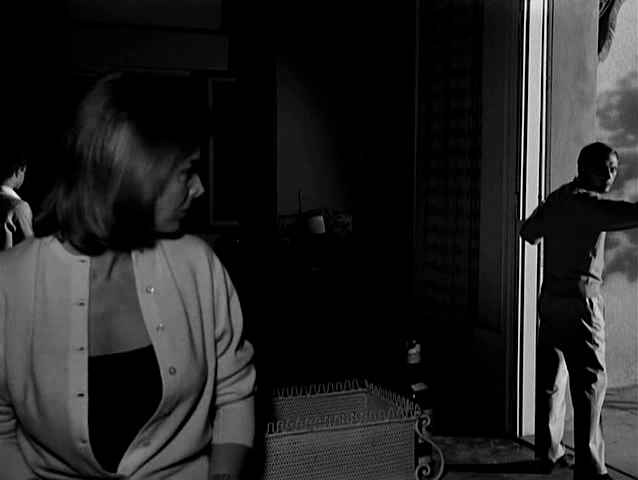
Roberta (Eleonora Rossi Drago) and Carlo (Jean-Louis Trintignant). DP: Tino Santoni.
Characters go on a date, or fall in love*
“It would be thrilling if you were willing,
and if it can never be, pity me,
for you were born to be kissed,
I can’t resist, you are temptation,
and I am yours!”
– Nacio Herb Brown & Arthur Freed, Temptation (1933)
On a beautiful summer day in Rimini, Carlo, the handsome son from a bourgeois home, saves a little girl and becomes infatuated with the girl's mother, a young widow years his senior. Set in July 1943, the events in the outer world (poss. spoilers) and the fate of the two uneven lovers slowly come to their logical conclusion.
view
Popiół i diament [Ashes and Diamonds] (Andrzej Wajda, 1958)
Jun
27
National Sunglasses Day
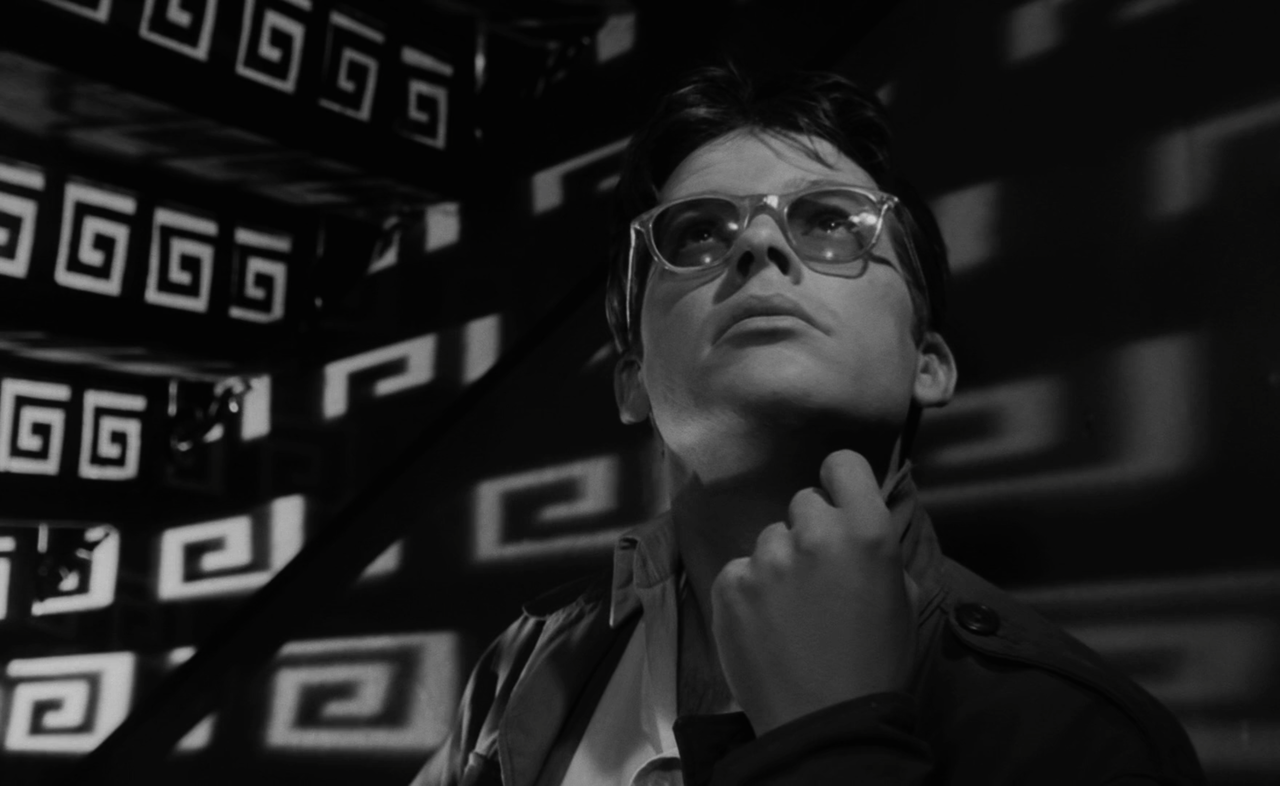
Maciek Chelmicki (Zbigniew Cybulski) wearing his sunglasses in a dark, almost German Expressionist space, embellished with meandros. DP: Jerzy Wójcik.
– Why do you always wear those dark glasses?
– A souvenir of unrequited love for my homeland.
According to IMDb, the sale of sunglasses in Poland went through the roof after this film was released and Cybulski became his country's very own James Dean.
view
The Diary of an Unknown Soldier (Peter Watkins, 1959)
Jun
14
Army Day
That glance. Any soldier at any time. DP: Peter Watkins.
A [favourite] soldier in film for Army Day (USA). I can not in all seriousness link to any official website in fear of throwing up, so please follow along here
“That’s how I will probably die, left like a poor old rag on the battlefield. When you know this is going to happen to you, your body suddenly becomes something terribly precious to you. This flesh, soft and warm is yours; a personal belonging not to be discarded like an awful piece of meat. You find yourself thinking about this, realizing what a wonderful thing your body is, and what an awful and wrong thing it is to maltreat it.”
Watkins takes the anonymous slaughter of the masses on the battlefield inside, into the body and mind of a young soldier.
view
Skammen [Shame] (Ingmar Bergman, 1968)
Jun
12
Loving Day
Eva (Liv Ullmann) and Jan Rosenberg (Max von Sydow) (via). DP: Sven Nykvist.
“Sometimes everything seems just like a dream. It's not my dream, it's somebody else's. But I have to participate in it. How do you think someone who dreams about us would feel when he wakes up. Feeling ashamed?”
– Eva
After Vargtimmen (1968), the second of Bergman's Ullmann/Von Sydow cycle. It was followed by En passion (1969).
Against the backdrop of war, a violinist couple tends a garden – and marriage – on the island of Fårö.
view
Le chagrin et la pitié [The Sorrow and the Pity] (Marcel Ophüls, 1969)
Jun
5
Sorry I Was on a Boat Day
“One thing I find appalling is when people who were [Vichy President] Pétain supporters come up to me and tell me what they did for the Resistance. Sometimes it's unreal. “Oh, Mr. Gaspard, if only you knew what we did, what I did for the Resistance.” Go ahead, pal, tell me all about it. I try to stay calm. I'm a salesman, and I want to sell my product. The company doesn't pay me to do politics and pick fights, so sometimes I find myself obliged to listen to a song and dance of some guy who shows me a drawer and gets his wife to confirm that there was indeed a revolver in that drawer during the war, a revolver which he was supposedly ready to use on the Germans. Only he never actually used it. History doesn't lie.”
And what is yours?
view
Летят журавли [Letyat zhuravli / The Cranes Are Flying] (Mikhail Kalatozov, 1957)
May
8
VE Day
A young woman standing in what was a room in a building, looks out over the ruins of a city. A broken lampshade and a grandfather's clock whisper of other times. DP: Sergey Urusevskiy.
A non-battlefield war movie on VE Day. It had to be a Soviet film, on this date. Thank you, Russia.
“Time will pass. Towns and villages will be rebuilt. Our wounds will heal. But our fierce hatred of war will never diminish.”
– Stepan
When the cranes fly over Moscow, a young couple learns about the war. Now separated, one day, when it is over, if, they'll reunite
view
Das Netz – Unabomber / LSD / Internet [The Net] (Lutz Dammbeck, 2003)
Apr
27
personal computer mouse – 1981
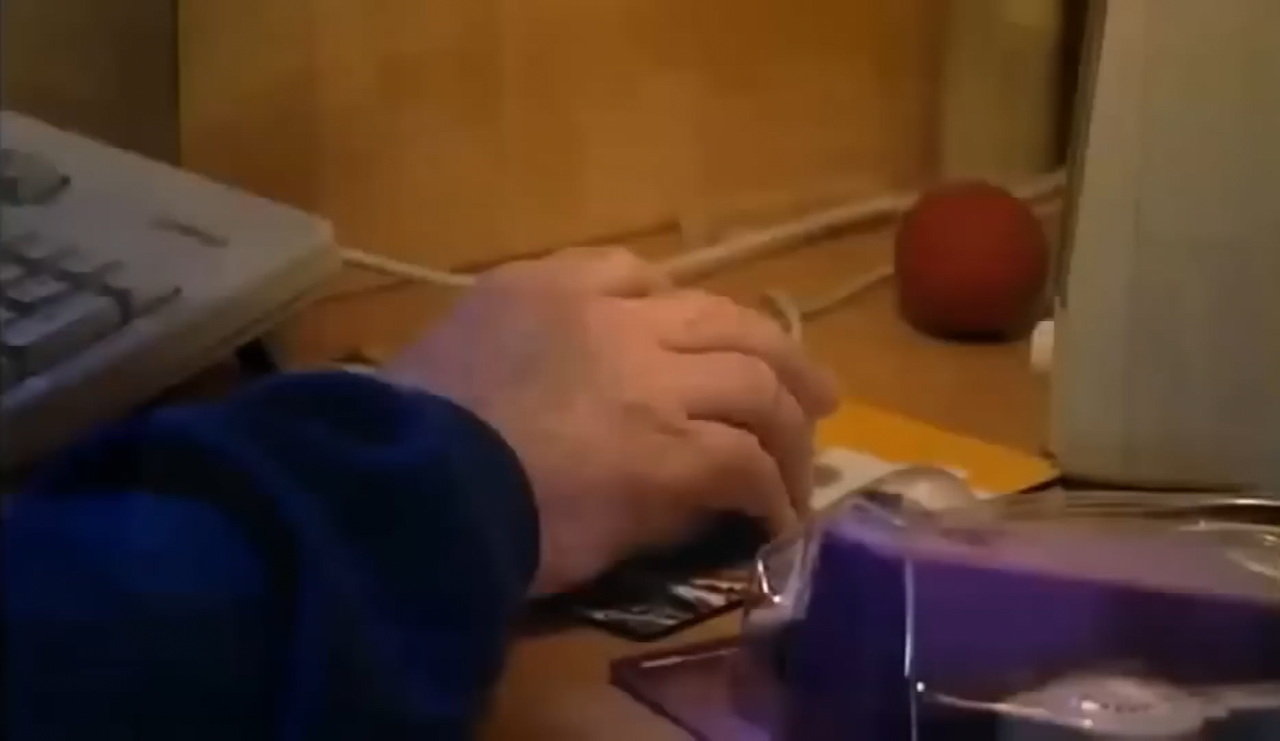
A mouse in action. Note the stress ball. DPs: James Carman, István Imre & Thomas Plenert.
A computer mouse: the first personal computer mouse debuted on this day in 1981.
“To those who think that all this sounds like science fiction, we point out that yesterday's science fiction is today's fact. The Industrial Revolution has radically altered man's environment and way of life, and it is only to be expected that as technology is increasingly applied to the human body and mind, man himself will be altered as radically as his environment and way of life have been.”
– Theodore J. Kaczynski
A Gedankenspiel.
Similar to the way moveable print has accelerated the spread of ideas, the personal computer mouse accelerated the speed of which individualist's ideas can spread. However, like the printing press and unlike the spoken word, the mouse can only point and enhance pre-existing notions, thus neutering any prospect of revolutionary change on an individual level.
view
Prigionieri della guerra [Prisoners of War] (Yervant Gianikian + Angela Ricci Lucchi, 1995)
Apr
24
Armenian genocide
Horse-pulled carts arrive at a cross (via). DPs: Yervant Gianikian & Angela Ricci Lucchi.
“Parfois ils disent que nos images sont esthétiques, mais nous disons que les images esthétiques sont des images hautement étiques. Pour nous éthique et esthétique marchent ensemble. Re-filmer signifie re-signifier.”
– Yervant Gianikian and Angela Ricci Lucchi in conversation with Daniele Dottorini, 2007 (via)
Re-purposed propaganda reels show citizens – displaced, dehumanised – turned into prisoners of war, and finally into corpses.
view
ビルマの竪琴 [Biruma no tategoto / The Burmese Harp] (Kon Ichikawa, 1956)
Apr
8
花祭り
Mizushima (Shōji Yasui) holding his harp, looked over by the reclining Buddha. DP: Minoru Yokoyama.
A film about Buddhism, or set in Japan, in honour of the birth of Buddha, celebrated in Japan on April 8 as 花祭り (Hana Matsuri, aka Flower Festival)
“Can't you see that whatever you do is futile? The armies of Britain and Japan can come and fight all they wish. Burma is still Burma. Burma is the Buddha's country.”
– old monk
While stationed in Burma, Mizushima disguises himself as a dhutanga, a wandering Buddhist monk, burying the remains of his fellow Japanese soldiers.