view
人間蒸発 [Ningen jōhatsu / A Man Vanishes] (Shōhei Imamura, 1967)
Apr
15
Rubber Eraser Day
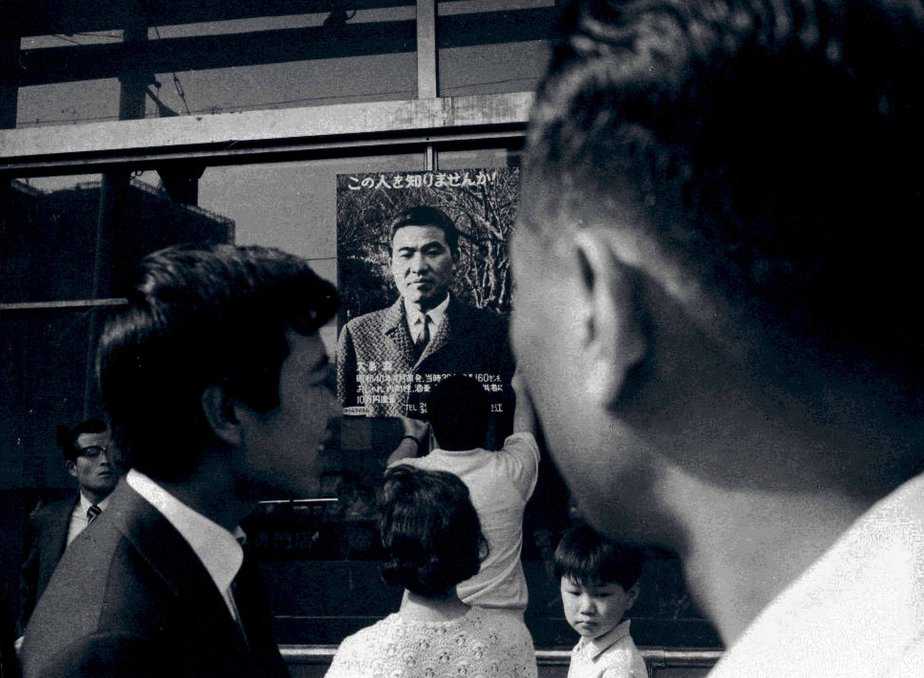
A man hangs a poster of the vanished Mr Oshima. Shoppers pass by. DP: Kenji Ishiguro.
Jōhatsu, literally “evaporation” is the Japanese term for people disappearing without a trace. Salesman Tadashi Oshima is one of them. Director Shōhei Imamura, together with Oshima's fiancé Yoshie Hayakawa and actor Shigeru Tsuyuguchi created an investigative documentary that looks into this man, his motives, his possible whereabouts, and the others that are gone.
人間蒸発 is a fascinating exploration of aspects of 1960s Japanese society that make jōhatsu distinct from similar phenomena elsewhere.
view
Boy on a Dolphin (Jean Negulesco, 1957)
Apr
14
National Dolphin Day
Phaedra (Sophia Loren) posing victoriously on the bow of a sailboat, with the statue, still in its ropes after hoisting it off the ocean floor, behind her. DP: Milton R. Krasner.
Shot on location in Greece, sponge diver Phaedra (Sophia Loren) makes a splash when she finds an ancient statue of a boy on a dolphin, rumoured to bring good luck to her town. Her attempts to sell it to the highest bidder makes not only the bronze but also her the object of desire of an honest archaeologist and an unscrupulous antiques dealer playboy.
“Our paths have crossed and re-crossed: in Dresden, Rotterdam, Florence – wherever the Nazis looted. Raphaels, Rembrandts, even down to a dreary little china pot, which belonged to Madame Pompadour… there was always Captain Jim Calder of the U.S. Army, restoring priceless objects to their rightful owners – a typical middle-class gesture.”
– Victor Parmalee
Boy on a dolphin is not only the title of this movie but also possibly a reference to #Arion, son of the inhabitants of Lesbos (would that make this movie a bit too wild for 1957?), or #Taras, son of Poseidon and Satyrion. According to Greek legend, both mythological characters were saved by #dolphins.
view
The Kirlian Witness (Jonathan Sarno, 1978)
Apr
13
International Plant Appreciation Day
Rilla (Nancy Snyder) in a neglected room, the floor's littered with empty food packaging. On a small table in front of her, a ficus hooked up to a polygraph. DP: João Fernandes.
Kirlian photography claims that plants can communicate telepathically. Rilla (Nancy Snyder) delves deep into the science so to interrogate the only witness to her plant-loving sister Laurie's murder, a ficus.
Not to be confused with the inferior alternative cut The Plants are Watching.
view
Mighty Joe Young (Ernest B. Schoedsack, 1949)
Apr
12
National Only Child Day
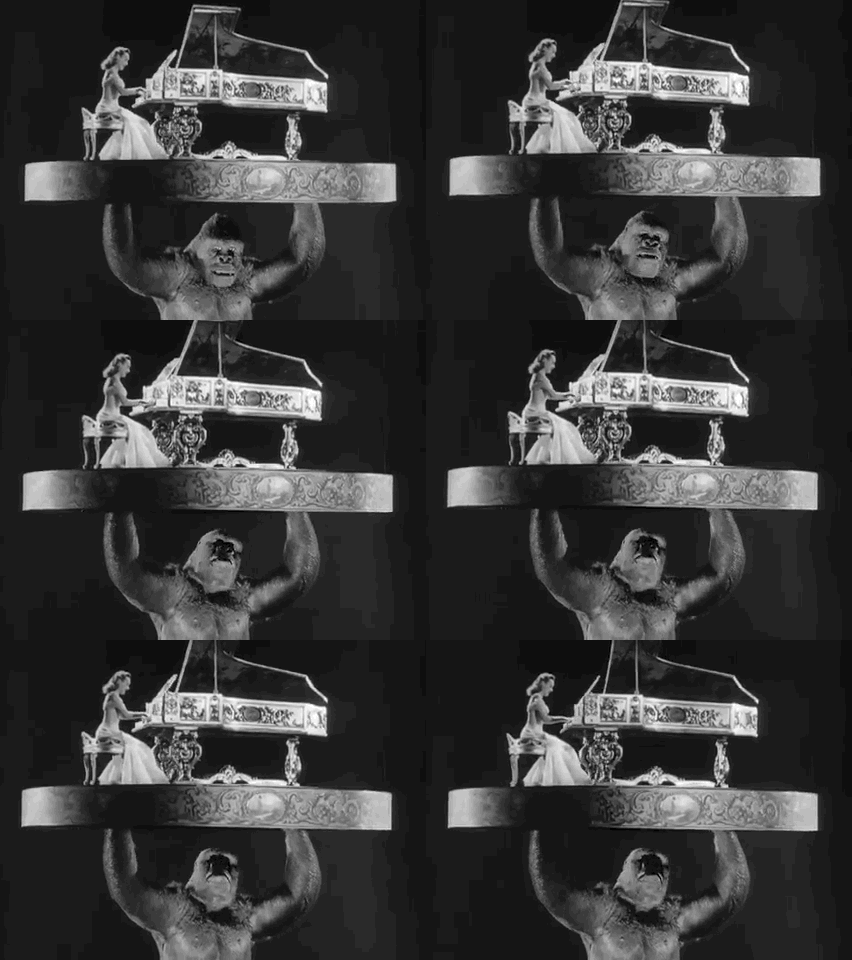
Jill playing the grand piano in a ballgown while suspended high up in the air by Joe. DP: J. Roy Hunt.
Young Jill – played by the tragically doomed Lora Lee Michel – grows up on a ranch in an undisclosed African country (aka “Africa”) with her father. One day, two porters pass her house carrying an orphaned baby #gorilla. Smitten, she wants and gets the ape, names it Joe, and raises it until the simian reaches exceptional size. That's when a couple of showman collecting exotic menagerie for a Hollywood nightclub come across the odd couple. After long consideration and desperate for money, Jill decides to take Joe to the States where the two become an overnight cabaret sensation. But like Kong before him, Joe is not made for the concrete jungle.
“Am I dreamin', or did I just see a gorilla? And a beautiful dame!”
– Max O'Hara
One decade and a Hays Code later, the people who brought the world King Kong (1933) present Mighty Joe Young: more drama, more spectacle, and superior special effects by Marcel Delgado, Ray #Harryhausen and Willis O'Brien et al. A box-office dud ánd Academy Award for Special Effects winner, Mighty Joe Young is now recognised as an #animation classic. In particular the nightclub scenes (keep your eyes peeled for Phil “The Swedish Angel” Olafsson!) are a wonderful display of the magic of #StopMotion.
view
Tystnaden [The Silence] (Ingmar Bergman, 1963)
Apr
10
Siblings Day
Sisters Ester (Ingrid Thulin) and Anna (Gunnel Lindblom). Similar as in Bergman's Persona (1966), the women's faces appear to complete each other. DP: Sven Nykvist.
#Sisters Ester and Anna arrive with Anna's son Johan in the small Central European town of Timoka. The country verges on the brink of war. Unwell Ester is confined to her hotel room, Anna roams Timoka's establishments, Johan wanders the hotel corridors.
“You need to watch your step among all the ghosts and memories.”
– Ester
It's hard to watch #Bergman's Tystnaden without #StanleyKubrick's ghosts sidling in. Tystnaden however doesn't need consternation to cause dread. The interaction and lack thereof between the three leads and the few extras translate into something merely tangible and evermore frightful.
view
Harvey (Henry Koster, 1950)
Apr
9
freebie: Easter Sunday
James Stewart is Elwood P. Dowd. An ordinary man with an extraordinary claim: his best friend is an invisible, six feet three and a half inches-tall #pooka – a mythological Celtic, shapeshifting creature – who in Mr Dowd's case resembles a rabbit called Harvey. Elwood's sister and niece, who also occasionally see the furry goblin, have their relative send to a sanatorium where the doctors and us viewers learn more about this curious case.
“Harvey and I sit in the bars… have a drink or two… play the juke box. And soon the faces of all the other people they turn toward mine and they smile. And they're saying, 'We don't know your name, mister, but you're a very nice fella'.”
– Elwood P. Dowd
Harvey, based on Mary Chase's #PulitzerPrizePlay with the same name, is guaranteed to bring a smile on your face, this humbug's scout's honour! Have a nice #Easter, CineMastodons!
view
Mickey One (Arthur Penn, 1965)
Apr
8
Step Into The Spotlight Day
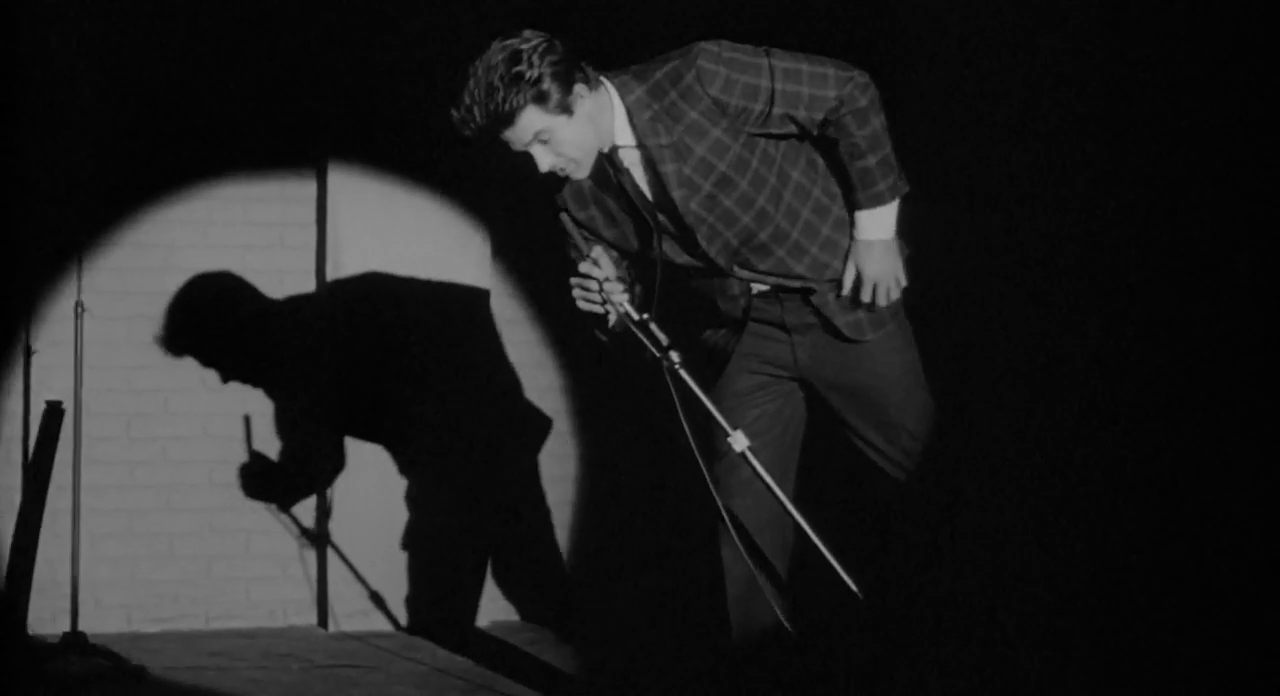
Mickey (Warren Beatty) bent over, holding a microphone with a bright spotlight aimed at him. DP: Ghislain Cloquet.
“I'm the king of the silent pictures. I'm hiding out till talkies blow over.”
– Mickey One
Having said that, there are several great small surreal moments that are carried by uncredited character actors alone. And then there's a sole spotlight, stealing it all away.
view
Hu-Man [Pleurs] (Jérôme Laperrousaz, 1975)
Apr
7
Public Television Day
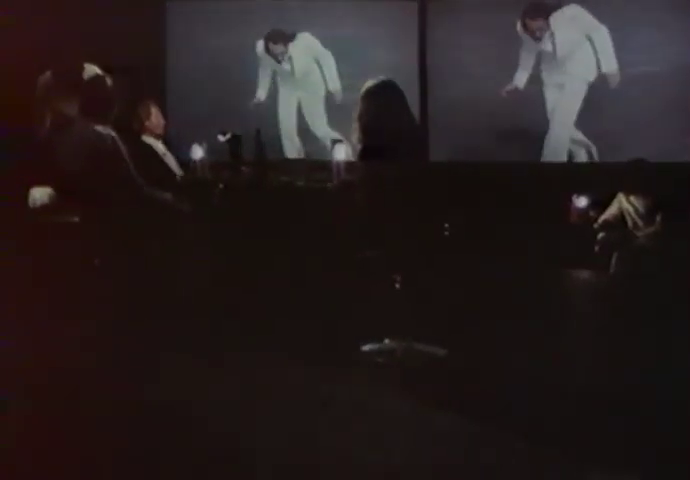
Terence (Terence Stamp) projected on multiple large screens with television executives watching. DP: Jimmy Glasberg.
The global audience of #Mondo-Vision, a live broadcast #TimeTravel experiment, determines through their emotional investment in the lead's screened experience what the man's destination will be. Even so, the spectators' collective energy should serve as a powerhouse, enabling a televised leap into the future. The man whose faith determines it all is Terence Stamp – played by the actor with the same name. He agrees to partake in the hope that enough emotional energy can be harvested for him to travel back in time so he can reunite with his lost love.
While definitely taking a cue or two from Alain Resnais' Je t'aime, je t'aime (1968), Hu-Man has a much grimmer feel to it. The seventies were not a time of or even for optimism, including Stamp's career and personal life. Noun Serra's dizzying editing and the real-world danger both the in-movie actor and real-world actor are exposed to makes Hu-Man a much more self-referential and personal experience for this future's reality-fatigued viewer.
view
Jagdszenen aus Niederbayern [Hunting Scenes from Bavaria / The Hunters and the Hunted] (Peter Fleischmann, 1969)
Apr
6
Sorry Charlie Day
The townspeople gather to prepare the communal harvest meal. A dead sow is laid out on an improvised table. DP: Alain Derobe.
A scandal, that's what it was! In the late 1960s, Peter Fleischmann picked the picturesque Catholic village of #Landshut as the backdrop for Jagdszenen aus #Niederbayern, the film adaptation of Martin Sperr's #TheatrePlay with the same name.
A young man named Abram – played by Sperr – returns to his family village. Soon the townspeople's thorns move from the in their eyes other disgraceful villagers to the much-needed mechanic.
“Ich habe ihn halb tot geschlagen, ich schwör's. Ich kann nichts dafür, dass eine Drecksau draus geworden ist.”
Where did he return from? He was in prison. What for? For being a homosexual. He's a Drecksau (a filthy pig), his mother says. The village whore can't turn him around. A sow is slaughtered in real time in celebration of a successful #harvest and plans for the town's future are forged.
While created when West Germany's #Paragrafen175 was in place [1872–1994], illegality of same-sex relations], the homosexual aspect wasn't the main cause of the outrage. Some of the Landshutter villagers who played alongside the professional actors felt they were depicted as being backwards. This isn't a movie about hunting, sigted some. Lifting the veil of the prevalence of, a #Fernweh in a sense, that Germany (hush) was another.
Catholic Mass is a theatrical re-enactment of the life and suffering of the son of God. When rites outstay their meaning, when invocations turn routine, the worshippers lose sight.