“Salt, pepper, sugar, ketchup and napkins, New York.” 66 scener fra Amerika [66 Scenes from America] (Jørgen Leth, 1982)
Jul
4
Independence Day

Director Jørgen Leth capturing Tsé Biiʼ Ndzisgaii [Merrick Butte] in Monument Valley, AZ, for the opening scene. He's waving a small American flag in front of the camera. DP: Dan Holmberg.
A road movie becomes interesting when the traveller is a stranger. When he or she takes that first step, head still firmly planted at home, soul on its way out.
Jørgen Leth is a Danish documentary maker who in the early 80s sent sixty-six postcards from America. These postcards form a #travelogue of bewilderment. The #landscape, #food, language, anything an American may take for granted framed in a moving still. The American, ever ready for stardom, poses and orates. The scenes become show, regardless if it's a New York cabbie or a man famously (falsely) credited for predicting fame, slowly eating a Whopper.
The resulting 66 scener fra Amerika is as much a time capsule as it is a portrait of forever.
Lo straniero [The Stranger] (Luchino Visconti, 1967)
Jul
3
soup
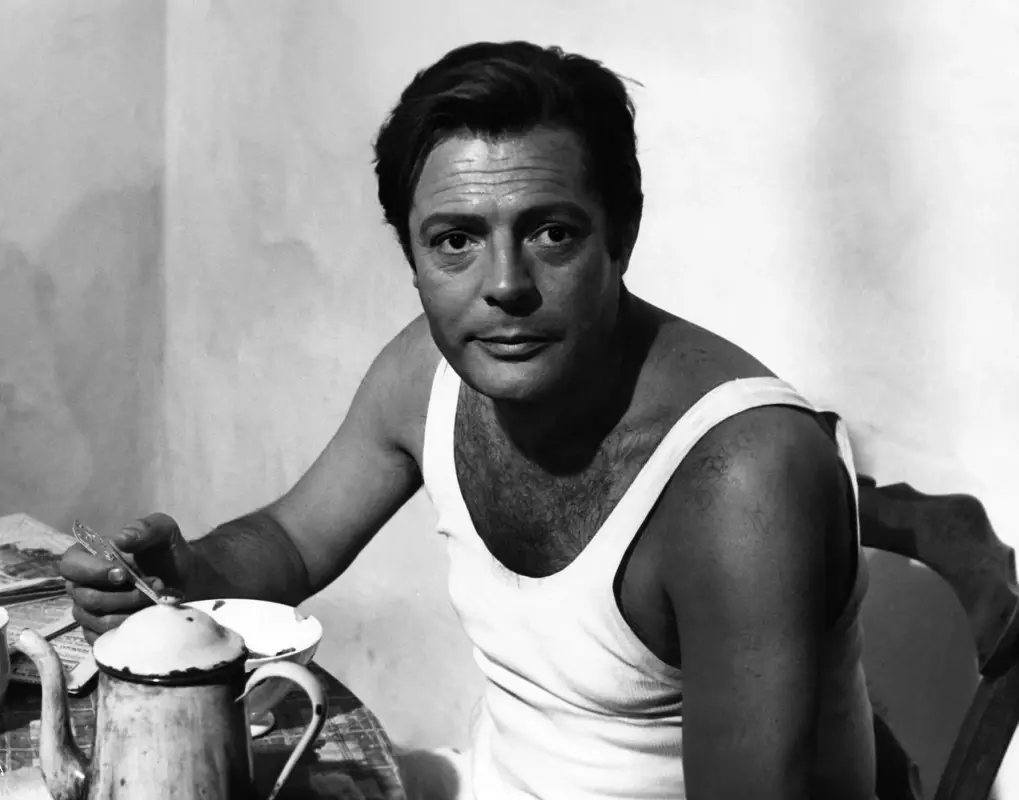
Arthur Meursault (Mastroianni) eating from a cracked bowl. DP: Giuseppe Rotunno.
“What do you want from Voss? She's no good at soccer.”Die Sehnsucht der Veronika Voss (Rainer Werner Fassbinder, 1982)
Jul
2
World Sports Journalists Day

Actress Veronika Voss (Rosel Zech) with sports journalist Robert Krohn (Hilmar Thate), driving a car at night. DP: Xaver Schwarzenberger.
Veronika Voss, once one of Ufa's greats and rumoured lover of Goebbels, has a chance meeting with #sports journalist Robert Krohn. Despite not recognising her at first glance, the faded star and her world turn out to be irresistible to him.
– Grete
Die Sehnsucht der Veronika Voss [litt. The yearning of Veronika Voss] is #Fassbinder's tribute to both Billy Wilder's Sunset Blvd. (1950) and real-world actress Sybille Schmitz whose career, like Voss', suffered greatly due to her #morphine dependence after the Entnazifizierung.
Ninotchka (1939)
Ninotchka and Leon (Garbo and Douglas) cracking up. DP: William H. Daniels.
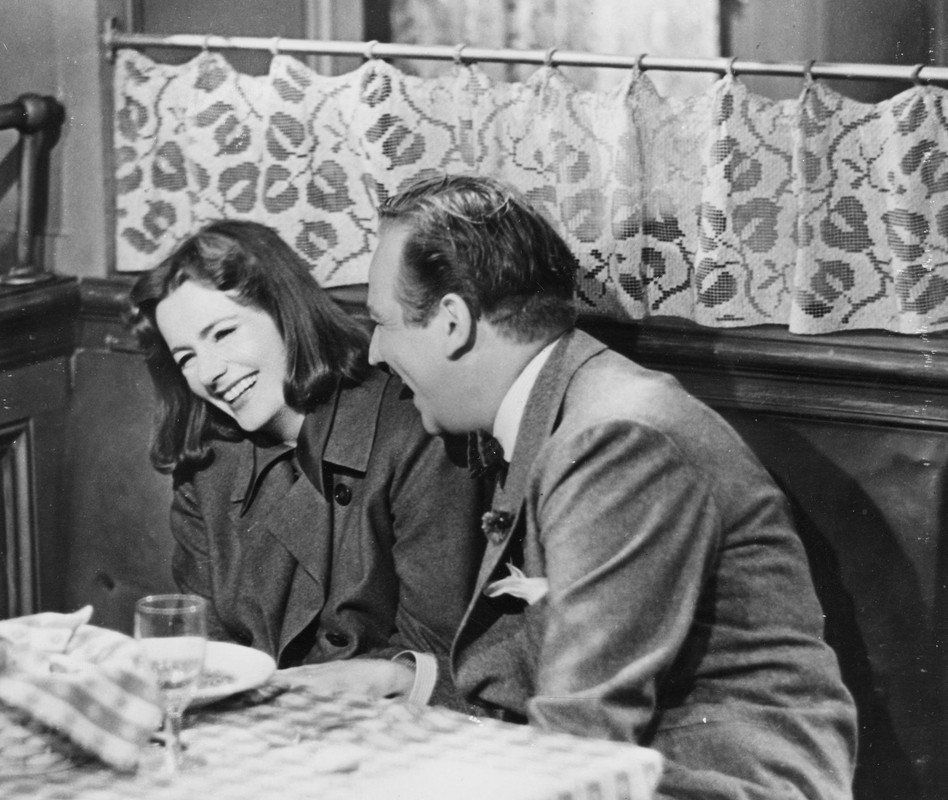
July 1: a joke for #InternationalJokeDay
Ninotchka (Ernst Lubitsch, 1939)
Garbo laughs!
The great Garbo was known for her beauty, her coolness, her tragedy, for a lot but her laughter. So typecast she became that the tagline for Ninotchka (1939) – Garbo laughs! – is a #joke in itself.
Penned by the great Billy Wilder, the Ernst Lubitsch directed comedy unexpectedly temporarily revived #Garbo's career, who by the time 1938 came around had become box office poison. And the joke? Well…
A man comes into a restaurant. He sits down at the table and he says, “Waiter, bring me a cup of coffee without cream.” Five minutes later, the waiter comes back and says, “I'm sorry, sir, we have no cream. Can it be without milk?”
#Bales2023FilmChallenge #ErnstLubitsch #BillyWilder #GretaGarbo #MelvynDouglas #WernerRHeymann #WilliamHDaniels #comedy #communism #romance #USA #1930s
O Bandido da Luz Vermelha [The Red Light Bandit] (Rogério Sganzerla, 1968)
Jul
1
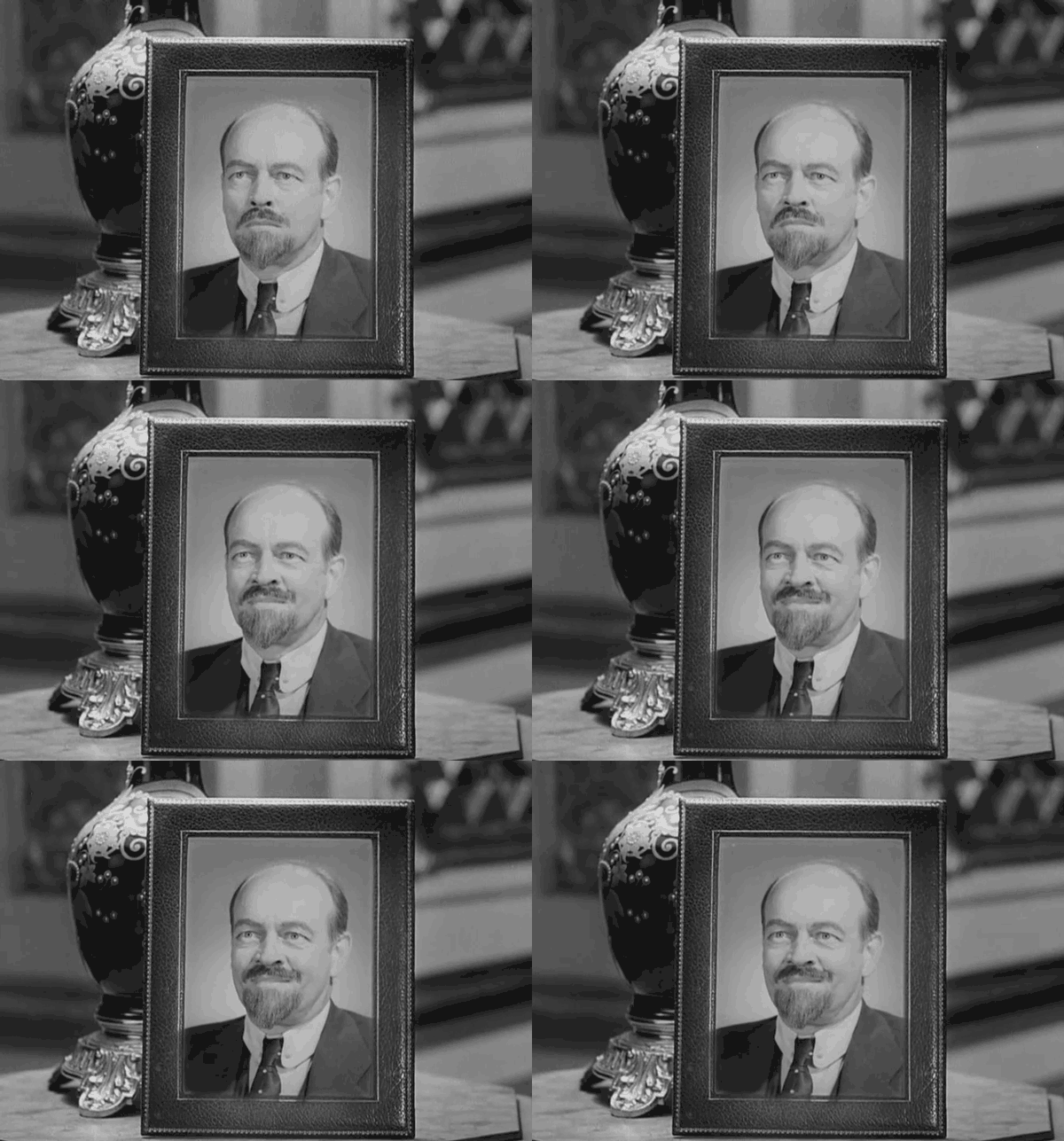
prairie oyster

The bandit (Paulo Villaça) cracks a raw egg over his liquid breakfast while one of his female victims (Sonia Braga) is on the phone beside him. Her cigarette smokes itself and the kitchen table is packed with drugstore items. DPs: Peter Overbeck & Carlos Ebert.
“Say, mister. Will you stake a fellow American to a meal?”The Treasure of the Sierra Madre (John Huston, 1948)
Jun
30
campfire grub

Curtin (Tim Holt), Dobbs (Bogart), and Howard (Walter Huston) eating campfire grub. DP: Ted D. McCord.
– Dobbs
“Things last as long as they last.”Peppermint Frappé (Carlos Saura, 1967)
Jun
30
Drive Your Corvette To Work Day

Producer Elías Querejeta (far left) and others pushing Geraldine Chaplin character Elena's Chevrolet Corvette C1. Behind the wheel actor José Luis López Vázquez (Julián). DP: Luis Cuadrado.
A chance encounter with a blonde drummer during the Holy Week in the village of Calanda leaves a deep impression on Julián (José Luis López Vázquez). When years later he reunites with his childhood friend Pablo, he finds that Pablo is married to bubbly cosmopolitan Elena (Geraldine Chaplin), the spitting image of the elusive drummer. Infatuated he tries to court her, but Elena sees nothing in the drab radiologist. Julián then turns his attention to his shy assistant Ana (also Chaplin) and grooms her into becoming the two unattainable women.
– Pablo
Saura's Peppermint Frappé takes #Hitchcock's Vertigo (1958) – indeed the peppermint green of the drink is an homage – with a twist of #Buñuel and serves it over an anti-#Francoist tale of self-doubting machismo obsessing over The Other. Even Elena's car, American instead of a much more obvious European model, dismisses fascist Spain's perceived superiority. Indeed the Generalisimo drove a Cadillac.
“I know what gold does to men's souls.”The Treasure of the Sierra Madre (John Huston, 1948)
Jun
29
National Handshake Day

Fred (Humphrey Bogart) and Curtin (Tim Holt) shake hands witnessed by gruff prospector Howard (Walter Huston). DP: Ted D. McCord.
Cheated out of their wages, broke Americans #Bogart and Holt are approached by a former prospector. There's #gold in the #SierraMadre mountains, he tells them.
– Howard
Seemingly character driven, Huston's The Treasure of the Sierra Madre is an adventure moved by a relentless #landscape, the urge to drift, and #greed.
“Europe, a Stutz Bearcat, the best restaurants. You fellas really have a hard life, don't you?”Compulsion (Richard Fleischer, 1959)
Jun
29
coffee
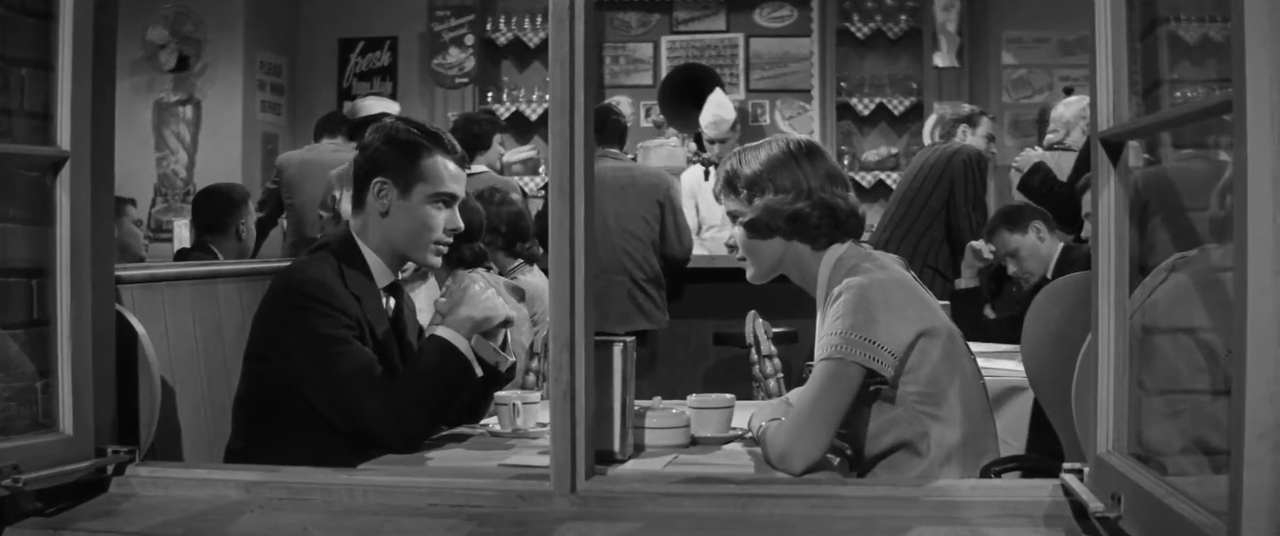
A squeaky young Stockwell and Varsi at a diner. We're looking in from the outside through an open window. The place is busy but she's all enthralled by his wit and intellect (and looks for sure). DP: William C. Mellor.
– Harold Horn, DA
“He's still alive.”Muerte de un ciclista [Death of a Cyclist / Age of Infidelity] (Juan Antonio Bardem, 1955)
Jun
28
National Insurance Awareness Day

Juan (Alberto Closas) looking out at María José (Lucia Bosè) and the car after the crash. The cyclist is never shown. The scene echoes Beckett's Waiting for Godot. DP: Alfredo Fraile.
A car crash on National Insurance Awareness Day (USA)
A couple rushing home at night hit a cyclist. Despite knowing that the man's still alive, they opt to leave the site of the #crash and never mention it again. News reports about the death of the cyclist cause a rupture; because of the couple's #class differences – she a wealthy socialite, he a former falange soldier turned university professor – because they're lovers, and because no one can know about their whereabouts on the night of the accident.
Striking about Bardem's Muerte de un ciclista is its outsiderness in the Spanish film landscape. By adopting the visual language of both Italian #Neorealismo and Hollywood #melodrama, Bardem elegantly circumvents #Francoist censorship.