Snow (Geoffrey Jones, 1963)
Sep
27
Stockton and Darlington Railway – 1825
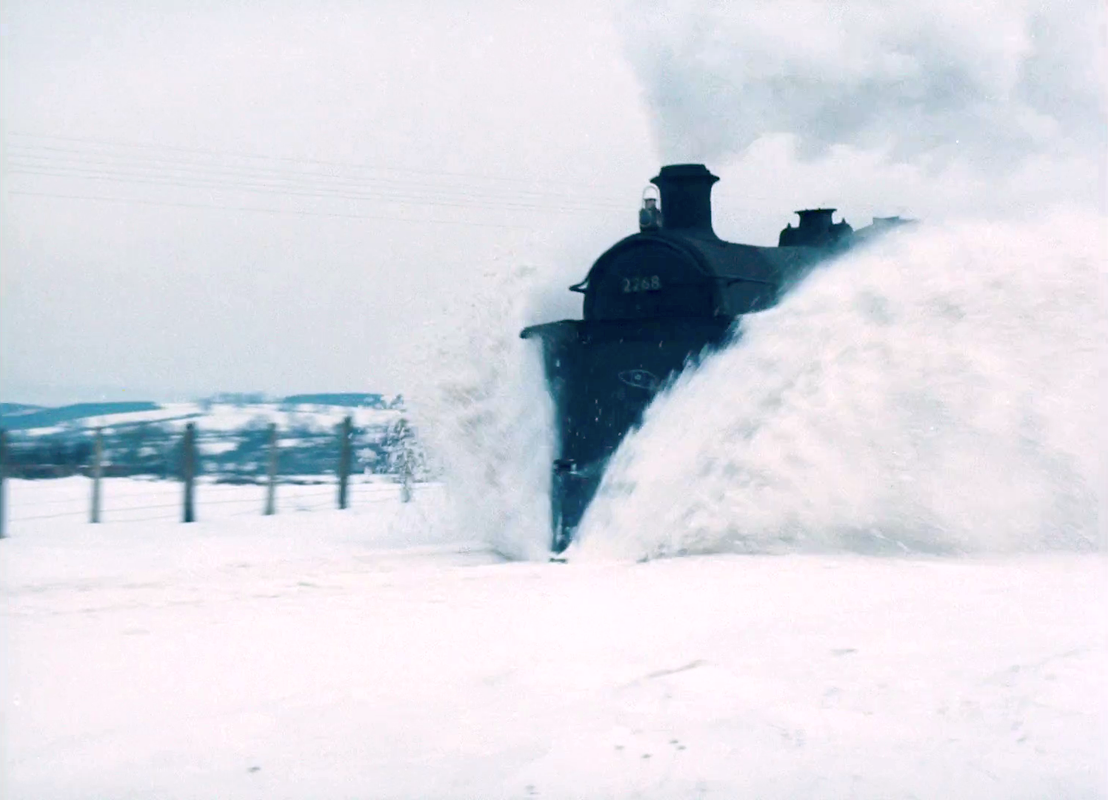
A steam locomotive ploughing through the snow using her cowcatcher. DP: Wolfgang Suschitzky.
A steam locomotive to celebrate the opening of the Stockton and Darlington Railway in 1825, the world's first public railway to use steam locomotives.
The Big Freeze of 1963 was one of the coldest winters recorded in British history. It was during this winter that filmmaker Geoffrey Jones was commissioned by British Transport Films to make a documentary about the British Railways Board. With the freeze setting in, Jones ran the footage in preparation of post-production, and was struck by the blackness of the locomotives against the white of the many feet of snow. This smaller experimental project became Snow. Accompanied by a stretched out version of the jazz tune Teen Beat, and BBC Radiophonic Workshop's own Daphne Oram, Snow is an improbable hypnotic trip in an impossible landscape.
ShortFilm
“Mars Daughter, You are fine. I am loving you and I should like very much to marry you.”Un matrimonio interplanetario [A Marriage in the Moon] (Enrico Novelli, 1910)
Sep
12
Луна 2 – 1959
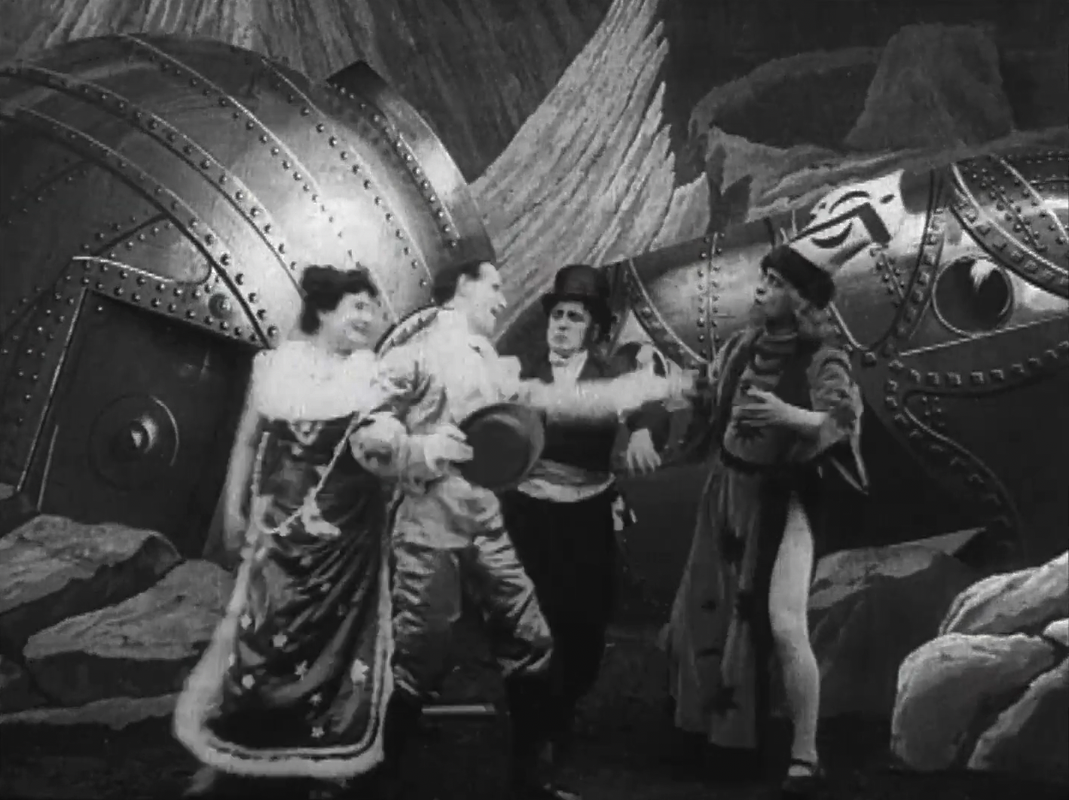
Aldovin (director and author of La Colonia Lunare (1908) meets his lovely Martian fiancée halfway, on the Moon.
To commemorate the launch (not landing) of the Луна 2 aka the Second Soviet Cosmic Rocket on September 12, 1959, we present The Moon.
According to Wikipedia, Luna 2 was the first spacecraft to touch the surface of the Moon, and the first human-made object to make contact with another celestial body. Well, Enrico Novelli went there first…
– Aldovin, Terrestrial Astronomer (Aldovin's radiotelegraph to Mars), via
…and what an adventure he had! An Earth gentleman points his telescope at the red planet, only to spot a beautiful Martian princess. He promptly falls in love and lo and behold! it's mutual! That asks for an instantaneous wedding halfway, on the Moon, and nothing can stop them!
“I first noticed it in Spring last year. […] It was from [my home] that I first saw it—its crest protruding over the roofs on the other side of the road. Surprised that I hadn’t noticed it before, I wondered what it was and then forgot about it for several weeks.” The Black Tower (John Smith, 1985—1987)
Aug
22
black
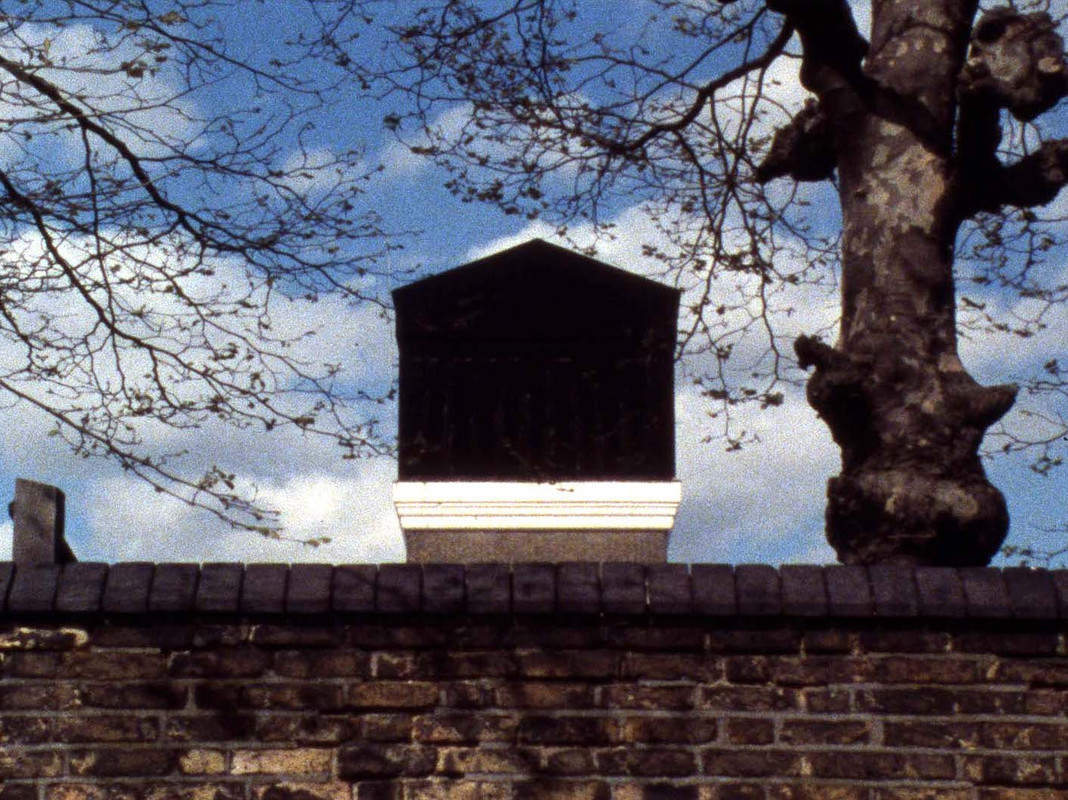
The black tower, visible from behind a brick wall (via)..
Black: a building or structure*
– narrator
A man becomes aware of a formerly unnoticed black tower. Surely it's nothing, yet as the weeks pass, its looming presence takes over.
The black tower was a real structure, first noticed by filmmaker John Smith when he moved to East London. The building, actually the upper part of a hospital's water tower, was painted pitch black, and on sunny days appeared to be a cutout in the sky. By framing the shots in such a way that only part of the surroundings is visible, and editing them in a narrative framework, Smith creates a new context suggesting movement. This style of montage called creative geography, or artificial landscape, was developed by Lev Kuleshov and enables filmmakers to expand existing material and narrative into something that usually is only available to prose poetry.
* the Bales 2025 Film Challenge for August is not date-related but lists, for the most part, the colours of the rainbow.
“Is it the form of the clouds, or the tints of the sky, or the colours of the surrounding objects which are so changeable, which have troubled my thoughts as they passed before my eyes? Who can tell?” Le Horla [The Horla] (Jean-Daniel Pollet, 1966)
Aug
19
violet
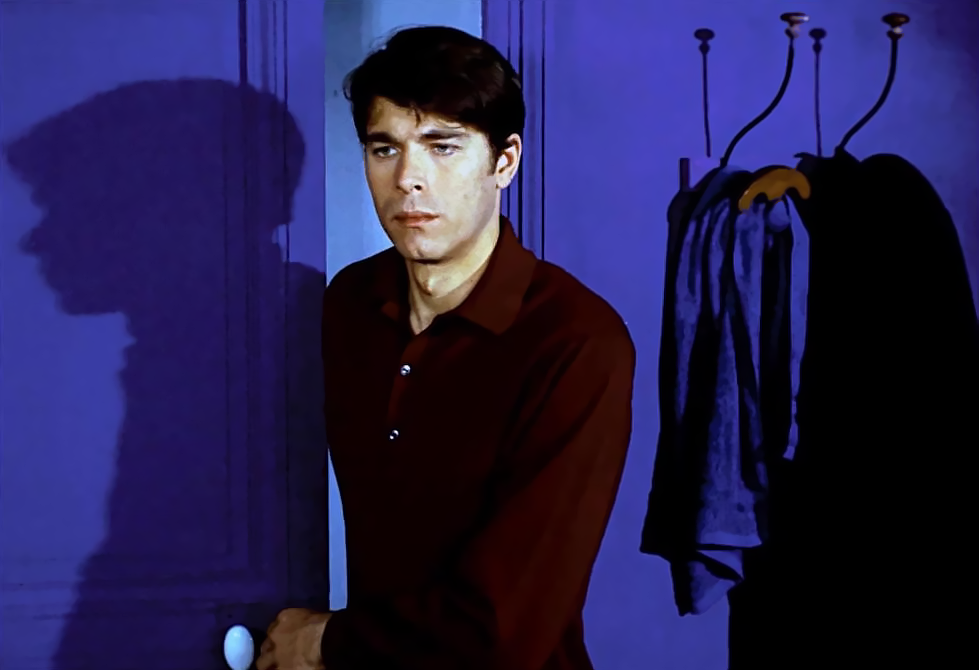
The narrator enters a violet-blue room via a lavender-purple corridor (via). DP: Jean-Jacques Rochut.
Violet: a building or structure *
– Guy de Maupassant, Le Horla, 1887 (via)
Objects and rooms have distinct colours ranging from the deepest blues and violets to a pale lavender, a muted silver and shocks of yellow. The usage of colour in Le Horla is striking throughout and reminds me of how Van Gogh's paintings became increasingly colourful as his madness enveloped him.
* the Bales 2025 Film Challenge for August is not date-related but lists, for the most part, the colours of the rainbow.
آداب بهاری [Adab-e Bahari / Rites of Spring] (Ali Asghar Agahbanaei, 1982)
Aug
11
spring
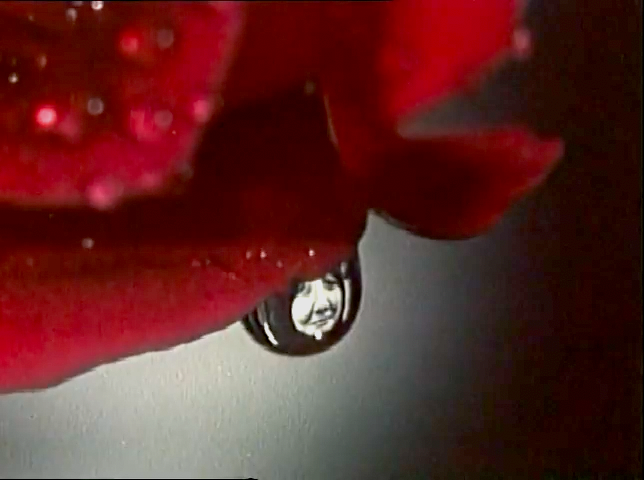
In a dewdrop hanging from a rose, the face of a smiling woman appears.
Dita e Verës, a pagan spring celebration from Albania, celebrated in March: a spring scene*
The restless anticipation of spring. Iran as it was before and after the 1979 toppling of the Shah. While the snow melts away, the Revolution takes place, and fresh buds appear on the rose bushes. A poem.
* the Bales 2025 Film Challenge for August is not date-related.
“Tourists prefer the trendy colors, yellow and blue. Pacing fancies, hotels are painted yellow and blue. Blue wins. All women want to be fashionable. All women wear blue, except the English, those learning to swim, and the Germans, who are dedicated to green.”Du côté de la côte [Along the Coast] (Agnès Varda, 1958)
Aug
9
yellow
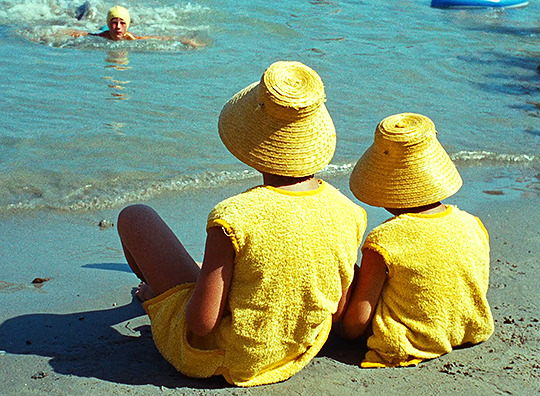
Two people, one big one small, in identical canary yellow robes and straw sun hats on the beach (more here). DPs: Quinto Albicocco & Raymond Castel.
Yellow, in food or fashion*
– narrator
* the Bales 2025 Film Challenge for August is not date-related but lists, for the most part, the colours of the rainbow.
“When we began to compare the typically American, typically European, and typically Russian films, we noticed that they were distinctly different from one another in their construction. We noticed that in a particular sequence of a Russian film there were, say, ten to fifteen splices, ten to fifteen different set-ups. In the European film there might be twenty to thirty such set-ups (one must not forget that this description pertains to the year 1916), while in the American film there would be from eighty, sometimes upward to a hundred, separate shots. The American films took first place in eliciting reactions from the audience; European films took second; and the Russian films, third. We became particularly intrigued by this, but in the beginning we did not understand it.” Эффект Кулешова [Kuleshov Effect] (Lev Kuleshov, 1918)
Aug
5
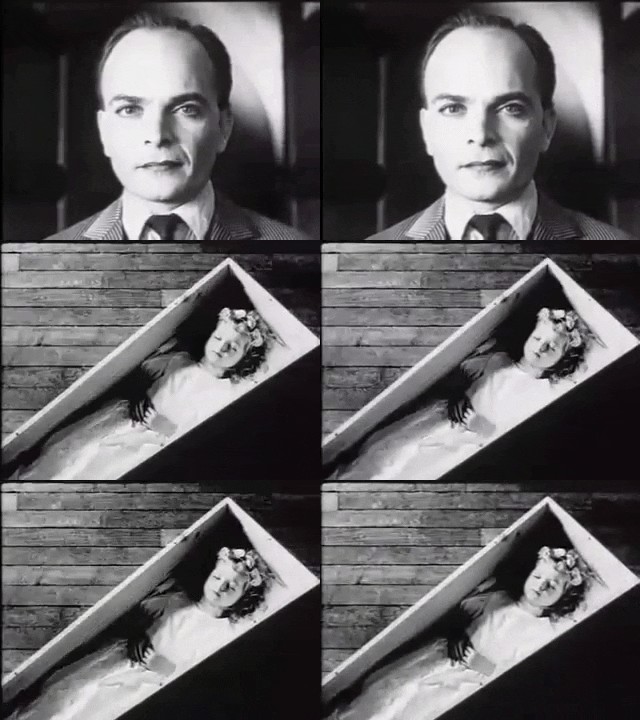
A closeup of a man, followed by a medium shot of a child in a coffin, then back to the man. Can you see how his expression changes? (via). DP: to be determined.
Celebrating Dia de Los Muertos [on November 1 and 2, of course]: a cemetery, coffin, or dead person*
– Lev Kuleshov, The Principles of Montage, from The Practice of Film Direction (pp. 183-195) (source)
Director Lev Kuleshov explains what happens when a scene is followed by a reaction shot. Depending on the preceding image, the viewer projects an emotion onto the performer's facial expression. In his most famous montage, made up of existing footage – because property is theft, we see matinee idol Ivan Mosjoukine “react” to a bowl of soup, a little girl in a coffin, and a woman sprawled out on a divan.
* the Bales 2025 Film Challenge for August is not date-related but lists, for the most part, the colours of the rainbow.
Paparazzi (Jacques Rozier, 1963/1964)
Jul
29
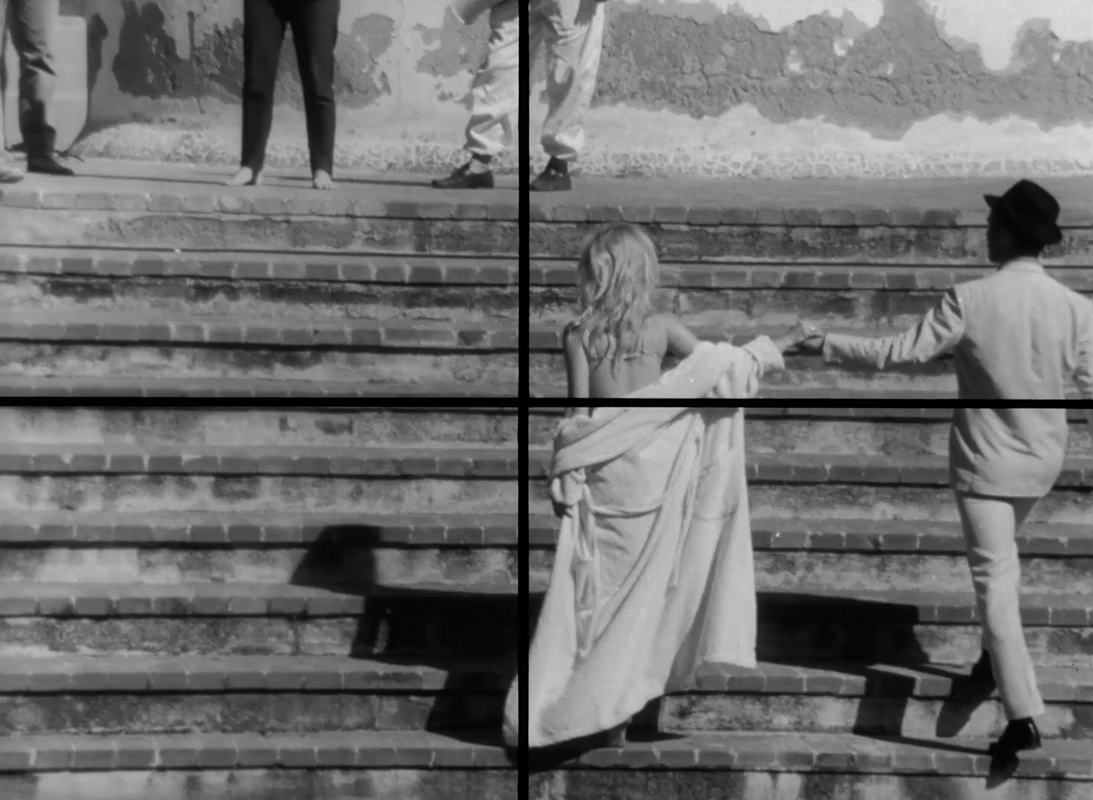
Brigitte Bardot and her co-star Michel Piccoli making a show of ascending the stairs of Casa Malaparte as seen through a paparazzo's lens. DP: Maurice Perrimond.
A character has a camera or takes photos*
It buzzes on the set of Le mépris. These mosquitos, the Italians say paparazzi, swarm La Bardot, make it merely impossible for anyone – themselves included – to do their job. But Bardot knows them, too well, and gives them what they want, when she wants it.
* the Bales 2025 Film Challenge for July is, for unknown reasons, mostly not date-related and follows some sort of vacation narrative.
“Un gâteau.”La boulangère de Monceau [The Bakery Girl of Monceau] (Éric Rohmer, 1963)
Jul
28
un gâteau
.png)
A young woman in an apron grabs a French cookie. DPs: Bruno Barbey & Jean-Michel Meurice.
– young man
“Telephones were still working, we are told, and the air-conditioning and refrigerators in many houses were still on.” La Soufrière – Warten auf eine unausweichliche Katastrophe [La Soufrière: Waiting for an Inevitable Catastrophe] (Werner Herzog, 1977)
Jul
13
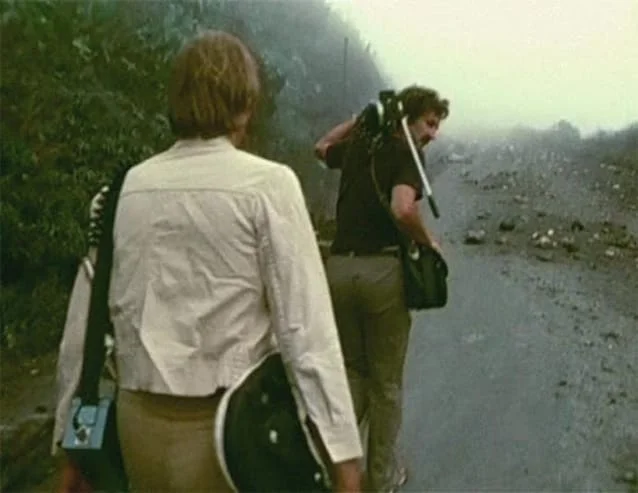
Herzog and crew make their way up the volcano (via). DPs: Edward Lachman & Jörg Schmidt-Reitwein.
Someone at a theme park or national park*
– narrator
The highest peak in the Parc national de la Guadeloupe is called La Grande Soufrière. The volcano had erupted before and was bound to do soon again. Hastily, the 76,000 islanders were evacuated with one farmer staying put. For Herzog reason to halt the editing of Herz aus Glas and make his way to the island.
* the Bales 2025 Film Challenge for July is, for unknown reasons, mostly not date-related and follows some sort of vacation narrative.