“He's still alive.”Muerte de un ciclista [Death of a Cyclist / Age of Infidelity] (Juan Antonio Bardem, 1955)
Jun
28
National Insurance Awareness Day

Juan (Alberto Closas) looking out at María José (Lucia Bosè) and the car after the crash. The cyclist is never shown. The scene echoes Beckett's Waiting for Godot. DP: Alfredo Fraile.
A car crash on National Insurance Awareness Day (USA)
A couple rushing home at night hit a cyclist. Despite knowing that the man's still alive, they opt to leave the site of the #crash and never mention it again. News reports about the death of the cyclist cause a rupture; because of the couple's #class differences – she a wealthy socialite, he a former falange soldier turned university professor – because they're lovers, and because no one can know about their whereabouts on the night of the accident.
Striking about Bardem's Muerte de un ciclista is its outsiderness in the Spanish film landscape. By adopting the visual language of both Italian #Neorealismo and Hollywood #melodrama, Bardem elegantly circumvents #Francoist censorship.
drama
– Why so grumpy?
– I'm starved! Dinner is always late!La main du diable [The Devil's Hand / Carnival of Sinners] (Maurice Tourneur, 1943)
Jun
27
dinner (late)

A disgruntled man in a hotel restaurant. DP: Armand Thirard.
“I don't care about your barley. Or, your vines! Or, your new terra!”Stromboli (Terra di Dio) [Stromboli] (Roberto Rossellini, 1950)
Jun
27
tuna (fresh)

Karen (Ingrid Bergman) looking miserable at a small kitchen table. A huge tuna covers most of its surface. DP: Otello Martelli.
Posted while deciding on my film dinner. Eventually I went with Tourneur's La Main du Diable (1943).
– Karen
“Here we are, poor wretches, in this hell, Condemned to tyranny.” Stromboli (Terra di Dio) [Stromboli] (Roberto Rossellini, 1950)
Jun
27
Decide To Be Married Day

Antonio (Mario Vitale) and Karen (Ingrid Bergman). DP: Otello Martelli.
Karen – “Karin” in the opening credits – is a displaced Lithuanian woman in an Italy-based refugee camp. She meets an Italian military man bivouacking on the other side of the barbed wire and decides to say yes when he proposes. When the newly-weds leave for home, she finds to her dismay that he's a poor Sicilian fisherman from #Stromboli; a magnificent active volcanic island home to a small Catholic parish. Again displaced, Karen is confronted with herself more than with the others that share her faith.
– Antonio
Roberto #Rossellini's Stromboli (Terra di Dio) is a peculiar melodramatic Italian/American hybrid that seems to strongly dismiss the Italian aspect. The significance of Struògnuli – the Sicilian name for the volcano – and the people's faith connected to the volatile mountain and the surrounding sea is presented as primitive superstition. That the Sicilian dialogue – song, prayer, life – remains untranslated and the locals' broken English is used as comic relief adds insult to injury.
Otello Martelli's photography excels when he manages to tear himself away from Bergman's face. Only when we're confronted with the magnificence of Struògnuli, the gifts from the ocean, and the greatness of nature we'll be able to understand why the island is man's home.
– Aw, mom. You always talk about civilization. – Don't knock it, son. Jeopardy (John Sturges, 1953)
Jun
25
National Camp Counts Day

Behind the scenes. Barbara Stanwyck as unhappy camper Helen Stilwin having her lipstick reapplied by makeup man Pat McNalley. DP: Victor Milner.
A nuclear family of three goes out on a #camping-slash-fishing-trip on a remote Mexican beach. On arrival, son Bobby (Lee Aaker) causes trouble by climbing a rickety old jetty, which then collapses after dad Doug (Barry Sullivan) frees the boy's stuck foot. Now with Doug stuck and the tide rolling in, Helen (Barbara Stanwyck) is on her own and needs to find a rope. And help…
John Sturges' Jeopardy is a thrilling reverse home invasion based on Maurice Zimm's radioplay A Question of Time. Without falling into the trap of an illustrated radio broadcast, the haunting photography by Victor Milner, small, intense cast, short runtime and claustrophobic sets make for a very modern, economic thriller.
And Barbara Stanwyck the type of heroine we wouldn't see much of until decades later.
Le trou [The Hole / The Night Watch] (Jacques Becker, 1960)
Jun
25
care package

Butchering a care package – butter, sausage and other joys of life – for contraband. DP: Ghislain Cloquet.
“I paint what I like when I like, and where I like.” A Bigger Splash (Jack Hazan, 1973/74)
Jun
24
Swim A Lap Day
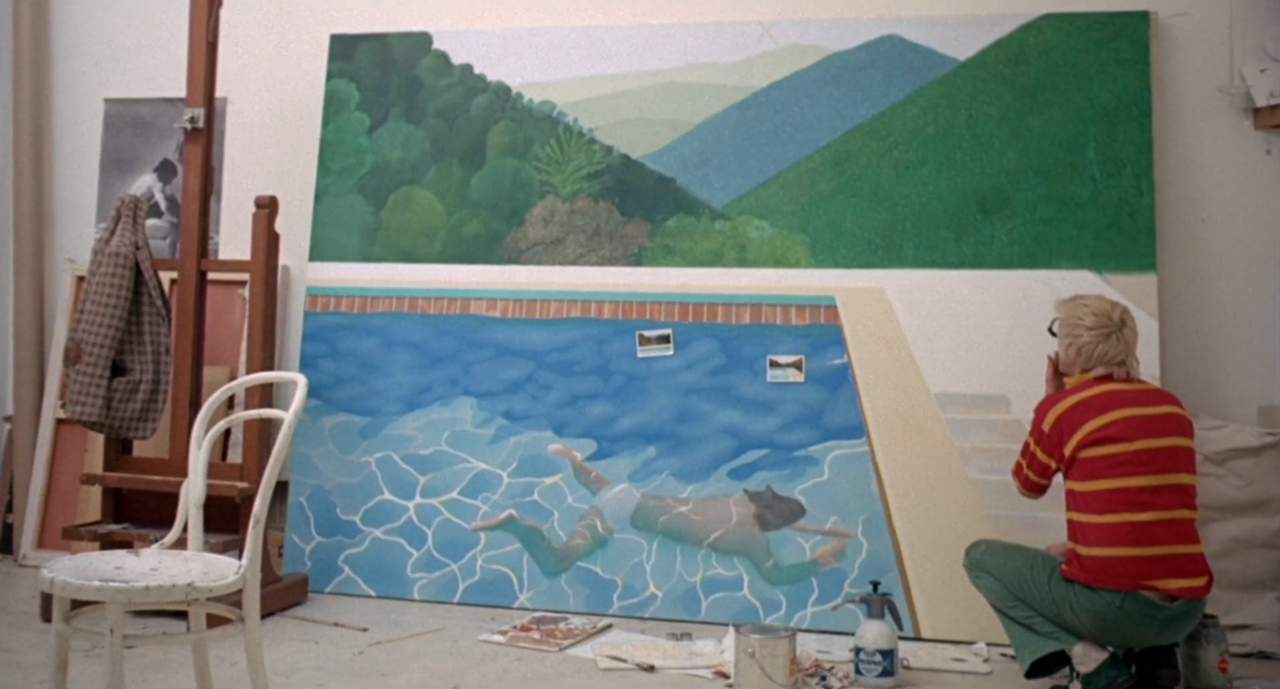
David Hockney as himself working on his painting Portrait of an Artist (Pool with Two Figures) (1971—1972). Two photos are pinned directly to the canvas. Yet unpainted is a figure on the poolside wearing a pink jacket, artist and Hockney's former lover and muse Peter Schlesinger. Hockney almost occupies the space of the missing figure. DP: Jack Hazan.
A Bigger Splash is the name of one of painter David Hockney's best known works and part of a series of pool portraits of the artist's close friends, one of them his lover Peter Schlesinger, an artist in his own right. When in the early 1970s the relationship between the two men started to unravel it affected #Hockney so much it almost rendered him incapable of working.
– David Hockney
While going through Polaroids he found that two of the shots, one of a man #swimming underwater, the other of a man standing on a poolside, fell into the composition he was looking for. The resulting Portrait of an Artist (Pool with Two Figures) – where an unknown man can be seen swimming towards Hockney's fully-dressed former lover – bears similarities to Renaissance paintings where the composition of human figures, landscape, and perspective culminate in proto-cinematic storytelling.
Cinematographer and filmmaker Jack Hazan juxtaposes David Hockney working on Portrait of an Artist (Pool with Two Figures) with speculative scenes about the creation of the work and the disintegration of Hockney's and Schlesinger's relationship. It did create a splash, in particular in its ordinary depiction of a homosexual relationship.
A Bigger Splash is of course not the only (pseudo) documentary about an artist and his or her life, but one of the very few honest ones. The struggle to create is not romanticised, nor is the intimate relationship between artist and muse a playground of lazy, perverse speculation. As Hockney creates, destroys, and recreates his Pool, so we all destroy our lovers to bloom again.
“All these fancy electronics, they're all right in their place, but not for anything practical.”Le procès [The Trial] (Orson Welles, 1962)
Jun
23
National Typewriter Day

Josef K. (Anthony Perkins) crossing an enormous open office space. The endless room is filled with clerks, identical desks, telephones, and typewriters. DP: Edmond Richard.
Office worker Josef K. is brought to trial and at no point told what he is accused of, if anything. Orson Welles' Le procès is an adaptation of Franz Kafka's unfinished 1914/15 novel Der Prozess. The manuscript, guarded from Kafka by his friend #MaxBrod in an attempt to keep the self-doubting author from destroying his work, was against K's wishes posthumously (re)assembled by Brod without the latter knowing the intended sequence of the loose pages nor what chapters were finished.
– Uncle Max
The story holds up in its vagueness thanks to the quirks of #Kafka's Brotberuf; Franz K. was a trained lawyer, working as an insurance agent in an impossible artifice world of reports and precise wording. Within its extended logic, a man can get perplexedly lost, either within the walls of his #office or one's bed.
“It's spontaneous combustion!” Get Rollin' (J. Terrance Mitchell, 1980)
Jun
22
Positive Media Day
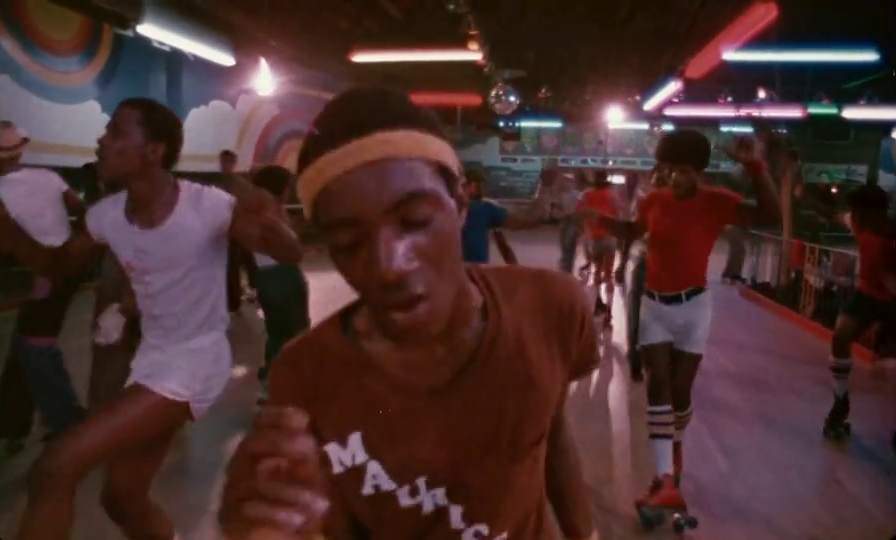
Young Black men jammin' to resident DJ “Big Bob” Clayton's grooves with Maurice Gatewood taking centre stage. Later in the 80s, the Empire Roller Disco would become a meeting point for gay Black and Latinx men who would hold rollerdance competitions. DP: Joseph Friedman.
The groove is driving and the characters jammin' in J. Terrance Mitchell's Get Rollin' (1980). We follow entrepreneur Vinzerrelli (Vinnie Vinzerrelli) who aims to become “the Muhammad Ali of #RollerBoogie” and to enter the Guinness Book of World Records as the first roller skater to make a million dollars. In his tow, smooth-as-silk Pat the Cat (Pat Richardson), who calls it a day to become a star roller derby player in “London, England”. Pat's wife and suddenly-ex-boss are less charmed by the idea. Those skates are expensive, and steam-cleaning those customised tees cost a dime, too. But Pat, he's determined. He's the Cowboy on Skates, rollin' his and everyone's blues away.
– Vinzerrelli
And in her own quiet way, there's soft-spoken physical therapist Inez from Alabama, who can be seen swerving around like a Disco Queen if not teaching a mangled man in Central Park how to rollerskate with flair and self-esteem.
A movie awash with so much groove and good vibes, so much love for Black life on #Brooklyn's Empire Roller Disco rink, it can not do other than put a huge grin on your face.
“Welcome home, Ethan.”The Searchers (John Ford, 1956)
Jun
21
National Arizona Day

Ethan Edwards (John Wayne) facing the endless desert. DP: Winton C. Hoch.