view
Whistle Down the Wind (Bryan Forbes, 1961)
Jul
9
white bread
A child grabs a thick slice of white bread while the cutlery on her plate indicates she's finished eating. DP: Arthur Ibbetson.
“It isn't Jesus. It's just a fella.”
– Charlie Bostock
view
Whistle Down the Wind (Bryan Forbes, 1961)
Jul
9
Barn Day
The man (Alan Bates) in the barn surrounded by little children. The older girl in the light coat, Kathy, is played by Hayley Mills, author Mary Hayley Bell's daughter. DP: Arthur Ibbetson.
In the barn of a remote Lancashire farmhouse, three children stumble upon a stranger. Confused, they conclude that the fellow must be the Second Coming of Christ. In the world of the adults, a man is wanted by the police.
“Good night, Gentle Jesus. Sleep well.”
– Charlie Bostock
view
少林三十六房 [Shao Lin san shi liu fang / The 36th Chamber of Shaolin] (Chia-Liang Liu, 1978)
Jul
8
rice
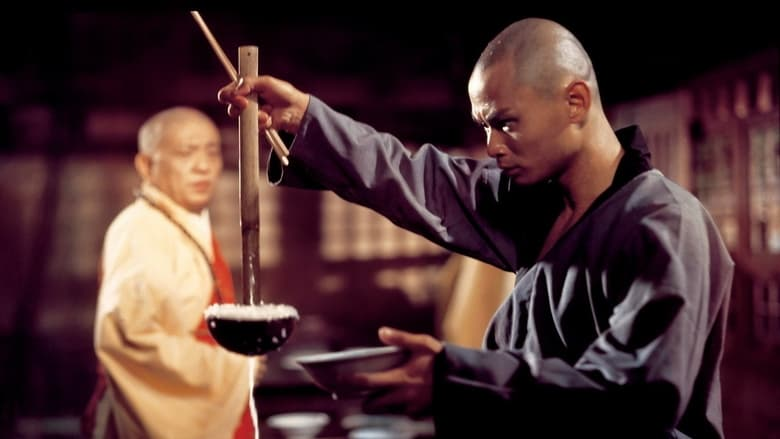
With the utmost focus, Monk San Te (Chia-Hui Liu aka Gordon Liu) carefully handles a large ladle with watery rice. His sceptical sifu (Hung Wei) looks on. DPs: Yueh-Tai Huang & Arthur Wong.
view
491 (Vilgot Sjöman, 1964)
Jul
7
Global Forgiveness Day
One of the juvenile delinquents carving a simple arithmetical calculation into a desk during the Reverend's lecture about forgiveness. DP: Gunnar Fischer.
Early 60s, Sweden. A social experiment. Six hopelessly criminal juveniles are packed in a guesthouse – cynically named Objectivity – and loosely supervised by social workers and a reverend. The public servants speak of a new lease on life, God's servant of how Jesus forgives; all speak on their own behalf. We follow the young men closely and sense their need to break out, to be young, to be out of that house. We learn that their world, in or out, is eternally equally irrelevant.
“Jesus Christ has promised to forgive you 490 times, whatever you have done… because those were his words. But about the 491st time… He has given no words. None at all.”
– Reverend Mild
Vilgot Sjöman's 491 is an extremely, bleak, aggressive, and hopeless depiction of youth in postwar Sweden. Forgiveness is a tool of power, a method of control. And as empty as a repetitive lecture.
view
Nicht der Homosexuelle ist pervers, sondern die Situation, in der er lebt [It Is Not the Homosexual Who Is Perverse, But the Society in Which He Lives] (Rosa von Praunheim, 1971)
Jul
6
National Daniel Day
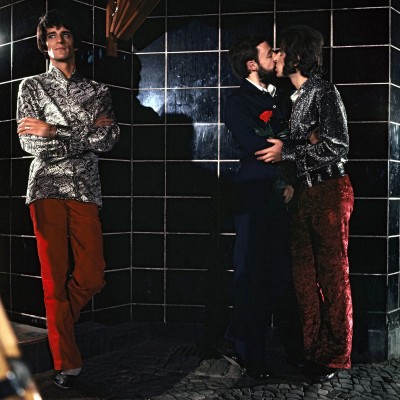
A gay couple kissing on the street in front of a black-tiled Berlin bar. A third gay man nearby looks away. DP: Robert van Ackeren.
“Werdet stolz auf eure Homosexualität! Raus aus den Toiletten, rein in die Strassen! Freiheit für die Schwulen!”
Von Praunheim's Nicht der Homosexuelle ist pervers is a plea for rebellion and visibility. For revolt and love. A wakeup call for gays and straights alike. Such a stir this film pamphlet made it became the blueprint for West-Germany's gay liberation movement.
view
Lo straniero [The Stranger] (Luchino Visconti, 1967)
Jul
3
soup
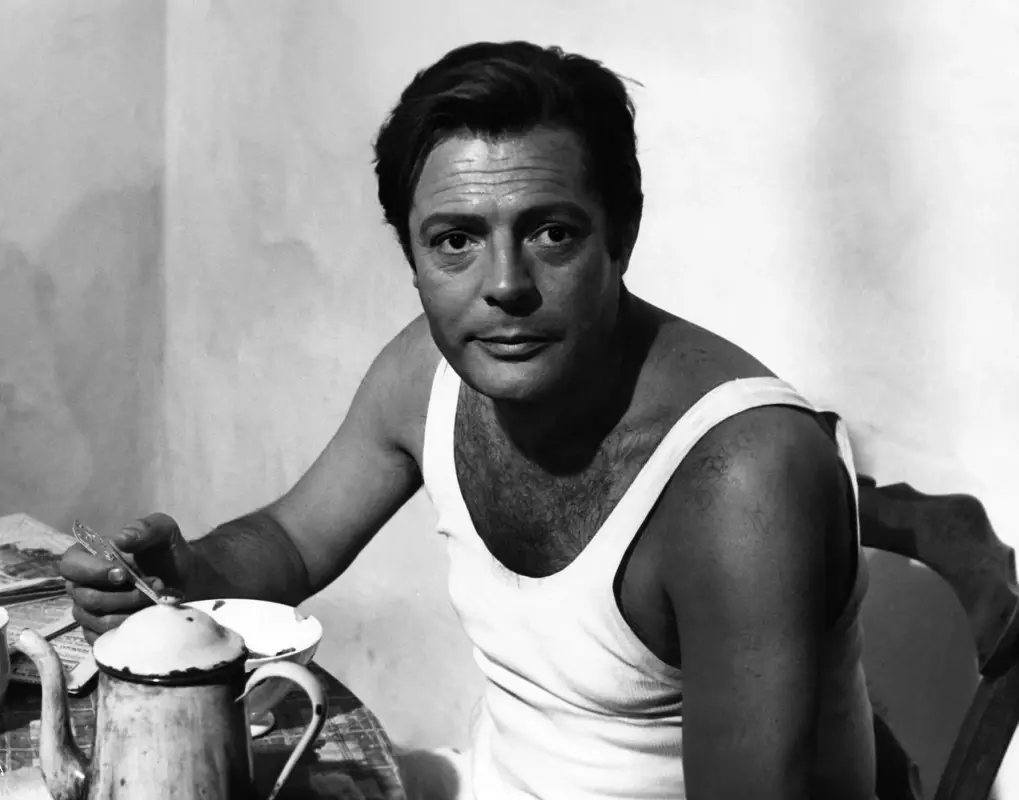
Arthur Meursault (Mastroianni) eating from a cracked bowl. DP: Giuseppe Rotunno.
view
Die Sehnsucht der Veronika Voss (Rainer Werner Fassbinder, 1982)
Jul
2
World Sports Journalists Day
Actress Veronika Voss (Rosel Zech) with sports journalist Robert Krohn (Hilmar Thate), driving a car at night. DP: Xaver Schwarzenberger.
Veronika Voss, once one of Ufa's greats and rumoured lover of Goebbels, has a chance meeting with #sports journalist Robert Krohn. Despite not recognising her at first glance, the faded star and her world turn out to be irresistible to him.
“What do you want from Voss? She's no good at soccer.”
– Grete
Die Sehnsucht der Veronika Voss [litt. The yearning of Veronika Voss] is #Fassbinder's tribute to both Billy Wilder's Sunset Blvd. (1950) and real-world actress Sybille Schmitz whose career, like Voss', suffered greatly due to her #morphine dependence after the Entnazifizierung.
view
The Treasure of the Sierra Madre (John Huston, 1948)
Jun
30
campfire grub
Curtin (Tim Holt), Dobbs (Bogart), and Howard (Walter Huston) eating campfire grub. DP: Ted D. McCord.
“Say, mister. Will you stake a fellow American to a meal?”
– Dobbs
view
The Treasure of the Sierra Madre (John Huston, 1948)
Jun
29
National Handshake Day
Fred (Humphrey Bogart) and Curtin (Tim Holt) shake hands witnessed by gruff prospector Howard (Walter Huston). DP: Ted D. McCord.
“I know what gold does to men's souls.”
– Howard
Seemingly character driven, Huston's The Treasure of the Sierra Madre is an adventure moved by a relentless #landscape, the urge to drift, and #greed.
view
Compulsion (Richard Fleischer, 1959)
Jun
29
coffee
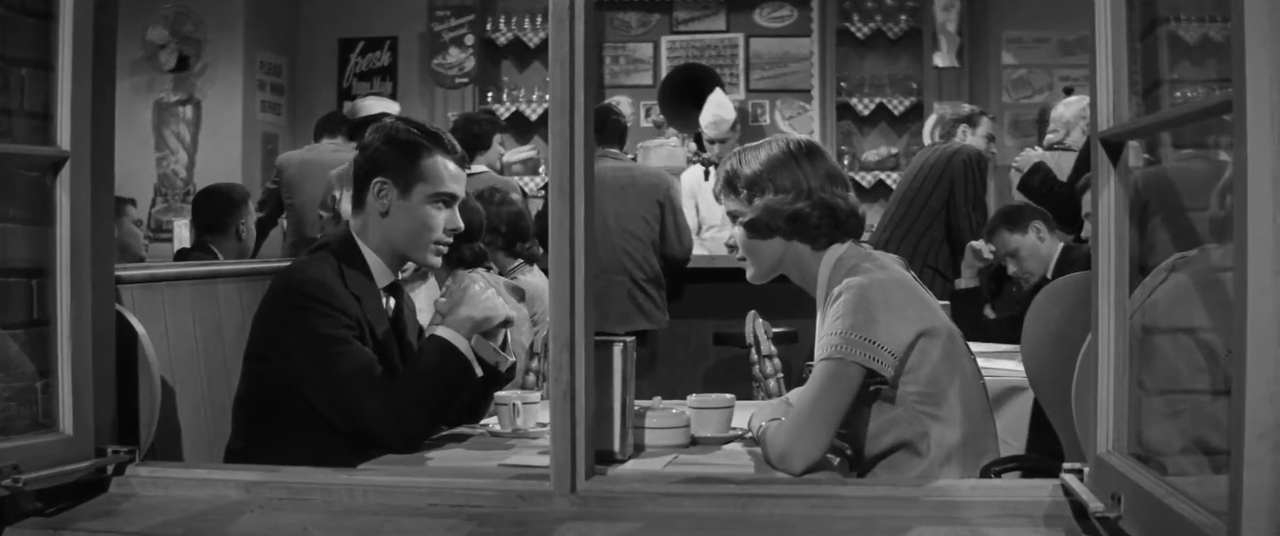
A squeaky young Stockwell and Varsi at a diner. We're looking in from the outside through an open window. The place is busy but she's all enthralled by his wit and intellect (and looks for sure). DP: William C. Mellor.
“Europe, a Stutz Bearcat, the best restaurants. You fellas really have a hard life, don't you?”
– Harold Horn, DA