view
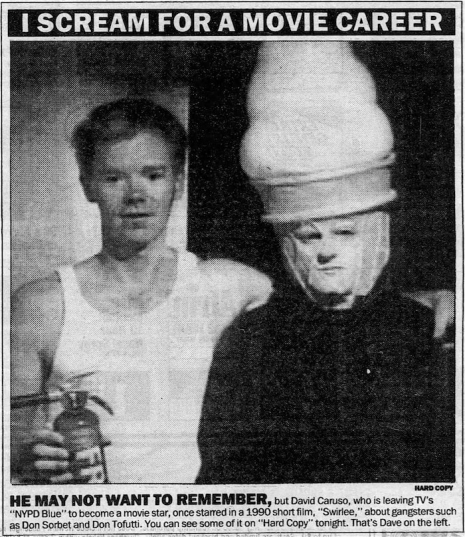
Swirlee (James Lorinz, 1989)
Jul
23
National Vanilla Ice Cream Day
Newspaper clipping. Mr Softy's roommate (David Caruso) and Mr Softy (James Lorinz), a man with a softee for/as a head, pose for a picture.
view
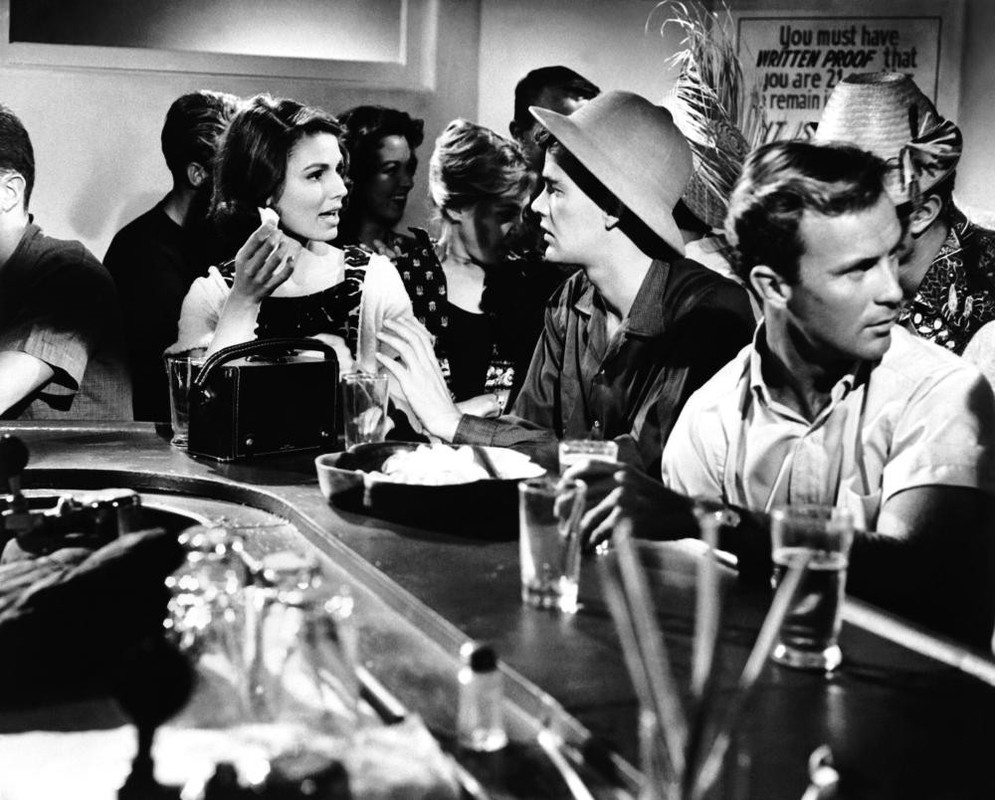
Where the Boys Are (Henry Levin, 1960)
Jul
21
Legal Drinking Age Day
While chatting up TV Thompson (Jim Hutton), Tuggle Carpenter (Paula Prentiss) presents a fake ID to prove that with her “25” years of age she's old enough to drink. The ID also states that despite her 5'10” (1,78m) frame, she's a petite 5'2” (1,57m). DP: Robert J. Bronner.
Where the Boys Are is chock-full of characters whose names appear to be straight space-travel-lifted from various #JohnWaters' movies: Tuggle Carpenter! TV Thompson! Lola Fandango! Dr. Raunch for Chrissakes!
“The boys come to soak up the sun, and a few carloads of beer. The girls come, very simply, because this is where the boys are.”
– narrator
We follow four female midwestern college students on #SpringBreak in Fort Lauderdale. Their objective is boys boys boys (and an even tan) and nothing, including being too young to drink, can stop them. This was one of the first post-Hayes Hollywood movies to address teenage sex yet despite all the innuendo (“What's your shoe size?” “13.” “Get in the car!”), it's all pretty clean. But without these girls, there wouldn't be any Dawn Davenport. And that would've ruined everybody's Christmas.
view
The Sniper (Edward Dmytryk, 1952)
Jul
21
chow mein
Dr. James G. Kent (Richard Kiley) discussing the case during lunch at a Chinese restaurant. After scratching his temple with his chopsticks, he attempts to eat his noodles with the utensils' grip. DP: Burnett Guffey.
“You know how much coffee I've had today? 17 cups. The Brazilians ought to give me a medal.”
– ER doctor
view
Ikarie XB 1 [Icarus XB 1] (Jindřich Polák, 1963)
Jul
20
Space Exploration Day
Two astronauts weightlessly pushing themselves through a round airlock. Their suits are eerily similar to the ones seen in Kubrick's 2001: A Space Odyssey (1968). DP: Jan Kališ.
Both anticapitalist and pre-Stanley space odyssey. Based on Stanislaw Lem's Obłok Magellana [The Magellanic Cloud] (1955).
view
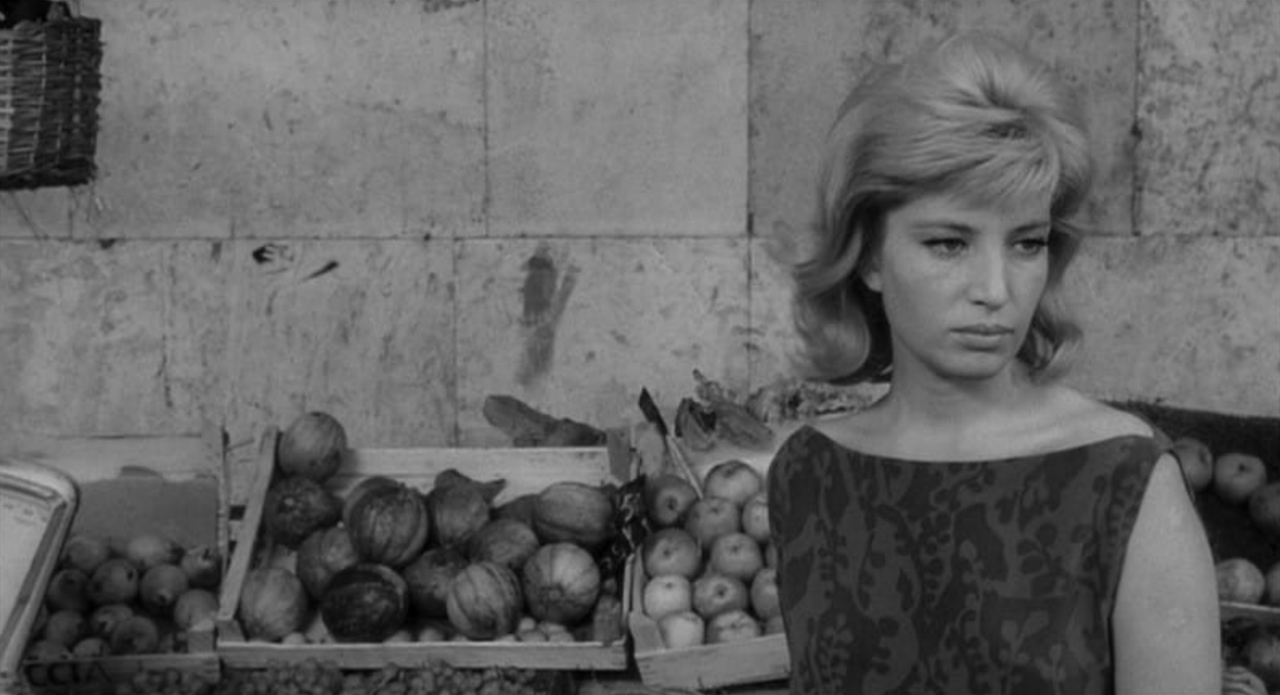
L'eclisse [The Eclipse] (Michelangelo Antonioni, 1962)
Jul
19
fruit
“I still can't figure out if it's an office, a market place, or a boxing ring. And maybe I don't even need to.”
– Vittoria
view
Flammes [Flames] (Adolfo Arrieta, 1978)
Jul
19
National Barbara Day
Barbara (Caroline Loeb) waking up to her fireman. DP: Thierry Arbogast.
Barbara wakes up believing a fireman entered her bedroom through the window. Her father reassures her there's nothing, just a children's story. Years later, the adult Barbara (Caroline Loeb), grown up, withdrawn, living with her father (Dionys Mascolo), tutor, half brother (Pascal Greggory), and a persistent longing for her fireman, sparks a scheme that forces the fire brigade to come to their house and climb through her window once again.
“It's you.”
view
Le temps d'une chasse [Once Upon a Hunt / The Time of a Hunt] (Francis Mankiewicz, 1972)
Jul
17
after hours coffee
A Hopperesque glimpse through a corridor reveals a young woman (Frédérique Collin) sitting at a mostly empty dinner table. There are two coffee cups and a fruit bowl, and a bare bulb hanging from the ceiling. DP: Michel Brault.
view
Flammes [Flames] (Adolfo Arrieta, 1978)
Jul
15
Barbara (Caroline Loeb) – in a patterned firetruck-red dress – descends a grande staircase. At the bottom of the stairs a long, beautifully set table with well-dressed guests. The seat at the head of the table is empty. DP: Thierry Arbogast.
view
La piscine [The Swimming Pool] (Jacques Deray, 1969)
Jul
13
“Chinese food”
The two couples (Delon and Schneider, and Ronet and Birkin) awkwardly share dinner. There's wine in red glasses and the food, plated on rustic French dinnerware, is handled with chopsticks. DP: Jean-Jacques Tarbès.
view
Blue (Derek Jarman, 1993)
Jul
13
Oxymoron Day
Not a screenshot from the film, but a pure representation of International Klein Blue.
Synchronous to the screening of a film that wasn't, Derek Jarman's Blue was broadcast on radio and television. Those who tuned into the radio could request a special card printed in that most spectral of colours, International Klein Blue, a blue that according to its creator Yves Klein, has “a quality close to pure space” and “immaterial values beyond what can be seen or touched”.
“You say to the boy 'Open your eyes'. When he opens his eyes and sees the light, you make him cry out, saying 'Oh, Blue, come forth! Oh, Blue, arise! Oh, Blue, ascend! Oh, Blue, come in!'.”
– Nigel Terry
Submerged in #blue, seeing through what was left of Jarman's eyes, we live through the artist's life, and love, and loss. When you leave the theatre, put down that card, you're temporarily blinded by the physiological afterimage of a devastating disease. What remains is the voice of a filmmaker who lost his sight.