“What are you going to do with the rest of your life? Sit on the shore and watch?”Last Summer (Frank Perry, 1969)
Mar
25
Walk In The Sand Day

One of the boys striking a threatening pose with a stick aimed at Sandy (Barbara Hershey aka Barbara Seagull). In the foreground a brooding Rhoda (the fantastic Catherine Burns). DPs: Enrique Bravo & Gerald Hirschfeld.
During a #summer #vacation on #FireIsland, two young men come across Sandy, an attractive young woman with an injured #seagull. While nursing the bird back to life, the relationship between the three deepens. A second girl, the much younger Rhoda (the breathtaking Catherine Burns) is taken in by the trio.
– Sandy
Set almost entirely on a sunny #beach, Frank Perry's Last Summer may be one of the most claustrophobic films you'll ever watch.
drama
愛情萬歲 [Ai qing wan sui / Vive L'Amour] (Tsai Ming-liang, 1994)
Mar
24
Flatmates Day

In a black-tiled bathroom, a black dress and black shoes are fitted. DPs: Pen-Jung Liao & Ming-Kuo Lin.
May Lin is a real estate agent who meets up with a man in the bare, too sterile flat she brokers. Another man who took the key of the same dwellings for his own cause, decides to settle in.
Over time, the apartment serves not only as the space where events take place, but locks and guides the flatmates through their compulsions.
洞 [Dóng / The Hole] (Tsai Ming-liang, 1998)
Mar
22
National Sing It Out Day

The man upstairs and the woman upstairs, both dressed in that perfectly cool, 1960s Chinese style, break out in song in their crumbling apartment block The woman's singing voice is legendary Grace Chang's. DP: Pen-Jung Liao.
Someone breaks into song on National Sing Out Day (USA)
In a #plague-ridden Taiwan, it rains relentlessly. The #rain and a #virus forces people to retreat. In Hsiao Kang's crumbling building, a plumber inadvertently punches a hole from his floor to the unnamed woman's below. While she, another victim of the #disease, holes up in her apartment they struck up a strange detached relationship.
Between the endless downpour and frantic #food hoarding, in her heart a #musical sings.
Un soir, un train [One Night, a Train] (André Delvaux, 1968)
Mar
20
French Language Day

Mathias (Montand) and Anne (Aimée) walk through a round archway. Both have a different focus and are on opposite sides of the arch as a foreshadowing of their parting. DP: Ghislain Cloquet.
A Walloon language professor and his French set designer fiancée are at an impasse. While his Flemish students vocally protest against more Walloon influence at their uni, the couple – who superficially speak the same #language, #French – struggles to find the right words. They meet, part ways, then find each other again on a train that at morning turns out to be standing still in the middle of nowhere. The man, now without her, disembarks and with two acquaintances who also were on that train tries to find out where he and she are.
André Delvaux's Un soir, un train is a masterpiece about finding the right language in a fractured world.
“I'm strange, all right! I'll show you just how strange I am!” The Damned [These Are the Damned] (Joseph Losey, 1962)
Mar
19
National Automatic Door Day

An 11-year old boy, Henry (Kit Williams), opens a featureless door in a rock surface for a drenched King (Oliver Reed). DP: Arthur Grant.
An American tourist visiting Dorset is tricked by a prostitute, then falls victim to a youth gang controlled by volatile con King – a still very green Oliver Reed at his meanest. The trickster is King's sister, who confides in the American hoping to escape her brother's incestuous advances.
– King
The couple elopes to a nearby island, closely followed by King and his gang, where they find a group of #children, all contently living in an underground lab, with #AutomaticDoors only they can control.
They are the damned.
“It's foolish to refuse happiness.”Un homme et une femme A Man and a Woman] (Claude Lelouch, 1966)
Mar
18
International Sports Car Racing Day

Jean-Louis Trintignant driving a Matra single-seater at the Autodrome de Montlhéry [caption taken from a photo from the same session]. Behind him his uncle Maurice in a Maserati Tipo 151/1. DP: Claude Lelouch.
A man and a woman meet and fall in love. The woman – Anouk Aimée – still mourns the loss of her stuntman husband, while the man – Jean-Louis Trintignant – is alone since his partner took her life, incapable of dealing with his near-fatal #crash at #LeMans.
#Trintignant came from a family obsessed with race car driving and was an avid amateur driver himself. His uncle, the #GrandPrix racer Maurice Trintignant, can be seen driving a #Maserati Tipo 151/1 during the race scene.
A deceptively simple film by Claude Lelouch, with an equally breezy soundtrack by Francis Lai.
“I like lots of things. But there are three things I like most: love, love, and love.”La dolce vita (Federico Fellini, 1960)
Mar
15
National Shoe The World Day
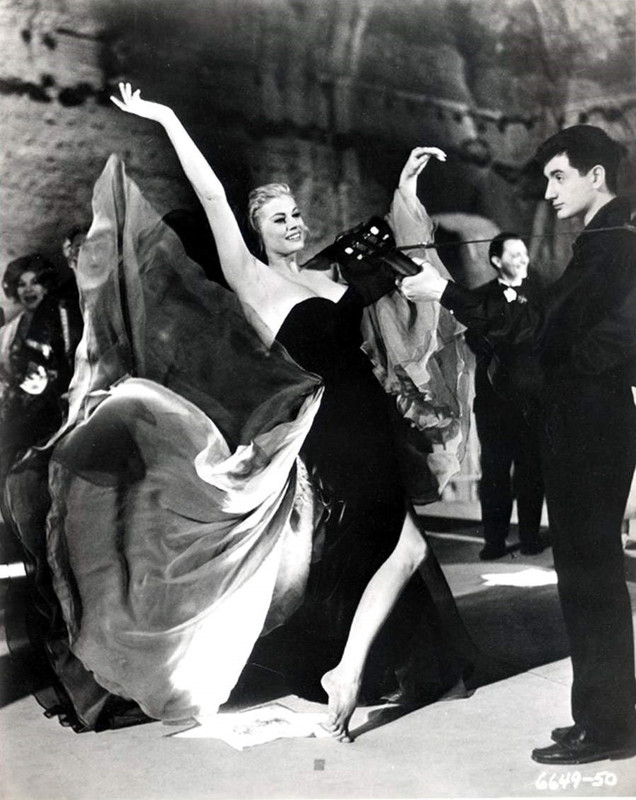
An exuberant Sylvia (Anita Ekberg) dances barefoot to a stoic guitarist. DP: Otello Martelli.
Various characters lose their shoes in Fellini's hedonistic La dolce vita, most famously Anita Ekberg after entering a freezing Fontana di Trevi with paparazzo Marcello Mastroianni.
– Sylvia
Une femme douce [A Gentle Woman / A Gentle Creature] (Robert Bresson, 1969)
Mar
14
National Write Your Story Day

Dominique Sanda as “elle” – “she” – a nameless woman. She peers out of a window, her face partially obscured by the muntin. DP: Ghislain Cloquet.
A young woman jumps out of a window, leaving behind her husband, an #antiques dealer. Sitting in their bedroom with the body lying in state, the widower remembers her. In his memory, she is nameless, abstract, a state not a life..
Une femme douce is closely adapted from Fyodor #Dostoyevsky Кроткая [Krotkaya / A Gentle Creature] (1876).
“This song of the Man and his Wife is of no place and every place; you might hear it anywhere, at any time.”Sunrise: A Song of Two Humans (F.W. Murnau, 1927)
Mar
12
Academy Award For Best Picture
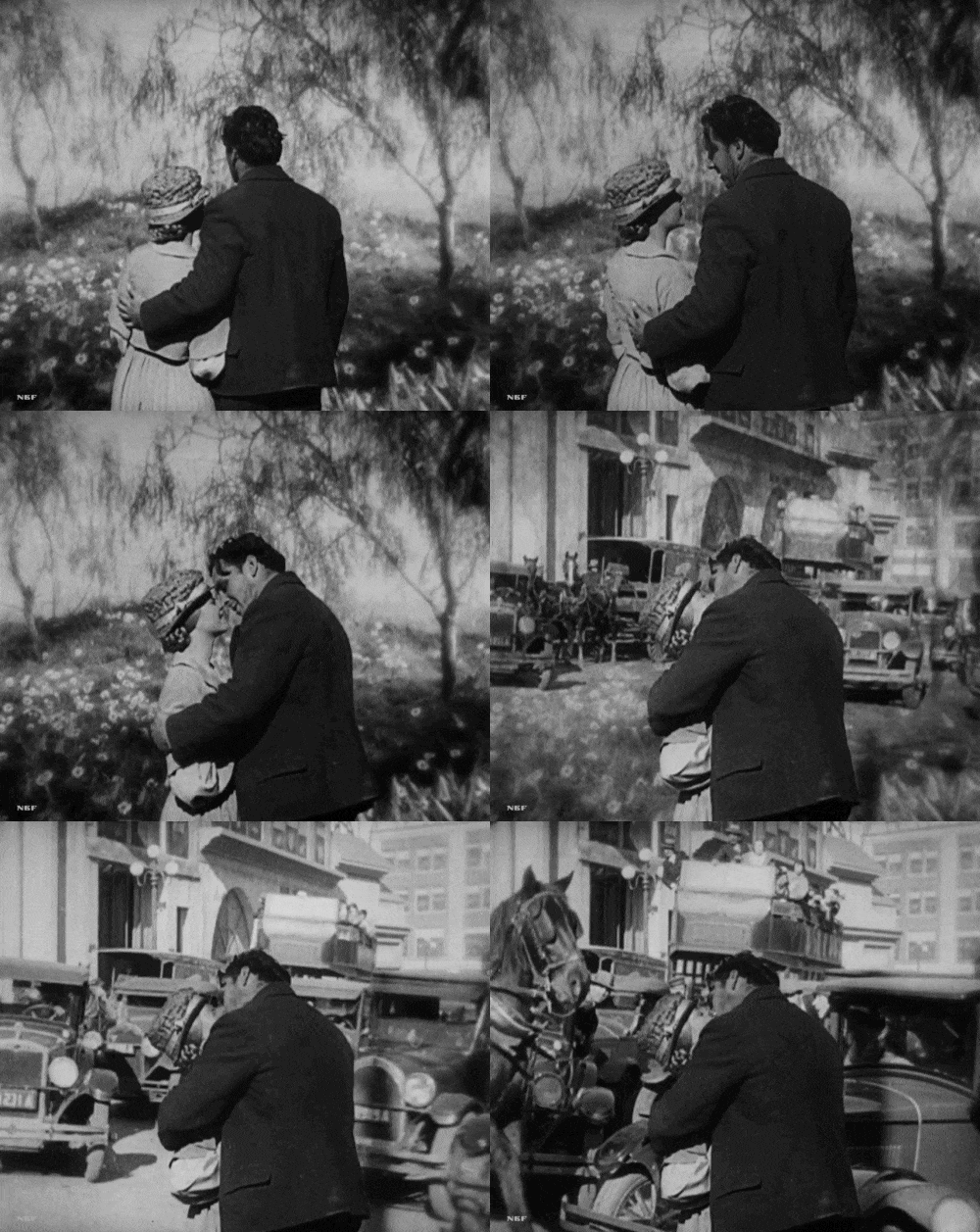
The Man and Wife kiss in the countryside. Suddenly, the backdrop changes to the hustle and bustle of the big city. Carts, both horse and engine driven, come to a halt for the lovers. DPs: Charles Rosher & Karl Struss.
Sunrise was bestowed the award for “Best Unique and Artistic Picture” on that first Oscar night. The first and last time that ever happened; in 1930, the price was scrapped and replaced by “Outstanding Picture” aka “Best Picture”. And that one went to the much more American-patriotic Wings (1927).
Also rightfully awarded in '29 were Janet Gaynor (Best Actress in a Leading Role), Charles Rosher and Karl Struss (Best #Cinematography), while Rochus Gliese was nominated for Best #ArtDirection.
– opening title card
Sunrise is a fantastic tour de force, and it winning that award should make you feel hopeful for the future of cinema. Instead, the current list of nominees and winners is, at least to me, a checklist of what to avoid for ever.
“If she is innocent! Why do you never wonder if Parris be innocent, or Abigail? Is the accuser always holy now? Were they born this morning as clean as God's fingers? I'll tell you what's walking Salem — vengeance is walking Salem. We are what we always were in Salem, but now the little crazy children are jangling the keys of the kingdom, and common vengeance writes the law!”Les sorcières de Salem [The Witches of Salem / The Crucible] (Raymond Rouleau, 1957)
Mar
7
National Town Meeting Day

The townspeople meet in the barn to judge the accused. DP: Claude Renoir.
Raymond Rouleau's Les sorcières de Salem – with a screenplay by Marxist philosopher Jean-Paul #Sartre – is a very early film adaptation of Arthur Miller's 1953 #TheatrePlay The Crucible. An allegory of #McCarthyism, the play is a (partially dramatised) retelling of the #SalemWitchTrials, a dramatic episode in early US-American history. During several court and town meetings, 200 people were falsely accused of meddling with the Devil; 19 of them were eventually executed.
– Arthur Miller, The Crucible (1953)
Miller himself was accused of un-American activities in 1956 and convicted of contempt of Congress for refusing to identify others present at meetings he had attended. Which doesn't mean that #WitchTrials are a thing of the past. As easily one can transplant Puritan religious mass hysteria to 1950s McCarthy anti-socialism, as easy is it applicable to the state of the world today.