Yanco (Servando González + Mohy Quandour, 1961)
Apr
21
Fiddlers Frolic

Juanito (Ricardo Ancona), seen in silhouette, playing his violin in the chinampas. DP: Álex Phillips Jr..
In Mayan worldview, mortals move along the horizontal, gods along the vertical plane. A boy travels both worlds, united by music and wonder.
Juanito, a #Mixquic boy with hypersensitive hearing, finds solace from the hustle of #MexicoCity in the silence of the chinampas – the pre-Hispanic man-made agricultural plots in lake #Xochimilco. There he plays his cardboard fiddle for the nature around him, until the sound from a real violin reaches him. The violinist, an old hermit who lives on one of the chinampas, takes the boy in and teaches him how to master Yanco, his hand-built instrument. When the man dies, the boy goes out at night to be able to play Yanco. In a changing world where the living and the dead used to naturally cross paths, the strings stir different to some.
The #Nahuatl film Yanco is a small cinematic miracle that begs for a beautiful restoration akin to how Govindan Aravindan's കുമ്മാട്ടി [Kummatty] (1979) opened up the world to indigenous filmmaking.
drama
Supermarkt [Die Stadt, Jane Love / Supermarket] (Roland Klick, 1974)
Apr
16
National Cash Day

A dirty, cut hand attempts to steal a few coins from a dish at a public toilet. DP: Jost Vacano.
Good-for-nothing Willi (Charly Wierzejewski) is in trouble. After yet another run-in with the law, and yet again meeting the wrong people at the wrong time, he falls in love with a destitute street worker (Eva Mattes). Now he really needs #money so he can support himself, her, and her kid. He tries his hand at renting himself out to a rich homosexual (homosexuality was illegal in 1970s W Germany), then moves forward to robbing the money transporter of a local supermarket with his pimp buddy. But as usual, Willi is in trouble.
Shot on location in #Hamburg's red-light district St. Pauli, Supermarkt is gritty, unpleasant and has an authenticity rarely seen in other films of this genre.
“Our paths have crossed and re-crossed: in Dresden, Rotterdam, Florence – wherever the Nazis looted. Raphaels, Rembrandts, even down to a dreary little china pot, which belonged to Madame Pompadour… there was always Captain Jim Calder of the U.S. Army, restoring priceless objects to their rightful owners – a typical middle-class gesture.”Boy on a Dolphin (Jean Negulesco, 1957)
Apr
14
National Dolphin Day

Phaedra (Sophia Loren) posing victoriously on the bow of a sailboat, with the statue, still in its ropes after hoisting it off the ocean floor, behind her. DP: Milton R. Krasner.
Shot on location in Greece, sponge diver Phaedra (Sophia Loren) makes a splash when she finds an ancient statue of a boy on a dolphin, rumoured to bring good luck to her town. Her attempts to sell it to the highest bidder makes not only the bronze but also her the object of desire of an honest archaeologist and an unscrupulous antiques dealer playboy.
– Victor Parmalee
Boy on a dolphin is not only the title of this movie but also possibly a reference to #Arion, son of the inhabitants of Lesbos (would that make this movie a bit too wild for 1957?), or #Taras, son of Poseidon and Satyrion. According to Greek legend, both mythological characters were saved by #dolphins.
“You need to watch your step among all the ghosts and memories.”Tystnaden [The Silence] (Ingmar Bergman, 1963)
Apr
10
Siblings Day

Sisters Ester (Ingrid Thulin) and Anna (Gunnel Lindblom). Similar as in Bergman's Persona (1966), the women's faces appear to complete each other. DP: Sven Nykvist.
#Sisters Ester and Anna arrive with Anna's son Johan in the small Central European town of Timoka. The country verges on the brink of war. Unwell Ester is confined to her hotel room, Anna roams Timoka's establishments, Johan wanders the hotel corridors.
– Ester
It's hard to watch #Bergman's Tystnaden without #StanleyKubrick's ghosts sidling in. Tystnaden however doesn't need consternation to cause dread. The interaction and lack thereof between the three leads and the few extras translate into something merely tangible and evermore frightful.
“Harvey and I sit in the bars… have a drink or two… play the juke box. And soon the faces of all the other people they turn toward mine and they smile. And they're saying, 'We don't know your name, mister, but you're a very nice fella'.”Harvey (Henry Koster, 1950)
Apr
9
freebie: Easter Sunday

Promotional photo. James Stewart as Elwood P. Dowd, holding a stuffed anthropomorphic rabbit. Both man and bunny wear black hats and smile at the camera. DP: William H. Daniels.
James Stewart is Elwood P. Dowd. An ordinary man with an extraordinary claim: his best friend is an invisible, six feet three and a half inches-tall #pooka – a mythological Celtic, shapeshifting creature – who in Mr Dowd's case resembles a rabbit called Harvey. Elwood's sister and niece, who also occasionally see the furry goblin, have their relative send to a sanatorium where the doctors and us viewers learn more about this curious case.
– Elwood P. Dowd
Harvey, based on Mary Chase's #PulitzerPrizePlay with the same name, is guaranteed to bring a smile on your face, this humbug's scout's honour! Have a nice #Easter, CineMastodons!
“I'm the king of the silent pictures. I'm hiding out till talkies blow over.”Mickey One (Arthur Penn, 1965)
Apr
8
Step Into The Spotlight Day
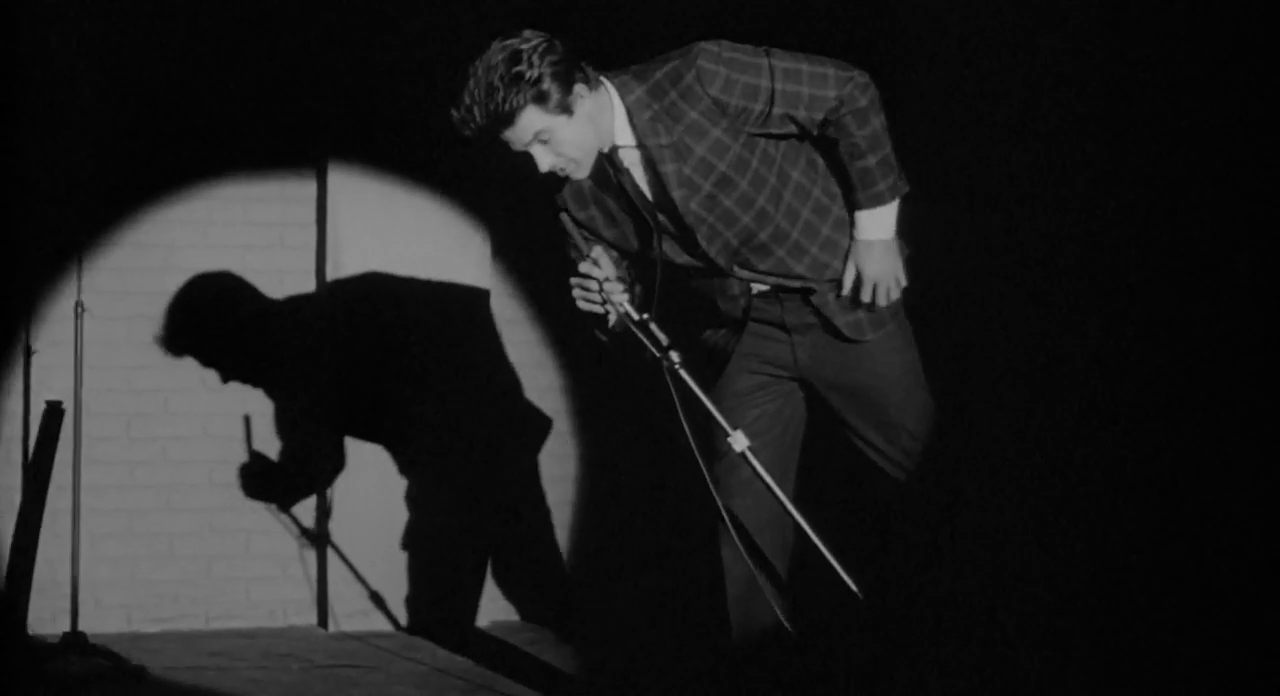
Mickey (Warren Beatty) bent over, holding a microphone with a bright spotlight aimed at him. DP: Ghislain Cloquet.
Warren Beatty plays Mickey, a #StandUpComedian who has it all, then gambles it all away. Well, that's the first 5 minutes of Arthur Penn's Mickey One. Beatty is out of his element, and the movie's still too indebted to the cheery 60s to carry that New American Cinema grit.
– Mickey One
Having said that, there are several great small surreal moments that are carried by uncredited character actors alone. And then there's a sole spotlight, stealing it all away.
Jagdszenen aus Niederbayern [Hunting Scenes from Bavaria / The Hunters and the Hunted] (Peter Fleischmann, 1969)
Apr
6
Sorry Charlie Day

The townspeople gather to prepare the communal harvest meal. A dead sow is laid out on an improvised table. DP: Alain Derobe.
A scandal, that's what it was! In the late 1960s, Peter Fleischmann picked the picturesque Catholic village of #Landshut as the backdrop for Jagdszenen aus #Niederbayern, the film adaptation of Martin Sperr's #TheatrePlay with the same name.
A young man named Abram – played by Sperr – returns to his family village. Soon the townspeople's thorns move from the in their eyes other disgraceful villagers to the much-needed mechanic.
Where did he return from? He was in prison. What for? For being a homosexual. He's a Drecksau (a filthy pig), his mother says. The village whore can't turn him around. A sow is slaughtered in real time in celebration of a successful #harvest and plans for the town's future are forged.
While created when West Germany's #Paragrafen175 was in place [1872–1994], illegality of same-sex relations], the homosexual aspect wasn't the main cause of the outrage. Some of the Landshutter villagers who played alongside the professional actors felt they were depicted as being backwards. This isn't a movie about hunting, sigted some. Lifting the veil of the prevalence of, a #Fernweh in a sense, that Germany (hush) was another.
Catholic Mass is a theatrical re-enactment of the life and suffering of the son of God. When rites outstay their meaning, when invocations turn routine, the worshippers lose sight.
“You're talking about a different kind of war.”Fail Safe (Sidney Lumet, 1964)
Apr
5
National Nebraska Day
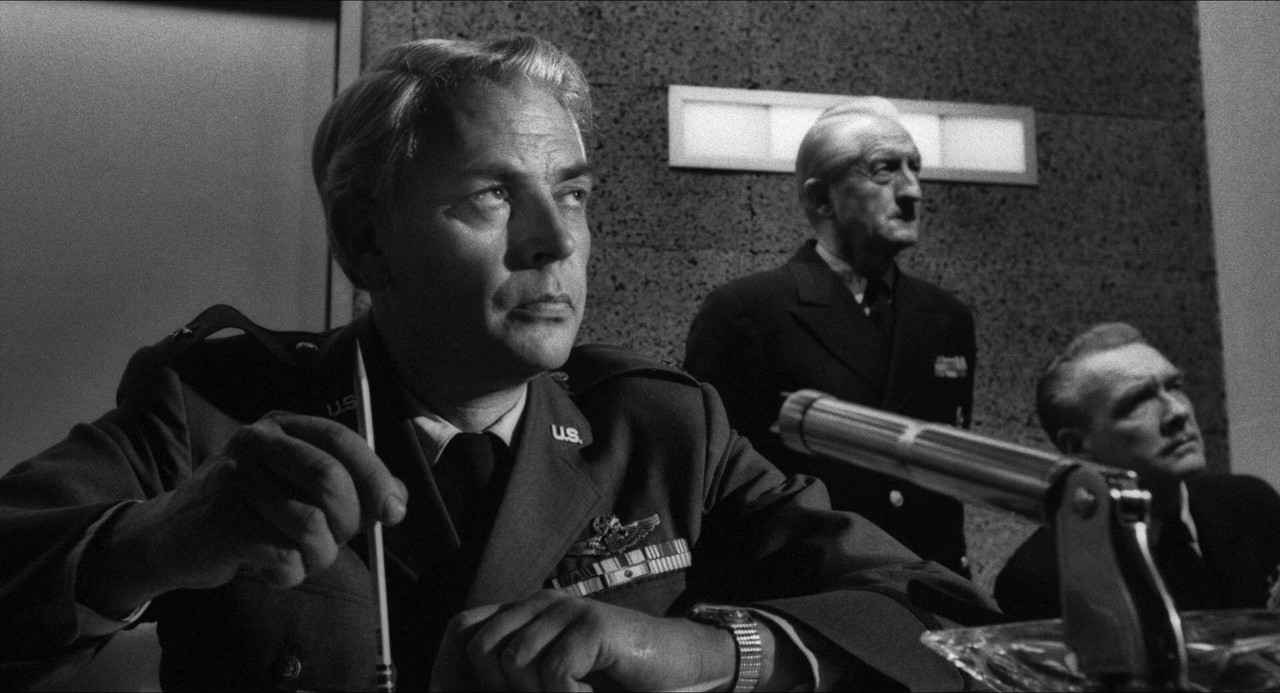
General Black (Dan O'Herlihy) being briefed. DP: Gerald Hirschfeld.
The one that got bombed by Strangelove.
– General Stark
Both Lumet's Fail Safe and #Kubrick's #ColdWar comedy came out in 1964, right after the #CubaCrisis. The world was awash with the realisation that the bomb, The Bomb, wasn't merely proverbial flexing. And when crisis happens, there are two options. One is to laugh, the other is to grasp. Sadly for Lumet, and the world, his Fail Safe was released while everyone was still too busy chuckling.
O Território [The Territory] (Raúl Ruiz, 1981)
Apr
2
Nature Day

A man and woman, plus a little girl perched on the man's shoulders, hike through an illusory landscape. DP: Henri Alekan.
Two American families, adults and their children, go on a #HikingTrip somewhere in the south of France. They find themselves increasingly lost, not only in #nature but also in and among themselves.
Supposedly based on a real troublesome event and riddled with much filmmaking adversity, O Território nearly stranded as much as the hikers did. In support, #WimWenders used the same cast for his Der Stand der Dinge (1982), about a film crew's attempt to remake #RogerCorman's Day the World Ended (1955).
In a wonderful, unscripted circular way, Corman was one of the executive producers of Ruiz's film.
Paris qui dort [Paris Asleep / The Invisible Ray / At 3:25] (René Clair, 1925)
Mar
30
freebie: Eiffel Tower Day

Two bright young things in their fashionable suits cease their scuffle mid fight, high up on the Eiffel Tower. DPs: Maurice Desfassiaux & Alfred Guichard.
Science fiction may be one of those genres that's forever linked to the future and, depending on which side of 2000 you are at, either in a dystopian of utopian fashion.
An #Eiffel Tower watchman wakes up to find the world around him asleep. The few ones still awake – the bright, pretty, carefree things – explore, live and loot.