“I first noticed it in Spring last year. […] It was from [my home] that I first saw it—its crest protruding over the roofs on the other side of the road. Surprised that I hadn’t noticed it before, I wondered what it was and then forgot about it for several weeks.” The Black Tower (John Smith, 1985—1987)
Aug
22
black
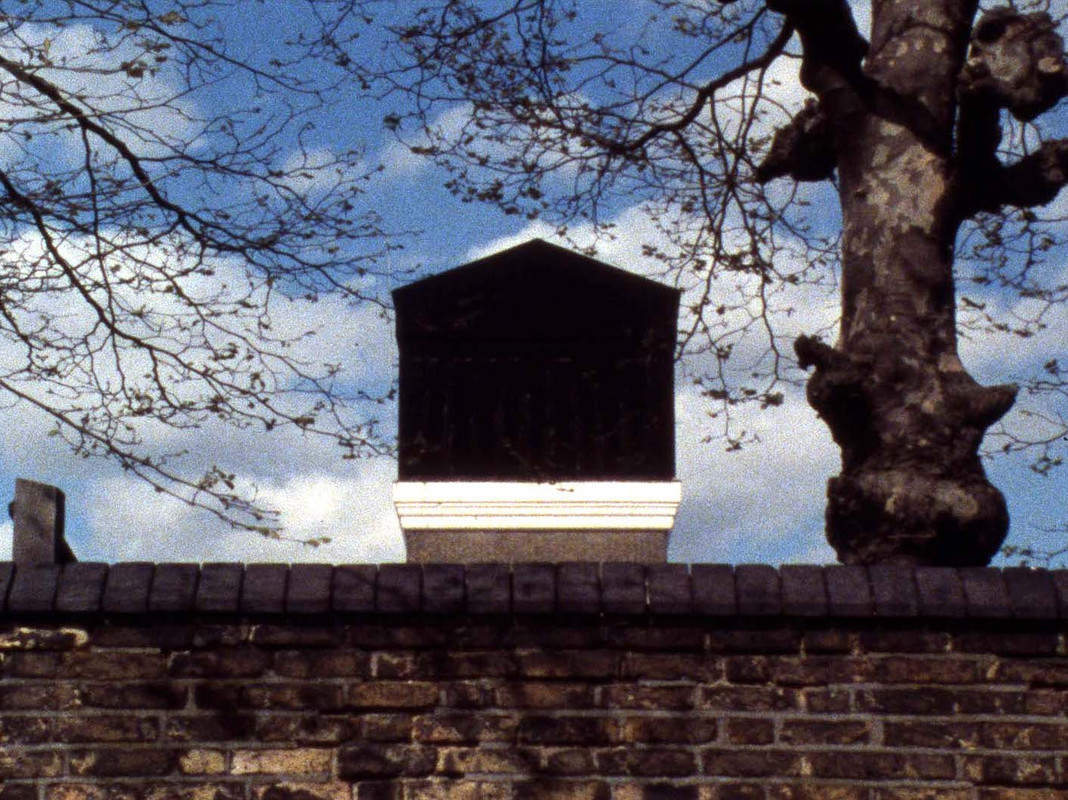
The black tower, visible from behind a brick wall (via)..
Black: a building or structure*
– narrator
A man becomes aware of a formerly unnoticed black tower. Surely it's nothing, yet as the weeks pass, its looming presence takes over.
The black tower was a real structure, first noticed by filmmaker John Smith when he moved to East London. The building, actually the upper part of a hospital's water tower, was painted pitch black, and on sunny days appeared to be a cutout in the sky. By framing the shots in such a way that only part of the surroundings is visible, and editing them in a narrative framework, Smith creates a new context suggesting movement. This style of montage called creative geography, or artificial landscape, was developed by Lev Kuleshov and enables filmmakers to expand existing material and narrative into something that usually is only available to prose poetry.
* the Bales 2025 Film Challenge for August is not date-related but lists, for the most part, the colours of the rainbow.
mystery
“Is it the form of the clouds, or the tints of the sky, or the colours of the surrounding objects which are so changeable, which have troubled my thoughts as they passed before my eyes? Who can tell?” Le Horla [The Horla] (Jean-Daniel Pollet, 1966)
Aug
19
violet
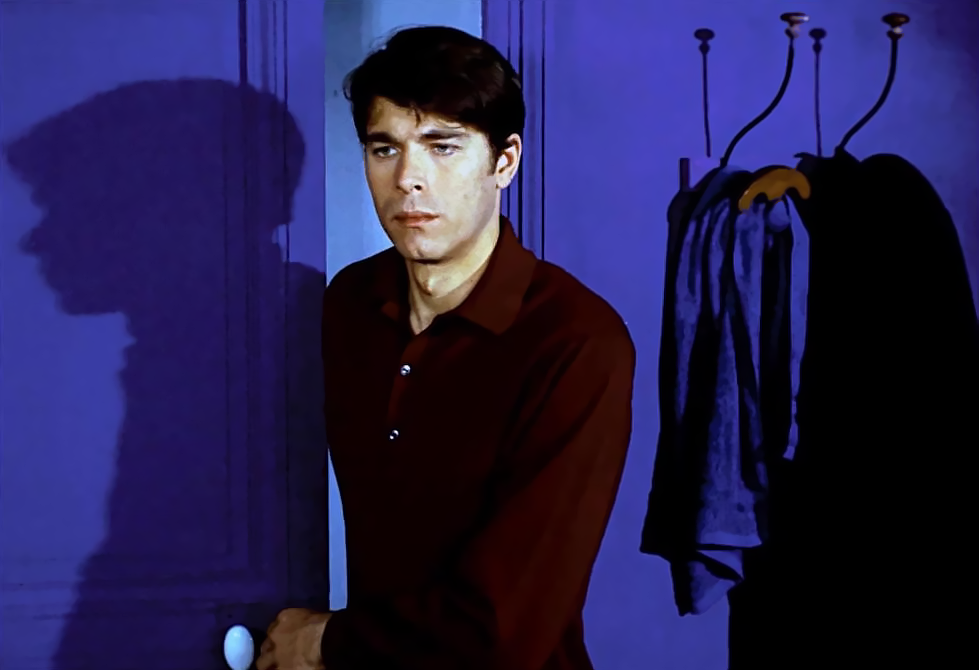
The narrator enters a violet-blue room via a lavender-purple corridor (via). DP: Jean-Jacques Rochut.
Violet: a building or structure *
– Guy de Maupassant, Le Horla, 1887 (via)
Objects and rooms have distinct colours ranging from the deepest blues and violets to a pale lavender, a muted silver and shocks of yellow. The usage of colour in Le Horla is striking throughout and reminds me of how Van Gogh's paintings became increasingly colourful as his madness enveloped him.
* the Bales 2025 Film Challenge for August is not date-related but lists, for the most part, the colours of the rainbow.
“On the bus, the air was so thick, he felt woozy. A wailing infant shook with tears and the woman beside him reeked with the stink of cheap perfume.” 野良犬 [Nora inu / Stray Dog] (Akira Kurosawa, 1949)
Jul
14
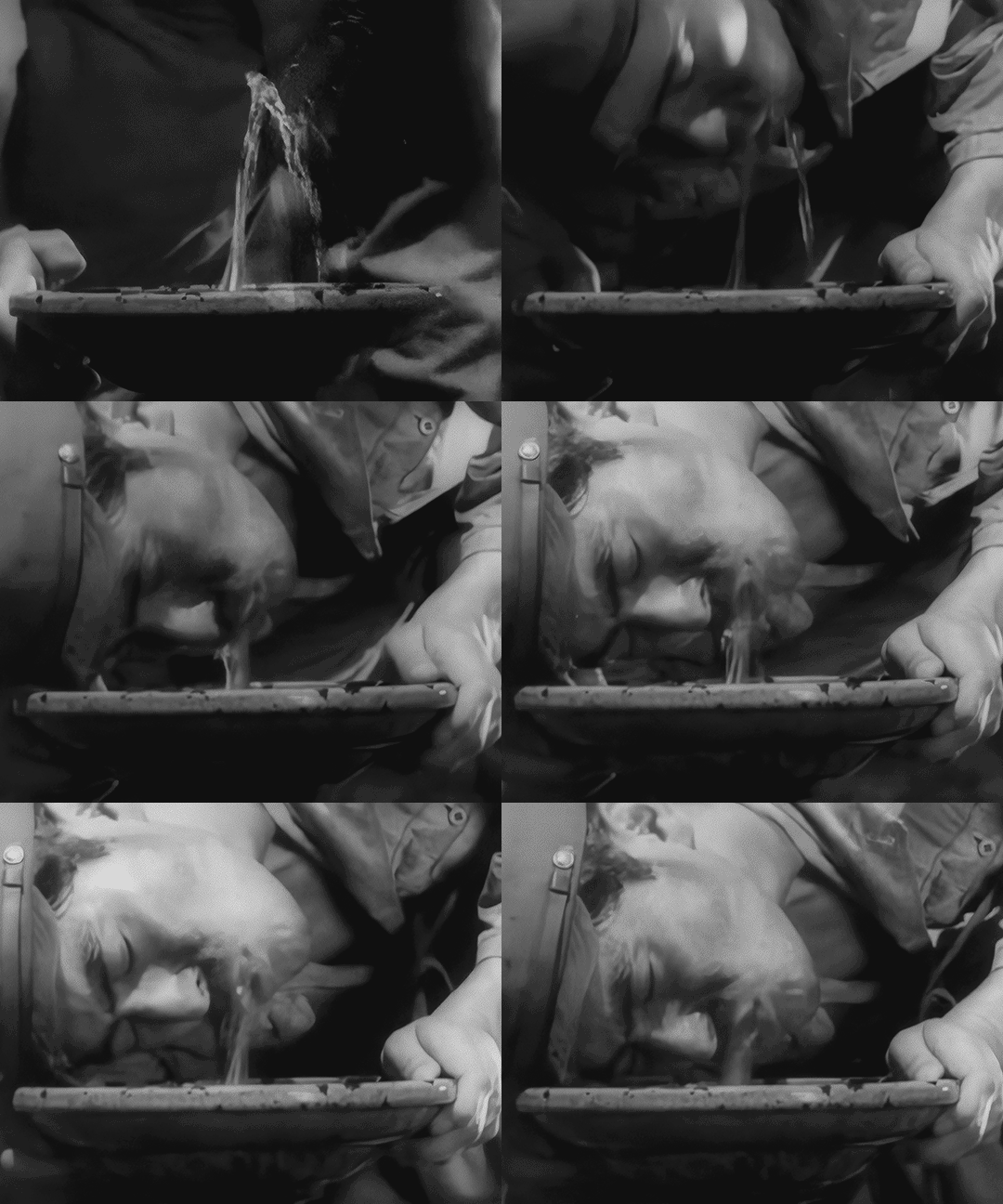
A sweaty man in uniform drinks from a water fountain like a dog (via). DP: Asakazu Nakai.
Someone enjoys a drink or beverage*
– narrator
On a sweltering summer day, Detective's Murakami's Colt gets stolen on a crowded bus. He must delve deep into the sticky sweaty seedy underbelly of Tokyo to retrieve it.
* the Bales 2025 Film Challenge for July is, for unknown reasons, mostly not date-related and follows some sort of vacation narrative.
“Janitor of lunacy
Paralyze my infancy
Petrify the empty cradle
Bring hope to them and me Janitor of tyranny
Testify my vanity
Mortalize my memory
Deceive the devil's deed”La cicatrice intérieure [The Inner Scar] (Philippe Garrel, 1972)
Jun
15
Ice Cube – 1969

Nico and Ari. DP: Michel Fournier.
A musician in a film role for O'Shea Jackson Sr. aka Ice Cube's birthday (1969).
– Nico, Janitor of Lunacy (Desertshore, 1970)
Accompanied and inspired by Nico's Desertshore, the musician tracks the barren landscapes of Iceland, Egypt's Sinai, and Death Valley with her son Christian (Ari) in tow.
“Producers are something I can easily do without”Le mépris [Contempt] (Jean-Luc Godard, 1963)
May
5
Europe Day

Michel Piccoli, director Fritz Lang, Jack Palance, and director Jean-Luc Godard behind the scenes. The clapperboard held by Godard is for the movie that Lang's working on in Le Mépris, an adaption of Homer's Odyssey. DP: Raoul Coutard.
A director from the EU for Europe Day
– Fritz Lang
A film in a film, the former directed by Fritz Lang, directed by Godard.
“Have you ever tried to dress as a priest? Try it, at least once. It's a bit like being a woman. In summer the breeze enters under the genitals. You can go without briefs. Priests are half men and half women.”Todo modo [One Way or Another] (Elio Petri, 1976)
May
1
National Day of Prayer

M. (Gian Maria Volontè) speaks to the gathered elite while a gypsum Christ multiplies bread and fishes. DP: Luigi Kuveiller.
A spiritual theme for the National Day of Prayer (USA)
– Don Gaetano
Inspired by the Spiritual Exercises of Ignatius of Loyola, Italy's political leaders, industrialists, bankers, and business leaders gather for a retreat as an atonement for their past crimes of corruption and unethical practices, and to reinforce their power.
“The walls of the room seemed to hold stories untold, whispering in the quiet.”Memoirs of a Survivor (David Gladwell, 1981)
Apr
20
Easter Sunday

A Victorian family, all dressed in white, marvel at an enormous egg in an ornate room. DP: Walter Lassally.
Eggs for Easter Sunday.
– Doris Lessing, The Memoirs of a Survivor (1974)
In a dystopian Britain, D (Julie Christie) survives taking care of a sullen teenage girl, and visiting a mirage behind the walls.
“and in big, spidery writing, he wrote
'In search of unicorns.'
The End”Images (Robert Altman, 1972)
Apr
9
National Unicorn Day
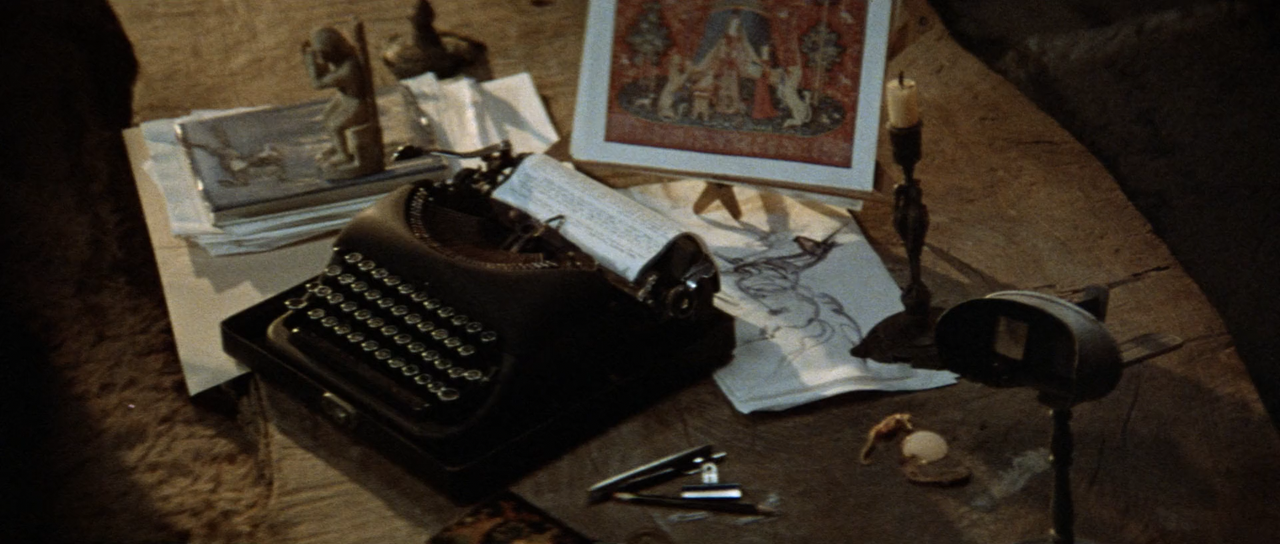
Cathryn's desk. There's a small framed reproduction of one of the six La Dame à la licorne tapestries, a sketch of a galloping unicorn, and a dried seahorse. DP: Vilmos Zsigmond.
A unicorn for National Unicorn Day (UK)
– quote from “In Search of Unicorns”, written by Susannah York
Cathryn (Susannah York), a children's book author, works on a book called “In Search of Unicorns”. Her desk, and mind, are occupied with images from a obscure diegesis.
“There was a silence different from all other silences, an ashen light, and then darkness – total stillness. I thought that during an eclipse even our feelings stop. Out of this came part of the idea for L'eclisse.”L'eclisse [The Eclipse] (Michelangelo Antonioni, 1962)
Mar
20
natural phenomena

Vitti's blond hair shifts in front of Delon's dark coupe, quietly mimicking the eclipse. DP: Gianni Di Venanzo.
A natural phenomenon for this year's March equinox, three supermoons, and the March 25 solar eclipse.
– Michelangelo Antonioni talking about experiencing a solar eclipse, possibly the total eclipse of 1961 which showed up in the film Barabbas (1961).
During several moments in the film, the main characters' mannerisms foreshadow the looming solar eclipse.
Un soir, un train [One Night, a Train] (André Delvaux, 1968)
Mar
18
André Delvaux
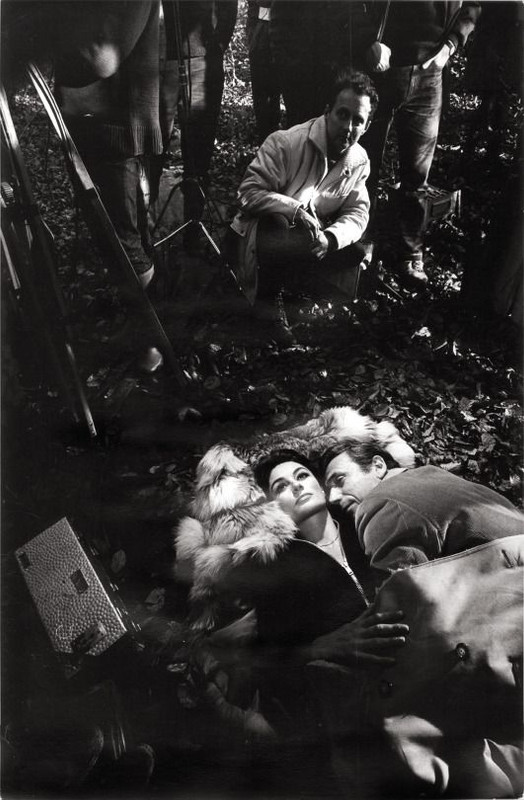
Anouk Aimée and Yves Montand in character on a leaf-strewn floor, his head resting on her chest, with director André Delvaux and others surrounding them. DP: Ghislain Cloquet.
A favourite film, director, or producer for Luc Besson's birthday (1959).
Having only seen three of Delvaux's films, I feel I can safely say his work is hypnotic, but not in the common sense. We see a world through both Delvaux's and his protagonists eyes, and experience their duality as one. This displacement is a recurring theme in Delvaux's work, the work of a man raised in one world and speaking the language of another, both worlds bearing the same name, Belgium.
This slow tear is also the theme is his best known film, De man die zijn haar kort liet knippen [The Man Who Had His Hair Cut Short] (1965), in which a schoolteacher loses himself after a pupil graduates. When we think we are firmly seated in Delvaux's universe, we fall back, like that moment just before sleep sets in. And again, in his tragically under-seen Belle from 1973. Now it's a poet who finds a woman living in a ramshackle hut in Belgium's peatland, her language an unknown. With only one main speaker, the duality forms in the poet's words, in his attempts to give her root.
And so do we, the viewers. We hang on to that root, Delvaux's, only to sink back into our own loss of words.