“What I sought in 'Pacific' was not the imitation of the sounds of the locomotive, but the translation of a visual impression and a physical enjoyment through a musical construction. It starts from objective contemplation: the quiet breathing of the engine at rest, the effort of starting, then the progressive increase in speed, to arrive at the lyrical state, the pathos of the 300-ton train, launched in the middle of the night at 120 km/h.” Пасифик 231 [Pasifik 231 / Pacific 231] (Mikhail Tsekhanovskiy, 1931)
Jul
2
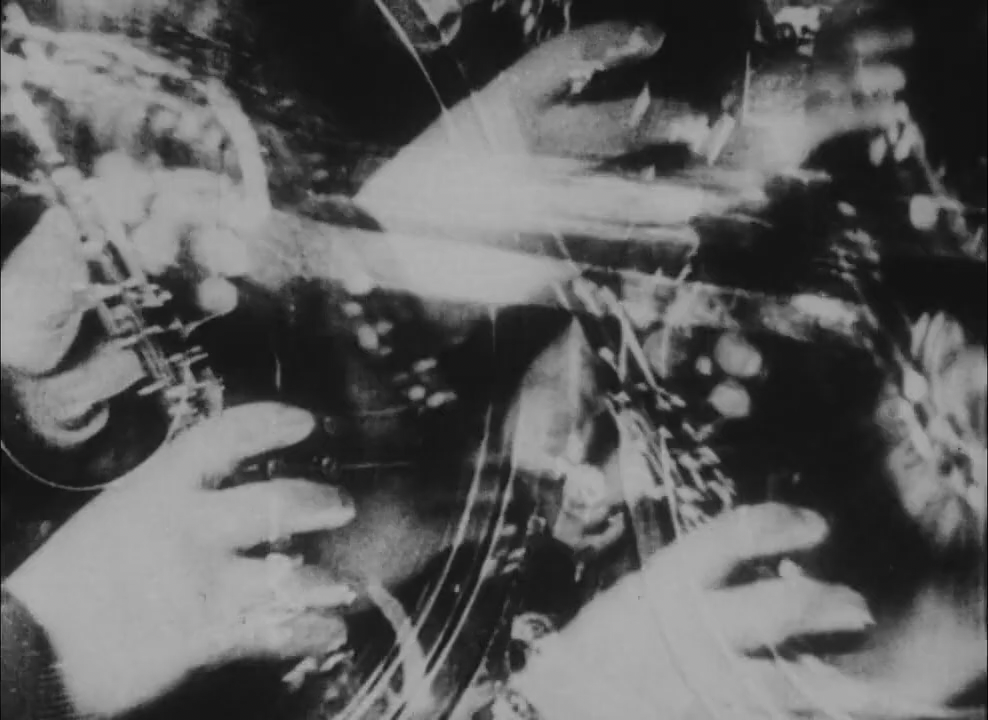
Musicians superimposed over the locomotive's pistons. DP: Leonid Patlis.
A mode of transportation to get me to my ideal vacation destination*. And yes, I would travel to an island by transcontinental locomotive
– Arthur Honegger, Dissonances. Revue musicale indépendante (1925) (via)
Hinted on in Abel Gance's La Roue (1923), composer Arthur Honegger's Пасифик 231 follows the narrative of a stream train ploughing through the night. The conductor's gestures mirror the fireman's and slowly, the machine comes to live. The music becomes abstract, machine-like, in its rendition of pistons and valves. Using double exposure and Soviet montage theory, music and movement become one. The Futurists, if not opposed to the Soviets that is, would have had a field day with this outing.
* the Bales 2025 Film Challenge for July is, for unknown reasons, mostly not date-related and follows some sort of vacation narrative.
shortfilm
“But this art of total synthesis that is Cinema, this fabulous newborn of Machine and Sentiment, is beginning to cease its moans and is entering its infancy. Its adolescence will soon arrive, seize its intelligence, and multiply its dreams; we ask that we hasten its development, precipitate the advent of its youth. We need Cinema to create the total art toward which the other arts have always tended.“Combat de boxe (Charles Dekeukeleire, 1927)
Jun
30
Mike Tyson – 1966
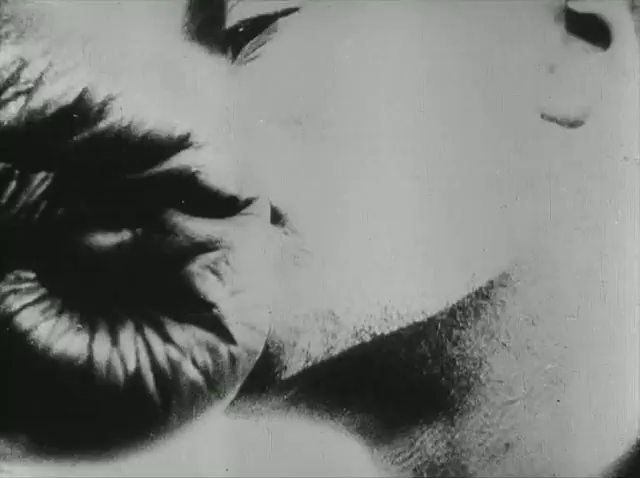
One of the fighters receives a direct hit. The camera is so close that we see abstract shapes, texture and contrast before recognising the scene. DP: Antoine Castille.
A [favourite] athlete in a film role for Mike Tyson's birthday
– Ricciotto Canudo, Gazette des sept arts, 1923 (via)
The match you see is real, between two actual fighters. Paul Werrie's rhythmic poem served as the basis. Everything else is illusion made flesh with what was available. An empty painter's studio, a few friends, footage of a crowd, a deep comprehension of the Kuleshov effect and rapid Soviet-style editing. Dekeukeleire places us from the safe world of the spectator right in the line of fire. But there's no release like in James Williamson's The Big Swallow (1901). Without that gimmick, cinema enters Canudo's realm, as the seventh art.
Poslední trik pana Schwarcewalldea a pana Edgara [The Last Trick of Mr. Schwarcewallde and Mr. Edgar] (Jan Švankmajer, 1964)
Jun
26
National Handshake Day
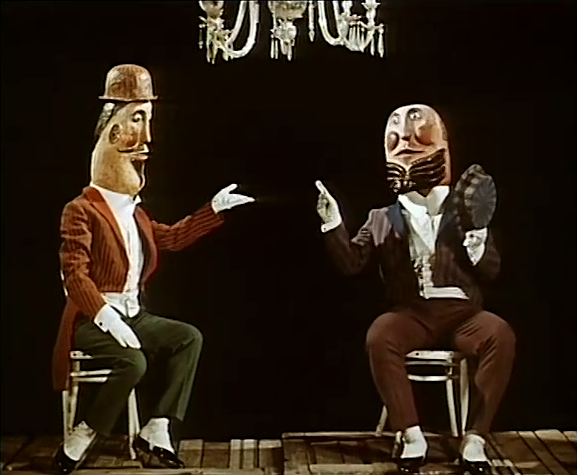
Mr Schwarcewallde and Mr Edgar on stage. Both are puppeteers in Edwardian costumes and oversized papier-mâché heads. DP: Svatopluk Malý.
Characters shake hands on National Handshake Day (USA)
Two illusionists compete with increasingly incredible tricks, sealed with a hefty handshake.
Nosferato no Brasil [Nosferato in Brazil] (Ivan Cardoso, 1970)
Jun
21
International Surfing Day

Nosferatu enjoys the breeze and fresh coconut water on the beaches of Rio. I could've posted a still of the surfers here but that would have been boring.
Someone surfing or skateboarding for either International Surfing Day or Go Skateboarding Day
José Mojica Marins' protégé Ivan Cardoso dabbled in short form horror movies. This one features a young hippie vampire who, after being defeated in beachy black-and-white Prague, hikes a ride to Super 8 Brazil. Can't help but notice a bit of (Charlie) Mansonsploitation going on, but that may be just me.
“That’s how I will probably die, left like a poor old rag on the battlefield. When you know this is going to happen to you, your body suddenly becomes something terribly precious to you. This flesh, soft and warm is yours; a personal belonging not to be discarded like an awful piece of meat. You find yourself thinking about this, realizing what a wonderful thing your body is, and what an awful and wrong thing it is to maltreat it.”The Diary of an Unknown Soldier (Peter Watkins, 1959)
Jun
14
Army Day

That glance. Any soldier at any time. DP: Peter Watkins.
A [favourite] soldier in film for Army Day (USA). I can not in all seriousness link to any official website in fear of throwing up, so please follow along here
Watkins takes the anonymous slaughter of the masses on the battlefield inside, into the body and mind of a young soldier.
“In the evenings, the little Hedgehog went to the Bear Cub to count stars. They would sit on the log and sip tea, gazing at the starry sky. It hung on the roof, just behind the chimney. To the right of the chimney were the Bear Cub's stars and the stars to the left were the Hedgehog's”Ёжик в тумане [Yózhik v tumáne / Hedgehog in the Fog] (Yuri Norstein, 1975)
Jun
9
Donald Duck – 1934
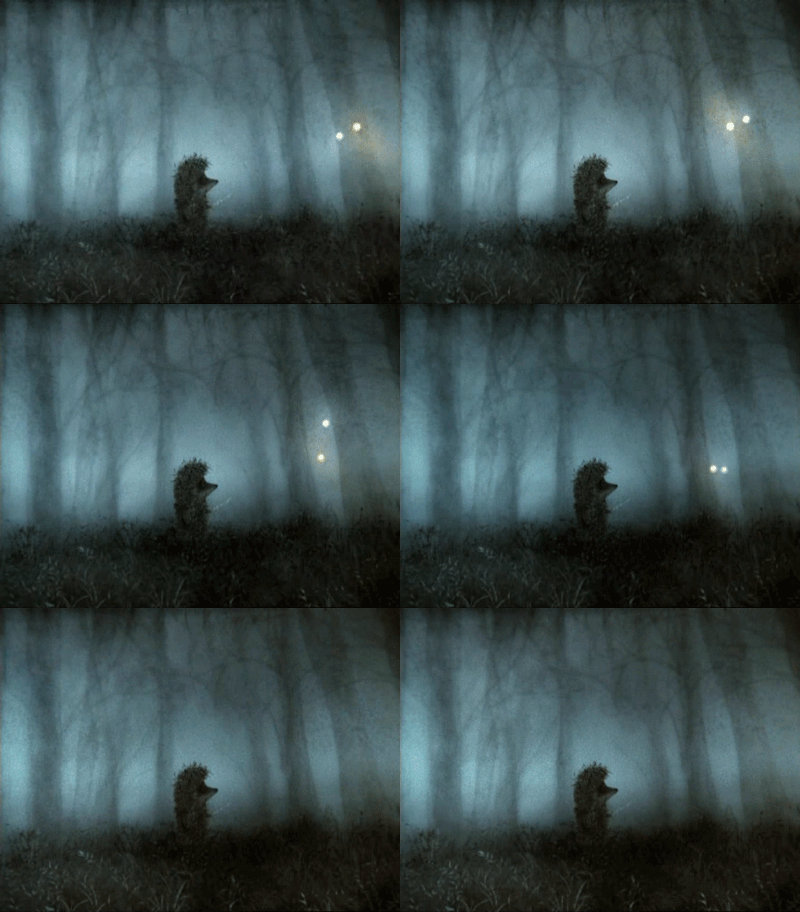
Fireflies in the fog. DP: Aleksandr Zhukovskiy.
A [favourite] animated character for Donald Duck Day (USA)
– opening lines
On his way to visit his friend Bear Cub, Hedgehog finds himself in a dense mistbank. Strange sounds, and even stranger creatures, omit from it. And all he wanted was have strawberry jam and tea with his friend.
“Everyone has the right to life, liberty, and security of person”فلسطين في العين [Filastin fi al-ayn / Palestine in the Eye] (Mustafa Abu Ali, 1977)
May
28
Amnesty International Day

Palestinian freedom fighters.
Amnesty International Day: someone who fights for human rights
– The Right to Live, the third of the Human Rights
Filmmaker #HaniJawharieh died while working for the #PLO Film Unit, an organisation fighting for the rights of the Palestinian people. His own death in 1976, which he caught on camera, is edited into this documentary.
“Spotkał katar Katarzynę –
A – psik!
Katarzyna pod pierzynę –
A – psik!”Katar [Cold] (Hieronim Neumann, 1984)
May
6
Childhood Depression Awareness Day

One little girl sneeze even bursts the camera! A – psik (achoo)! DP: Zbigniew Kotecki.
A child with health struggles for Childhood Depression Awareness Day (USA)
– Jan Brzechwa, Katar (via)
A little girl has the sniffles, sees the doctor, and so happily spreads the bug all over town. A quirky animated short based on a poem by Jan Brzechwa.
“Bonsoir. Je m'appelle Rosalie!” Rosalie et son phonographe [Rosalie and Her Phonograph] (Romeo Bosetti, 1911)
Mar
28
Something-on-a-Stick Day

Rosalie (Sarah Duhamel) dances to her new phonograph. Duhamel makes eye contact with the viewer throughout the film, and even formally introduces herself during the intro.
A laugh out loud scene for Something on a Stick Day (USA)
Rosalie (the wonderful Sarah Duhamel) buys herself a phonograph and is delighted by the wonders it brings. Quick, the whole household should know!
Not only the obvious moments (no spoilers here), but the small, seemingly improvised bits is what makes Rosalie stand out above American productions of the time – with the exception of Roscoe Arbuckle's; his water bucket pun in His Wife's Mistakes (1916) still has me in stitches.
Duhamel makes great use of her physique, and doesn't shy away from looking inelegant, boorish even. Her hips are for pushing things and men out of her way, and her mighty paws easily toss any unwieldy piece of furniture out of the window.
Like Rosalie's irresistible gusto and her delightful ditties, the combination of Duhamel's physical comedy and (former #vaudeville-ian) Bosetti's Italian-flavoured slapstick, plus some of the best stop-motion trickery I've ever seen, is simply magical.
絵を描く子どもたち [E o kaku kodomotachi: jidōga o rikai suru tame ni / Children Who Draw] (Susumu Hani, 1956)
Mar
13
Youth Art Month
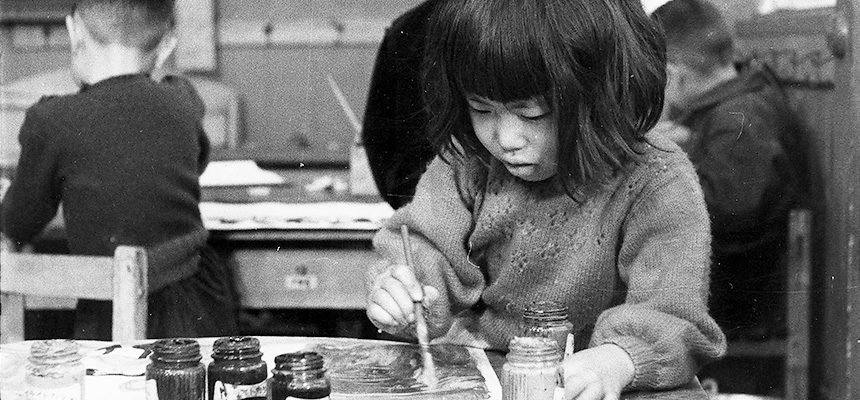
A little girl painting. DP: Shizuo Komura.
An artistic child for Youth Art Month (USA)
Small children work with clay, paint, and other materials. Under the camera's watchful eye, we see their work come to life.