view
Threads (Mick Jackson, 1984)
Mar
5
Sat
A caption superimosed over the city of Sheffield: SHEFFIELD SATURDAY MARCH 5TH. DPs: Andrew Dunn & Paul Morris.
“In an urban society, everything connects. Each person's needs are fed by the skills of many others. Our lives are woven together in a fabric. But the connections that make society strong also make it vulnerable.”
– Narrator
view
簪 [Kanzashi / Ornamental Hairpin] (Hiroshi Shimizu, 1941)
Mar
3
melon
A traditional Japanese room with tatami mats. Boys at a table eat melon slices. A woman makes a phone call. The view through the window reveals a gnarly tree and a mountain in the background. DP: Suketarō Inokai.
view
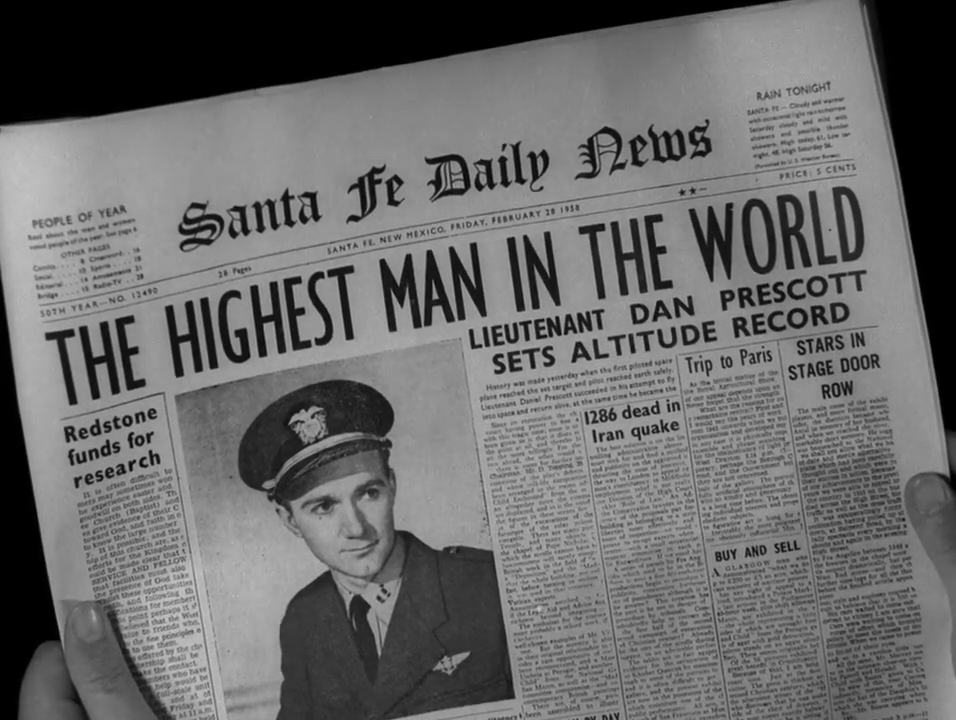
First Man Into Space [Satellite of Blood] (Robert Day, 1959)
Feb
28
1958
A newspaper headline for February 28, 1958 reading THE HIGHEST MAN IN THE WORLD. DP: Geoffrey Faithfull.
“The conquest of new worlds always makes demands of human life. And there will always be men who will accept the risk.”
view
Il mare [The Sea] (Giuseppe Patroni Griffi, 1962)
Feb
17
1962
The actor (Umberto Orsini) approaches a hotel lobby. A blackboard notes the date: February 17, 1962. DP: Ennio Guarnieri.
view
Picnic at Hanging Rock (Peter Weir, 1975)
Feb
14
Valentine's Day
A delicate, pink frosted Valentine's cake topped with a yellow marzipan rose. The cake, which bears the words St. Valentine in crude writing, has a deep straight cut right through the middle and a scorched dark spot on its side. On the right a rusty knife. DP: Russell Boyd.
“On Saturday 14th February 1900, a party of schoolgirls from Appleyard College picnicked at Hanging Rock near Mt. Macedon in the state of Victoria. During the afternoon, several members of the party disappeared without trace.”
view
The Treasure of the Sierra Madre (John Huston, 1948)
Feb
14
1925
The winning lottery numbers of February 14, 1925. DP: Ted D. McCord.
“A thousand men, say, go searchin' for gold. After six months, one of them's lucky: one out of a thousand. His find represents not only his own labor, but that of nine hundred and ninety-nine others to boot. That's six thousand months, five hundred years, scramblin' over a mountain, goin' hungry and thirsty. An ounce of gold, mister, is worth what it is because of the human labor that went into the findin' and the gettin' of it.”
– Howard
view
3 Women (Robert Altman, 1977)
Feb
7
1970
Millie Lammoreaux's Social Security card, issued on February 7, 1970. DP: Charles Rosher Jr.
“Got a lot to write about today. You.”
– Millie Lammoreaux
view
Superstar: The Karen Carpenter Story (Todd Haynes, 1987)
Feb
4
A brunette Barbie doll representing Karen Carpenter makes a statement in front of the White House. DP: Barry Ellsworth.
“Mother, didn't you know there are children starving in Africa?”
– “Karen Carpenter”
view
Night Must Fall (Karel Reisz, 1964)
Feb
2
roast
A man mostly off screen carves meat of some sort. Surely it's symbolic. DP: Freddie Francis.
view
Little Malcolm and His Struggle Against the Eunuchs (Stuart Cooper, 1974)
Scrawdyke
2
Malcolm Scrawdyke (John Hurt), disgruntled art student. DP: John Alcott.
“So, this month becomes the month of Scrawdyke.”
– Malcolm Scrawdyke
.jpg)
.png)


.png)