view
Supermarkt [Die Stadt, Jane Love / Supermarket] (Roland Klick, 1974)
Mar
30
Willi Hansen (Charly Wierzejewski) in a phone booth. Filmed from the outside in, his face is partially obscured by neon lights. DP: Jost Vacano.
view
Grauzone [Zones] (Fredi M. Murer, 1979)
Mar
21
1976
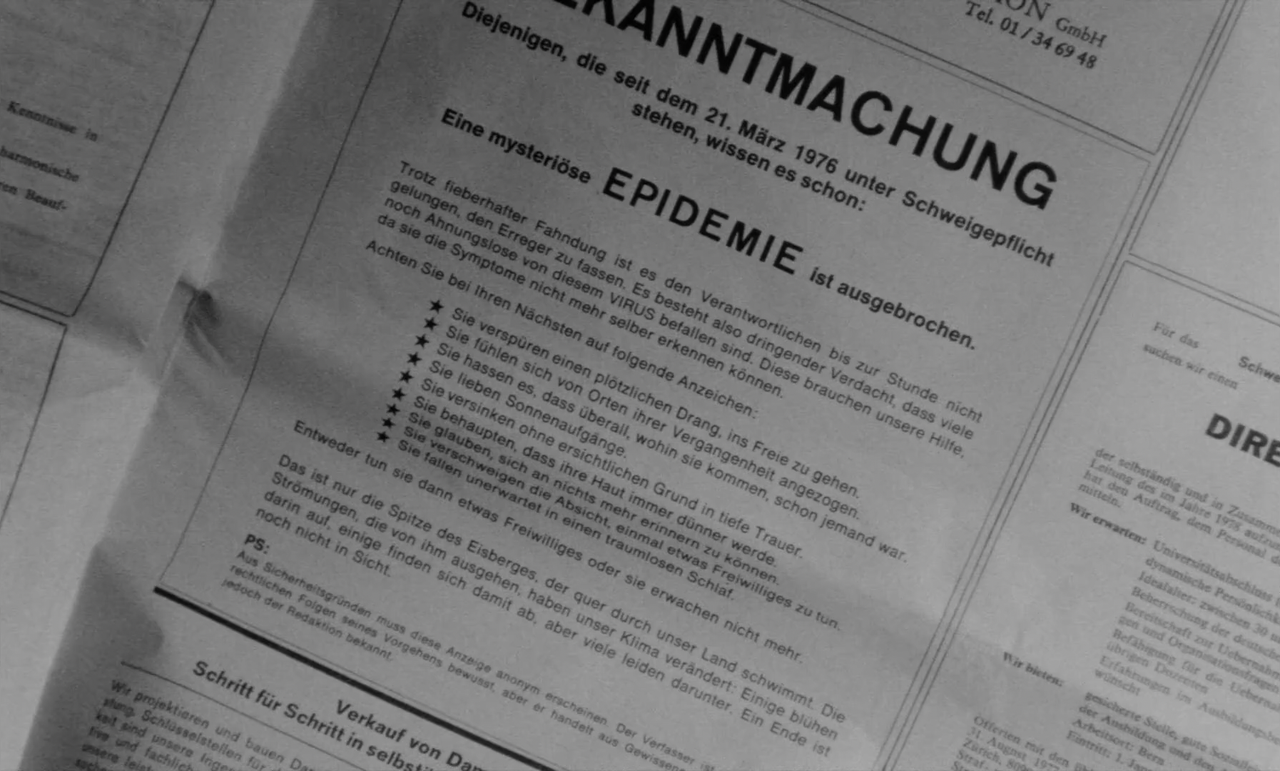
The anonymous, urgent newspaper announcement referencing the oath of secrecy considering a mysterious epidemic, starting March 21, 1976. It lists all the symptoms. DP: Hans Liechti.
Eine mysteriöse EPIDEMIE ist ausgebrochen.
view
Die große Ekstase des Bildschnitzers Steiner [The Great Ecstasy of Woodcarver Steiner] (Werner Herzog, 1974)
Mar
13
Walter Steiner, flying. DP: Jörg Schmidt-Reitwein.
“Ich sollte eigentlich ganz allein auf der Welt sein, ich, Steiner, und sonst kein anderes lebendes Wesen. Keine Sonne, keine Kultur, ich nackt auf einem hohen Fels, kein Sturm, kein Schnee, keine Straßen, keine Banken, kein Geld, keine Zeit und kein Atem. Ich würde dann jedenfalls keine Angst mehr haben.”
– Walter Steiner
view
Fata/Morgana [Left-Handed Fate / Panik 75] (Vicente Aranda, 1966)
Mar
9
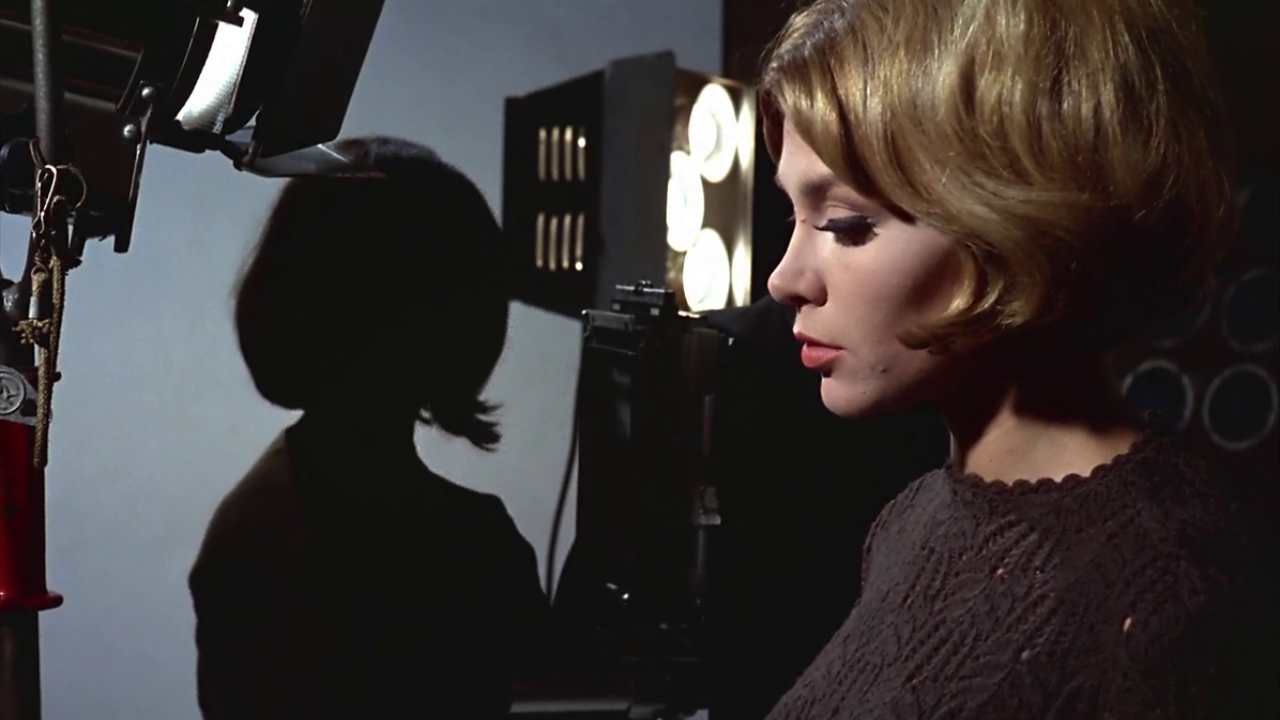
Gim (Teresa Gimpera) modelling in a photo studio. The photographer, another woman in silhouette, has an identical hairstyle and outfit. DP: Aurelio G. Larraya.
view
Die Blechtrommel [The Tin Drum] (Volker Schlöndorff, 1979)
Dec
21
winter solstice
Little Oskar with his tin drum. DP: Igor Luther.
Something short for winter solstice.
“He's growing! Look! See how he's growing! I have seen the Lord! The Lord! The Lord!”
– Schugger-Leo
On the eve of World War 2, little Oskar – just three years old – decides he doesn't want to grow anymore.
view
The Lickerish Quartet (Radley Metzger, 1970)
Dec
5
A 70s couple in a grainy black-and-white still. The frame looks damaged, suggesting a stag reel. The seemingly nude blonde pours a drink for her dark-haired man. She holds the cork between her teeth, seducingly. DP: Hans Jura.
– I've never seen a film like this before.
– Oh, it's different, alright.
view
Hexen bis aufs Blut gequält [Mark of the Devil] (Michael Armstrong + Adrian Hoven, 1970)
Nov
28
cheese
A very young, very pretty Udo Kier seated at a dinner table. There are various fruits on a platter and Udo's eating cheese. His outfit suggests the 18th century. DP: Ernst W. Kalinke.
“I accuse you of having trampled on the cross, of having ridden to the Sabbath, of throwing the Holy Cross of our Saviour into manure so that the skies grew dark, and the rain fell upon the earth!”
– Albino
view
Bübchen (Roland Klick, 1968)
Nov
1
autumn
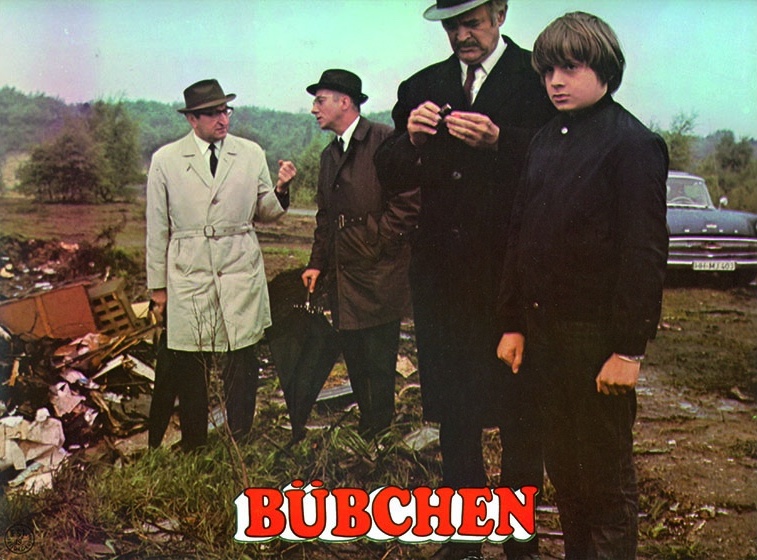
Lobby card. Achim (Alexander Kekulé) at a dreary, autumn-y scrapyard surrounded by several serious looking men in trenchcoats. Bübchen is an endearing term for a little boy (via (spoilers)). DP: Robert van Ackeren.
A movie that feels like autumn*
A family of four share the same house and live their own lives. When the parents attend a company party, the neighbour's teenage daughter reluctantly babysits the children then promptly runs off with her secret boyfriend. Left to his own devices, the bored 10-year old Achim plays a game with his little sister
“Junge, du bist ja ganz woanders!”
I Initially nomintad the RAF critique Deutschland im Herbst (1978) for today's challenge, when I realised that Bübchen too is about Germany's youth's antics and the society that planted its seeds. Here again, a repressed community dutifully finds a way to bury the terror into the fabric of mundanity. You'll find it again in Michael Haneke's Das weiße Band (2009), now foretelling the German youth that came to embrace Nazism.
Eternal return, ad nauseam.
* the Bales 2025 Film Challenge for November is, again, not date-based, but follows a sloppy schmaltzy all-American Thanksgiving-y narrative. Trying to make it work my way.
view
Nosferatu: Phantom der Nacht [Nosferatu the Vampyre] (Werner Herzog, 1979)
Oct
22
eternal returns
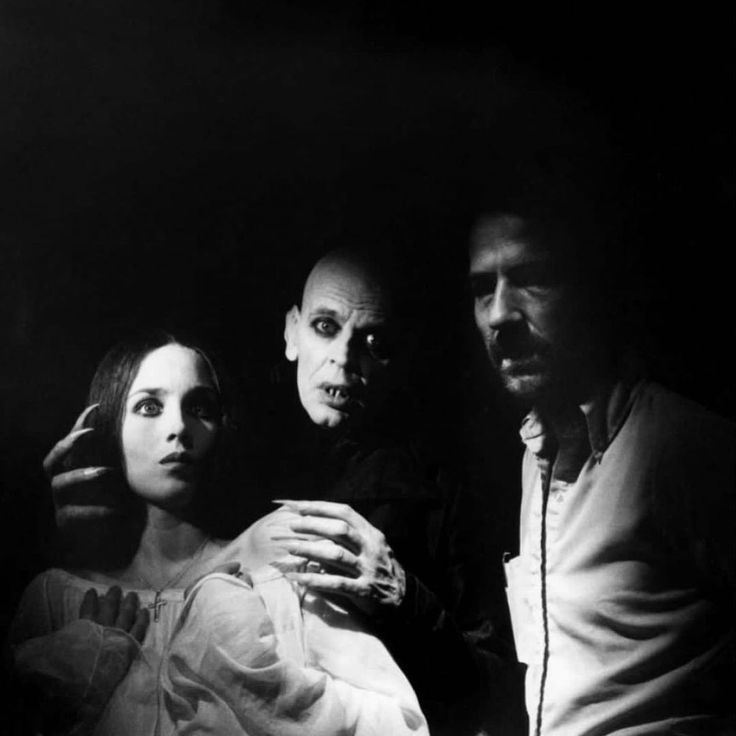
Adjani, Kinski, and Herzog on set. DP: Jörg Schmidt-Reitwein.
[A favourite] horror remake*
“I never thought I could be friends with a German again. But here I am… Werner is somehow like Murnau brought back to life.”
– Lotte Eisner visiting the set of Herzog's Nosferatu (via)
Coming back to Murnau's expressionist masterpiece was Herzog's bridge between the films made by the grandfathers of German cinema and his era. Herzog, born in 1942 Munich, noted this void created by that philistine regime and felt that, by picking up the thread cut a quarter of a century earlier, German culture could see a restoration to its (non-nationalistic) greatness. Thus a menagerie of rats and actors was released in a reluctant, bourgeois Dutch town.
But that's a story for another generation to draw upon.
* the Bales 2025 Film Challenge for October is horror-themed as opposed to date-based, and is all about favourites. Expect non-horror and films I believe to be relevant instead.
view
Vampyros Lesbos (Jesús Franco, 1971)
Oct
2
Dracula
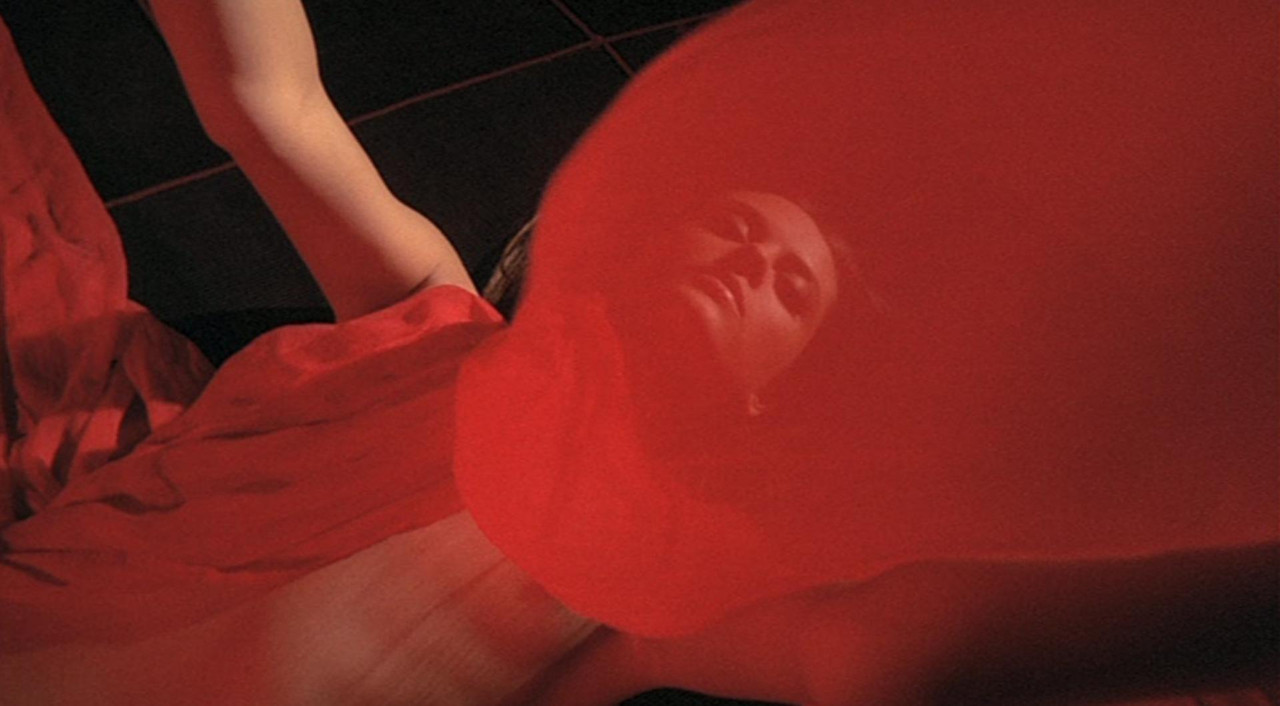
A favourite Dracula movie. As my very most favourite Dracula movie has been claimed, I go with its nearest competitor that somehow also features my favourite Jesus*
Linda (Ewa Strömberg) has been summoned by Countess Nadine Carody (Soledad Miranda) to handle a real estate inheritance from a certain Count Dracula. Spellbound, she finds herself on a small island, and helpless in the Countess' embrace.
“You are one of us now. The Queen of the Night will bear you up on her black wings.”
– Countess Nadine Carody
A film that can easily hold up against Jean Rollins' dreamy vampire erotica, this love letter to Soledad Miranda's brooding torment is a delight to watch and a pinnacle in Jess Franco's filmography. Its influence on neo-Giallo Amer and Dario Argento – particularly his Suspiria – is evident, and that in itself should give you enough clues of how much of an essential chapter Vampyros Lesbos is in adult European filmmaking.
* the Bales 2025 Film Challenge for October is horror-themed as opposed to date-based, and is all about favourites. Expect non-horror and films I believe to be relevant instead.