Jagdszenen aus Niederbayern [Hunting Scenes from Bavaria / The Hunters and the Hunted] (Peter Fleischmann, 1969)
Apr
6
Sorry Charlie Day

The townspeople gather to prepare the communal harvest meal. A dead sow is laid out on an improvised table. DP: Alain Derobe.
A scandal, that's what it was! In the late 1960s, Peter Fleischmann picked the picturesque Catholic village of #Landshut as the backdrop for Jagdszenen aus #Niederbayern, the film adaptation of Martin Sperr's #TheatrePlay with the same name.
A young man named Abram – played by Sperr – returns to his family village. Soon the townspeople's thorns move from the in their eyes other disgraceful villagers to the much-needed mechanic.
Where did he return from? He was in prison. What for? For being a homosexual. He's a Drecksau (a filthy pig), his mother says. The village whore can't turn him around. A sow is slaughtered in real time in celebration of a successful #harvest and plans for the town's future are forged.
While created when West Germany's #Paragrafen175 was in place [1872–1994], illegality of same-sex relations], the homosexual aspect wasn't the main cause of the outrage. Some of the Landshutter villagers who played alongside the professional actors felt they were depicted as being backwards. This isn't a movie about hunting, sigted some. Lifting the veil of the prevalence of, a #Fernweh in a sense, that Germany (hush) was another.
Catholic Mass is a theatrical re-enactment of the life and suffering of the son of God. When rites outstay their meaning, when invocations turn routine, the worshippers lose sight.
“You're talking about a different kind of war.”Fail Safe (Sidney Lumet, 1964)
Apr
5
National Nebraska Day
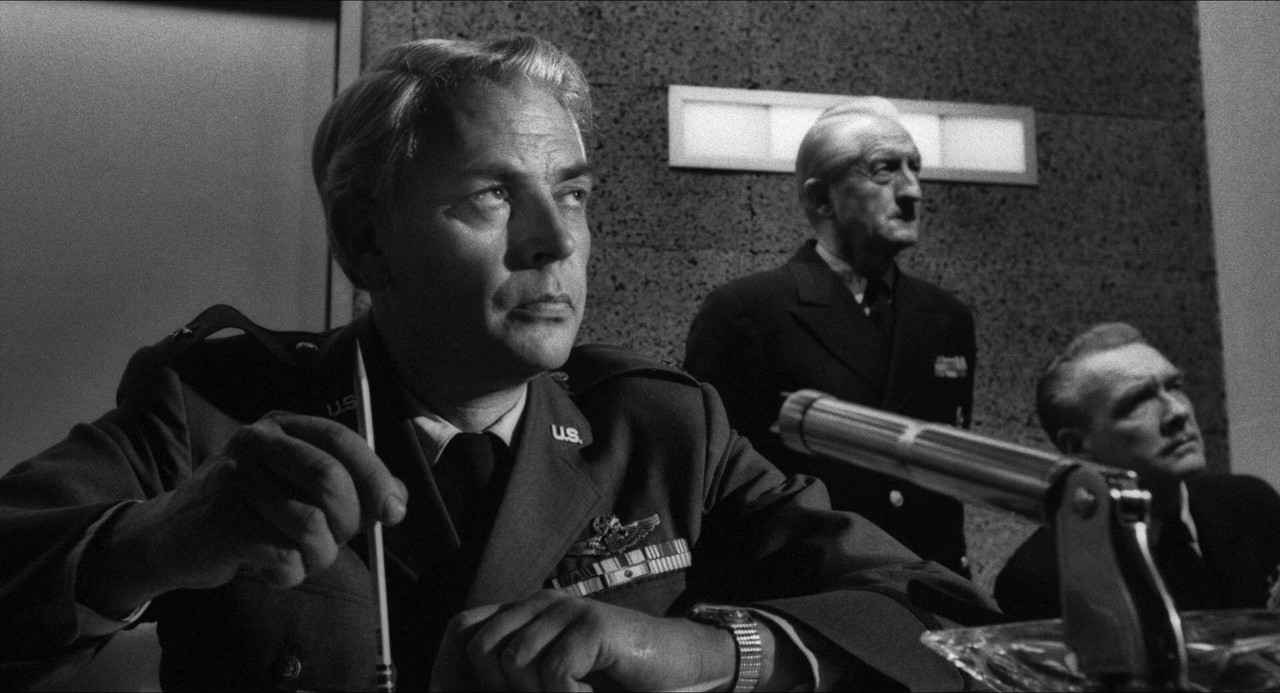
General Black (Dan O'Herlihy) being briefed. DP: Gerald Hirschfeld.
The one that got bombed by Strangelove.
– General Stark
Both Lumet's Fail Safe and #Kubrick's #ColdWar comedy came out in 1964, right after the #CubaCrisis. The world was awash with the realisation that the bomb, The Bomb, wasn't merely proverbial flexing. And when crisis happens, there are two options. One is to laugh, the other is to grasp. Sadly for Lumet, and the world, his Fail Safe was released while everyone was still too busy chuckling.
“Where rats turn up, they spread diseases and carry extermination into the land. They are cunning, cowardly and cruel, they travel in large packs, exactly the way the Jews infect the races of the world.”Der ewige Jude [The Eternal Jew] (Fritz Hippler, 1940)
Apr
4
World Rat Day

Nazi propaganda postcard advertising an exhibition in the library of the Deutsche Museum in Munich called Der ewige Jude: Große politische Schau (“The Eternal Jew: Great Political Exhibition”). The front of the card is a reproduction of the film poster. The card is dated 1937, which is at odds with the information in this blogpost. DPs: A. Endrejat, Anton Haffner, R. Hartmann, F.C. Heeve, Heinz Kluth, Erich Stoll & H. Winterfeld.
I took a long time considering what to nominate for today's topic. This is not an easy one. And frankly, barely qualifies as as film.
In the 1930s, three films (2 British, 1 American) portrayed Jews in a positive light, as victims of persecution through history. When in 1938 the Novemberpogrome took place in (Nazi-occupied) Germany (the term “Kristallnacht” is a horrible euphemism and I won't use it), media was not unanimously jubilant about it. Understanding that violence is not the way to popular consensus, plans were made to change people's thinking about the Jews, using widely available visual media.
In 1939, the faux #documentary Der ewige Jude, directed by the leader of Goebbels' #propaganda film department Fritz Hippler, started production. Scenes shot in Jewish ghettos in occupied Poland were intercut with real, but out-of-context documentary footage, giving it a false sense of authenticity./
– narrator
A recurring theme in Der ewige Jude is disease. Not merely to suggest “the Jew”'s unclean life and religion, but as a synonym of people as a vermin, a parasite to decent (read: Aryan) society. In a chilling demonstration of the Kuleshov Effect, footage of a large group of #rats coming out of a sewer is followed by a crowd of Jews in the Łódź Ghetto, filmed without their consent or knowledge of where this footage would end up.
“My wife gave me a big kiss this morning. I only get kisses once a month, on payday.”Il posto [The Job] (Ermanno Olmi, 1961)
Apr
3
World Party Day

Two office workers awkwardly dancing cheek to cheek at the company Christmas party. She's in her finest cocktail dress and pearls, he listlessly wears a mock sheriff's hat. DP: Lamberto Caimi.
To support his family, small-town boy Domenico moves to Milan in the hope to find a job. Eventually he's employed, as a clerk in a drab office replacing a senior worker who died. While the days drag on, only interrupted by coffee shop small talk with fellow teenager Antonietta, the Christmas office #party draws nearer.
– Sartori
With the dark absurdity of coming out of fascism and having to run a real-world country with a naive ineptitude – represented by the too-large-borrowed-from-father-suits – and pretence childlike bureaucratic procedures, Olmi's Il posto is a wonderfully sharp observation of postwar Italy.
O Território [The Territory] (Raúl Ruiz, 1981)
Apr
2
Nature Day

A man and woman, plus a little girl perched on the man's shoulders, hike through an illusory landscape. DP: Henri Alekan.
Two American families, adults and their children, go on a #HikingTrip somewhere in the south of France. They find themselves increasingly lost, not only in #nature but also in and among themselves.
Supposedly based on a real troublesome event and riddled with much filmmaking adversity, O Território nearly stranded as much as the hikers did. In support, #WimWenders used the same cast for his Der Stand der Dinge (1982), about a film crew's attempt to remake #RogerCorman's Day the World Ended (1955).
In a wonderful, unscripted circular way, Corman was one of the executive producers of Ruiz's film.
Red & Rosy (Frank Grow, 1989)
Apr
1
National Handmade Day

Big Red (Rico Martinez) high on adrenaline. DPs: Frank Grow, Ralph Hawkins & Rico Martinez.
All you need for a movie is a gun and a girl. Or a girl with a glue gun. Or skip the girl, get yourself a piece of cardboard, some foam latex, and a six pack of beer. Frank Grow's Red & Rosy is the embodiment of a special staple of #DIY culture that appears to be long-lost. Really kids, you don't need much of a budget. Or tomorrows latest equipment. The hottest Hollywood hotshot? Forget about it, ask your drunk uncle to yell at the camera for 10 minutes. You want authenticity? Tape some random medical footage straight from your teevee. Need a shot of adrenal juice?
Well, just watch this.
”'Playtime' is a peculiar, mysterious, magical film. Perhaps you should see it as a preparation for seeing it; the first time won't quite work.”Playtime (Jacques Tati, 1967)
Mar
31
Eiffel Tower Day
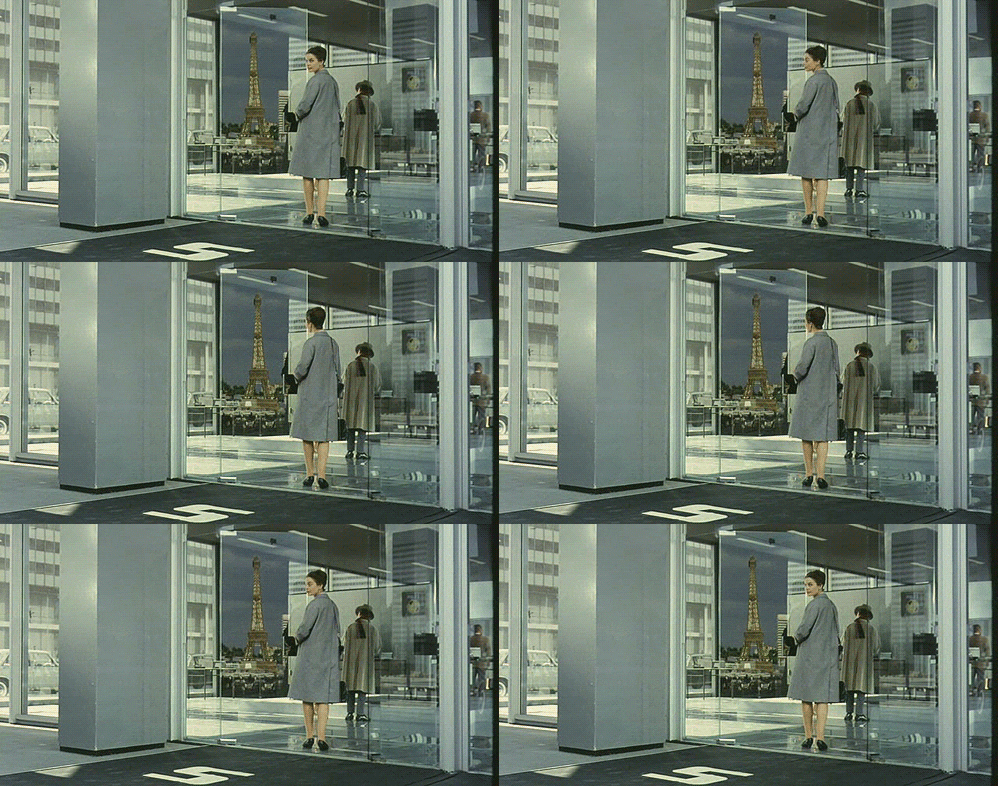
A woman in a long grey overcoat holds a glass door of one of the many impersonal, grey modernist buildings. For a brief moment the Eiffel Tower can be seen reflected in the glass, providing a much needed flash of colour. DPs: Jean Badal & Andréas Winding.
Never was or will I be a fan of Jacques #Tati, the loveable Luddite who wouldn't be as big as he became if it wasn't for the technological wonders of the 20th century. Having said that, his Playtime (1967) holds a special place in my heart.
Tati's alter ego Monsieur Hulot roams a hyper-modern #Paris, actually an enormous soundstage dubbed Tativille. People, buildings and gadgets interact with and against each other, each and everyone as plotless as a prop. In unison, it becomes a perfectly orchestrated symphony of maddening modernism.
But Tati wouldn't be Tati if it wasn't for a glimpse of quiet nostalgia. A woman holding the glass-and-steel entrance door of yet another concrete office building. In the glass, a burst of warm light and colour and movement. And then it's gone, and we remember how that tower once was the thorn in the Luddite's eye, that “baroque and mercantile fancy of a builder of machines”.
I'm going to take Mr Ebert's words to heart for my long overdue revisit to #Tativille:
– Roger Ebert
Paris qui dort [Paris Asleep / The Invisible Ray / At 3:25] (René Clair, 1925)
Mar
30
freebie: Eiffel Tower Day

Two bright young things in their fashionable suits cease their scuffle mid fight, high up on the Eiffel Tower. DPs: Maurice Desfassiaux & Alfred Guichard.
Science fiction may be one of those genres that's forever linked to the future and, depending on which side of 2000 you are at, either in a dystopian of utopian fashion.
An #Eiffel Tower watchman wakes up to find the world around him asleep. The few ones still awake – the bright, pretty, carefree things – explore, live and loot.
“Back to the old tricks.”Vérités et Mensonges [F for Fake] (Orson Welles, Gary Graver, Oja Kodar + François Reichenbach, 1973)
March
29
Smoke And Mirrors Day

A wide shot of Orson Welles in his black cape and wide rimmed hat. His corpulence and black outfit sharply contrast with the bright, white background. The background is a white plane, held up by two assistants. The wide shot reveals that Welles, the white plane, and the assistants are on the platform of a train station, obscuring a passenger train if in close-up. DP: François Reichenbach.
Vérités et Mensonges is what it's actually called, but you may know it as F for Fake. Orson Welles and three uncredited fellow conspirators – Gary Graver, Oja Kodar, and François Reichenbach – delve into the world of #art forger Elmyr de Hory by way of his biographer Clifford Irving.
– Orson Welles
Welles et al free-associate with concepts of art, lies, #deception, and #authenticity. #Houdin, Welles, #Picasso and Hughes, hoaxers, hucksters and artists in their own right. And then it's over: this work of art, this sleight of hand, this demonstration of factuality, an exposé.
“In terms of sheer entertainment value, I think that it demonstrated that one eccentric genius alone in his garage can rival the best of the Hollywood studios”” Multiple SIDosis (Sid Laverents, 1970)
Mar
27
National Acoustic Soul Day

Clockwise: Sid playing a ukulele, Sid whistling, Sid playing improvised chimes (metal pipes and one cymbal hanging from an overhead microphone stand), Sid blowing a tune on champagne bottles, one metronome. DP: Sid Laverents.
There's a handful of notable amateur films in the National Film Registry. One of them is the Zapruder film, another Sid Laverents' Multiple SIDosis.
– Ross Lipman, UCLA Film & Television Archive restorationist
Sid Laverents was an airplane engineer and former one-man band vaudevillian who in his fifties joined the #SanDiego Amateur Moviemakers Club. One of his best-known outputs, Multiple SIDosis, took him and his 16 mm #Bolex four years and 1,900 feet of celluloid to make. In it, Sid – and a musical troupe made up of many overdubbed versions of himself – performs the popular and insanely catchy tune Nola.
Catch it here.