海底から来た女 [Kaitei kara kita onna / Woman from the Sea] (Koreyoshi Kurahara, 1959)
Sep
4
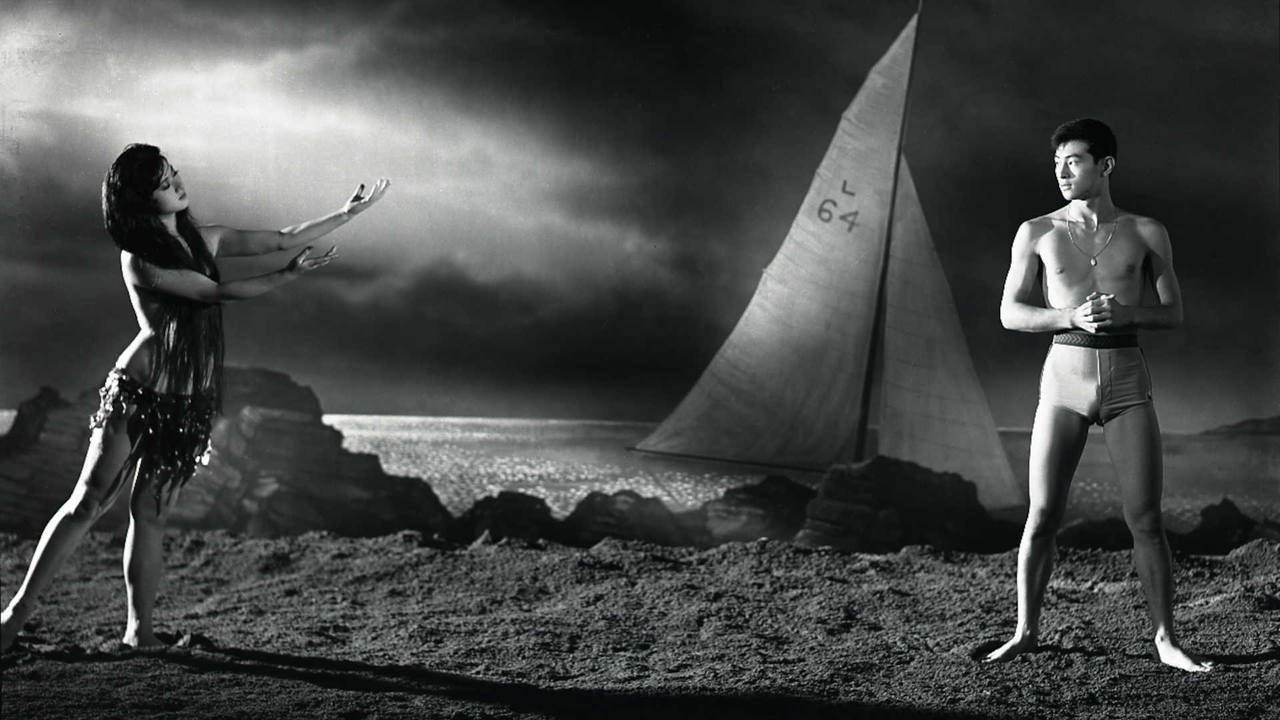
The mysterious sea woman (Hisako Tsukuba, who under the name Chako van Leeuwen went on to produce the Jawsploitation franchise Piranha) and a bewitched Toshio (Tamio Kawachi). Note how the boat's sail resembles a shark's dorsal fin. DP: Yoshihiro Yamazaki.
It's this month's Bales Challenges' dad's VaderJaws' birthday! Celebrating with Vader, or sharks, or churches, or Chvrches. Erm… let's stick to sharks.
A strange woman appears in the life of a young man. He falls in love with her, but the fishermen know. She's the wife of a shark killed years ago. And she's out for revenge.
Doing Hooptober parallel to Bales. Expect some contamination of the September/October posts.
Petit à petit [Little by Little] (Jean Rouch, 1970)
Sep
3
Skyscraper Day
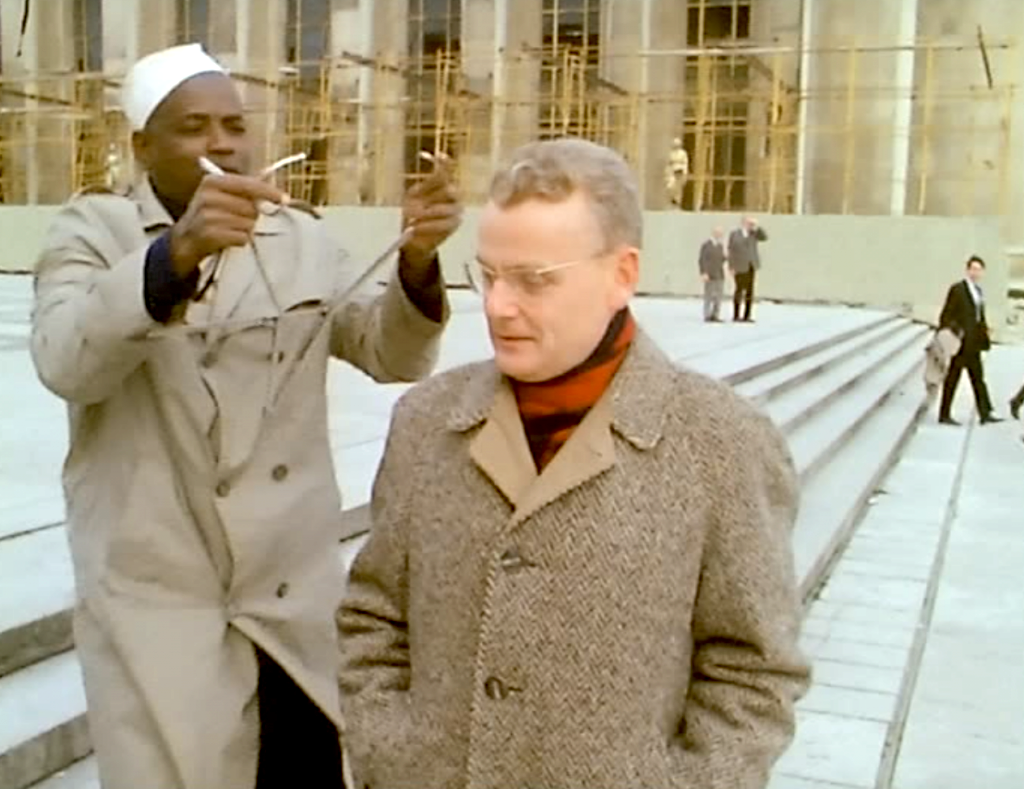
Damouré (Damouré Zika) measures a Parisian with craniology callipers. No skyscraper in this still, but there's scaffolding. DP: Jean Rouch.
A skyscraper for Skyscraper Day (USA)
In the sequel to Rouch's Jaguar (1967), Damouré wants a high rise for his Niger business with “as many floors as he has wives”. He decides to travel to Paris to learn about the construction of such building, and what made Paris to the Paris of today. While there, he gets distracted by the peculiarities of the French natives. Worried about Damouré's increasingly puzzling postcards, his company sends out Lam (Lam Ibrahim Dia) to bring him home.
“Ich mag Männer, bin 30 Jahre alt, von Beruf Lehrer.”Taxi zum Klo (Frank Ripploh, 1980)
Sep
2
Christa McAuliffe 1948 – 1986
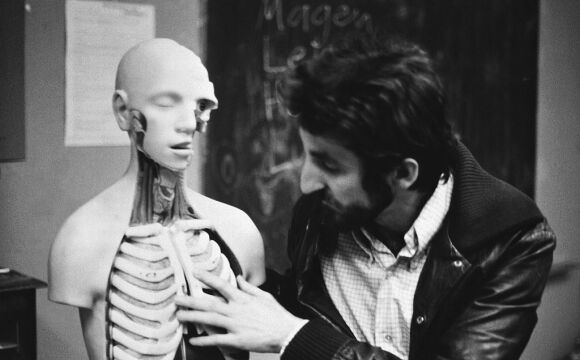
Frank (Frank Ripploh) teaching kids about the human body on an anatomy dummy. DP: Horst Schier.
A teacher for what would have been Christa McAuliffe's birthday.
– Frank Ripploh
Frank Ripploh is a sexual ethics and biology teacher by day, and hedonistic gay man and aspiring pornographer by night. When Frank Ripploh, the man, publicly came out in 1978 in the tabloid Stern, he lost his teaching job and did become that filmmaker. Taxi zum Klo – litt. taxi to the john/loo – is his story. A frank pre-AIDS pre-Internet pre-victimhood depiction of male gay culture in West Germany. Maybe raw, possibly misogynist, definitely true to life.
Endişe [Anxiety] (Yılmaz Güney + Şerif Gören, 1974)
Sep
1
Labor Day
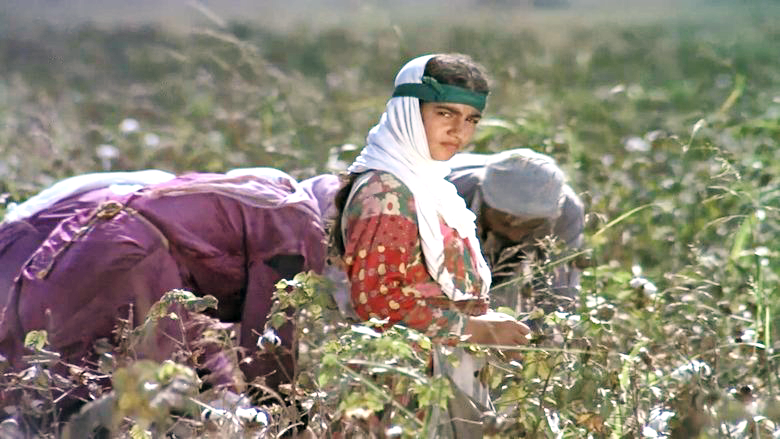
A Kurdish worker in the cotton fields. She looks straight into the camera while two others continue their work. DP: Kenan Ormanlar.
The Industrial Revolution, or unions, for Labor Day (USA)
Kurdish seasonal cotton pickers fear losing their job when mechanisation is preferred by their overseers. While unionising, Cevher, one of the workers – tries to stay out of the hands of his enemies, who want him because of a blood feud.
Mon oncle (Jacques Tati, 1958)
Aug
29

Mr Hulot and three women enjoy an outdoor lunch in Villa Arpel's concrete backyard. A woman in furs laughs heartily, head thrown back, with Hulot looking into her open mouth, halting a woman reaching for a carafe mid-movement. The third woman, in an avant-garde Eastmancolor-red poncho, calmly smokes through her cigarette holder. DP: Jean Bourgoin.
– A house like yours must be such a job!
– Oh, a leaf! Ah, yes it's a chore.
– Admit it, you love it.
Mon oncle (Jacques Tati, 1958) / Koolhaas Houselife (Ila Bêka + Louise Lemoine, 2008)
Aug
29
grey
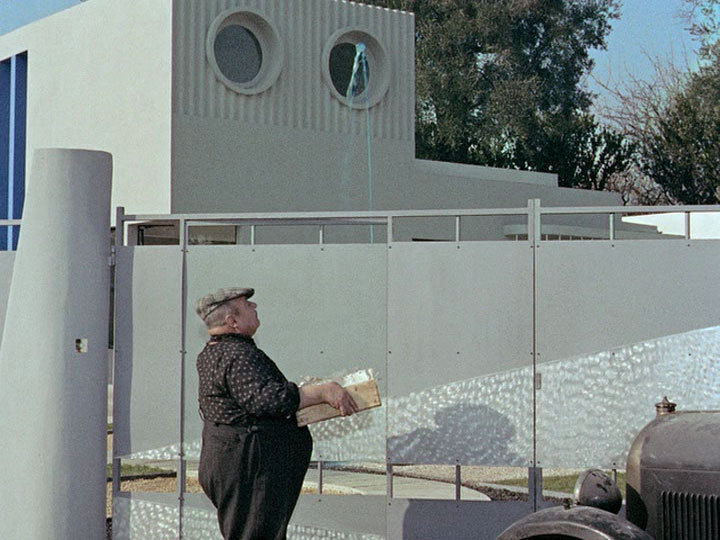
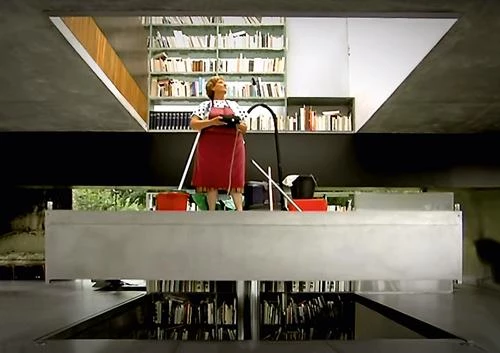
A delivery man in front of the gates of Villa Arpel (via), and custodian Guadalupe Acedo working the lift in Maison à Bordeaux. DP of Mon Oncle: Jean Bourgoin.
[A favourite] colour: grey*
Approaching the 60s, Mr Hulot finally switches from black-and-white to colour. Suddenly, we see that his suit is a beigeish grey and so is the Arpels' house, that modernist masterpiece designed by Tati. The beloved luddite struggles with hypermodern people and their hypermodern constructs, much alike the future Hulot from Playtime (1967).
In similar absurd fashion, Guadalupe Acedo, cleaning lady, works her way through Rem Koolhaas' Maison à Bordeaux (1998) in Bêka and Lemoine's Koolhaas Houselife (2008). Too steep are the stairs, too leaky everything else. Levelheaded, she does her thing; a small beacon of romantic practicality in a world of absurd efficiency.
* the Bales 2025 Film Challenge for August is not date-related but lists, for the most part, the colours of the rainbow.
“Remember love, remember love
Love is what it takes to dream”
Bed Peace [John and Yoko: The Bed-In] (John Lennon + Yoko Ono, 1969)
Aug
27
white
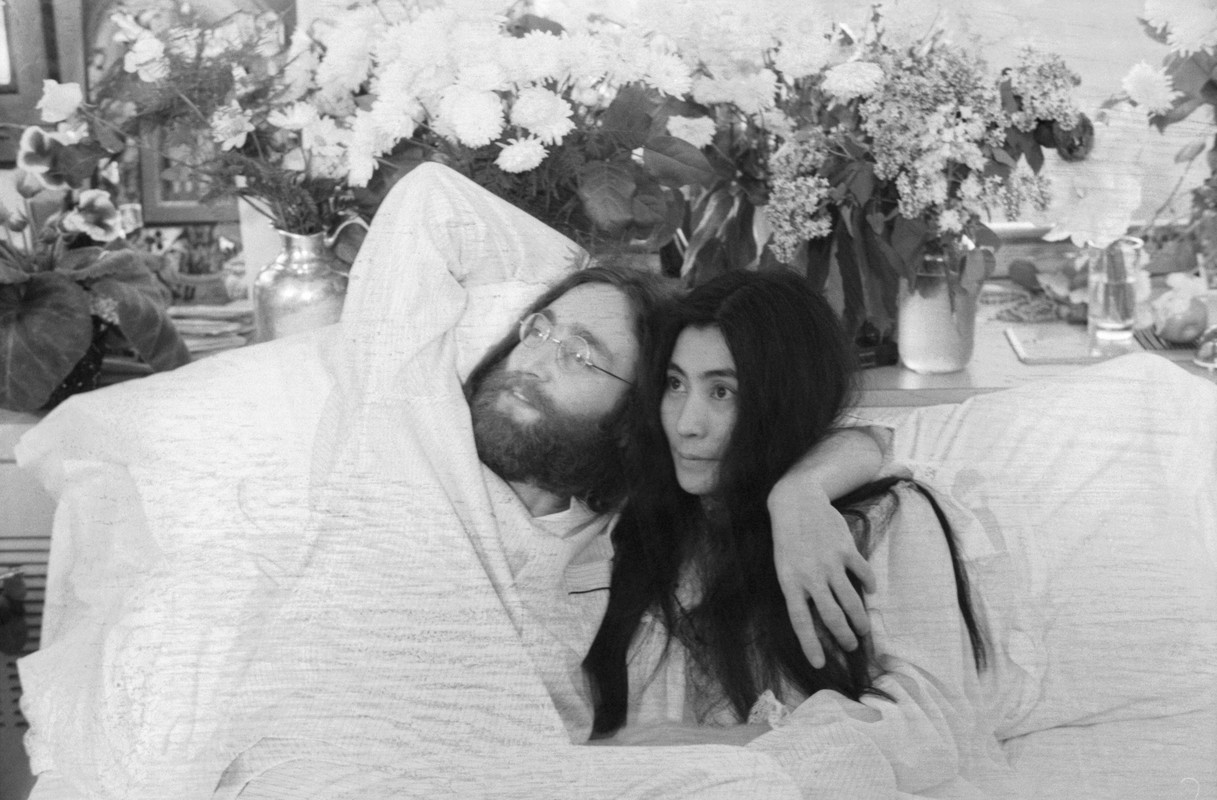
John and Yoko in their bed, dressed in all-white, framed by flowers. DP: Nicholas D. Knowland.
White, in food or fashion*
– Yoko Ono, Remember Love (1969)
While the press expected the newlyweds' “bed-in” to be a scandalous nude affair, the two lovers showed up in all-white – like angels, as John put it. Surrounded by journalists and friends, John and Yoko imaged peace.
* the Bales 2025 Film Challenge for August is not date-related but lists, for the most part, the colours of the rainbow.
“It is vital to be photogenic from head to foot. After that you are allowed to display some measure of talent.”
Les Vampires [The Vampires or, The Arch Criminals of Paris] (Louis Feuillade, 1915/1916)
Aug
24
black
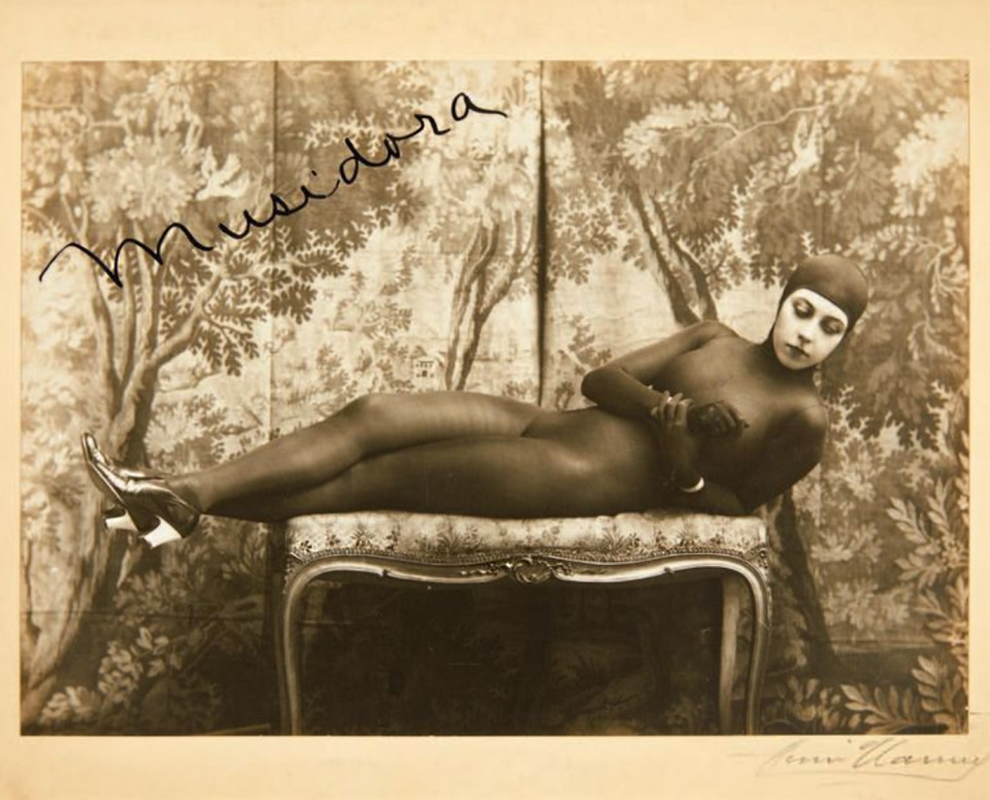
A signed promotional photograph of Irma Vep (Musidora) in her iconic black catsuit. DPs: Georges Guérin & Manichoux.
Black, in food or fashion*
– Musidora
Possibly the first, and definitely the most, iconic catsuit in cinema is worn by Musidora as Irma Vep in Les Vampires. Skintight and scandalous, Musidora's screen presence in the serial further cemented the popularity of the vamp and set the scene for many man-eaters to come.
* the Bales 2025 Film Challenge for August is not date-related but lists, for the most part, the colours of the rainbow.
颱風圏の女 [Taifuken no onna / The Woman in the Typhoon Area] (Hideo Ōba, 1948)
Aug
23

Pirate moll Kuriko Sato (Setsuko Hara) (via). DP: Hiroyuki Nagaoka.
Celebrating International Talk like a Pirate Day*: a [favourite] pirate film.
* International Talk like a Pirate Day takes place on September 19.
“I first noticed it in Spring last year. […] It was from [my home] that I first saw it—its crest protruding over the roofs on the other side of the road. Surprised that I hadn’t noticed it before, I wondered what it was and then forgot about it for several weeks.” The Black Tower (John Smith, 1985—1987)
Aug
22
black
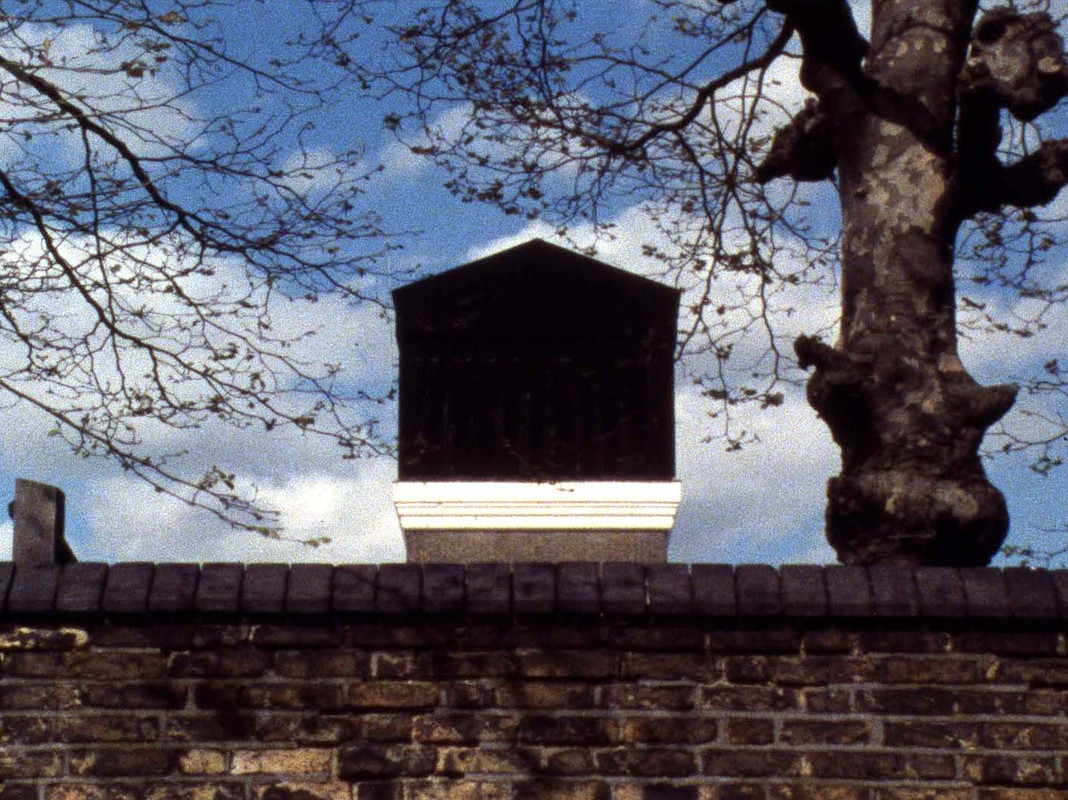
The black tower, visible from behind a brick wall (via)..
Black: a building or structure*
– narrator
A man becomes aware of a formerly unnoticed black tower. Surely it's nothing, yet as the weeks pass, its looming presence takes over.
The black tower was a real structure, first noticed by filmmaker John Smith when he moved to East London. The building, actually the upper part of a hospital's water tower, was painted pitch black, and on sunny days appeared to be a cutout in the sky. By framing the shots in such a way that only part of the surroundings is visible, and editing them in a narrative framework, Smith creates a new context suggesting movement. This style of montage called creative geography, or artificial landscape, was developed by Lev Kuleshov and enables filmmakers to expand existing material and narrative into something that usually is only available to prose poetry.
* the Bales 2025 Film Challenge for August is not date-related but lists, for the most part, the colours of the rainbow.