view
Holubice [The White Dove] (František Vláčil, 1960)
Dec
9
Official Lost And Found Day
Michal (Karel Smyczek) finds the white dove perched on a sculpture. The artwork depicts a faceless boy. DP: Jan Čuřík.
view
Fireworks (Kenneth Anger, 1947)
Dec
8
National Christmas Tree Day
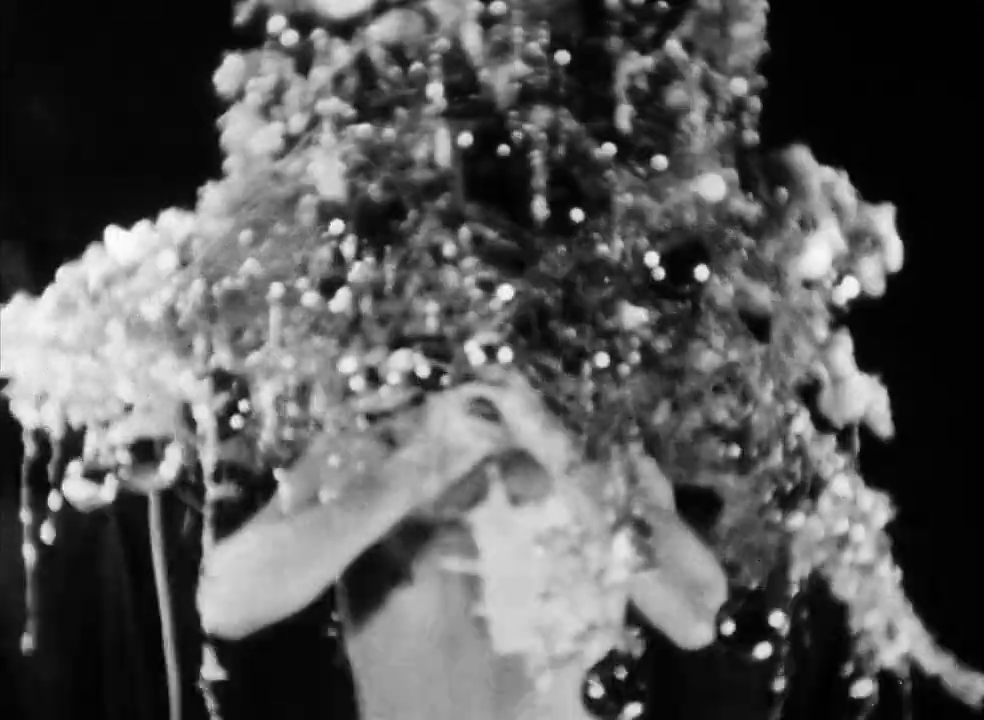
The Dreamer (Kenneth Anger) holding a tinsel-decked Christmas tree in front of his naked upper body. The scene appears to foreshadow Yvonne Marquis getting into her silver dress in Anger's Puce Moment (1949).
In August 1942, a Mexican-American man with a broken finger was found semiconscious near Sleepy Lagoon, Ca.. By association, a group of young Latinos was put on trial. This spark, mere months after Roosevelt sent thousands of Japanese Americans to concentration camps and fuelled by Cold War paranoia, eventually set off the Zoot Suit Riots.
Zoot Suiters or Pachucos and other “outsiders” like African, Italian and Filipino Americans, were viciously attacked by Anglo-American #sailors. Those suits, all that fabric, this colourful extravagance, they cried out, were hampering the war effort.
“Inflammable desires dampened by day under the cold water of consciousness are ignited that night by the libertarian matches of sleep, and burst forth in showers of shimmering incandescence.”
– The Dreamer
The Dreamer, Anger, dreams of a similar violent attack. The sadism is harrowing, filmed with such exquisite eye that it's impossible to look away. Blood finds its way out, pulsating and spurting. Ambiguous glances. A hand, no finger. A young man awakes, is born. The dreamer is still asleep.
view
The Savage Eye (Ben Maddow, Sidney Meyers + Joseph Strick, 1959)
Dec
7
National Judith Day
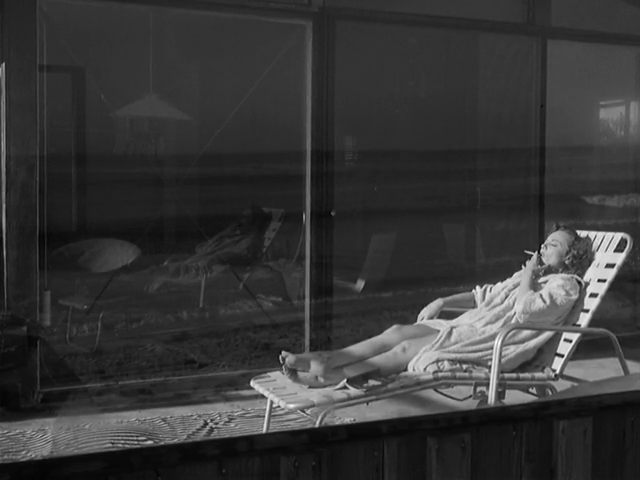
Judith X (Barbara Baxley) relaxing on a sun lounger. DPs: Jack Couffer, Helen Levitt & Haskell Wexler.
By times, The Savage Eye has more in common with mondo than with drama. Judith's betrayed, by her husband. She takes a plane out out out. To Los Angeles, where an angel – it's their town after all – talks to her. About her life, the old one and the new. She tries to reinvent herself with new clothes, a hairstyle, a manicure. It fills the longs days, that too. She attends bloodsports. A burlesque, with her new lover, a married man. There are bleeders and drinkers and jumpers. Sticky sheets. New eyes and fiery tongues, courtesy of Jesus. What is Judith's life if not a stranger's.
“I dream of resurrection in a party dress.”
– Judith X
view
剣 (小説) [Ken / The Sword] (Kenji Misumi, 1964)
Dec
6
rice
Young people eating. An older woman in kimono scoops rice from an electric rice cooker. When read from right to left, this scene – as are numerous others in Chikashi Makiura's photographed 剣 (小説) – are split into tradition and modernity. DP: Chikashi Makiura.
“We come to life, we die… It's a perpetual renewal. How boring.”
– Mibu
view
3615 code Père Noël [Deadly Games / Dial Code Santa Claus] (René Manzor, 1989)
Dec
4
Santa's List Day
A man in a grey overcoat and yellow scarf at a public Minitel terminal. On the display the code 3615 and an 8-bit illustration of Santa Claus carrying his bag with presents. The sack holds a smaller Minitel device with the text PERE NOEL. DP: Michel Gaffier.
Aah France… Land of old wine, old cheese, old art, and Internet access in the early 80s. Prestige project of Président Giscard, France was determined to take a technological leap. Any French man, woman and child could borrow a Minitel – a PC-like videotex device – from the national telecommunications services. For those without landline there were numerous public terminals throughout the land. The machine gave the people access to a phonebook (convenient!), the news (smart!), same-day delivery shopping(!) and sexting (ooh la la!). All these services were accessible via a code starting with 3615 followed by a string of letters. Dial 3615 ULLA to text with a sexy lady – some telecom employee pretending to be one – and 3615 PERE NOEL for Santa Claus. The real one, of course.
9 year old whizkid Thomas (Alain Lalanne aka Alain Musy) is dead set on proving that Santa is real and not some weirdo looking for a gullible kid to play with. A trap is set, and the boy waits.
“You know Mum, I don't have to write to Santa anymore. There's an easier way, through Minitel.”
– Thomas
3615 code Père Noël is definitely not your cutesy little Christmas romp. The violence is not cartoonish, the bandit is more Manson than moist. The boy's disillusionment in the adults around him is a perfect mirror of “Santa's” lonely attempts to communicate and be accepted. However, Thomas' mom didn't lie about one thing; that seeing Santa on Christmas Eve turns you into an ogre. Or an adult, as the grownups call it.
view
The Unknown (Tod Browning, 1927)
Dec
3
Let's Hug Day
Target girl Nanon (Joan Crawford) hugs her circus partner, Alonzo (Lon Chaney) the knife thrower. Her tight embrace may reveal his secret. DP: Merritt B. Gerstad.
“Men! The beasts! God would show wisdom if he took the hands from all of them!”
– Nanon Zanzi
As mighty as Alonzo may be, the incomparable Lon Chaney owes much to armless violinist and knife thrower “Judge” Paul Desmuke. Story goes that Desmuke taught Chaney his knife act in two months. More probable is that some of the more impressive close-up scenes show the Judge's, not Chaney's, feet.
Like Alonzo, The Unknown has lost some flesh. Until 1968, only mangled bootlegs were available; a complete print was considered non-existent. Five years later, news broke about film reels of unknown origin labelled inconnu – [the] unknown, somewhere in the bowels of the Cinémathèque Française.
Some 14 minutes, outlining the Armless' background, are still missing. Do check your attic.
view
3 Women (Robert Altman, 1977)
Dec
2
Pillsbury™ Crescent Dogs
Pinky Rose: Wine! You got wine!
Millie: Yeah.
PR: Tickled Pink!
M: And the other's Lemon Satin.
PR: Ooo! Lemon Satin!
view
Em bé Hà Nội [The Little Girl of Hanoi] (Hải Ninh, 1974)
Nov
30
Day of Remembrance for All Victims of Chemical Warfare
The titular little girl walking past a wall covered in bullet holes. DP: The Dan Tran.
Operation Linebacker II, sometimes euphemistically referred to as the #Christmas bombings, was the outcome of a 1972 agreement between US war criminal and future Nobel Prize winner Henry #Kissinger and Vietnamese general Lê Đức Thọ. During an 11 day period, a staggering 20000 tons of shells were dropped on the cities of Hà Nội [#Hanoi] and Hải Phòng [#Haiphong], killing at least 1624 civilians.
“Peace is at hand.”
Film as you may know it approaches the #Vietnam war from one of two perspectives. There is your heroic propaganda, reducing the Vietnamese to cruel vermin to be rooted out by brave Americans. That list is endless and I'm tired. Then on the other hand there's levity, song and dance and a swish of sentiment with Hair and the unforgivable Good Morning, Vietnam; the, see it wasn't too bad we brought “them” rock 'n' roll and bubblegum-approach. And only once upon a time there was The Deer Hunter. However none of these see the Vietnamese, regardless of North or South, as people. A backdrop perhaps, as exotic as foliage.
Showing what happened on the ground, other than the faith of Phan Thị Kim Phúc or Nguyễn Văn Lém, something beyond the fetishisation of helpless victimhood, is essential to put a face on things. And a voice in people's mouths.
view
Angst vor der Angst [Fear of Fear] (Rainer Werner Fassbinder, 1975)
Nov
29
freebie: Housewife Day
Margot (Margit Carstensen) seeing herself reflected twice in a triple mirror. We see her from the back, which blocks out the third reflection. DP: Jürgen Jürges.
“I'm calm. I'm completely calm. You can leave me alone now”
– Margot
view
Si muero antes de despertar [If I Should Die Before I Wake] (Carlos Hugo Christensen, 1952)
Nov
28
soup
Lucio (Néstor Zavarce) having dinner with his mother (Blanca del Prado) and strict father. DP: Pablo Tabernero.