“I therefore concluded and decided unhesitatingly, that there are three stars in the heavens moving about Jupiter, as Venus and Mercury round the Sun; which at length was established as clear as daylight by numerous subsequent observations. These observations also established that there are not only three, but four, erratic sidereal bodies performing their revolutions round Jupiter… the revolutions are so swift that an observer may generally get differences of position every hour.”Operation Ganymed [Helden, verloren im Staub der Sterne] (Rainer Erler, 1977)
Jan
7
moons

Jupiter rising. DP: Wolfgang Grasshoff.
Moons for Galileo Galilei's observation of Jupiter's four largest moons in 1610: Ganymede and Callisto on January 7, and Europa and Io on January 8.
– Galileo Galilei, Sidereus Nuncius (”Starry Messenger”), 1610
A spacecraft named Ganymede II returns back to Earth after its expedition to Jupiter's moons followed by 1500 days stuck in space. The Earth they find, is deserted.
TVMovie
“I think it's really rotten of them to lock you up like this for making love to a boy.”Die Konsequenz [The Consequence] (Wolfgang Petersen, 1977)
Jun
17
prison grub

Thomas (Ernst Hannawald), the warden's son, and convicted homosexual Martin (Jürgen Prochnow) sharing a mug, a meal, a cell. DP: Jörg-Michael Baldenius.
– Thomas Manzoni
Kontrakt [The Contract] (Krzysztof Zanussi, 1980)
Jun
4
Coca-Cola

Two middle-aged men in discussion with a woman, semi off-screen, holding a drink. There's food covered with a napkin and a wineglass in front of the men. Behind the men, the maid – a tense woman cradling many small Coca-Cola bottles – looks on. DP: Slawomir Idziak.
“I'm calm. I'm completely calm. You can leave me alone now”Angst vor der Angst [Fear of Fear] (Rainer Werner Fassbinder, 1975)
Nov
29
freebie: Housewife Day

Margot (Margit Carstensen) seeing herself reflected twice in a triple mirror. We see her from the back, which blocks out the third reflection. DP: Jürgen Jürges.
November 3 redux
– Margot
“And wherever he went, he took with him his music, his poetry, his language and his children… thus within a century of Culloden, the English and the Scottish lowlanders had made secure forever their religion, their commerce, their culture, their ruling dynasty.”Culloden [The Battle of Culloden] (Peter Watkins, 1964)
Jul
27
Bagpipe Appreciation Day
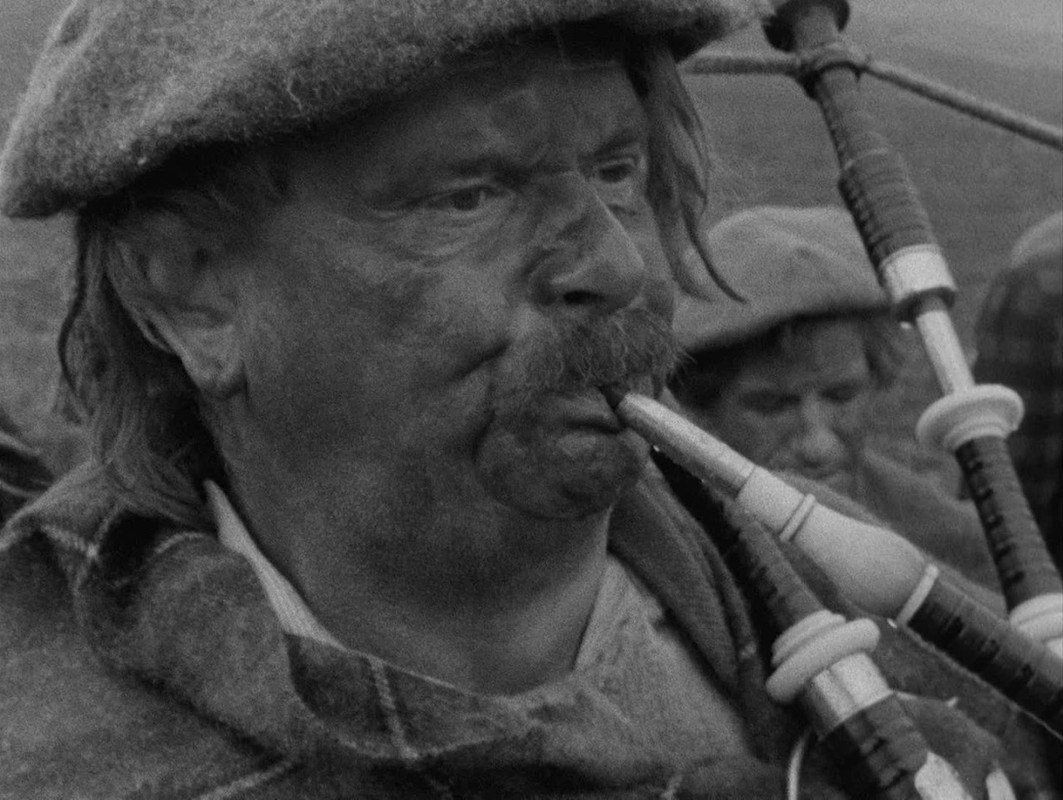
John Hunt Leigh in Culloden, pìobaireachd “ceòl mór” (litt. piping “great music”). DP: Dick Bush.
Great Highland #bagpipes, or a' phìob mhòr as they're called in Scottish Gaelic, are traditionally played on the battlefield. Peter Watkins' Culloden moves the senseless bloodshed from 1960s Vietnam to the Scottish Highlands of 1746.
– narrator
The most clearly it's seen in the men's eyes. That stare we recognise all too well from the many images that reached the west in the 60s, ever before and after.
“An diesem Tag war das Bild, drei Monate nach Beginn und 67 Arbeitstagen fertig.”Ein Bild von Sarah Schumann [A Picture of Sarah Schumann] (Harun Farocki, 1978)
Jun
26
National Sarah Day
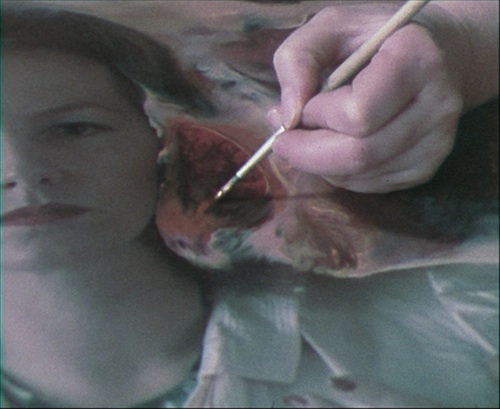
A close-up of the artist's hand at work. More stills and details about this film on Frieze. DP: Ingo Kratisch.
Commissioned for a West-German TV series called Kunstgeschichten (litt. both “art stories” and “#art histories”), filmmaker Harun Farocki visits artist Sarah Schumann in her #Berlin studio.
– narrator
The resulting documentary shows the process of creating one art piece over the course of nine weeks. Schumann's work in that period consists of collage portraits of women important in her life.
“Sir John MacDonald, Jacobite captain of cavalry. Aged, frequently intoxicated, described as 'a man of the most limited capacities'.”Culloden (Peter Watkins, 1964)
May
23

Wigged man at a table, drinking wine with three men lower in rank standing behind them with their arms crossed. DP: Dick Bush.
– narrator
“Don't laugh at Gavino. Hands on your desks! Today is Gavino's turn. Tomorrow will be yours.”Padre padrone [My Father My Master / Father and Master] (Paolo + Vittorio Taviani, 1977)
May
23
freebie: National Sons Day
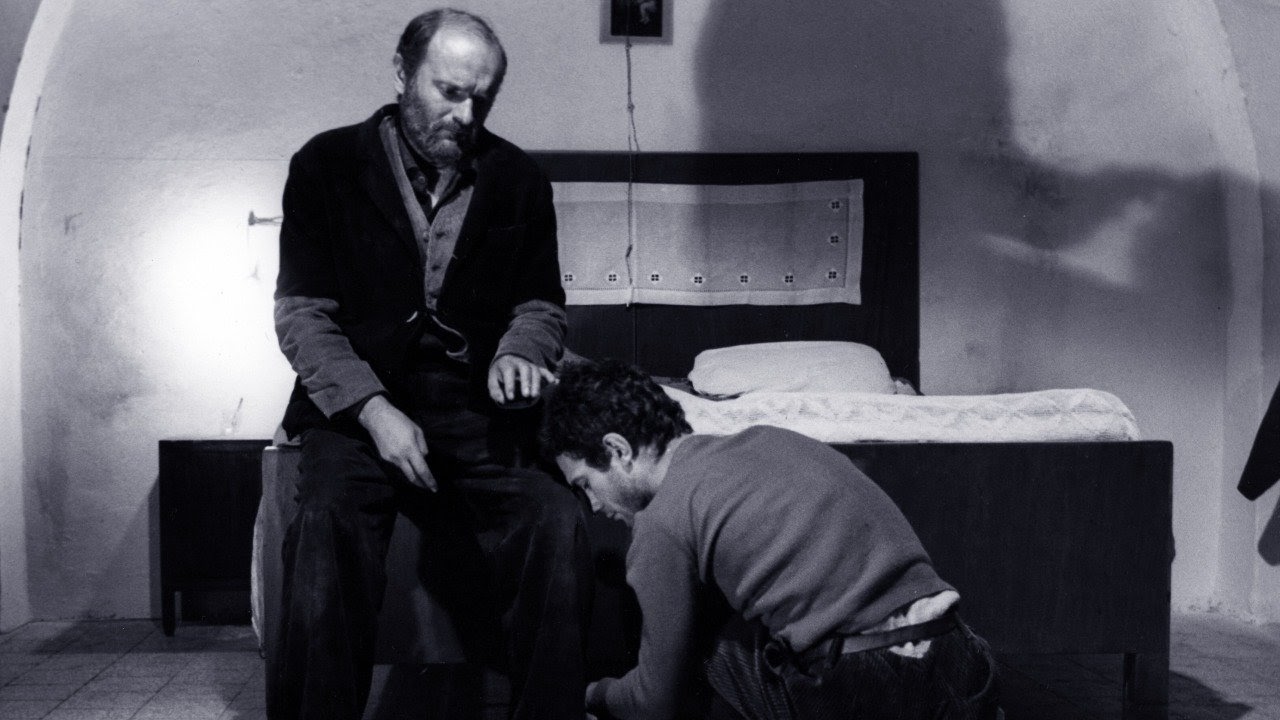
Father (Omero Antonutti) and son (Saverio Marconi). The son, an adult here, kneels and rests his head on his father's knee. The father, perched on the edge of a bed, looks down on the young man. DP: Mario Masini.
Not a film you can be prepared for, Padre padrone. The author, Gavino Ledda, hands a stick – that stick – to the actor who plays his part. There we are, in Sardinia, beautiful Sardinia. A boy in class, learning. His father barges in: the boy must attend the sheep, or else. From that moment on we become that boy Gavino. Life's cruel on the island, but his father, his master, is worse. But that's how it is, there's sheep to herd. When Gavino enlist in the army, he encounters a new world. The precise world of electronics, other people, other sounds, the Italian #language. When he returns home, he finds his father a small man.
– father
In a 1977 New York Times article the Taviani's are cited as seeing Gavino in the same light as #Truffaut's L'Enfant sauvage (1970) and #Herzog's Kaspar Hauser (Jeder für sich und Gott gegen alle) (1974). However, the Sardinian boy's outsiderness is not caused by estrangement, but an immense loneliness that cannot be put into words. This is why Ledda's newfound language is such an important tool. It's not a stick, or a fist, or a dead snake. It's the foundation of his Home.
How much Wood would a Woodchuck chuck… – Beobachtungen zu einer neuen Sprache (Werner Herzog, 1976)
Apr
20
National Auctioneers Day

One of the younger auctioneers during his attempt. DP: Thomas Mauch.
#Herzog travels to New Holland, Pennsylvania to witness the 1976 World Livestock Auctioneer Championship. Cattle is weighed and paraded in front of the buyers, and the 53 contestants have a few minutes to auction the animals off to the highest bidder.
We see glimpses of the audience. New Holland is the land of the money-eschewing #Amish, descendants of German-speaking Swiss, whose dress, ways and speech found an ideal state in an increasingly convoluted world. While money rolls, the Amish hand out their home-baked pies free of charge to the Championship onlookers.
To German-as-Apfeltorte Herzog, the auction is bewildering, the “last #poetry possible, the poetry of #capitalism”. In keeping with Herzog's poetic, ecstatic truth, Bruno S. too travels to America and encounters the auctioneers in Stroszek (1977).
“Fran.”De man die zijn haar kort liet knippen [The Man Who Had His Hair Cut Short] (André Delvaux, 1965)
Jan
12
freebie: Teacher Appreciation Day
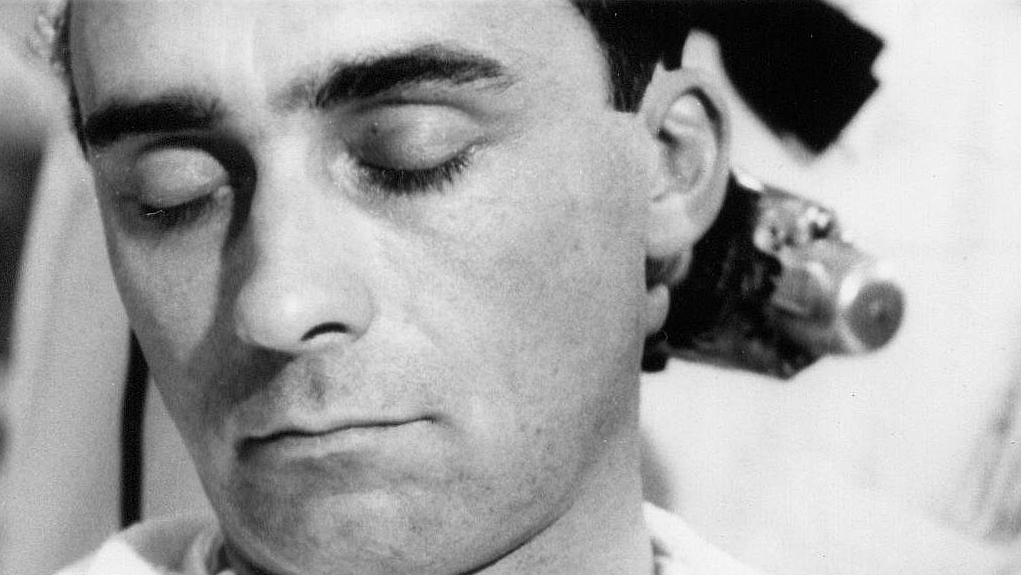
Govert Miereveld (Senne Rouffaer) having his hair cut. DPs: Ghislain Cloquet & Roland Delcour.
A teacher, enthralled by one of his students, gets lost after she graduates.
– Govert Miereveld
Heavy and light, absurd and profane. An absolute recommendation.