view
女篮五号 [Nü lan wu hao / Woman Basketball Player No. 5] (Jin Xie, 1957)
Apr
7
March Madness
Tense moments during the match. DPs: Shaofen Huang & Xilin Shen.
view
Klincz [Clinch] (Piotr Andrejew, 1979)
Apr
5
Chicago
A Polish factory worker hopes to find a better life when he picks up boxing. Initially unsuccessful. he finds himself in Chicago, facing an amateur boxer below his ranking.
view
Le moindre geste [The Slightest Gesture] (Jean-Pierre Daniel, Fernand Deligny + Josée Manenti, 1962–1964, 1971)
Apr
2
World Autism Awareness Day
Yves (Yves Guignard), resting. Deligny wrote a lot about the lack of words, and how it stays close to the heart of cinema. Still (and a wonderful essay) via. DP: Josée Manenti.
“Celui qui n’a jamais rien dit
a cinquante ans d’âge
et ne dira jamais rien
s’est appris à lire
dans les moindres gestes”
– Fernand Deligny, Essi & Copeaux. Derniers écrits et aphorismes, via
Over time, the film was forgotten and even lost, until it was found in a tree, then completed with a narrative and soundtrack in 1969, selected for the 1971 Cannes Film Festival and praised by Cahiers du Cinéma, lost once more, and eventually – with support of Chris Marker – restored and brought to a wider audience.
view
कालिया मर्दन [Kaliya Mardan / The Childhood of Krishna] (Dhundiraj Govind Phalke, 1919)
Apr
1
April Fools' Day
Shri Krishna (Mandakini Phalke, the director's seven-year old daughter), playing his flute with a twinkle in his eye. DP: Dhundiraj Govind Phalke.
Kaliya Mardan is one of the handful films from India's early cinematic output that has survived. Do check your attic
view
父ありき [Chichi ariki / There Was a Father] (Yasujirō Ozu, 1942)
Mar
31
a father
Father and son fishing in a creek. DP: Yūharu Atsuta.
A father for OP's father's birthday.
A father, and proud teacher, raises his son alone. When the boy is an adult and a teacher himself, the elder's traditional concept of societal hierarchy affirms the balance between the generations.
view
Chac: Dios de la lluvia [Chac: The Rain God] (Rolando Klein, 1975)
Mar
30
mythology
Mythology on the date Wrath of the Titans (2012) was released.
With their shaman lost to alcohol, villagers make their way to a diviner in the hope to appease Chac, the rain god.
“This is the account
of when
all is still silent
and placid.
All is silent
and calm.
Hushed
and empty is the womb of the sky.”
– Popul Vuh, The Primordial World
Filmed in the forests of Tenejapa, Chiapas, Chac is probably the first film completely in Tzotzil, one of several Maya languages, and based on themes found in the Popol Vuh.
view
Die Patriotin [The Patriotic Woman] (Alexander Kluge, 1979)
Mar
29
秦始皇兵马俑
Teacher Gabi Teichert (Hannelore Hoger), knee-deep in a puddle with a shovel, inspecting a find. DPs: Guenter Hoermann, Werner Lüring, Thomas Mauch & Jörg Schmidt-Reitwein.
A German history teacher, unhappy with the standardised history textbooks she has to work with, literally digs up her nation's past and sees how it is reflected in modern society.
view
Paris, Texas (Wim Wenders, 1984)
Mar
27
94th Academy Awards
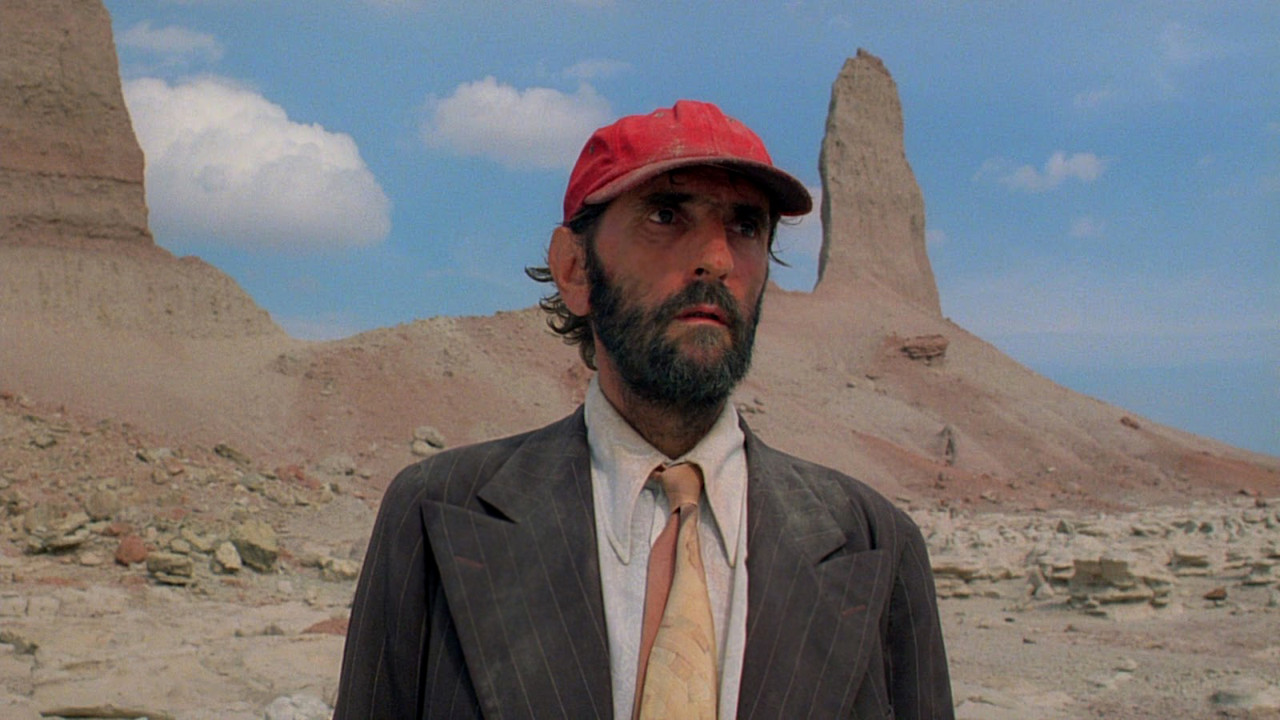
Travis (Harry Dean Stanton) wandering the desert. DP: Robby Müller.
“The Dust has come to stay. You may stay or pass on through or whatever.”
– gas station sign
view
Ludwig (Luchino Visconti, 1973)
Mar
25
Elton John – 1947
Elisabeth “Sissi” of Austria (Romy Schneider) and King Ludwig II of Bavaria (Helmut Berger) in his beloved Venus Grotto below Schloss Linderhoff. Ludwig wanted blue light in reference to the Grotta Azzurra in #Capri, and had electricity installed in the grotto, which was the first usage of electricity in Austria. DP: Armando Nannuzzi.
A flamboyant character for Elton John’s birthday (1947).
“I want to remain an enigma forever. To others, and also to myself.”
– Ludwig II
view
The Moon Over the Alley (Joseph Despins, 1976)
Mar
21
End Racism Day
Ronnie Gusset (Patrick Murray), Sherry (Bill Williams), and Belinda (Sharon Forester) at a kitchen table, chatting and laughing. DP: Peter Hannan.
Today marks the anniversary of the Sharpeville massacre (1960), when police butchered dozens of people gathered to protest the pass law, one of Apartheid's many cruel segregation measurements.
“In a short while you'll see that the moon won't be so bright as it is. Clouds will cover it… it'll get broken up there. I hope it won't break us.”
– Sybil
The multicultural residents of a Notting Hill boarding house go about their day – listening to the radio, humming, singing – with the local council's imminent demolition of their home looming over them.
A kitchen sink drama, yes. But also a catchy musical, written by no other than Galt MacDermot, who brought the world the musical Hair (1967) and the blaxploitation neo-noir Cotton Comes to Harlem (1970).